Showing posts with label henry street. Show all posts
Showing posts with label henry street. Show all posts
Friday, April 20, 2012
The Empty Lot On Henry And Market: 1932


Saturday, November 12, 2011
28 Henry Street: Flight of the Conchords
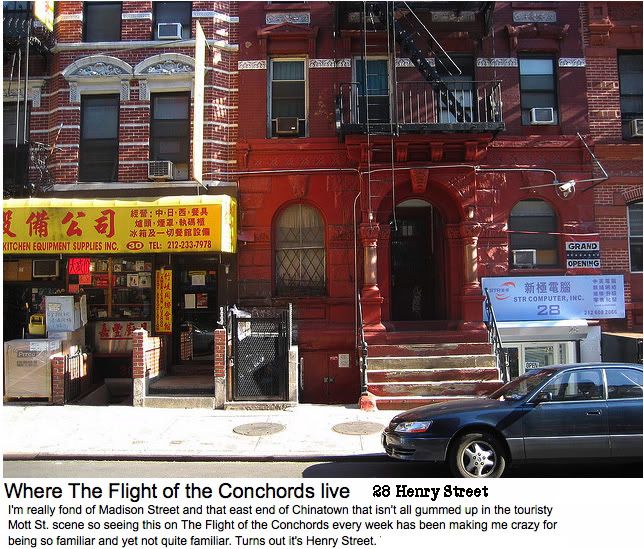
Discover Inner City Pressure with this Flight of the Conchords walking tour If you're a big fan of Flight of the Conchords and are visiting New York, checking out the filming locations of this Emmy-nominated series is an absolute must. Flight of the Conchords has a worldwide cult following, and wandering the streets of their filming locations will complete any Conchords die-hard's claims to be the ultimate fanatic. For those that don't know, Flight of the Conchords (comprising Bret McKenzie and Jemaine Clement) started off as a two-piece comedy act from New Zealand. Tongue and cheekily billed as 'Formerly New Zealand's fourth most popular guitar-based digi-bongo acapella-rap-funk-comedy folk duo', the Conchords built a small cult following in New Zealand before hitting the big time and impressing HBO executives in the United States, and were quickly signed up to produce 2 award winning seasons of the self-titled television series. The Locations Whilst (like every TV series) there are several exterior locations, as well as a vast amount of studio filming, Flight of the Conchords has been shot at many landmarks and well known areas of New York City. Since this is a walking tour, we will concentrate on the Lower Manhattan locations, where the majority of exterior filming takes place. The beauty about this part of the tour is that the neighborhood undertakes very little adjustment between what you see on the show, and what you will see in person. As you wander around these Chinatown areas of Lower Manhattan, one finds it hard to comprehend that an award winning TV series was filmed there.
Thursday, April 21, 2011
The King's Daughters and Sons House In The News: 1895-1897
King's House
In 1897 the house moved from 77 Madison Street to 48 Henry Street.
A previous post about 48 Henry
In 1897 the house moved from 77 Madison Street to 48 Henry Street.
A previous post about 48 Henry
Tuesday, April 13, 2010
172 Henry Street
172 Henry Street
A lower east side elementary school student asked me to research the building he currently lives in. A while ago I took some photos of some of the interesting architectural elements of 172 Henry and the surrounding buildings.
A lower east side elementary school student asked me to research the building he currently lives in. A while ago I took some photos of some of the interesting architectural elements of 172 Henry and the surrounding buildings.
Sunday, March 14, 2010
16 Henry Street: Then And Now
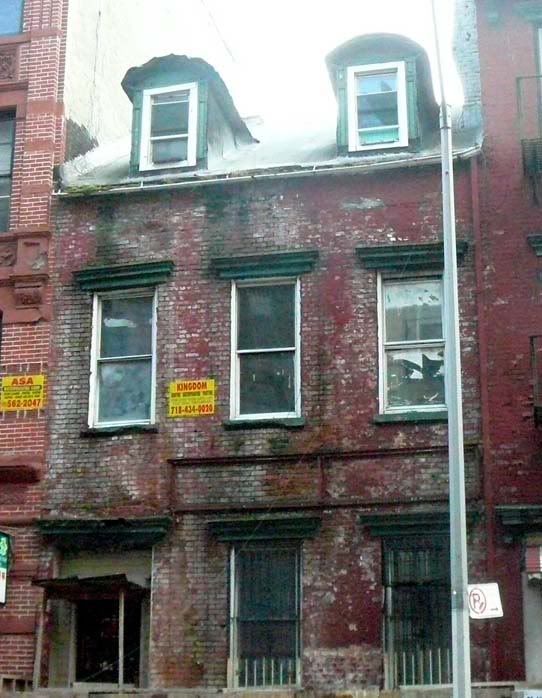

It really should be "then and Then" since 16 Henry Street looks like it hasn't changed.
Correction: The pic of the house is of 24 Henry Street, which, as of May, 2012, is slated to be demolished.
Friday, May 1, 2009
In The Fifties: Leonard Michaels
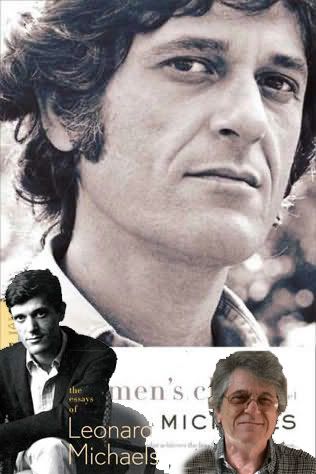 from thisrecording from his second collection of short stories, I Would Have Saved Them If I Could.
In the fifties I learned to drive a car. I was frequently in love. I had more friends than now. When Khrushchev denounced Stalin my roommate shit blood, turned yellow, and lost most of his hair. I attended the lectures of the excellent E.B. Burgum until Senator McCarthy ended his tenure. I imagined N.Y.U. would burn. Miserable students, drifting in the halls, looked at one another.
In less than a month, working day and night, I wrote a bad novel.
I went to school—N.Y.U., Michigan, Berkeley—much of the time.
I had witty, giddy conversation, four or five nights a week, in a homosexual bar in Ann Arbor.
I read literary reviews the way people suck candy.
Personal relationships were more important to me than anything else.
I had a fight with a powerful fat man who fell on my face and was immovable.
I had personal relationships with football players, Jazz musicians, ass-bandits, nymphomaniacs, non-specialized degenerates, and numerous Jewish premedical students.
I had personal relationships with thirty-five rhesus monkeys in an experiment on monkey addiction to morphine. Thy knew me as one who shot reeking crap out of cages with a hose.
With four other students I lived in the home of chiropractor named Leo.
I met a man in Detroit who owned a submachine gun; he claimed to have hit Dutch Schultz. I saw a gangster movie that disproved his claim.
I knew two girls who had brains, talent, health, good looks, plenty to eat, and hanged themselves.
I heard of parties in Ann Arbor where everyone made it with everyone else, including the cat.
I knew card sharks and con men. I liked marginal types because they seemed original and aristocratic, living for an ideal or obliged to live in it. Ordinary types seem fundamentally unserious. These distinctions belong to the romantic fop. I didn't think that way too much.
I worked for an evil vanity publisher in Manhattan.
I worked in a fish packing plant in Massachusetts, on the line with a sincere Jewish poet from Harvard and three lesbians; one was beautiful, one grim; both loved the other, who was intelligent. I loved her, too. I dreamed of violating her purity. They taked among themselves, in creepy whispers, always about Jung. In a dark corner, away from our line, old Portuguese men slit fish into open flaps, flicking out the bones. I could only see their eyes and knives. I'd arrive early every morning to dash in and out until the stench became bearable. After work I'd go to bed and pluck fish scales out of my skin.
I was a teaching assistant in two English departments. I graded thousands of freshman themes. One began like, "Karl Marx, for that was his name…" Another began like this: "In Jonathan Swift's famous letter to the Pope…" I wrote edifying comments in the margins. Later I began to scribble "Awkward" beside everything, even spelling errors.
I got A's and F's as a graduate student. A professor of English said my attitude wasn't professional. He said that he always read a "good book" after dinner.
A girl from Indiana said this of me on a teacher-evaluation form: "It is bad enough to go to English class at eight in the morning, but to be instructed by a shabby man is horrible."
I made enemies on the East Coast, the West Coast, and in the Middle West. All now dead, sick, or out of luck.
I was arrested, photographed, and fingerprinted. In a soundproof room two detectives lectured me on the American way of life, and I was charged with the crime of nothing. A New York cop told me that detectives were called "defectives."
I had an automobile accident. I did the mambo. I had urethritis and mononucleosis.
In Ann Arbor, a few years before the advent of Malcolm X, a lot of my friends were black. After Malcolm X, almost all my friends were white. They admired John F. Kennedy.
In the fifties, I smoked marijuana, hash, and opium. Once I drank absinthe. Once I swallowed twenty glycerine caps of peyote. The social effects of "drugs," unless sexual, always seemed tedious. But I liked people who inclined the drug way. Especially if they didn't proselytize. I listened to long conversations about the phenomenological weirdness of familiar reality and the great spiritual questions this entailed—for example, "Do you think Wallace Stevens is a head?"
I witnessed an abortion.
I was godless, but I thought the fashion of intellectual religiosity more despicable. I wished that I could live in a culture rather than study life among the cultured.
I drove a Chevy Bel Air eighty-five miles per hour on a two-lane blacktop. It was nighttime. Intermittent thick white fog made the headlights feeble and diffuse. Four others in the car sat with the strict silent rectitude of catatonics. If one of them didn't admit to being frightened, we were dead. A Cadillac, doing a hundred miles per hour, passed us and was obliterated in the fog. I slowed down.
I drank Old Fashioneds in the apartment of my friend Julian. We talked about Worringer and Spengler. We gossiped about friends. Then we left to meet our dates. There was more drinking. We all climbed trees, crawled in the street, and went to a church. Julian walked into an elm, smashed his glasses, vomited on a lawn, and returned home to memorize Anglo-Saxon grammatical forms. I ended on my knees, vomiting into a toilet bowl, repeatedly flushing the water to hide my noises. Later I phoned New York so that I could listen to the voices of my parents, their Yiddish, their English, their logics.
I knew a professor of English who wrote impassioned sonnets in honor of Henry Ford.
I played freshman varsity basketball at N.Y.U. and received a dollar an hour for practice sessions and double that for games. It was called "meal money." I played badly, too psychological, too worried about not studying, too short. If pushed or elbowed during a practice game, I was ready to kill. The coach liked my attitude. In his day, he said, practice ended when there was blood on the boards. I ran back and forth, in urgent sneakers, through my freshman year. Near the end I came down with pleurisy, quit basketball, started smoking more.
I took classes in comparative anatomy and chemistry. I took classes in old English, Middle English, and modern literature. I took classes and classes.
I fired a twelve-gauge shotgun down the hallway of a railroad flat into a couch pillow.
My roommate bought the shotgun because of his gambling debts. He expected murderous thugs to come for him. I'd wake in the middle of the night listening for a knock, a cough, a footstep, wondering how to identify myself as not him when they broke through out door.
My roommate was an expensively dressed kid from a Chicago suburb. Though very intelligent, he suffered in school. He suffered with girls though he was handsome and witty. He suffered with boys though he was heterosexual. He slept on three mattresses and used a sun lamp all winter. He bathed, oiled and perfumed his body daily. He wanted soft, sweet joys in every part, but when some whore asked if he'd like to be beaten with a garrison belt, he said yes. He suffered with food, eating from morning to night, loading his pockets with fried pumpkin seeds when he left for class, smearing caviar paste on his filet mignons, eating himself into a monumental face of eating because he was eating. Then he killed himself.
A lot of young, gifted people I knew in the fifties killed themselves. Only a few of them continue walking around.
I wrote literary essays in the turgid, tumescent manner of darkest Blackmur.
I used to think that someday I would write a fictional version of my stupid life in the fifties.
I was a waiter at a Catskill hotel. The captain of the waiters ordered us to dance with the female guests who appeared in the casino without escorts and, as much as possible, fuck them. A professional tummler walked the ground. Whenever he saw a group of people merely chatting, he thrust in quickly and created a tumult.
I heard the Budapest String quartet, Dylan Thomas, Lester Young, and Billie Holiday together, and I saw Pearl Primus dance, in a Village nightclub, in a space two yards square, accompanied by an African drummer about seventy years old. His hands moved in spasms of mathematical complexity at invisible speed. People left their tables to press close to Primus and see the expression in her face, the sweat, the muscles, the way her naked feet seized and released the floor.
Eventually I had friends in New York, Ann Arbor, Chicago, Berkeley & Los Angeles.
I did the cha-cha, wearing a tux, at a New Year's party in Hollywood, and sat at a table with Steve McQueen. He'd become famous in a TV series about a cowboy with a rifle. He said he didn't know which he liked best, acting or driving a racing car. I thought he was a silly person and then realized he thought I was. I met a few other famous people who said something. One night, in a yellow Porsche, I circle Manhattan with Jack Kerouac. He recited passages, perfectly remembered from his book reviews, to the sky. His manner was ironical, sweet, and depressing.
I had a friend named Chicky who drove his chopped, blocked, stripped, dual-exhaust Ford convertible, while vomiting out the fly window, into a telephone pole. He survived, lit a match to see if the engine was all right, and it blew up in his face. I saw him in the hospital. Through his bandages he said that ever since high school he'd been trying to kill himself. Because his girlfriend wasn't good-looking enough. He was crying and laughing while he pleaded with me to believe that he had really been trying to kill himself because his girlfriend wasn't good-looking enough. I told him that I was going out with a certain girl and he told me that had fucked her once but it didn't matter because I could take her away and live somewhere else. He was a Sicilian kid with a face like Caravaggio's angels of debauch. He'd been educated by priests and nuns. When his hair grew back and his face healed, his mind healed. He broke up with his girlfriend. he wasn't nearly as narcissistic as other men I knew in the fifties.
I knew one who, before picking up his dates, ironed his dollar bills and powdered his testicles. And another who referred to women as "cockless wonders" and used only their family names—for example, "I'm going to meet Goldberg, the cockless wonder." Many women thought he was extremely attractive and became his sexual slaves. Men didn't like him.
I had a friend who was dragged down a courthouse stairway, in San Francisco, by her hair. She'd wanted to attend the House Un-American hearings. The next morning I crossed the Bay Bridge to join my first protest demonstration. I felt frightened and embarrassed. I was bitter about what had happened to her and the others she'd been with. I expected to see thirty or forty people lke me, carrying hysterical placards around the courthouse until the cops bludgeoned us into the pavement. About two thousand people were there. I marched beside a little kid who had a bag of marbles to throw under the hoofs of the horse cops. His mother kept saying, "Not yet, not yet." We marched all day. That was the end of the fifties.
Leonard Michaels died in 2003. He was one of the most talented writers of the short story in the form's history. He also wrote novels, including The Men's Club, a brilliant satire, and Sylvia, about his first wife, Sylvia Bloch.
Tuesday, April 21, 2009
239 Henry Street: Benny Fein
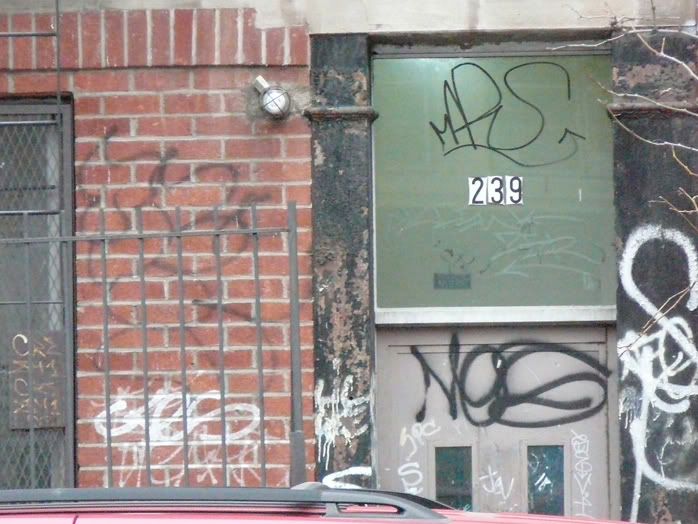
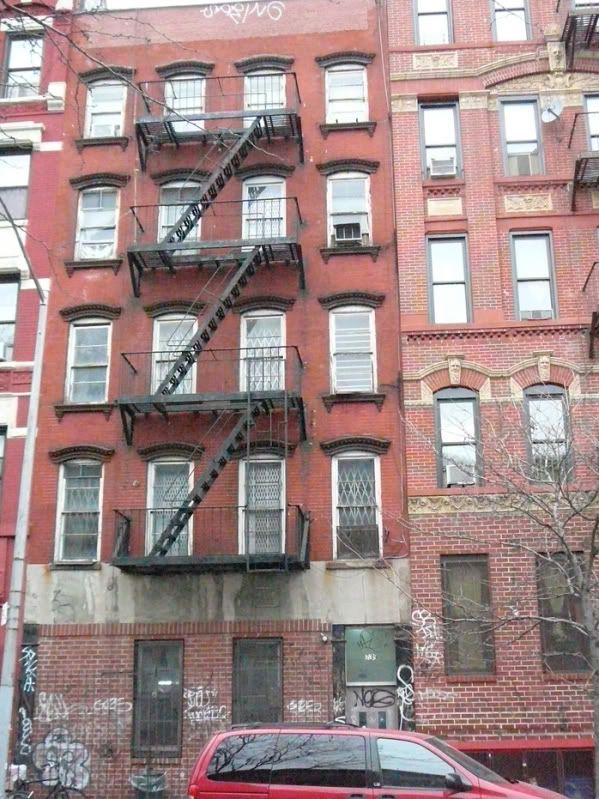
According to Ron Roth, Benny Fein was born here in 1889
from the six for five site
BENJAMIN FEIN aka DOPEY BENNY, 1889-1962
Dopey Benny acquired his nickname from an adenoidal condition, giving him a constant sleepy appearance. Another product of the Lower East Side, there was however nothing dopey about Benny. He had above average streets smarts and proved himself a visionary when it came to organizing the art of the shtarke, the strong-armed man. After a youth of stealing, pick pocketing and other petty crimes, his wayward habits caught up with him for awhile when was sent up to Sing Sing for armed robbery. Upon his release in 1910, he joined Big Jack Zelig's gang and it was during that period where he blossomed from just another street thug, exuding leadership qualities that he would later put to use.
That leadership in question fell into his lap after boss Zelig was shot and killed on a 14th St. streetcar. It was one of the many ripple effects that followed in the wake of the murder of gambler Herman Rosenthal, and the trial of Lieut. Charles Becker that followed it. Gang business could no longer operate in the same manner as it had in Zelig’s day, as there were too many prying eyes from every corner zeroing in on Lower East Side criminal activity. The corrupt nature of police and politicians and their affiliations to these gangs had been exposed, and some Tammany Hall members, once in bed with such gangs and rewarded handsomely, stepped back as well. Fein knew that the press coverage had been too hot on the Rosenthal – Becker affair and new angles needed to be figured out. While predecessors like Eastman and Zelig had dabbled in labor racketeering, Benny made it his first and foremost order of business and excelled at it. After all, he was the son of a tailor.
The Lower East Side garment industry was changing. Tenement sweatshops were giving way to factory - like production lines in buildings all around town up to 33rd st., and the industry was learning to meet the demands of a national marketplace. At the time, New York was producing the majority of clothing for the rest of America. Jews were at the forefront of this industry, as it was the one trade that they brought with them from Eastern Europe that helped them start a new life on these shores. Unions were set up early on to help the predominately Jewish labor force to make sure they were not exploited and working conditions were deemed satisfactory. At the forefront was the United Hebrew Trades (UHT), who in the past was not shy in relying on some of their own members to do a little intimidating with owners when needed. But after some time realized they would need to rely on some outside help for a little more persuading. Enter the gangster and his henchmen. Part of the problem in hiring whom some would deem ‘undesirables’ was there was never a guarantee they would work only for their side. Money motivated most of these men more than someone’s labor troubles, and reaping rewards from both sides of the conflict while it continued was a concern by the unions when hiring these gangs.
Benny Fein was different however. He was a man of principles. I like to think one particular event may of marked him significantly, and deeply affect they way he would conduct his business. On March 25, 1911 a fire broke out at the Triangle shirtwaist factory, housed in a building in Greenwich Village facing Washing Square Park. An unwatched, misplaced cigarette ignited a raging blaze that spread quickly within minutes, kindled by baskets of spare rags soaked in sewing machine grease and clothing materials. It consumed the upper three floors of the ten story building in less than ten minutes. Firemen at the scene were unable to conduct proper rescue operations, as their ladders just couldn’t reach past the sixth floor. Panic had set in for many of the trapped workers; most of them young women, and many of them Jewish. For unexplained reasons, some of the fire exits and doors leading to stairway exits and safety were locked or blocked. What crowds below at first thought were clothing bundles hurtling to the ground, soon realized the grim truth. Faced with the prospect burning alive, many watched in helpless horror from the street as some of the trapped workers started leaping, some holding hands with others, to their death nine and ten stories below. It was, and continues to be the worst workplace disaster in New York’s history. The death toll ended up at 146, and 123 of them were women, who worked more than fifty hour weeks in abhorrent working conditions. Despite unexplained locked doors, a fire escape that collapsed, and unsafe working conditions, Triangle’s owners were found not guilty of negligence in the trial that followed. District Attorney Charles Whitman, who was to be instrumental in the arrest and prosecution of Charles Becker had witnessed the building burn. So did Herbert Bayard Swope, the journalist who would print Herman Rosenthal’s story fifteen months later. I like to think Benjamin ‘Dopey’ Fein was one of those horrified in the crowd of thousands as well, helpless and angry, and vowing to try and make a difference.
"My heart lay with the workers." he was once quoted after refusing an offer of $15,000 to work on the manufacturer's side. He was unable to double cross his friends. His men, ‘shlammers’, broke heads only for the unions and under Benny they kept their loyalty. His operation was on the UHT payroll for four years. He also had ties to the ILGWU, the International Ladies Garment Workers Union. Dopey’s gang were given union cards as to picket alongside regular members so their actions seemed legitimate. He also was involved with the bakers’, butchers’, hat frame and neckwear workers, ragpickers’ and signpainters’ unions among others. Benny was busy. He almost single-handedly organized the practice of labor racketeering and thuggery into a full – fledged business. He drew up contacts and pay fees depending on the kind of slugging and ‘persuading’ that was needed by the unions. Instead of fighting, he created an elaborate system of territorial jurisdictions, delegating work to other gangs. Once contracted, he would sub-contract outside of the Lower East Side, somewhat unheard of in an underworld where most are motivated by greed and domination. Benny wasn’t dumb though. He still got his percentage on every sub-contract.
He also treated both sexes alike, giving equal pay for equal work, a very unusual practice back in the day. Because he used bats, clubs and blackjacks, though rarely guns, women were indispensable to him and served as ' toters' concealing weapons in mufflers, wigs, or a special hair-do of the day called the 'Mikado tuck-up'. Benny’s ladies encouraged nonunion female workers to join the unions with some intimidating practices as well. Of course, not all union members were happy with this scenario, after all, their demands were not always being met with legitimate manners, and a working relationship and trust between workers and employers could never be solidified completely. But, anytime anyone objected to their union’s strong - armed tactics, one of Benny's guerillas would warn them to keep quiet and avoid trouble. Not everybody was happy with Benny and his men, but many probably kept their jobs as a result.
Of course it wasn’t always smooth sailing for Fein and his gang. Rivalries with Italian labor racketeer Joe Sirroco led to many battles along Broome St and other areas. Dopey had led the way, building a monopoly, which was being continually challenged. Sirroco’s crew followed Dopey’s lead but in the other direction, working for the manufacturers. He also had a long running rivalry with Joseph ‘The Greaser’ Rosenzweig, and the labor slugging wars between these gangs would continue throughout 1913 and onwards. When an innocent bystander was shot and killed by accident after a botched set up by Dopey's men on Sirroco's troops, his power slowly began to decline.
Following numerous arrests, his last slip up was in the fall of 1914. Fein confronted and threatened to kill B. Zalamanowitz, a business agent for the butchers’ union who refused to pay Benny his $ 600 fee to protect his striking butchers, saying his job had been unsatisfactory. Zalamanowitz, panicked and frightened, called in the police prior to Dopey’s next scheduled visit. Waiting in the wings, they watched as Benny repeated his threats, and promptly arrested him on first-degree extortion charges. This was nothing new, a few hours in the Tombs and someone would come forward with the bail money, just like they always did, and Benny would be home by supper. But nobody came. Perhaps this time around the bail was too high at $ 8000, which the police had compounded from previous arrests. Maybe Benny was getting too hot for union officials to contiinue their affiliation and decided maybe the labor wars needed one less general. Benny sat and fumed. He felt double-crossed by everyone. Perhaps he had had enough. Benny finally broke down and began naming names. His organizational skills contributed to his thinking ahead, that this day may eventually come, and he had stayed one step ahead. Benny had written every single transaction down, unbeknownst to most of his associates. His testimony was a few hundred pages in length, explaining all the inner working of all the strike breaking gangs, and the unions involved. This led to many arrests of higher ups of both in the UHT and the ILGWU. Twenty -three labor leaders and eleven gangsters were charged with murder, extortion, assault, and riot in the months that followed. The man who designed the empire was able to tear it down as well.
Up until recently, crime historians had lost sight of him after the age of 26 and that last arrest, assuming he had disappeared into the city’s streets and never heard from again. But thanks in part to his grandson, Geoff Fein, the rest of Grandpa Dopey’s life has been brought to light a little bit more. While his 1914 testimony in exchange set him free, it would be a few more years before Benny would fly straight. He was arrested numerous times over the next few years, still active in the labor slugging trades, but in a smaller role. Benny probably didn’t make too many new friends after his testimony and it was probably much like starting over. He had a court appearance in 1931 on assault charges, his first in over thirteen years. Ten years later, Benny faced the courts again. He and fellow mobsters Abraham Cohen, John Ferraro, Herman Fogel, and Samuel Klein were taken into custody after a police raid caught them with a stolen garment shipment worth $ 10,000. He and Cohen were pegged as ringleaders in a gang responsible for over $ 250,000, 000 worth of stolen garments over a three year period. This would be his last trip to up Sing Sing, after being spared a mandatory life sentence. In the years following his release, Benny would stay in the garment industry, but on the legitimate side this time for good, applying his trade as a tailor, which he had learned from his father and had never forgotten. He made his life in Brooklyn and raised a family.
Benjamin Fein may have of walked a crooked line, and his actions deemed unjustifiable by most. But as a young man he was passionate enough to the cause of the worker, which he truly believed in, and was moved enough to try and do something about it. He was a rare breed of gangster; one spared a violent end on the streets, or in the electric chair. He passed away in 1962 from cancer and emphysema.
217 Henry Street: Louis Lepke Buchalter
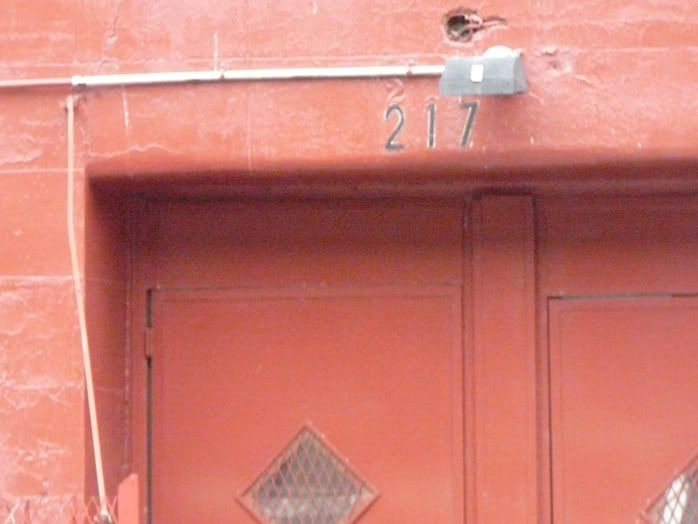
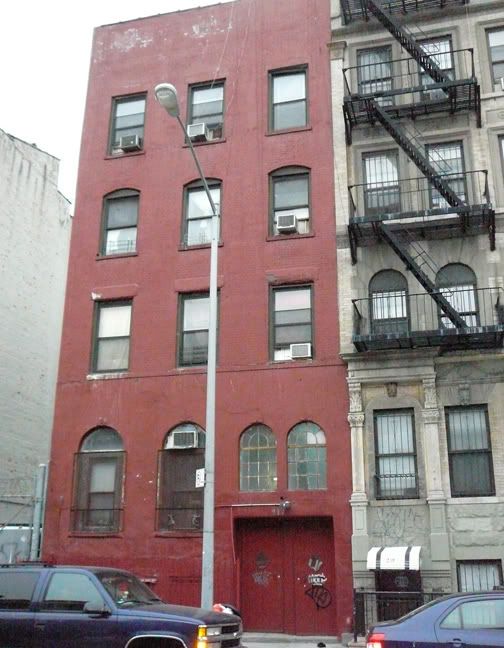
According to Ron Roth, the infamous Lepke lived here sometime between 1900-1910. Lepke was mentioned previously with a slide show
from wikipedia
Louis "Lepke" Buchalter (12 February 1897 – 4 March 1944) was a Jewish- American mobster of the 1930s. He is the only major mob boss ever to have been executed by state or federal authorities for his crimes.
Born in 1897 to Eastern European immigrants on the Lower East Side of Manhattan, Buchalter took on the nickname "Lepke" at an early age. The name was an abridgement of the affectionate diminutive "Lepkeleh" ("Little Louis" in Yiddish) his mother had called him when he was a small boy. By 1919, at the age of only 22, he had already served two prison terms.
Upon his release, he teamed up with his childhood friend, Jacob "Gurrah" Shapiro, gradually gaining control of the garment industry unions on the Lower East Side. He used the unions to threaten strikes and demand weekly payments from factory owners while simultaneously dipping into union bank accounts. His control of the unions later evolved into a general protection racket, extending into such areas as bakery trucking. The unions were an extremely profitable venture for him, and he kept a firm hold on them even after becoming an important figure in the organized crime world.
In the early 1930s, Charles "Lucky" Luciano, Lepke, and John "Johnny The Fox" Torrio, (the former Chicago boss and mentor of Al Capone), formed a loose alliance. To take care of any problems that arose, Luciano's associates Benjamin "Bugsy" Siegel and Meyer Lansky formed Murder, Inc. Originally a band of Brooklyn killers, they were highly effective and eventually used to fulfill most murder contracts. Control of the group soon passed to Lepke and Albert "Mad Hatter" Anastasia, as Siegel and Lansky had larger concerns to deal with. Murder, Inc., the name given to it by the media in the 1940s, was credited with carrying out numerous contract killings throughout the country, including the slaying of Dutch Schultz.
As many as a hundred corpses have been attributed to Lepke[citation needed]. Some of the hitmen at Lepke's disposal included Abe "Kid Twist" Reles, Seymour "Blue Jaw" Magoon, Frank "Dasher" Abbandando, Harry "Happy" Maione, Albert "Tick-Tock" Tannenbaum, and Harry "Pittsburgh Phil" Strauss (known as "Pittsburgh Phil" despite his having no known connection to that city). The killing of Dutch Schultz on 23 October 1935 was a major killing for the group, as was the murder of Louis "Pretty" Amberg the same day.
Buchalter's downfall began in the mid-1930s when he went on the run from both the FBI, who wanted to arrest him on a narcotics charge, and from New York City special prosecutor Thomas E. Dewey, who wanted him tried for his syndicate activities. He was tricked by a childhood friend into surrendering to the federal government in exchange for his not being turned over to Dewey. Buchalter was sent to Leavenworth Federal Penitentiary in Kansas on a 14 year term for narcotics trafficking. The sentence was later extended to 30 years on account of Buchalter's involvement in union racketeering.
Even more serious legal problems and consequences followed for Buchalter in 1940. That year, the state of New York indicted him for a murder committed over four years earlier, on 13 September 1936. On Sunday morning, a crew of Murder, Inc. killers, acting on Buchalter's orders[citation needed], had gunned down Brooklyn candy store owner Joseph Rosen. Rosen was a former garment industry trucker whom Buchalter had forced out of business. He had aroused Buchalter's ire by failing to heed Lepke's warnings to keep quiet and leave town. Rosen allegedly began threatening to expose Lepke and his vast crime operations to special prosecutor Thomas E. Dewey.
Buchalter's order for the Rosen hit had been overheard by Abe Reles, who turned informant for New York State in 1940 and fingered Buchalter for four murders. Brought back from Leavenworth to Brooklyn to stand trial for the Rosen slaying, Buchalter's position was worsened by the testimony of Albert Tannenbaum. Four hours after they were handed the case, the jury arrived at a verdict at 2:00 a.m. on 30 November 1941, finding Buchalter guilty of first degree murder. The penalty at the time for such a crime in the state of New York was death by electrocution. Also convicted and sentenced to death for the same crime were two of Buchalter's lieutenants who had participated in the planning and carrying out of the Rosen murder, Emanuel "Mendy" Weiss, and Louis Capone (no relation to Al).
Buchalter's conviction took place in December 1941, and the New York Court of Appeals, upon review of his case, upheld his conviction and death sentence in October 1942. At the time, Buchalter was serving his racketeering sentence at Leavenworth Federal Prison, and New York state authorities demanded that he be turned over to them for execution. Buchalter resisted, managing to remain in Kansas and out of New York's hands until finally extradited in January 1944. Buchalter and his lieutenants Weiss and Capone were electrocuted within minutes of each other at New York's Sing Sing prison on 4 March 1944.
Many people are aware that the Gambino Family’s base of operations was (and probably still is) New York City’s Garment Center. Few know that the Gambinos inherited the garment rackets from a Jewish gangster—Louis (Lepke) Buchalter, considered by some historians to be the wealthiest and most powerful mob boss in American organized crime history.
Lepke was born on New York’s Lower East Side in 1897. His father ran a successful hardware store, and one of his brothers became a doctor. But Lepke was drawn to the dark side. His first crime boss was Dopey Benny Fein, who ran a large, successful violence-for-hire racket in the Garment District. Buchalter and his pal, Jacob (Gurrah) Shapiro, later associated themselves with Jacob (Little Augie) Orgen, Benny’s successor. Lepke and Gurrah took over after murdering Little Augie. But they didn’t simply replace Augie as thugs-for-hire—like Jewish Kelly Girls with muscle. Instead, they saw themselves as integrating and harmonizing forces across both management and labor sides of an industry in which violence and turmoil were ceaseless. Lepke used the model of the turn of the century “Robber Barons,” as well as military tactics, to gain control:
Buchalter looked for weak links in the industry’s chain of power. His first move was against the furriers’ unions, weakened by the Depression. He seized control of the rabbit furriers’ union, which was still viable, then moved in on all the others. By the end of his first year, both unions and management were paying him $5 million annually for peace.
He then attacked the garment unions. His target was the cutters’ union, small (less than 1,000 members) but highly strategic: no cutters, no patterns; no patterns, no dresses and suits. All the other unions shortly fell under his thumb. Then, in an unprecedented move for a labor racketeer, he muscled his way into controlling positions in three of the Garment District’s biggest manufacturing companies. Now Lepke had a commanding position in both labor and management. He recognized that trucking was crucial to the industry, so he knocked over the trucking companies and their unions.
By the mid-Thirties, Lepke controlled everything that was made in, and that went in and out of, the Garment District. Sidney Hillman, head of the Amalgamated Clothing Workers Union and President Roosevelt’s top labor adviser (“Clear it with Sidney” was one of FDR’s most familiar phrases) allegedly paid Lepke $5,000 a week for peace. Lepke’s control was so pervasive that the first Federal charge against him, in 1936, was for violating the Sherman Antitrust Act by operating a “combination in restraint of trade”—a distinction previously awarded to the likes of U.S. Steel and Standard Oil.
Like a true Robber Baron, Lepke had a zeal for conglomeration. He knocked over the handbag industry, since handbags were accessories to the dresses he controlled in the Garment Center. Pursuing several clothing companies that had moved to Brooklyn to escape his clutches, he saw that the bakers’ union was ripe for takeover. Within weeks, every loaf of bread sold in New York City was paying a “Lepke tax.” He grabbed a big piece of the movie industry rackets without ever stepping foot in Hollywood: he forced his way into the movie projectionists’ union, another small but strategically placed group—no projectionists, no movies; no movies, dark studios.
Buchalter’s zeal for conglomeration proved to be his undoing. To provide an unlimited source of muscle needed to enforce his will, he reached into the Brownsville section of Brooklyn, the most densely populated neighborhood in America and the most concentrated source of Jewish thugs. There he (not, as myth has it, Albert Anastasia, Bugsy Siegel or Meyer Lansky) formed “Murder, Inc.,” headquartered in Midnight Rose’s candy store (where Yours Truly worked as a teenager). In another innovation, Lepke paid his killers weekly salaries, rather than commissions for various jobs, which would have encouraged them to work for the highest bidders. Ever the businessman, Lepke saw that Murder, Inc. was a cost center. So he endeavored to turn it into a profit center by hiring out his thugs to others. One of his biggest customers was Albert Anastasia, boss of the Ocean Hill section of the neighborhood. Albert A also provided Lepke with some Mafia killers.
With so much blood on their hands (as many as 1,000 killings according to some accounts), Murder, Inc. came under intense scrutiny from law enforcement. Charged with several murders, two of the group’s top lieutenants, Abraham (Kid Twist) Reles and Allie (Tick-Tock) Tanenbaum, turned state’s evidence in 1939 and provided thousands of pages of testimony, as well as details of dozens of murders, several of which implicated Lepke directly. Reles mysteriously “fell” out of a sixth-floor hotel window while in police custody, earning him the sobriquet, “the canary who could sing but couldn’t fly.” Lepke took it on the lam, hiding out in Brooklyn for more than a year while his business went to hell.
Finally, three of Lepke’s underworld pals—Albert A, Lansky and Abner (Longy) Zwillman, convinced him to surrender on Federal drugs and racketeering charges, which they assured him would result in no more than a five- or six-year sentence and protect him from New York’s special prosecutor, Thomas E. Dewey, who wanted to send him to the electric chair for his murders. Lepke met with famed radio and newspaper columnist Walter Winchell, who drove him to a car containing FBI chief J. Edgar Hoover, to whom he surrendered. He was convicted on the Federal raps in 1941, and sentenced to 14 years in Leavenworth.
However, Lepke was so big that he had become a factor in Presidential politics. Dewey (who was to be the GOP Presidential candidate in 1944 and 1948) charged that FDR was being “soft” on Lepke to keep him quiet about his relationship with Sidney Hillman. The Justice Department obligingly turned Lepke over to Dewey, who prosecuted and convicted him for murder. Lepke was executed in 1944, the first and only mob boss to die in the chair. The Mangano/Anastasia Mafia family took over his labor and trucking rackets, which to this day are a Gambino stronghold.
Monday, April 20, 2009
87-89 Henry Street: Then And Now
Yet another Fletcher's Castoria sign

Just down the block (eastward from Sophie Loeb Park).


Just down the block (eastward from Sophie Loeb Park).

Sophie Loeb: The Namesake Of Sophie Loeb Park
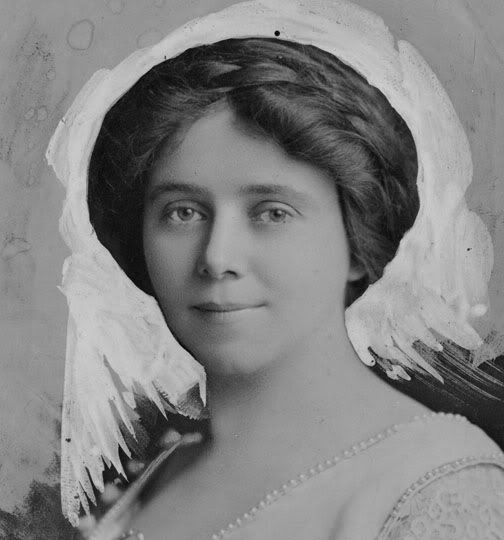
It's on the east side of Market Street, between Henry and East Broadway
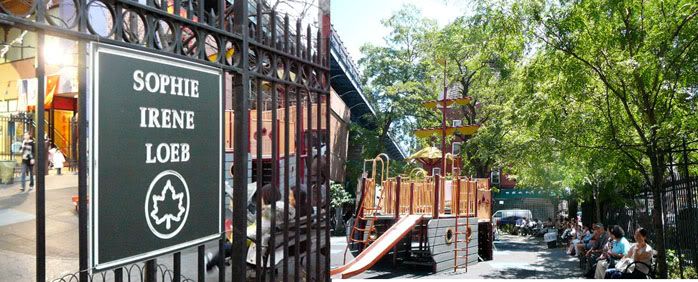
In addition to the park above, there's a fountain in Central Park named after her. from wikipedia:
Sophie Irene Loeb (July 4, 1876, Rovno / Rivne, Volhynia, Russia (now Ukraine) - 1929) was a US journalist and social-welfare advocate.
She was born Sophie Irene Simon.
She was the president of the Board of Child Welfare of New York for seven years, and in 1921 she established the first child welfare building. In 1924, she became president of the Child Welfare Committee of America.
SOPHIE IRENE LOEB FOUNTAIN
James Michael Levin Playground, Central Park
Frederick George Richard Roth (1872–1944) created this decorative, reinforced concrete drinking fountain inspired by Lewis Carroll’s children’s story Alice in Wonderland (1865). The fountain commemorates newspaperwoman and social worker Sophie Irene Loeb (1876-1929), who was the founder and first president of the Child Welfare Board of New York City. Loeb is recognized in this context for her support of recreational opportunities for children in Central Park.
In 1926 philanthropist August Heckscher (the grandfather of the Parks Commissioner of the same name) pledged funds to create what would become later known as James Michael Levin Playground. Loeb campaigned fervently for the construction of the playground and was appreciated by the Parks community for her efforts. The fountain was commissioned by Parks when it rebuilt the playground in 1935, and it was dedicated in 1936 in Loeb’s memory. Roth is well known for his animal sculptures and limestone reliefs that appear in and around both the Central and Prospect Park Zoos. Some of his well-known works include Dancing Bear and Dancing Goat (both 1937) at the Central Park Zoo and Balto (1925), also in Central Park.
Born in Russia, Sophie Irene Simon immigrated with her family to the United States when she was six years old. Soon after settling in Pennsylvania, Loeb’s father died, leaving the family with no means of support. As the eldest of six children, sixteen-year-old Sophie was forced to work in a store to help her mother support their large family. These financial struggles prompted Loeb’s later concern for social reform and welfare.
After graduating from high school, Sophie began teaching young children. In 1896, she married Anselm Loeb, a storeowner and her former employer. Marriage freed Sophie from teaching and allowed her to pursue other interests such as art, poetry, and writing. Her writing came to the attention of several publishers, including those at the New York Evening World. In 1910, Loeb moved to New York City after divorcing her husband. Keeping the surname Loeb, she began working at the Evening World as a reporter.
Loeb focused her journalistic and social attentions on welfare for widowed mothers. New York City had struggled for years over the idea of civic versus state economic relief for “destitute mothers.” The City maintained homes for children of widowed mothers, but many women refused to send their children to these homes, leaving them to the mercy of private charities. Believing that private aid was insufficient, Loeb sought state relief as well. She wrote several articles that argued for the establishment of such a system, and worked closely with Hannah Bachman Einstein, who founded the Widowed Mothers’ Fund Association in 1909. Elected President of the New York City Welfare Board in 1923, Loeb helped to found the Child Welfare Committee of America in 1924. She also fought for immigrant use of New York City schools as civic centers; and the cleaning and fireproofing of movie theaters; installation of public baths; funding of school lunches, and support for housing reform.
Ten years after Loeb’s death, Congress amended the Social Security Act of 1935 to include provisions for the protection of widows and children of laborers. Although she died childless, Loeb nevertheless was known as the “godmother of American children.”
Friday, April 10, 2009
Lepkoff Photo Match

Life On the Lower East Side by Rebecca Lepkoff and Peter Dans is a great book, but I've always been frustrated by trying to figure out exactly where the photos were taken since that information wasn't provided. Here's one I solved recently, 158 Henry Street, between Rutgers and Jefferson.
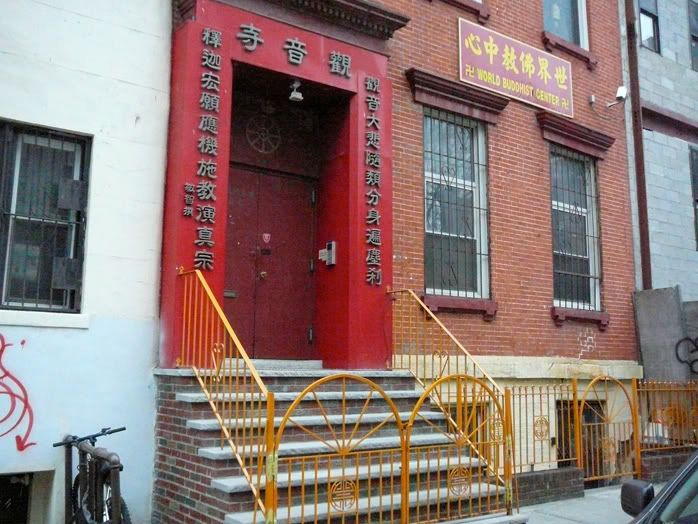
Corrections 4: 173 Henry Street

Previous I believed that 173 Henry Street was the location of a Rebecca Lepkoff photo Now I think it might have been 146 Henry Street (photo above), since another Lepkoff photo was taken down the block at 158 (see the post that follows). Still, I'm not sure of either location's certainty.
48 Henry Street 2
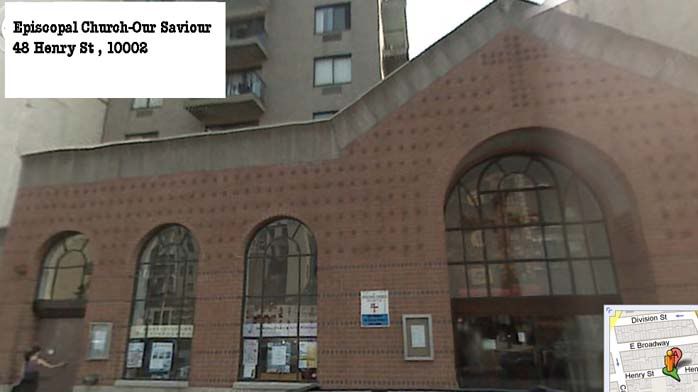
The web site of the church is ecoserve
Up until 1950 it housed the Jacob Riis Settlement House. From the Riis Settlement site
THE HISTORY OF JACOB A. RIIS NEIGHBORHOOD SETTLEMENT HOUSE
Jacob A. Riis was the founder of the Jacob A. Riis Neighborhood Settlement House. He was a native of Ribe, Denmark, and came to New York City in 1870. Riis's book, "How the Other Half Lives" exposed conditions previously thought not to exist in America. He used photography to bring unprecedented public awareness to pressing social problems through a relatively new medium. In 1888, he established the Jacob A. Riis Neighborhood Settlement House to meet the needs of newly arrived immigrants.
In 1888, Jacob A. Riis collaborated with the King's daughters, an organization of Episcopalian church women, to establish the organization which in 1901 was renamed as the Jacob A. Riis Neighborhood Settlement House. In it's early years, the Settlement House offered sewing classes, mothers clubs, health care, a summer camp, and a penny provident bank. In 1897, the Settlement House moved into its first home at 48 Henry St. Jacob A. Riis Neighborhood Settlement House continued to diversify activities, broadening the scope of activities to include athletics,-citizenship classes, and drama. In the 1940's and 50;s, the Settlement House began to offer programs for residents of public housing developments in Queens, Brooklyn and Manhattan. At the same time, the original Settlement House building was sold; in 1950, Jacob A. Riis Settlement House moved all of it's activities to the Queensbridge Houses in Long Island City, Queens.
48 Henry Street Slide Show
Above a slide show of images from an historic house that used to be located at 48 Henry Street.
Below a pdf docment with the history of that building
48 Henry
Wednesday, March 11, 2009
Tuesday, March 10, 2009
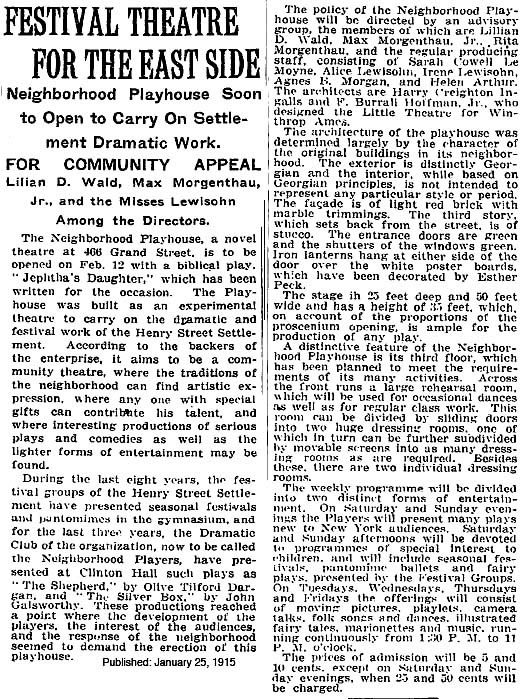
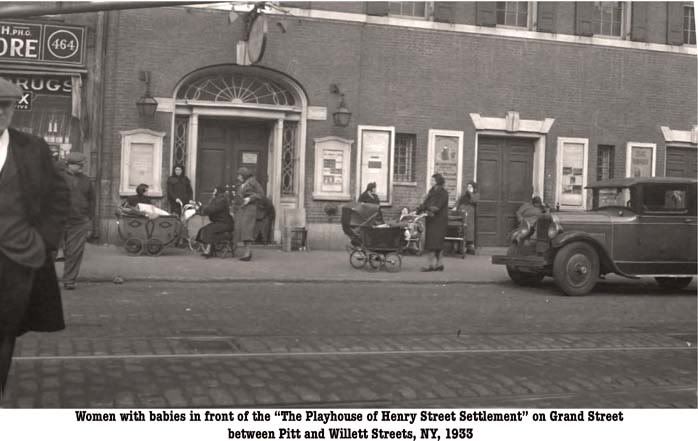
Henry Street Playhouse Opens: 1915. Grace Spofford
About Grace Spofford. An excerpt from the iawm journal
Then in 1935, she was named to what she came to consider her most important post-Director of the Music School of the Henry Street Settlement School in New York, an appointment that she would hold for nineteen years.
Spofford's decision to enter settlement work was typical of college educated women of her generation, who, in searching out ways to put their education and gifts at the service of society, found in settlement work a perfect outlet for their aspirations. At the Henry Street Settlement, Grace Spofford accessed yet another female network group which would energize her as she continued to work for social reform.
From the outset, Grace Spofford continued to use the collaborative processes that had become her modus operandi, surrounding herself with an excellent Music Committee which served as an Advisory Board. Its members included Lillian Wald, Helen Hall, Aaron Copland, George Gershwin, Jascha Heifetz, Felix Salmond, and Harold Taylor. Under Spofford's guidance, the Music School began to move in ways that made it more meaningful to the lower East Side community and enabled it to continue excellent musical standards and make important contributions to the field of music education.24 With the enthusiastic support of Henry Street Settlement House Director Helen Hall, the Henry Street Music School strengthened its already excellent programs.
A highlight of Spofford's early years at the Henry Street Settlement House occurred during the 1936-37 academic year-one year after Spofford's arrival. She convinced Aaron Copland, whom she had appointed to the Composition Faculty, to write a new work for the children at the school, one that would be suitable for performance by students, while simultaneously not sacrificing musical standards. Copland welcomed the challenge to write a piece that would be simple enough for youngsters to perform and that would allow him contact with the youth of America. The resulting work was a young people's "play opera" entitled "Second Hurricane," performed by children and young people ages 8-19 from the Music School, the Professional Children's School, the Seward Park High School, and the Adult Chorus of the Henry Street Music School. Many who were involved in the production went on to become prominent in their various spheres of the arts: conductor Lehman Engel, director Orson Welles, and actors Joseph Cotton and Charles Pettinger being the principals among them
Under Spofford's leadership, enrollment at the Henry Street Settlement Music School grew and faculty was expanded. In the 1940-41 season, the school could boast among its faculty pianist Isabelle Vengerova, violinist Ivan Galamian, harpist Lucile Lawrence, and composer Roy Harris, to mention but a few. By 1952 the school had 70 teachers and an enrollment of 900, ranging in age from 5-65 and representing 32 different national backgrounds. Although many of the students had made names for themselves in the world of music, Spofford's philosophy in educating the underprivileged was that "we are just as proud of the ones who marry and raise families or follow careers which have nothing to do with music."
Wednesday, March 4, 2009
Henry Street, Between Market And Catherine: 1932, Close-Up
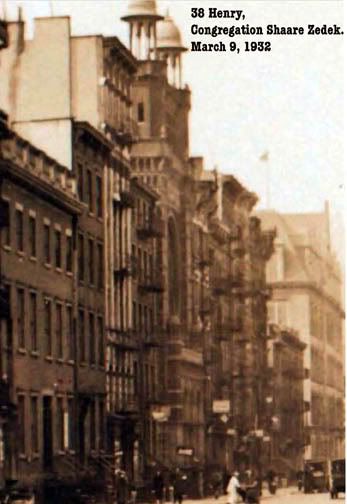
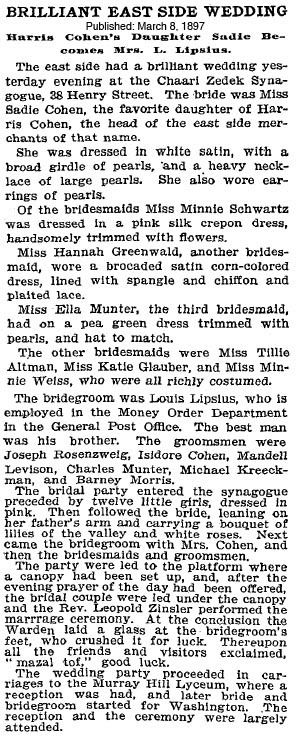
This structure at 38 Henry really caught my eye. I investigated further
from wikipedia
Congregation Shaare Zedek (Gates of righteousness) is a Conservative synagogue located on West 93rd Street in Manhattan. Founded in 1837, by Polish Jews, Shaare Zedek is the third oldest synagogue in New York City. The congregation originally met at 38 Henry Street on Manhattan's Lower East Side. In 1850, it purchased a building at 38 Henry Street that was originally built by a Quaker congregation in 1828 that had been converted for use as a synagogue by congregation Ansche Chesed in 1840. The congregation replaced this building with a new building on the same property in 1891 and in 1900 opened a branch synagogue at 25 West 118th Street in the newly-fashionable neighborhood of Harlem. The building is now a church. The Henry Street building was sold to Congregation Mishkan Israel Anshei Suwalk in 1911.Shaare Zedek's present, elaborate, Neoclassical building was designed by the architecture firm of Sommerfeld and Steckler and buit in 1922/3.
Since July 2006 the congregation has been led by Rabbi Julia Andelman and President Richard Friedman. Although Shaare Zedek was the last Conservative synagogue in the area to allow fully egalitarian worship, women now participate in every aspect of the service and the congregation has hired its first female rabbi. While preserving the traditional liturgy quite closely and committing to a fairly strict observance of Jewish law, the community is generally politically and socially progressive. Jews of all sexual orientations and races are fully welcomed.
more to come on this and the structure to the left at 48 Henry Street
Subscribe to:
Posts (Atom)


 Posts
Posts