Showing posts with label rebecca lepkoff. Show all posts

Saturday, May 15, 2010

Life On The Lower East Side, Part 3


from the Tenement Museum description of an event on May 13, 2010
The Lower East Side became by the 1930s a vibrant multiethnic community full of families and friends. The residents congregated on stoops, street corners, sidewalks, fire escapes, and rooftops of the neighborhood tenements and shared the unique languages, food, and festivals of their various cultures.
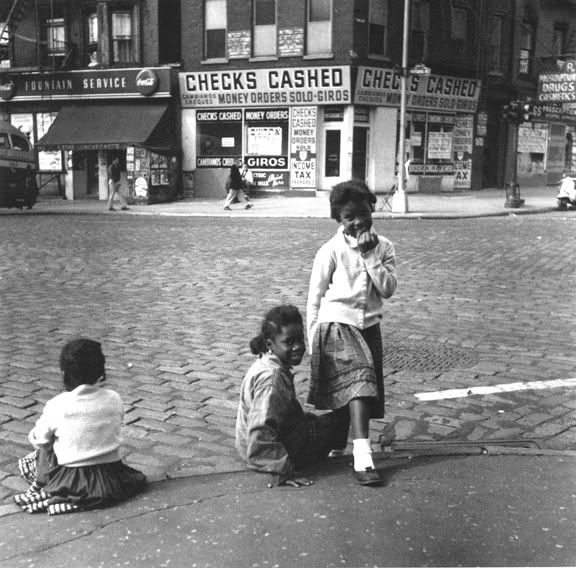
Rebecca Lepkoff, herself a child of immigrant parents, grew up in this community. The faces of the Lower East Side became her muse and through the lens of her camera she captured the lives of a spirited neighborhood - women hanging laundry out their windows, children playing stickball in the street, men chatting at the barbershop. This book, the first monograph of Lepkoff's work, highlights the area between the Brooklyn and Manhattan bridges from the Bowery to the East River.
Over 170 reproduced photographs and essays by Peter E. Dans and Suzanne Wasserman uncover a forgotten time and place and reveal how the Lower East Side remains both unaltered and forever changed.

Suzanne Wasserman: Life On The Lower East Side, Part 2


from the Tenement Museum description of an event on May 13, 2010
The Lower East Side became by the 1930s a vibrant multiethnic community full of families and friends. The residents congregated on stoops, street corners, sidewalks, fire escapes, and rooftops of the neighborhood tenements and shared the unique languages, food, and festivals of their various cultures.
Rebecca Lepkoff, herself a child of immigrant parents, grew up in this community. The faces of the Lower East Side became her muse and through the lens of her camera she captured the lives of a spirited neighborhood - women hanging laundry out their windows, children playing stickball in the street, men chatting at the barbershop. This book, the first monograph of Lepkoff's work, highlights the area between the Brooklyn and Manhattan bridges from the Bowery to the East River.
Over 170 reproduced photographs and essays by Peter E. Dans and Suzanne Wasserman uncover a forgotten time and place and reveal how the Lower East Side remains both unaltered and forever changed.

Friday, May 14, 2010

A Lower East Side History Show, In The First Person

Lepkoff Tenement
from the nytimes cityroom blog
Thursday night at the Lower East Side Tenement Museum, there will be a show of Rebecca Lepkoff’s gorgeously gritty photographs of daily life in the neighborhood in the 1930s and ’40s. The occasion is the publication of the paperback edition of Ms. Lepkoff’s 2006 book “Life on the Lower East Side.”

Thursday, May 13, 2010

A Room With A View: KV In The 50's

from Rebecca's son Jesse's web site. I recognized that signature KV parquet floor pattern.

Rebecca Lepkoff: Life On The Lower East Side, Part 4


An excerpt of Rebecca's portion of a book talk at the Tenement Museum on May 13, 2010
The Lower East Side became by the 1930s a vibrant multiethnic community full of families and friends. The residents congregated on stoops, street corners, sidewalks, fire escapes, and rooftops of the neighborhood tenements and shared the unique languages, food, and festivals of their various cultures.
Rebecca Lepkoff, herself a child of immigrant parents, grew up in this community. The faces of the Lower East Side became her muse and through the lens of her camera she captured the lives of a spirited neighborhood - women hanging laundry out their windows, children playing stickball in the street, men chatting at the barbershop. This book, the first monograph of Lepkoff's work, highlights the area between the Brooklyn and Manhattan bridges from the Bowery to the East River.
Over 170 reproduced photographs and essays by Peter E. Dans and Suzanne Wasserman uncover a forgotten time and place and reveal how the Lower East Side remains both unaltered and forever changed.

Peter Dans: Life On The Lower East Side, Part 1


from the Tenement Museum description of an event on May 13, 2010
The Lower East Side became by the 1930s a vibrant multiethnic community full of families and friends. The residents congregated on stoops, street corners, sidewalks, fire escapes, and rooftops of the neighborhood tenements and shared the unique languages, food, and festivals of their various cultures.
Rebecca Lepkoff, herself a child of immigrant parents, grew up in this community. The faces of the Lower East Side became her muse and through the lens of her camera she captured the lives of a spirited neighborhood - women hanging laundry out their windows, children playing stickball in the street, men chatting at the barbershop. This book, the first monograph of Lepkoff's work, highlights the area between the Brooklyn and Manhattan bridges from the Bowery to the East River.
Over 170 reproduced photographs and essays by Peter E. Dans and Suzanne Wasserman uncover a forgotten time and place and reveal how the Lower East Side remains both unaltered and forever changed.

Saturday, June 6, 2009

Vivian Cherry And The Women Of The Photo League


the audio is from bob edwards' radio show of 8/8/08 The images are mostly from a recent exhibit of the women of the photo league. Those women were:erika stone, ida wyman, marion palfi, sandra weiner, helen levitt, rae russel, sonia handelman meyer, ann cooper, consuelo kanaga, ann zane shanks, lisette model, nancy bulkey, maryann older ausubel, vivian cherry, angela calomiris, jeanne friedberg ebstel, rosalie gwathmey, ruth orkin, rebecca lepkoff, lee sievan. About Vivian Cherry and her site
Bob talks to photographer Vivian Cherry, who started shooting pictures of her native New York City as a young woman in the 1940s. Although she followed various career paths, Cherry continued to take pictures of the city that never sleeps. Now 90 years old, many of Cherry's photographs are published for the first time in “Helluva Town: New York City in the 1940s and '50s.”
Street Photographers are a breed apart from other photographers. They have almost no time to make a decision and they must be prepared to snap the picture as soon as the subject comes into focus and the brain signals "NOW". A fine instinct for the perfect moment in never enough. The eye and the hand and the brain must coordinate perfectly and without hesitation., the rest is good street photography. Vivian Cherry has the gift and has had it since she began her career in the early 1940's while working as a dancer in Broadway shows and nightclubs. Ms Cherry supported herself partly as a "darkroom technician'"for Underwood and Underwood, a prominent photo service to new organizations, which turned her into a skilled printer of photographs. Searching for more skill as a photographer, Ms. Cherry joined the Photo League, an organization formed by professional photographers in the 1930's during the Depression , to teach and support the "art of photography". Cherry studied with Sid Grossman, a teacher who had a profound influence on countless photographers of the 1940's and 1950's, and she began selling her photo essays to popular magazines while continuing to work in Broadway Musicals and Supper Clubs.
Cherry sold her photographs to Popular Photography, Life Magazine, Sports Illustrated, Red Book and Ebony. She also worked on assignment for This Week, Pageant, Colliers, Amerika and Sinclair Oil, almost all of which are no longer extant.
She made several short films and worked with the photographer Arnold Eagle as a still photographer on a film about Lee Strasberg and the historic drama school, the Lee Strasberg Institute.
These photographs are of work done over a half a century by a gifted artist who represents the countless photographers who turned us into a nation of observers who still get most of their information from imagery. This is the personal statement of the impersonal world as viewed by a "Working Street Photographer".

About the Photo League Exhibit, which included Rebecca Lepkoff
Higher Pictures announces New York’s first exhibition devoted to the women of the Photo League. The show includes work by 26 photographers, from the well known Berenice Abbott, Ruth Orkin, and Helen Levitt, to the infamous Angela Calomiris, and many whose work has rarely been seen in fifty years.
From 1936 through 1951, the Photo League offered classes, exhibitions, lectures, and friendship to New Yorkers united by an interest in photography and, as Erika Stone recalled, an idealistic desire to “make the world a better place.” Teachers such as Paul Strand, Aaron Siskind and Sid Grossman insisted that strong documents also had to be excellent pictures, a philosophy nurtured by lecturers Beaumont Newhall, Ansel Adams, and W. Eugene Smith. At the Photo League, professionals and amateurs alike joined to use the darkroom and enjoyed lively discussions at every gathering. Their monthly journal, Photo Notes, was filled with gossip and jokes along with serious criticism and reviews. The League sponsored exhibitions when no museum (including MoMA) had galleries devoted to photography.
In 1947, the Photo League appeared on a long list of organizations identified with the Communist Party. Efforts to counter the allegation included a large exhibition, This Is the Photo League, with photographs by members and supporters such as Rudy Burckhardt, Nancy Newhall, and Lisette Model. But in 1949, Angela Calomiris, a League member and F.B.I. informant, publicly testified that members of the organization were Communist. The League disbanded in 1951, a casualty of the Red Scare.
Rosalie Gwathmey, who served on the League’s executive committee, remembered that a “real feeling of equality” prevailed between women and men at the Photo League. However, like American women in other professions in the 1950s, women who came to photography through the Photo League often returned to their homes and families. Those who remained professionals settled for second-class status and much of their work was hidden or lost. More than five decades after the Photo League closed its doors, Higher Pictures presents an exhibition that draws upon the pioneering work of the women of the Photo League. This show offers a rich, warm, yet unsentimental view of life in New York City from the 1930s – 1950s, while presenting a fresh and controversial look at the Photo League itself.

Friday, April 10, 2009

26 Canal Street: Aba Supergift


Over the last few years I've gotten to know the owner of the store at 26 Canal Street. I get all my watch batteries repaired there, phone chargers, headphones, etc.
The owner is a very nice man. I made copies of the pictures of the Lepkoff pictures from my Life On The Lower East Side Book to give him. It showed his building from 60 years ago. He was fascinated and very appreciative.
A previous post with a panoramic movie of that intersection

Rebecca Lepkoff In The 1930 Census


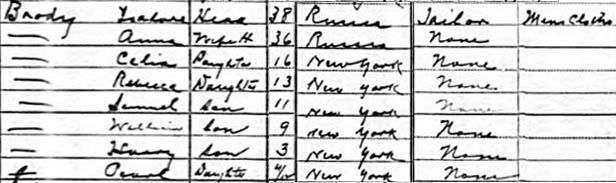
Rebecca Lepkoff's maiden name was Brody. In 1930 the 13 year old Rebecca was living at 10 Montgomery Street. The building still stands at the corner of East Broadway. That's where Neal Hellman's father, Sol, was living at the same time. Here's a posting about Sol and 10 Montgomery

Lepkoff Photo Match


Life On the Lower East Side by Rebecca Lepkoff and Peter Dans is a great book, but I've always been frustrated by trying to figure out exactly where the photos were taken since that information wasn't provided. Here's one I solved recently, 158 Henry Street, between Rutgers and Jefferson.

Corrections 4: 173 Henry Street


Previous I believed that 173 Henry Street was the location of a Rebecca Lepkoff photo Now I think it might have been 146 Henry Street (photo above), since another Lepkoff photo was taken down the block at 158 (see the post that follows). Still, I'm not sure of either location's certainty.

Wednesday, August 6, 2008

Rebecaa Lepkoff: 1947


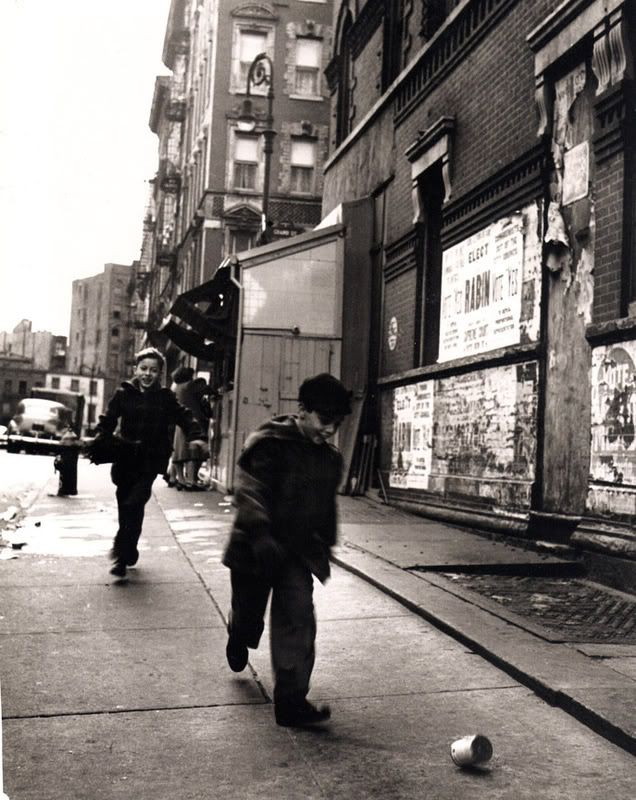
Rebecca, a famous photographer, lived at one time in Knickerbocker. This photo is from her book, Life On The Lower East Side, written with Peter Dans. There's little information as to where (it's stated somewhere in the vicinity of Clinton Street) and when this photo was taken but I figured out it was 1947 from the election poster which names a Rabin and asking people to vote Yes. More on this

Thursday, December 20, 2007

Rebecca Of Knickerbocker Village


Like Rebecca of Sunnybrook Farm. Get it? Rebecca lived there for a while in the 1950's
Life on the Lower East Side: A Profile of Photographer Rebecca Lepkoff from NY Voices original airdate: 1/19/07
Since Jacob Riis first took photos of the slums on Mulberry Street in the 1890s, artists and reformers have used the Lower East Side to make social statements about the people who lived there. In the late 1930s, a young photographer named Rebecca Lepkoff simply went out into the streets and took pictures of the people she saw. Today she's 90, and her new book, LIFE ON THE LOWER EAST SIDE , provides an unusually clear window into what the neighborhood was like when she was young.

Friday, December 7, 2007

Rutgers Square: Rebecca Lepkoff


A photo taken in the late 1940's by Rebecca Lepkoff showing the spot where Amy Irving emerged from the subway at the beginning of Crossing Delancey. Again here's a panoramic view of the area from a previous post