Showing posts with label two bridges. Show all posts

Wednesday, February 11, 2009

Two Bridges: Proposed Chinatown and Little Italy Historic District


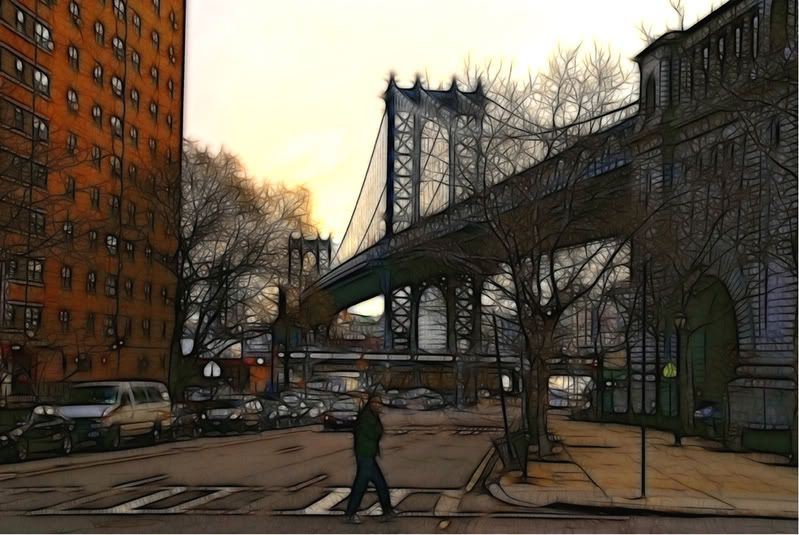
above image from an incredible photographer/artist called Skyshaper that I discover on Flickr Knickerbocker Village is viewable on the right
an excerpt from the Villager pf 12/10/08
Victor Papa is on a mission to save Chinatown and Little Italy.
Papa, president of the Two Bridges Neighborhood Council, wants to create the Chinatown and Little Italy Historic District as part of the State and National Register of Historic Places.
“We’re concerned development will wipe away the memory of all of this,” Papa said.
The State Historic Preservation Office gave Papa’s cause a lift several weeks ago by determining that the neighborhood is eligible to become a historic district. Both the tenement architecture and the area’s cultural and social history make the proposed district worth preserving, said Dan Keefe, SHiPO spokesperson.
“We’re elated,” Papa said of the state’s preliminary support. But he also couldn’t imagine it being otherwise. “How could it not be a historic district?” he said. “It is already a historic district in the minds of many, many people. It is appropriate that it be designated.”
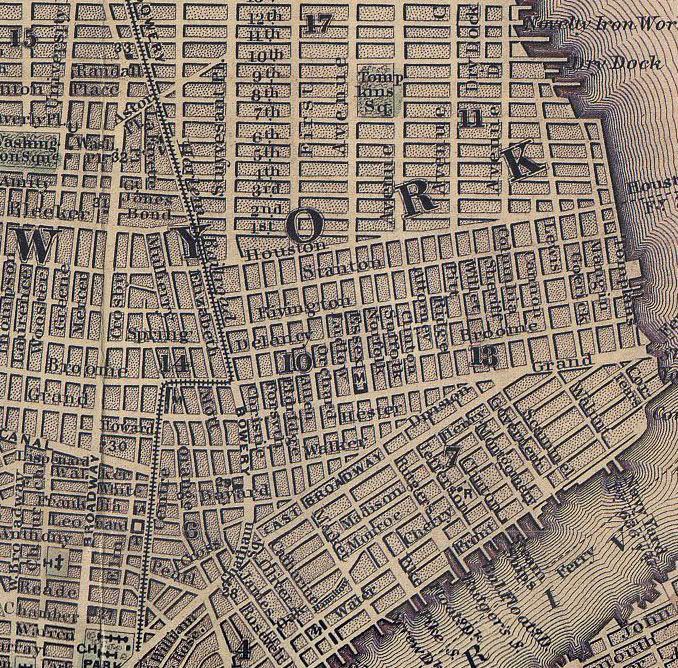
The proposed district is a narrow rectangle roughly bordered on the north by Houston St., on the west by Mulberry and Baxter Sts., on the south by Worth St. and on the east by Elizabeth St. and the Bowery.
Papa highlighted the coexistence of Chinese and Italian immigrants in the district as a key piece of the city’s history. Italian and Chinese immigrants began settling along Mott and Mulberry Sts. in the mid-1800s. Although the two cultures stayed separate, the early immigrants shopped in each other’s stores and sometimes worshipped in the same churches, according to historian Kerri Culhane-Black, who prepared the proposal for Two Bridges.
Simeon Bankoff, director of the Historic Districts Council, also supports the designation of the district.
“There are definitely very important cultural and architectural buildings down there,” he said. The district would include Columbus Park, the location of the historic Five Points neighborhood. The area is also home to many settlement houses and old social associations, Bankoff said.
Unlike the city’s landmark districts, the state’s designation would not put any burdens on owners, since it does not prohibit demolition of buildings. Instead, property owners would be eligible for tax credits and matching funds to preserve their buildings.
Because it would offer incentives to preserve the district’s buildings, Papa hopes the designation will preserve some affordable housing, as well.

The Two Bridges Neighborhood Council


about The Two Bridges Neighborhood Council from their site:
The Two Bridges Neighborhood Council was established in the 1950’s as a civic organization. It was specifically founded to address emerging racial tensions resulting from Black and Hispanic populations settling into the Lower East Side neighborhoods that lie between the Manhattan and Brooklyn Bridges. These neighborhoods, at the time, were comprised mainly of white-ethnic national groups. Working along with churches, settlement houses and a group of racially integrated, visionary leaders from the community, the Council served as a forum and catalyst for resolving racial conflicts. It soon published a neighborhood newspaper with the intention of exchanging news about local events and people, and sponsored little leagues and sports events and other activities for youth - all with the goal of improving racial and cultural conflicts.
As has been its strength over the years, the Council changed its focus in the late 1960’s to the very preservation of the neighborhood when AT&T planned to purchase, and in turn, demolish old tenement buildings located on Madison Street and replacing them with a huge Switching Station. This plan would have forever displaced hundreds of low-income families, and would have been an impetus to transforming the Lower East Side from a traditional enclave of affordable housing to a commercial area. Organizing the community against the proposal, the Council hired its first community organizer and was successful in preserving the stock of housing in this area by working out a plan that eventually moved the Switching Station closer to the Financial District. This is now a Verizon building located adjacent to Police Headquarters.
Having assumed at first a housing advocacy role in the community, the Council soon grew from a civic neighborhood association into one of New York City’s major housing development organizations for low and moderate income housing.In the 1970’s, TBNC teamed with Settlement Housing Fund, a nonprofit housing organization, to redevelop the Two Bridges Urban Renewal Area. This blighted urban renewal area was bounded by Montgomery, Cherry, South and Pike Streets, and adjacent to the East River. Since then the two organizations have developed on the site a large scale supermarket, Pathmark, and five residential sites containing over 1500 units of affordable housing, including a condominium and a 108 unit HUD financed rental development building for senior citizens, the Two Bridges Helen Harris Senior Residence.
The most recent development, Two Bridges Tower, at 82 Rutgers Street represents the culmination of this twenty-five year collaboration. In the climate of scarce government funding at the time, the two groups, now formed as the TwoBridgeset Associates, LP, had put together six different sources of financing for this building, including New York City capital funds, blended with bank loans and equity from low income housing tax credit investors. A row of small stores have been built adjacent to the tower.
Both the nonprofit developers also realized that besides all the housing and commercial development both were so effective in building on the urban renewal site, social services became a special concern, especially for the needs of formerly homeless families moving into the 80/20 Two Bridges Tower, and for the aging-in population of seniors at the Helen Harris Residence. As a result of this concern, Hamilton-Madison House, one of New York City’s largest social service providers, and a local organization, was sub-contracted to provide social workers in both buildings.
The Two Bridges Tower also includes, in a separate part of the residential tower, space for Hamilton-Madison House’s expanded behavioral health services which it provides to the burgeoning Asian community. It also includes an adult day-care and rehabilitation services sponsored by the Cabrini Nursing Home.
Having achieved all of this, TBNC now seeks to change its mission through a more individualized approach to community development programs that (i) are meant to sustain the current stock of affordable housing it helped to build, (ii) strengthen families and community bonds, and (iii) initiate programs meant to enhance the waterfront for the use and enjoyment of the local community.

Two Bridges 2


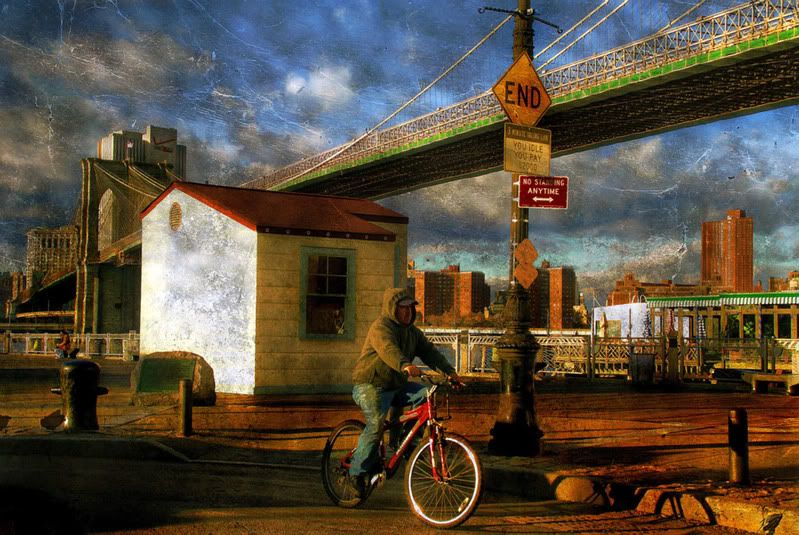
from an incredible photographer/artist called Skyshaper that I found on Flickr
an excerpt from a 2006 ny post piece. I wonder how far down prices have gone since then
WHAT’S to like about Two Bridges, the tiny Manhattan nabe around the Brooklyn Bridge and Manhattan Bridge?
“It’s the only neighborhood left in Manhattan that doesn’t have a Starbucks,” says 39-year-old Guns N’ Roses guitarist and Two Bridges resident Richard Fortus.
Indeed, with its gritty, hidden-in-plain-sight kind of vibe, Two Bridges might just be Manhattan’s last frontier.
But blink and you could miss the bargains. Though the area is dominated by 1880s tenements and low-and middle-income housing projects, numerous new condos are transforming the nabe.
Along with the new housing is an ever-increasing influx of young hipsters, artists, professionals and those being priced out of the rest of Manhattan — all of whom are helping put this once virtually uncharted territory on the map.
“It’s a unique area,” says Barrie Mandel, senior vice president at the Corcoran Group. “It feels like SoHo 10 years ago. It has a great cultural mix.”
And for now — like SoHo 10 years ago — Two Bridges remains relatively cheap.
“The prices in Two Bridges and its fringes are about 10 to 20 percent less than the Lower East Side,” says Rob Gross, senior vice president at Prudential Douglas Elliman.
In many cases, however, you get what you pay for.
“Most of the apartments are small walk-ups with not a lot of closet space and, like the Lower East Side, you could have a tub in the kitchen,” Gross says.
The new condos, of course, are changing that. Among the new residences in Two Bridges are 142 Henry St. ($535,000 to $1.8 million) and the Two Bridges condominium at 48 Canal St., with units from $660,000 to $1.6 million. Adding to the gentrified feel is the newly renovated Seward Park and the nearby East River waterfront promenade.
The area is bounded by the East River, the Brook-lyn Bridge, St. James Place, East Broadway and Montgomery Street. (Technically, the neighborhood might more accurately be called Three Bridges; the heart of the area is between the Brooklyn Bridge and the Manhattan Bridge, but the area also includes part of the space between the Manhattan Bridge and the Williamsburg Bridge.)
The area has historically been a settlement for immigrants, first Jewish and European, then Puerto Rican and Chinese. Now, however, the newest residents are the young professional set.
Gypsy Lovett and her husband, Stephen Coates, a law student, purchased their newly updated three-bedroom co-op three months ago for about $1 million.
“It’s such a great, quiet and diverse neighborhood that isn’t too far, but just set enough away from it all,” says the 30-year-old cookbook publicist.
But because the neighborhood is an up-and-comer, it has its drawbacks.
“I wish there were more conveniences like gyms and bodegas and things open late,” says 32-year-old personal trainer and two-year Two Bridges renter Cindy Sherwin. “It can also be kind of dirty, and I wish there weren’t so many rats. But all in all I love living here.”
But not everyone is happy with the gentrification the neighborhood is seeing.
“Two Bridges is a neighborhood in transition,” says Victor Papa, Two Bridges Neighborhood Council director and lifetime resident. “Part of what attracts people here is its character, but I’m afraid we’re fighting a losing battle.
“Developers are discovering treasures of buildings and converting them to expensive condos,” he adds. “They stop by here all the time and ask if a building is for sale, but I tell them we’re not going anywhere.”
And he might be right —to a certain extent.

Two Bridges


An excerpt from a 2006 Newsday story by Jonathan Scheff. I had forgotten that KV was in the heart of the Two Bridges neighborhood.
Paul Ratnofsky remembers playing Skully in the streets of Two Bridges, using a detergent cap weighted with melted crayons.
"Back then, you were thrown together with all sorts of neighborhood kids. It didn't matter if you really liked each other; you were friends," said Ratnofsky, who was born on Madison Street, grew up on Grand, and now lives on Grand with his two sons.
The historically Italian and Irish population of Two Bridges in Manhattan gave way to black and Hispanic newcomers after World War II, said Victor Papa, president and director of the Two Bridges Neighborhood Council.
Now the population is becoming more Asian.
"It's maybe the last wave of immigrants we'll see on the Lower East Side. The Lower East Side is quickly becoming a museum of immigrant memories. When you become a historic designation, that's a clear indication that immigration is over," Papa said.
In 1957, when Seward Park Cooperatives were built, there were many kids in the neighborhood, said Anne Lewison, an architect who lives in the co-ops with her two children. As residents grew older and their children moved away, the neighborhood became a NORC (a Naturally Occurring Retirement Community.)
Now, partly due to the expensive Manhattan market, more families are moving in. Seward Park has been revitalized by renovation and by the presence of children.
Blue Condominium, architect Bernard Tschumi's blue whale of a building that towers over Delancey Street, serves as an example of change in the neighborhood.
Ratner's, a popular Kosher restaurant in the mid-20th century, eventually went non-Kosher when business slowed in the 1980s and finally closed in 2002. Now a Sleepy's occupies the space and Blue Condominium's sales office occupies Ratner's old kitchen.
Two Bridges has one of the highest densities of public housing in the city, mostly located in the southern part of the neighborhood, along the FDR Drive.
"When Pathmark opened up, it was a big deal. But that was pretty much it," he said. "You can walk for blocks there and find nothing. It's a little isolated and sad there … [that's why] the Two Bridges area will never gentrify the way other areas can."