Showing posts with label Joseph Rumshinsky. Show all posts
Showing posts with label Joseph Rumshinsky. Show all posts
Wednesday, May 23, 2012
Comes Love: Artie Shaw's Version
Here writing credits go to Sam Stept, Charles Tobias and Lew Brown. Rumshinsky was often plagiarized. Sammy Cahn supposedly "borrowed" Bei-Mir-Mister-Schoen from him. Charles Tobias'
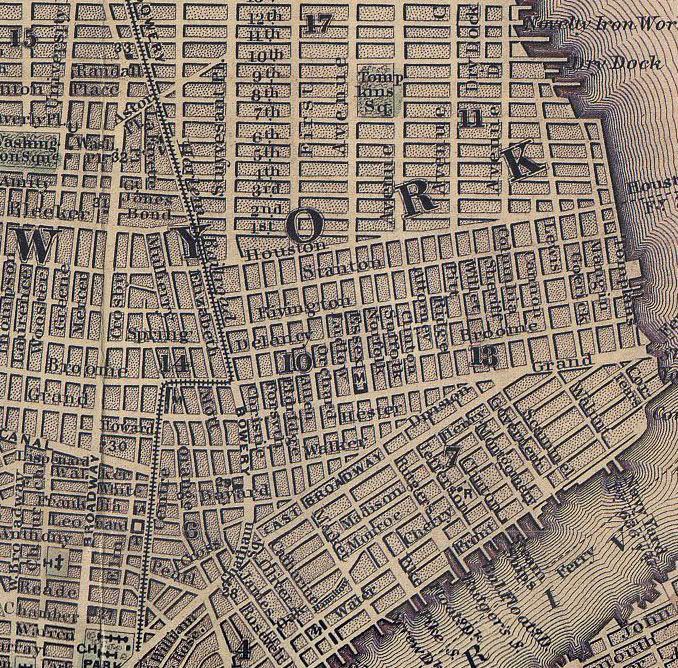
roots are within blocks of Knickerbocker Village


Joseph Rumshinsky: Comes Love
"Libes Shmertsn" [alternate transliteration Liebes Schmerzen] was written by Joseph Rumshinsky for the 1923 Yiddish musical "Shtarker fun Libe." Performed by Metropolitan Klezmer.
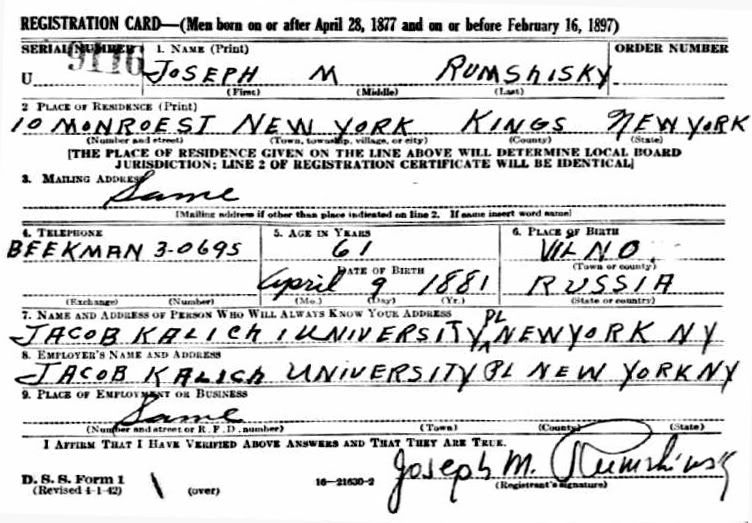
Who's Who In Knickerbocker Village History, 1940 Census: Joseph Rumshinsky
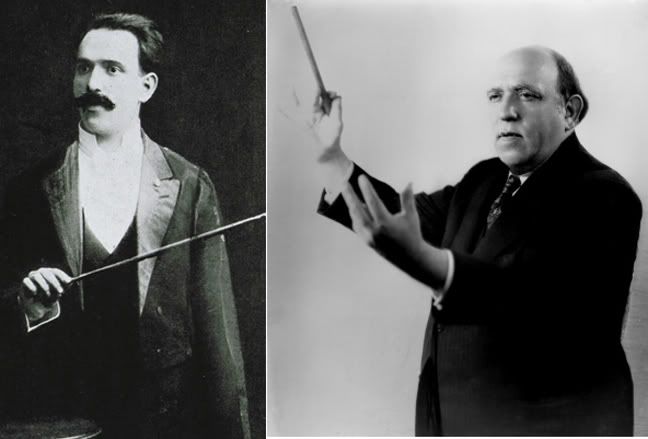
from part of his biography:
Among the significant composers and conductors associated with Second Avenue Yiddish musical theater at its zenith—a list that includes a great many once prominent names that are now no longer so widely remembered—Joseph Rumshinsky (1881 [1879?]–1956), along with Sholom Secunda, Alexander Olshanetsky, and Abraham Ellstein, is always considered one of the "big four" in aggregate achievement as well as undiminished fame. The beginning of his Second Avenue career, however, preceded the entrance of the other three in that group. He arrived in America as a young adult and an experienced musician before Ellstein was born, more than a decade before Olshanetsky immigrated from Europe, and only a few years before Secunda's bar mitzvah. (By the time Secunda first attempted to break into the Second Avenue arena, for example, Rumshinsky was already a major force within the entrenched establishment, whose hegemony posed an obstacle to the young newcomer that he could overcome only gradually and patiently—a situation Rumshinsky himself had faced upon his own arrival on the scene years earlier.) In terms of his formative role in the progress of the Yiddish musical, Rumshinsky's generic impact as a would-be reformer—independent of qualitative artistic or literary judgments of his ultimate products—was probably greater than that of the others who followed him. For it was he who first tried to edge Yiddish musical entertainments away from their earlier theatrical crudeness and lift them toward his theoretical ideal of a new American genre of Yiddish light operetta (or, as one critic later characterized Rumshinsky's admittedly unfulfilled aim, operetta in Yiddish). He succeeded, to a degree, in terms of form and structure, as well as with certain lasting innovations both in the pit and on the stage. But content remained little affected in the wake of his commercially driven recidivism. In many respects it may be said of Rumshinsky that his American career mirrored the chronological course of Second Avenue's development from the first decade of the 20th century until the 1950s.
Wednesday, July 16, 2008
The True Story Of Bei Mir Bist Du Schoen
According to Nehemiah Persoff Knickerbocker Resident, Joseph Rumshinsky wrote Bei Mir Bist Du Schoen. According to this archival article Sholom Secunda wrote it. In either case, Seward Park "graduate" Sammy Cahn reaped much of the rewards
Subscribe to:
Posts (Atom)


 Posts
Posts