Showing posts with label immigration. Show all posts

Monday, October 17, 2011

The Lee Family Of Forsyth Street

Lee Family Forsyth
Below,  an excerpt from the excellent accompanying nytimes' article
Three Generations Under One Roof
By SARAH KRAMER
SEVEN o’clock on a Thursday morning: time for bao, Chinese breakfast buns. Dressed for school in striped leggings and a pink shirt, Mebrat Yong, 9, waited for the baby sitter to arrive at her family’s building in Chinatown with a red shopping bag filled with the steaming treats from her uncle’s bakery a few blocks away. Mebrat was dividing up this day’s buns.
She slipped a plain bun into her Hello Kitty backpack, then set aside another for Gung Gung, as she and her siblings call their 86-year-old grandfather, who speaks only Cantonese and occupies the first floor. She took a half-dozen — one coconut, two plain, one roast pork, one bacon and scallion, one cookie — up to the third floor for her aunt and three cousins, who washed them down with fruit shakes.
Then Mebrat returned to the second floor, where she lives with her parents and three older brothers, handing out buns amid reminders from Mom to the children to tidy the bathroom and take homework to school. The second-floor kitchen is the heart of the building, so Mebrat set a plate of buns in the middle of the long, dark wood table, where they would remain all day for snacking.
Such is breakfast at the Lees, where three generations live together in a household at once retro and revolutionary. Gung Gung and his children, May Wong Lee and Warren Lee, bought the building for about $700,000 a dozen years ago from a Jewish family that had owned it for generations. An addition brought it to 10,000 square feet, with room for each branch of the Lee family to have its own space.
The family rents out the basement to a Mexican restaurant, and the fourth floor is a free-for-all, where the children play, everyone entertains and Warren, who runs the bakery and cooks dinner daily for the adults, tends a roof garden of herbs and vegetables. The brother and sister and their spouses, Jennifer Lee and Benito Yong, split the mortgage and the bills for food and building repairs.
The percentage of households in the United States containing three or more generations has nearly tripled over the past 30 years, to 7 percent in 2009 from 2.4 percent in 1980, according to Census Bureau reports. The living arrangement is even more common, and growing more rapidly, in New York City, where immigrant values and expensive real estate have combined to make 10 percent of households span at least three generations. And there are untold others like the Lees, who file separate census reports but live under one roof, sharing chores, parenting and, in their case, caring for the patriarch — whose real name is Kuey Wing Lee — all of which, at times, can lead to conflict........

Saturday, August 13, 2011

Mariner's Church History: 1895

Mariner's Church 1895
Learned something new here. Lettish is a term for natives of Latvia. Also note the multi-ethnic nature of the area due to its proximity to sailors frequenting and living in the area.

Tuesday, March 8, 2011

My Life: Russo Inqui, A School Technology Project On LES History


A school technology project, circa 2004, where a student from a lower east side school used a primary source to imagine the life of an immigrant attending that same school 80 years in the past.
Born 1912. Russo's record shows his marks in the 7th and 8th grades where he had the following subjects: English, Oral English, Arithmetic/Algebra, Science/Sewing, Music, History, Geography and Shop/Cooking. His marks were mostly in the 70's. He only got a 65 and a 66 in History and Geo9graphy. His official teacher was someone named Tucker. He moved 4 times before he came to PS 20. He went to PS 104, PS 79 and PS 19. He used to live uptown on 84th Street.

My Life: Catherine Fazio, A School Technology Project On LES History


A school technology project, circa 2004, where a student from a lower east side school used a primary source to imagine the life of an immigrant attending that same school 80 years in the past.
Born in 1925. Catherine's student card shows that she attended PS 91 before she came to PS 20. She lived on East 4th Street. In the 7th and 8th grade she got separate marks in the subject areas. The subjects were: English, Oral English, Arithmetic/Algebra, History, Geography, Science/Sewing, Music and Shop/Cooking. Her marks weren't too great.

My Life: Peter Inguatiato, A School Technology Project On LES History


A school technology project, circa 2004, where a student from a lower east side school used a primary source to imagine the life of an immigrant attending that same school 80 years in the past.
Born in 1909. From his record card we see that Peter lived at 313 Bowery all during his elementary school years, which was unusual for those times. People moved a lot. He went to PS 79 for most of that time and transferred to PS 20 in the 7th grade. He repeated 2B in 1918, maybe because he got a C minus the first time. He was out sick for a long time in 1921.

Thursday, May 13, 2010

Immigrant Number One: Annie Moore Of The Fourth Ward

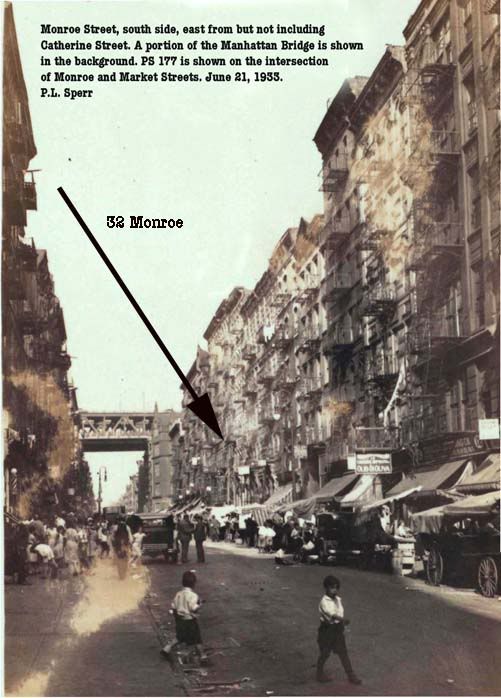
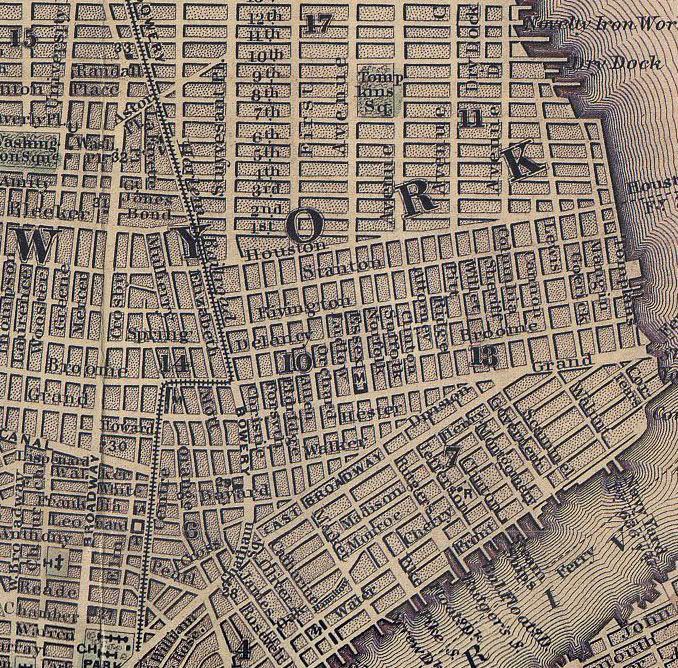
 above, the arrow points to 32 Monroe Street, where Annie Moore lived.
a previous 2008 post about Annie Moore

an excerpt from new york magazine
Immigrant Number One
In 1892, she was the first foreigner to arrive at Ellis Island. By 1893, she was an American mystery.
Annie surely knew to expect that other immigrant, the tall one from France. Not yet six years in the harbor, the Statue of Liberty was already famous, even as far away as Cork, for her inscription welcoming the wretched refuse if not for her cold, suspicious face.
What Annie wouldn’t have expected was Ellis Island. When her parents had come from Ireland four years earlier, they’d been brought to Castle Garden, which was neither a castle nor a garden but a scandal-ridden immigrant station at the tip of Manhattan. Maybe as Annie and her two younger brothers waited out their last frigid night on the S.S. Nevada—they had arrived in the harbor on the evening of December 31, 1891—someone explained to them that things had changed. They and the 145 other steerage passengers would be among the first immigrants sent to a new facility whose opening was planned for New Year’s Day.
How could Annie have cared about that? She and Anthony and Phillip had not left Ireland unchaperoned—had not endured the twelve dark and airless below decks days of the crossing, including Christmas!—to be the first of anything. They just wanted to see their parents and their older brother and sister, who by now were young adults of New York. To that end, the less attention the better. There were tales about immigrants being rejected for any reason, from a limp to a lie, and all three Moores, probably to save their father money on the passage, had understated their ages.
If Annie wanted to make as little of the big day as possible, the press had the opposite idea. Perhaps it was for the papers’ benefit that the two other ships whose passengers might have had the honor of inaugurating Ellis Island—the City of Paris and the Victoria—were overlooked in favor of the Nevada. It sounded so American. And perhaps it was on the press’s behalf, too, that a “rosy-cheeked” Irish lass headed the line to get off the barge as it moseyed into its slip, amid foghorns, bells, and shrieking whistles. How perfect that it also happened to be her 15th birthday! (Too perfect: She’d turned 17 the previous spring.) But this was not the only detail the press seems to have invented. “As soon as the gangplank was run ashore,” the Times reported the next day, “Annie tripped across it.”
Maybe. Or maybe, as other versions have it, she was so visibly upset by the emotions of the day that the Italian gentleman who was actually first in line insisted she take his place. Or was it a German man, who was shunted aside in favor of the English-speaking youngster? Surely she would make a better ceremonial subject for the Treasury Department dignitary who’d come from Washington to welcome Ellis Island’s first immigrant. Nor was that the end of the pomp: A Catholic chaplain blessed Annie, and the island’s commissioner handed her a gold Liberty coin.
It seems doubtful that Annie said, as the Times also reported, that she would never part with the $10 piece, but would “always keep it as a pleasant memento of the occasion.” Is it more believable that, as family lore maintains, she barely kept it five minutes? Supposedly, her father, a longshoreman, took it for safekeeping—it was a week’s salary, a month’s rent!—and that night, to celebrate the reunion of his family, drank it away in the saloons of the dismal Fourth Ward, in the shadow of the Brooklyn Bridge.

Sunday, April 4, 2010

15 Forsyth Street: 1884


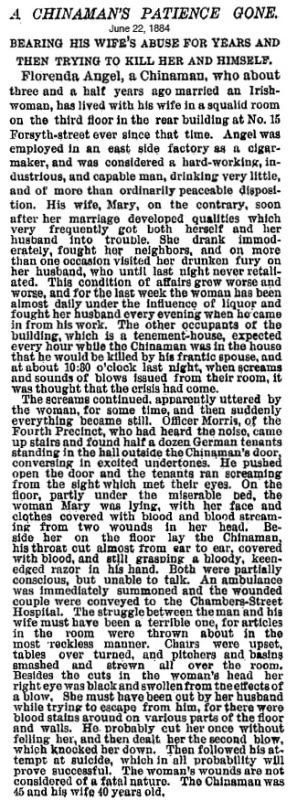
This story certainly would have made the papered wall today. It bares witness to the common intermarriage of Chinese men and Irish women during this era. At that time there was a shortage of Chinese women and Irish men. I'm sure this union was not a typical dysfunctional one.

Tuesday, February 2, 2010

"My" Russians


an excerpt of a letter written to my wife
Now to the Riga, Latvia Burlak.. connection.
Your maternal grandmother known to all as Anna Sosnovsky, was born Hinde Luchkovsky in Tal'noye, Ukraine, Imperial Russia to Zipporah Burlakov, who was married to Gershn Luchkovsky. Baba Tsipoyra, as she was called us, was daughter of Feivl Burlak...
Feivl had a number of siblings -- I've forgotten their first names -- one of whom was father to 4 or 5 sons and one daughter. The oldest son was Ulyi and youngest Grigory. Ulyi left Tal'noye in about 1921 0r 22 and made it to the US a few years later after quite a set of tribulations. Here he adopted Tsipoyra's sister Ruchl as his mother, although she was "merely" his aunt. That made Ida (Bea Jaffe's mom), Fannie (my mother), Hinde, whose name translates as Anna into English, and Leah (who took the name Liza) a first cousin of Ulyi Burlak.., who adopted the name Lou, and after WWII changed it to Louis Burle.
That makes me a first cousin twice removed, maybe, or a second cousin. I don't know quite how to figure that stuff out.
About 18 months ago I got an email from an unknown person named Mary Klevit... in Harrisburg, PA, who claimed that she was inquiring on behalf of Burlak... in Riga and Ukraine: was I a Burlakov from Tal'noye. My answer was a resounding yes. She then telephoned me, we spoke at length, and then I received a few emails from Ukraine together with pre-Revolutionary and current photos of people, two of whom I recognized as Baba Tsipoyra and Ruchl when they were in their late teens or early 20s. I responded by some old and some recent photos of Yulyi, who we called either Lulyi or Lou, his wife Minna, ac concert pianist, and other in the family including Anna, Abe, Rina, and Tisa. That established our tie. The correspondents in Ukraine knew no English and my Russian is rudimentary and rusty enough that I couldn't ace up to the prospect of taking a few days to write only a paragraph or two of unidiomatic Russian.
That put an end to the correspondence until this past January when I got a phone call from a young woman named Iri.. Burlak.. who was telephoning on behalf of her father, Leonid, in Latvia, to wish me Happy New Year. She also passed on the news that she was coming to New York to work for a perfume company there. I asked her to call me and I would come to NYC to meet her.

To make a long story short, the birthday girl is a cousin of my wife's who she recently became aware of. The cousin's part of the family stayed in Russia while the other branch emigrated in the early 1900's. A story very similar to Across The Sea Of Time.

Monday, February 1, 2010

Across The Sea Of Time


A great movie for Immigration studies with kids and for giving a then and now view of NYC. from amazon, unfortunately not available on DVD
A young boy travels across the ocean, from Europe to New York, carrying only letters, stereoptican photos, and a viewer. The letters and photos were sent over a hundred years ago by a long dead relative. He wanders around New York City trying to use the letters and photos, he has no address, to locate his family--the only family he has left. He meets many different people in the city who try to help him, but most cannot visualize any other New York than the one they know. Wonderful voice-overs from the letters and amazing juxtapositions of the old photograph against the same location decades later. The boy is clever and resourceful--you find yourself cheering him on. Fun, all ages movie. Good history of multicultural New York.

Sunday, March 15, 2009

The Mintz's Of Colchester, CT


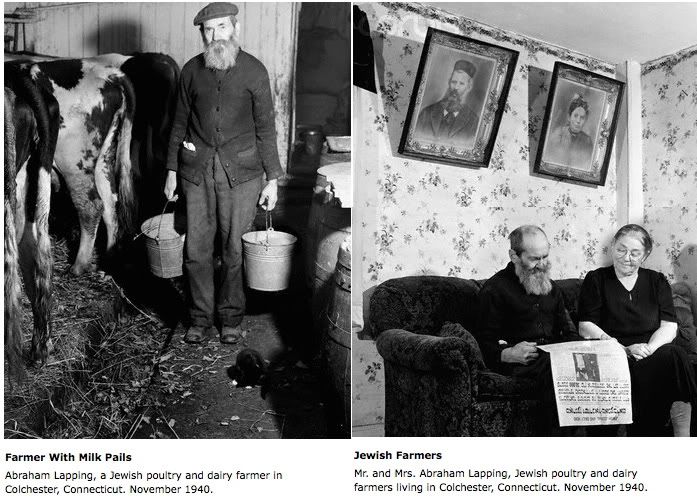
The Mintz's were evidently part of the same group as the Lapping's
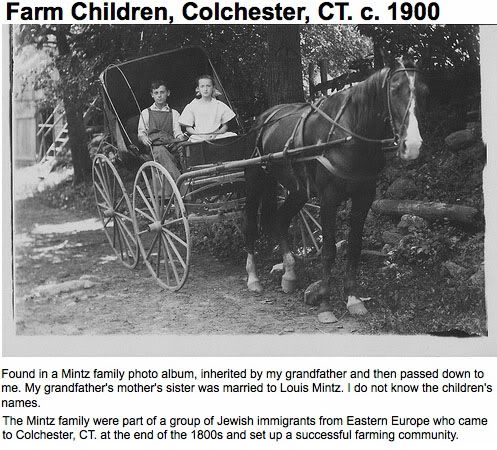
above photo and below info from the Mintz flickr page
Found in a Mintz family photo album, inherited by my grandfather and then passed down to me. My grandfather's mother's sister was married to Louis Mintz. I do not know the children's names. I do not know the farmer's names, but it's possible they are Louis, Simon, Soloman or Benjamin Mintz.
The Mintz family were part of a group of Jewish immigrants from Eastern Europe who came to Colchester, CT. at the end of the 1800s and set up a successful farming community.
Hyman Mintz owned the old victorian house that sits on Hammond Court in early 1900s. When he died, his daughter Katie inherited that property. Previously owned by the Zenowitz family, it's now owned by the Stevens's. Question is, is this horse and buggy traveling down Hammond Lane, a common pathway up until 1955 when the town of Colchester moved the pathway to what is now Hammond Court? My resources tell me the road was stopped short by erecting a longer building on what is now the Coiro's propery and moved because the Colchester Convalescent Home had built their facility, which years later was condemned, right smack in the middle of the pathway. If anyone has pictures, I sure would like to see them.

What Was Mrs. Lapping's Husband Doing In Colchester, CT?

Below: Mrs. Lapping's in-laws

I was curious as to why Paul Lapping, an immigrant from Russia in the early 1900's, was living in Colchester, CT. I found this under the Colchester, CT town site.
I certainly get an education working on this blog
By 1900 farming had diminished and the rubber mill had closed, but this was a time for another new beginning for Colchester. The Hirsch Foundation of New York had discovered that Colchester was an excellent place for the settlement of European Jewish immigrants. By 1923, there were about 750 children recorded in the school census out of a total town population of 2,100. Since farming was no longer prosperous, many began to supplement their livelihoods in the summer by taking on boarders from nearby cities and New York.
Within the span of a few years, Colchester became the 20th Century's "Catskills of Connecticut". At least seven major hotels thrived including the Broadway House, owned by Abraham and Rose Jaffe, Harris Cohen's Fairview House, Julian Sultan's Hilltop Lodge, Schwartz's Kessler's Horowitz's and Barnett Dember's. The tourist industry boomed throughout the 1930s.
Postwar growth in neighboring towns led to a new era for Colchester. A new generation of suburban dwellers found Colchester to be an excellent "bedroom" community due to an improved highway system and its proximity to Hartford, Middletown and the Norwich/New London areas. During the 1950s the beach traffic brought many through Colchester to their favorite stops including Harry's, the Colchester Bakery and Levine's Coat Shop. The Route 2 by-pass of the town was completed in the 1960s. But for those who did not just pass through, Colchester's dedication to the public school system, its acceptance of all peoples and its quality of life increased its population to 7,761 by 1980. Today, over 300 years after the settling of Colchester, the population has grown to over 14,000.

Thursday, November 13, 2008

Sam Rosoff: Immigrant Transportation Scion


from Time Magazine, 4/08/1935
Last week a crowd gathered on the steps of New York County's Supreme Court House to witness a bankruptcy sale of the property of Hudson River Navigation Corp. Forced to earn a year's maintenance in four summer months, the 100-year-old concern went under in 1932, has since been operated at a loss by court trustees. Sole bidder for its assets last week was a contractor named Harry R. Pearley, whose offer of $100,100 was promptly accepted. Newshawks soon found that the real buyer was not Mr. Pearley but a fat and fabulous man named Samuel Rosoff who was pacing about at the fringe of the crowd. Asked why he bought it, Rosoff explained:
"I am interested in the welfare of the good old Night Line. I love the Hudson River."
The Hudson River Night Line used to carry some 200,000 passengers. 20,000 automobiles, 175,000 tons of freight annually between New York and Albany before it went bankrupt. Its four passenger ships are the finest of their kind afloat. The Berkshire, world's largest river steamer, accommodates 2.400 passengers, has 413 staterooms. Night liners take 12 hours to cover their 160-mile route. Last week Buyer Rosoff promised to build "swell new boats," put the line on its sea-legs.
Samuel Rufus Rosoff was born in Minsk, Russia, 53 years ago. Aged u, he worked his way to the U. S. as a potato-peeler on an immigrant ship. A tough, dirty little boy who had never been inside a school, he sold newspapers, slept on warm sidewalk gratings, learned to read at the Public Library. One job led to another until Samuel Rosoff was building New York City subways, operating bus lines, brewing King's beer, buying race horses and making money hand over fist. Today he often carries $50,000 cash in his pockets, tells competitors: "Money talks." Shrewd at dealing with all kinds of politicians, he boasts: "I'm a member of Tammany Hall and proud of it. I'm also a Republican and proud of that. ... I haven't got education. What I got is what it takes to make guys with education do the job I want done."

Wednesday, November 5, 2008

Pauline Newman: Oral History


About Pauline Newman along with the transcript from the interview.
Pauline Newman giving an interview in 1981 [Pauline Newman was born in Lithuania around 1890 and came to the United States in 1901. Soon after her arrival, she went to work to help support her family. As a young teenager, she became employed at the Triangle Factory. She was no longer employed there by the time of the fire but she wrote the following description of working conditions at this factory and speaks about why workers endured the indignities.
from history matters
Pauline M. Newman (1890? - 1986)
We raise this cup in honor of Pauline M. Newman. Newman was born to religious parents in Kovno, Lithuania sometime around 1890. In 1901, Newman's widowed mother immigrated to America with her children. Nine-year old Newman went to work in a New York City hairbrush factory. Two years later, she began working among other children in the "kindergarten" at the Triangle Shirtwaist Factory. At the age of sixteen Newman planned and led a rent strike involving 10,000 families in lower Manhattan. It was the largest rent strike New York City had seen, and it catalyzed decades of tenant activism that eventually led to the establishment of rent control. Once Newman's talent for organizing became apparent, the International Ladies' Garment Workers' Union hired her. For more than seventy years she worked for the Union as an organizer, labor journalist, health educator and government liaison. An acerbic woman whose unorthodox tastes ran to cropped hair and tailored tweed jackets, Newman loved the labor movement. She referred to the ILGWU as her "family" and believed that it was, for all its flaws, the best hope for women garment workers. Newman's "family" also embraced a cross-class circle of women reformers that included Eleanor Roosevelt, Rose Schneiderman and Frieda Miller, Newman's partner of fifty-six years. This circle of women shaped the body of laws and government protections that most workers now take for granted.
In this oral history interview conducted by historian Joan Morrison, Pauline Newman told of getting a job at the Triangle Company as a child, soon after arriving in the United States from Lithuania in 1901. Newman described her life as an immigrant and factory worker. Like many other young immigrant workers, she chafed at the strict regulations imposed by the garment manufacturers. One of the greatest industrial tragedies in U.S. history occurred on March 25, 1911, when 146 workers, mostly young women, died in a fire at the Triangle Shirtwaist Company. Although she was not working in the factory at the time of the fire, many of her friends perished. Newman later became an organizer and leader of the International Ladies Garment Workers’ Union.
Joan Morrison: So, back to the early days when you first came, and you lived in this flat, with the toilet in the street, and the, ah coal stove. Did you go right to work then? And your mother? Do you remember about your first job, how you got it?
PaulineNewman: We got here in May and I . . . a cousin of mine who worked for the Triangle Shirtwaist Company. And by the time she got me in there it was October. So between May and October I did various jobs off and on, you know? But in October she got me to the Triangle basement.
Morrison: Do you remember your first impressions, of going in there?
Newman: What, the Triangle Shirtwaist Company? You don’t forget a situation of that kind, because it was one . . . In the first place, it was probably the largest shirtwaist factory in the city of New York. By the time I got there, they had something like two, more than two hundred operators. And they had collars, examiners, finishers. All together probably, they had about four hundred people. And that was a large staff. And they had two floors. The fire took place on one floor. And they got, we started work at 7: 30 and during the busy season, we worked until nine o’clock in the evening. They didn’t pay any overtime and didn’t give you anything for supper money. At times they would give you - in those days, the bakery had a little apple pie not very much bigger than this - and they would give you that for your supper. Very generous.
Morrison: A small child then, like you, would go in and work all day with that and .. ?
Newman: You’d work until you got your regular pay from six to nine in those times.
Morrison: And what did they pay you?
Newman: And what, ah, what they did, as I said, at times they’d be generous. You could get a little apple pie.
Morrison: Yes.
Newman: The wage scales. You forget nothing, as long as your memory still serves, and mine does. My own wages when I got to the Triangle Shirtwaist Company was a dollar and a half a week. And by the time I left during the shirtwaist workers strike in 1909 I had worked myself up to six dollars.
Morrison: Ah, magnificent.
Newman: But you see hours didn’t change. The hours remained, no matter how much you got. The operators, their average wage, as I recall - because two of my sisters worked there - they averaged around six, seven dollars a week. If you were very fast - because they worked piece work - if you were very fast and nothing happened to your machine, no breakage or anything, you could make around ten dollars a week. But most of them, as I remember - and I do remember them very well - they averaged about seven dollars a week. Now the collars are the skilled men in the trade. Twelve dollars was the maximum.
Morrison: And that was piece work, also?
Newman: You were considered well paid, twelve dollars a week!
Morrison: And how about what you did? What did you do for your six dollars and a half?
Newman: Well, what I did really was not difficult for, ah, when you fitted the shirtwaist at the machine, there are some threads that are left. And I wasn’t the only one. We was, we had the corner on the floor. It resembled a kindergarten: we were all youngsters. And we were given little scissors to cut the threads off, like so. It wasn’t heavy work. It was monotonous 'cause you did that from 7: 30 till nine o’clock at night. You had one half hour for lunch and nothing for supper or anything like that. Before I left I was promoted to the cutting department. You’d cut the embroidery, which was inserted in the front of the shirtwaist in those days, and that was . . . They were the kind of employers who didn’t recognize anyone working for them as a human being. You were not allowed to sing. Operators would like to have sung, because they, too, had the same thing to do, and weren’t allowed to sing. You were not allowed to talk to each other. Oh, no! They would sneak up behind you, and if you were found talking to your next colleague you were admonished. If you’d keep on, you’d be fired. If you went to the toilet, and you were there more than the forelady or foreman thought you should be, you were threatened to be laid off for a half a day, and sent home, and that meant, of course, no pay, you know? You were not allowed to use the passenger elevator, only a freight elevator. And ah, you were watched every minute of the day by the foreman, forelady. Employers would sneak behind your back. And you were not allowed to have your lunch on the fire escape in the summertime. And that door was locked. And that was proved during the investigation of the fire. They were mean people. There were two partners, Rank and Harris, and one was worse than the other. People were afraid, actually. And finally, it took from the time I got there, October 1901 to November 1909, for the people to really rise and proclaim that they cannot work under such condition any longer. And we had 20,000 of them coming out here, and 15,000 in Philadelphia, you know? And that was the strike, Boston from November 1909 to the end of March 1910.
Morrison: That must have been very hard on the workers, to get along without...
Newman: It was the coldest winter anyone could remember and my particular assignment took me to the coldest part of the State of New York. I was assigned to go to Buffalo, Rochester, Syracuse, to collect money.
Source: Joan Morrison and Charolotte Fox Zabusky,American Mosaic: The Immigrant Experience in the Words of Those Who Lived It(Pittsburgh: University of Pittsburgh Press, 1980, 1993). By permission of the University of Pittsburgh Press. (c) 1980, (c) 1993 by Joan Morrison and Charlotte Fox Zabusky.

Thursday, October 9, 2008

Dreamland, An Interview With Kevin Baker


The audio is fro a 1999 npr interview
Weekend Edition Saturday, March 6, 1999 · Brooke gets a tour of Coney Island from author Kevin Baker. His latest book, Dreamland (Harper Collins), is set in turn of the century New York City and features an extensive cast of characters.

The images of Coney Island, circa 1900, come from the nypl digital library

Dreamland By Kevin Baker

This circa 1900 thread that I'm currently on reminds me of one of my favorite books by one of my favorite authors, Kevin Baker. Here's an excerpt from it. Here's Kevin's site

Saturday, October 4, 2008

99 Years Ago On The Lower East Side


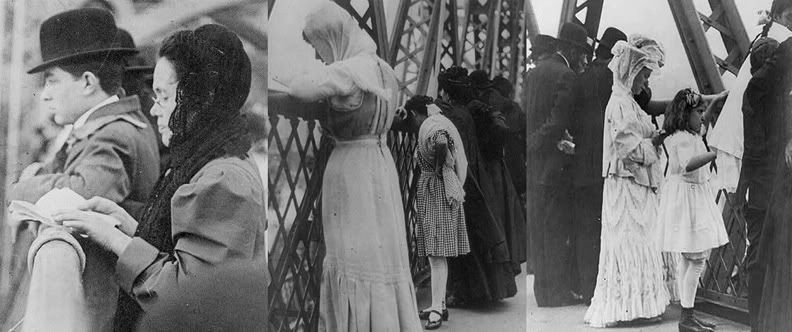
1909, Jewish New Year - Praying on the Williamsburg Bridge (Tashlich). Bain News Service, as noted on the mental blog

Tuesday, December 11, 2007

Coming To America: Opening From Across The Sea Of Time


The opening scene from one of the first iMax movies called Across the Sea of Time. Here's a previous mention of this film

Wednesday, December 5, 2007

Across The Sea Of Time


A clip I had of a 1995 film that I used a lot for teaching about immigration
Some reviews and a link to the film on amazon:
New York born and bred, I have a soft spot for any movie that tenderly portrays the journey of our ancestors through Ellis Island. This film is touching in its telling of the story of a little boy who stows away on a ship to New York City to find his distant relative. Armed only with a torn back pack and tattered old photos from the early 1900's, he travels through the city, wide-eyed and in wonder of all the beauty the city has to offer. From the simple pleasures of eating a real New York hot dog, to walking the boardwalk on Coney Island, there is something for everyone in this touching tale. Lots of authentic filming in New York brings the story to life, and the pre September 11th shots of Downtown Manhattan and the World Trade Center are profound. If you had the chance to see this wonderful film in IMAX 3-D many years ago, you were treated to something even more spectacular. The soundtrack is not to be missed ~ just perfect to accompany this movie. Enjoy!

I was not only astounded by the realism of the 3D in the IMAX Theaters I've seen it in. But the story is so overwhelmingly heart grabbing. It throws you into the world of a boy who is making a journey that most people dream of at least one time in their lives. The 3D is nothing like that seen in the cheesy films in the past. The 3D in an IMAX film- Especially Across The Sea Of Time!- is almost exactly like being on a Holodeck! I am not exagerating. The new technology is almost perfect. The only thing left, is to make the goggles so lightweight and large that you don't know they are on your head.I loved this movie. The story is so strong, that I'm sure it would be enjoyable on Video. But if you EVER have a chance to see it in an IMAX Theater. DO NOT MISS THE CHANCE!It was THE BEST thing I did on my first trip to New York! And that's really saying a lot. It had to compete with The Statue of Liberty, The Empire State Building, and Rita Ford's Large Antique Music Box Store- which I had been looking forward to seeing for over 15 years!You won't be disappointed.