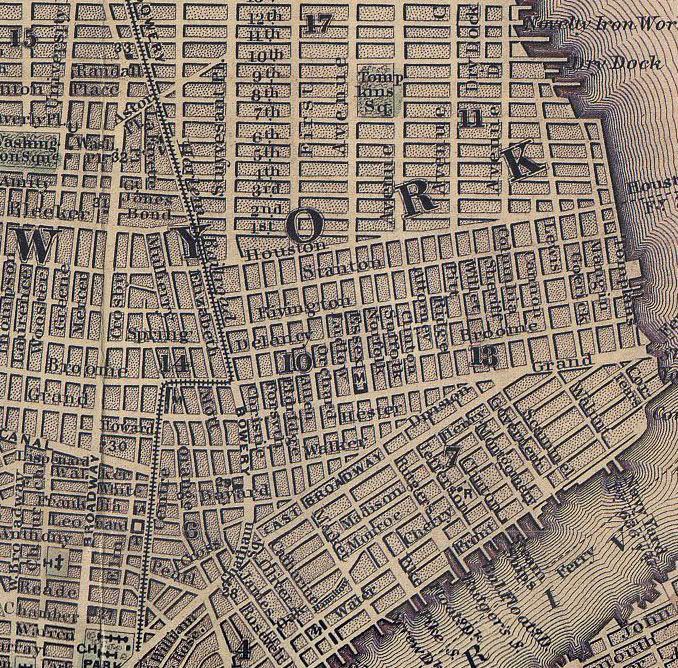
Another Sanborn Insurance gem. A shout out to my nephew Jamie, whose U of Buffalo attendance provided digital library access. Here's a math tech integration activity. "If there were x number of synagogues on these y square blocks, how many synagogues would there be on z square blocks?' The spot where I placed an image of the real PS 7 was an empty lot. The front of PS 7 faced Chrystie Street. The area is now part of Sara Delano Roosevelt Park. In the 1896 Tribune, the school was described as the dirtiest school in the city. Behind the Grand Theater there are "Bowling Alleys and a Turkish Bathouse. I'll try to see who was playing at the Grand Theater. The hook and ladder company on Canal Street is still a fire house 100 years later. The Boarding Stable on Allen Street logically became a parking garage. BTW, SD stands for steel door.
Showing posts with label forsyth street. Show all posts
Showing posts with label forsyth street. Show all posts
Friday, October 28, 2011
1905 Map Of Grand, Forsyth, Hester, Chrystie Area
originally from the early days of pseudo-intellectualism
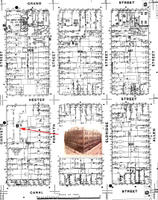 Another Sanborn Insurance gem. A shout out to my nephew Jamie, whose U of Buffalo attendance provided digital library access. Here's a math tech integration activity. "If there were x number of synagogues on these y square blocks, how many synagogues would there be on z square blocks?' The spot where I placed an image of the real PS 7 was an empty lot. The front of PS 7 faced Chrystie Street. The area is now part of Sara Delano Roosevelt Park. In the 1896 Tribune, the school was described as the dirtiest school in the city. Behind the Grand Theater there are "Bowling Alleys and a Turkish Bathouse. I'll try to see who was playing at the Grand Theater. The hook and ladder company on Canal Street is still a fire house 100 years later. The Boarding Stable on Allen Street logically became a parking garage. BTW, SD stands for steel door.
Another Sanborn Insurance gem. A shout out to my nephew Jamie, whose U of Buffalo attendance provided digital library access. Here's a math tech integration activity. "If there were x number of synagogues on these y square blocks, how many synagogues would there be on z square blocks?' The spot where I placed an image of the real PS 7 was an empty lot. The front of PS 7 faced Chrystie Street. The area is now part of Sara Delano Roosevelt Park. In the 1896 Tribune, the school was described as the dirtiest school in the city. Behind the Grand Theater there are "Bowling Alleys and a Turkish Bathouse. I'll try to see who was playing at the Grand Theater. The hook and ladder company on Canal Street is still a fire house 100 years later. The Boarding Stable on Allen Street logically became a parking garage. BTW, SD stands for steel door.


Saturday, October 22, 2011
Who's Almost Who In Knickerbocker Village History: Abe Beame, 176 Forsyth Street

Abraham David Beame was born in London on March 20, 1906, to Polish-Jewish parents who had fled Warsaw, then part of Czarist Russia. His father, Philip Birnbaum, a Socialist revolutionary who barely escaped arrest, went directly to New York, while his mother, Esther Goldfarb Birnbaum, stopped in London to give birth and joined her husband three months later. In New York, the family name was changed to Beame. Abraham's mother, who had two more sons and a daughter, died in 1912; his father remarried and had two more children. The boy, called ''Spunky'' for his scrappiness, grew up in a crowded cold-water flat on the Lower East Side. Childhood friends said he was an outstanding student at Public School 160. At the High School of Commerce, where he graduated at the top of his class, he had perfect scores in the state Regents bookkeeping exams and showed an extraordinary ability to absorb data and memorize facts. He was always working. One early morning job was to go through tenements, waking people who had no alarm clocks. During his high school years, he worked evenings in a paper factory, studying during his dinner hour. He roller-skated to school and work to save subway fare. His father took him to Socialist party meetings, and he remembered Eugene V. Debs, who ran for president five times. At 15, he met Mary Ingerman over checkers at the University Settlement House on Eldridge Street. Seven years later, after he graduated from City College with an accounting degree in 1928, they were married. They lived in Brooklyn for the next 45 years, first in a two-family house in Crown Heights, where they raised their sons, then in a modest apartment near Prospect Park. They spent summers at rented cottages in Belle Harbor, on the Rockaways in Queens.My rational, he was a Birnbaum before his named was changed to Beame.
Monday, October 17, 2011
Brigadier General Theodore Bingham, NYC Police Commissioner
Bingham Obituary
The above is Bingham's obituary.
Bingham is mentioned in the previous post on the McKinley assassination and the 1906 story on 106 Forsyth Street
from the digital history project
The above is Bingham's obituary.
Bingham is mentioned in the previous post on the McKinley assassination and the 1906 story on 106 Forsyth Street
from the digital history project
Brigadier General Theodore A Bingham Police Commissioner of New York
In the great capitals of Europe, the heads of the police are always men of first-rate character, accomplishments, and training, and they rank with high officers in the regular army. In our own country, too often, men of a very different type have been selected for these responsible positions, and from this fact there have resulted some of the great scandals of our municipal politics.
When Mayor McClellan placed him at the head of the New York police system, the wisdom of the appointment was questioned by politicians of the old school. "He'lI not last long," they. said. But General Bingham has lasted. He has brought to his task the efficiency of a trained soldier and organizer. His personal forcefulness and his cogent arguments induced the Legislature to increase his powers. Today he is going on with tireless energy to correct certain defects in the morale of the metropolitan police - defects presenting problems which many earnest reformers have despaired of solving.
Alfred Bingham, who is the commander-in-chief of New York's ten thousand stalwart guardians of the peace. A graduate of Yale and of West Point, he served in the regular army as a major of engineers, and was United States military attache at Berlin and Rome. Later he was the personal aide of President McKinley, and was promoted to the command of a brigade by President Roosevelt in 1904, retiring on the day following his promotion.
106 Forsyth Street: 1906, The Progressive Lyceum Hall, McKinley Assasination and Leon Czolgosz
106-forsyth-mckinley-1906
About the McKinley Assassination, by Scott Miller, from Sept. 6, 2011
About the McKinley Assassination, by Scott Miller, from Sept. 6, 2011
On a sweltering afternoon 110 years ago today, President William McKinley stood in a receiving line at the Pan-American Exposition in Buffalo, New York. Shortly after 4:00, a slightly built man in his mid-20s stepped forward as if to greet the affable and popular president, but instead withdrew from his pocket a .32 caliber revolver wrapped in a white handkerchief. Before McKinley or any of his security men realized what was happening, the man, Leon Czolgosz, fired two shots point blank into the president's torso. McKinley died eight days later.a podcast on the subject with Scott Miller
Czolgosz, a staggered American public would soon learn, subscribed to theories of anarchism. Almost forgotten today, anarchists were at the turn of the century a widely known and feared group, determined to destroy the power of the rich and improve lives of the working class. Already Americans had read of numerous attacks in Europe and in the United States where a small but ruthless minority of anarchists practiced a violent strategy they called Propaganda of the Deed. Today, we would call their tactics terrorism.
It's worth noting on the anniversary of McKinley's death, and five days before another tragic anniversary, that America has long faced radicals who employ violence and murder and that such attacks have much in common, whether aimed at American involvement in the Middle East, or the power of big business.
Read the literature of radical anarchists in the 1880s and 1890s, and time and again the same justification for violence is put forward: The authorities -- the police, the courts, the government -- had been the first to employ violence and murder, through the courts and the execution chamber. By replying with bombings and attacks of their own, radical anarchists felt like they were only repaying in kind. Such was the case, for example, when Italian-American Gaetano Bresci traveled to Italy from New Jersey to murder King Umberto I because, in the view of American anarchists, he ruthlessly oppressed his people.
Likewise, anarchists of the 1880s and '90s were every bit as willing to lay down their lives for their cause as are modern terrorists. In France in the 1890s, one social radical after another set off bombs or attacked public figures, knowing that he would be caught and sent to the guillotines. In 1887, an American anarchist by the name of Albert Parsons was sentenced to death for the murder of a Chicago policeman, even though he was not at the scene of the attack. He could have escaped the hangman's noose if he had simply made a written request to the governor of Illinois for a pardon. Maintaining his innocence, he refused. Parsons and three others went to their deaths as unrepentant anarchists.
Finally, regardless of the century, terrorism begets terrorism. Then, as now, each attack only seemed to inspire another. Alexander Berkman, who attempted to murder steel magnate Henry Clay Frick in 1892, hoped to punctuate his attack by committing suicide just as another anarchist had done in a Chicago jail cell. Both his attack and his suicide attempt failed and he served a lengthy prison sentence. McKinley's assassin, similarly inspired, carried a newspaper clipping of Bresci's attack in Italy to his final days.
In the end, of course, anarchists failed to achieve their goals. Rather than engendering sympathy for the cause, these terrorist attacks only hardened the public against them and led to new laws to stomp out anarchism altogether.
McKinley's shooting over a century ago is a reminder that terrorism is neither the product of a particular religion nor place in the world. Terrorism rather should be seen in a historical context. The decades show us that extremists can convince themselves that violence is perfectly justifiable and that suicide is a price worth paying to achieve their beliefs.
Scott Miller's book, The President and the Assassin: McKinley, Terror, and Empire at the Dawn of the American Century, was published in June by Random House.
The Lee Family Of Forsyth Street, Part 2
Untitled from david bellel on Vimeo.
The original article from the nytimes
Another excerpt:
Below, an oral history of the Lee family of Forsyth Street. (Interviews have been edited and condensed.)
The Traffic Cop
MAY WONG LEE, 49
With a blond streak in her black hair, multiple ear piercings and the word “Grace” tattooed on her neck, May is the loudest in the family and often the center of attention.
She met Ben, her husband, who is from a large Cuban-Chinese immigrant family, at their evangelical church when they were teenagers. They had three boys — Noah, 17, Jonah, 15, and Elijah, 10 — and decided to adopt a girl. When they brought Mebrat home, in 2007, they thought she was 3, but it turned out she was a malnourished 6. Ben, 47, is one of the least-talkative members of the household. A Federal Express driver, he is out of the house from 7 a.m. until 8:30 p.m., leaving May to be the disciplinarian and organizer.
May dropped out of law school after Jonah was born early and doctors told her his weak lungs made him susceptible to sudden infant death syndrome. She later went back to school to add an administrator’s certificate to her master’s in education.
As assistant principal at P.S. 42, which she, Warren and Ben all attended a generation ago, May spends her days squelching arguments and solving problems (and peeking in on Mebrat, who is in fourth grade there). At home, her role is similar.
“I can’t stay on top of anything anymore. I just give this image that I’m organized, but I’m so unorganized. As long as I can get up and brush my teeth and get out of the house on time, I’m very happy. Today, this morning, I brushed my teeth with my face wash. Ben thought it was the funniest thing.
“We have a lot of stresses, but with some things, being with three separate households, you sort of have to let it roll. Let’s say if I’m a little upset about something, I’ll wait it out and think about it and is it worth it to mention.
“I mean we sort of chose to live this way, so Warren and I, we know we have to compromise. I think if we were all in our 20s and starting out, it would be rough. We’re much older. We waited a bit to have kids. I think that’s a big help.
“We have our arguments, and it gets pretty loud.
“Jen will pretty much go along with whatever Warren decides. He more calls the shots.
“I call the shots because Ben couldn’t care less. He totally leaves it up to me.
“That’s why this works out, because Jen and Ben are very easygoing. A lot of things don’t faze them.
“Our biggest issue was my boys. They would use the fourth floor and leave it a mess. And it got to the point where, you know, I was really mad with my boys. But I was also a little upset because I’m, like, you know, ‘You don’t have teenagers. Wait till you have teenagers.’ So I sort of nipped it in the bud, I said, ‘You can’t use it until you prove to me you’re responsible to take care of upstairs.’
“My boys are just as happy in the back. And I can ignore the noise as long as they’re not running and thumping. I keep telling them they have to be respectful because Gung Gung’s downstairs.”......
The Lee Family Of Forsyth Street
Lee Family Forsyth
Below, an excerpt from the excellent accompanying nytimes' article
Below, an excerpt from the excellent accompanying nytimes' article
Three Generations Under One Roof
By SARAH KRAMER
SEVEN o’clock on a Thursday morning: time for bao, Chinese breakfast buns. Dressed for school in striped leggings and a pink shirt, Mebrat Yong, 9, waited for the baby sitter to arrive at her family’s building in Chinatown with a red shopping bag filled with the steaming treats from her uncle’s bakery a few blocks away. Mebrat was dividing up this day’s buns.
She slipped a plain bun into her Hello Kitty backpack, then set aside another for Gung Gung, as she and her siblings call their 86-year-old grandfather, who speaks only Cantonese and occupies the first floor. She took a half-dozen — one coconut, two plain, one roast pork, one bacon and scallion, one cookie — up to the third floor for her aunt and three cousins, who washed them down with fruit shakes.
Then Mebrat returned to the second floor, where she lives with her parents and three older brothers, handing out buns amid reminders from Mom to the children to tidy the bathroom and take homework to school. The second-floor kitchen is the heart of the building, so Mebrat set a plate of buns in the middle of the long, dark wood table, where they would remain all day for snacking.
Such is breakfast at the Lees, where three generations live together in a household at once retro and revolutionary. Gung Gung and his children, May Wong Lee and Warren Lee, bought the building for about $700,000 a dozen years ago from a Jewish family that had owned it for generations. An addition brought it to 10,000 square feet, with room for each branch of the Lee family to have its own space.
The family rents out the basement to a Mexican restaurant, and the fourth floor is a free-for-all, where the children play, everyone entertains and Warren, who runs the bakery and cooks dinner daily for the adults, tends a roof garden of herbs and vegetables. The brother and sister and their spouses, Jennifer Lee and Benito Yong, split the mortgage and the bills for food and building repairs.
The percentage of households in the United States containing three or more generations has nearly tripled over the past 30 years, to 7 percent in 2009 from 2.4 percent in 1980, according to Census Bureau reports. The living arrangement is even more common, and growing more rapidly, in New York City, where immigrant values and expensive real estate have combined to make 10 percent of households span at least three generations. And there are untold others like the Lees, who file separate census reports but live under one roof, sharing chores, parenting and, in their case, caring for the patriarch — whose real name is Kuey Wing Lee — all of which, at times, can lead to conflict........
Sunday, April 4, 2010
Lt. Colonel Benjamin Forsyth
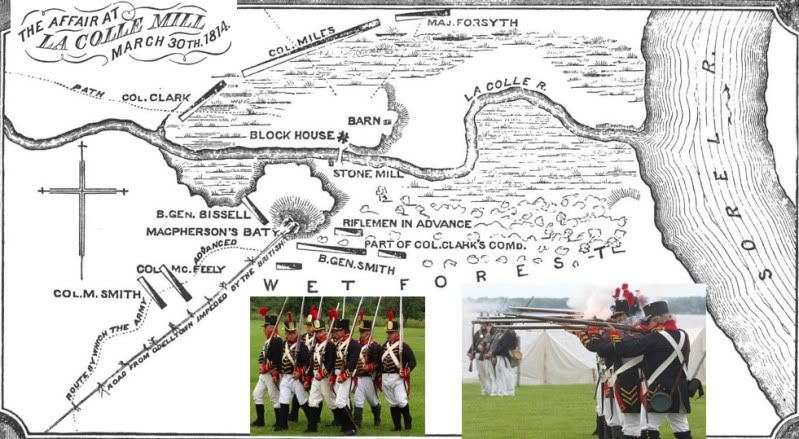
an excellent site about the war of 1812 and the Forsyth Rifles
Benjamin Forsyth was an American officer of Rifle troops in the War of 1812 between Britain and America.
Originally from Stokes County, North Carolina, he obtained a lieutenancy in the U.S. 1st Rifle Regiment when it was formed in 1808. By the time the War broke out, he had risen to the rank of Captain and commanded a company.
Based at Ogdensburg, New York during the autumn and winter of 1812, he led the successful Raid on Gananoque and other attacks across the Saint Lawrence River, which threatened the British supply lines to their forces in Upper Canada. In February 1813, the British used a temporary superiority in strength to drive Forsyth from his positions at the Battle of Ogdensburg.
Forsyth's company was ordered to join the main American force at Sackett's Harbor rather than reoccupy Ogdensburg. They led the American assault at the Battle of York, and played a major part at the Battle of Fort George.
Later in the year, Forsyth (now a major) and his men took part in the campaign aimed at capturing Montreal, but were not present at the Battle of Crysler's Farm. Forsyth was promoted to brevet Lieutenant Colonel the following winter. He was active in skirmishing and patrolling north of Lake Champlain in the late spring and summer and was killed in June in a clash at Odelltown.
His death made him a hero to the people of North Carolina. Because of this, North Carolinians named a county after him; Forsyth County. In addition, the state General Assembly paid for his son's education through special legislation and gave him a jewelled sword. Forsyth Street in Manhattan, New York City is also named for him.
27 Forsyth Street: St. Barbara's Church
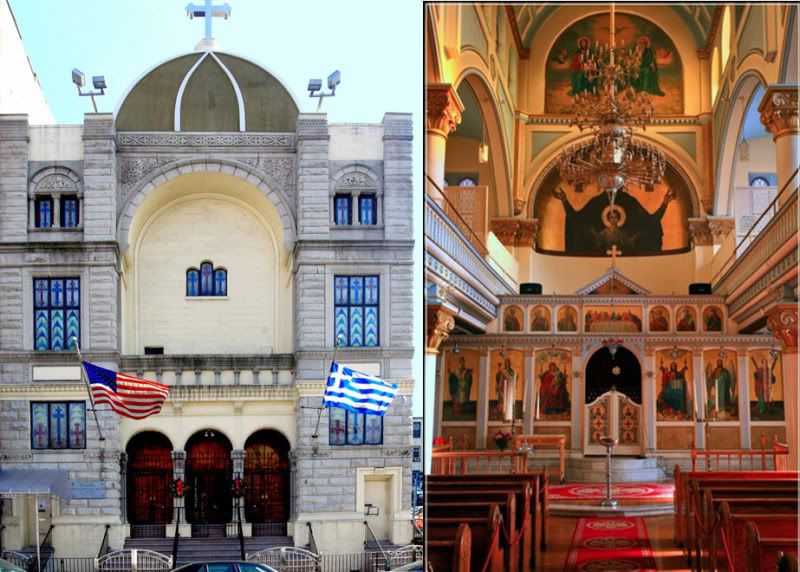
partly from the St. Barbara site
St. Barbara Greek Orthodox Church - 27 Forsyth Street, NYC - originally built in 1892 as a synagogue for Congregation Kol Israel Anshe Poland, this building was acquired by the Greek Orthodox Church in 1932.
It is with great pride that we welcome you to Saint Barbara's website. Our goal is to make your log in with us friendly and personal, just like being one of the family. Saint Barbara, located in the heart of Chinatown, has been servicing the spiritual needs of the Orthodox Christians since the mid 1920's. We are continuing to do so up to this present day. We are the beautiful building you see when you exit east on the Manhattan Bridge. Since September 11th we are the only Greek Orthodox Church on the lower east side. Our sister church, Saint Nicolas on Cedar Street was lost on that tragic day.
Saint Barbara throughout history has been the patron saint of artillerymen and firemen. She is also the protector against sudden death. True to her example, our community became a National Orthodox Relief center from that day forward.
Saint Barbara, known in the Eastern Orthodox Church as the Great Martyr Barbara (3rd century - December 4, 306), was a Christian saint and martyr. Although there is no reference to her in the authentic early Christian writings, nor in the original recension of Saint Jerome's martyrology, veneration of her was common from the seventh century. Because of doubts about the historicity of her legend, she was removed from the liturgical calendar of the Roman rite in 1969. However, she continues to be a popular saint in modern times, perhaps best known as the patron saint of artillerymen, military engineers, miners and others who work with explosives because of her old legend's association with lightning, and also of mathematicians. Many of the thirteen miracles in a 15th-century French version of her story turn on the security she offered that her devotees would not die without making confession and receiving extreme unction.
24 Forsyth Street: 1910
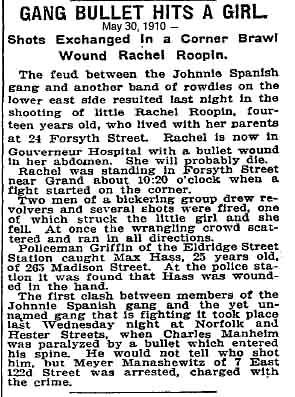
I tried to find out if Rachel survived. She's not in any census subsequent to this. It's possible she could have married. I'm sure the name is misspelled. Matthew Manashewitz was working as a chauffeur in the Bronx in 1930. In 1930 24 Forsyth was the home of the Shafran family. Bernice Shafran would marry Joe Kuperstein and move into Knickerbocker Village.
15 Forsyth Street: 1884
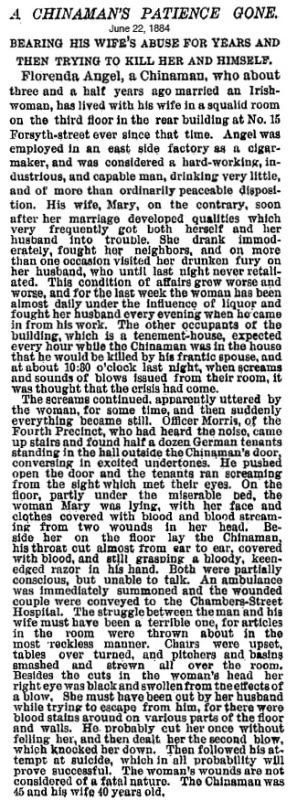
This story certainly would have made the papered wall today. It bares witness to the common intermarriage of Chinese men and Irish women during this era. At that time there was a shortage of Chinese women and Irish men. I'm sure this union was not a typical dysfunctional one.
The Papered Wall Of Forsyth Street
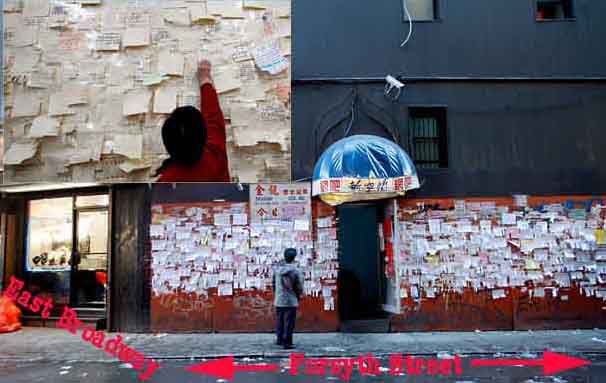
an excerpt from the nytimes
When a Papered Wall Acts Like a Web Site, By SARAH MASLIN NIR
MANY people hustle right past the wall pasted with paper fliers on Forsyth Street, in the shadow of the Manhattan Bridge. But others make pilgrimages to this easternmost reach of Chinatown, where scores of advertisements, most handwritten in Chinese, are posted, their phone-number strips curling like beckoning fingers.
The wall functions as an offline Craigslist — a Craigswall, if you will — where Mandarin and Cantonese speakers do brisk business renting rooms to longtime residents and newly arrived immigrants for whom English and the Internet are as yet unnavigable. There is a similar wall inside a grocery store in Flushing, Queens.
Though the wall on Forsyth Street advertises mostly apartments, Margaret Chin, who represents Chinatown on the City Council, said she had seen all kinds of fliers around the neighborhood, including complaints about particular lawyers.
“If you have something to say,” she said, “you write it up and you just post it up.” The custom of hawking goods and ideas by poster and placard took hold in China after the 1949 revolution, said Lincoln Cushing, co-author of “Chinese Revolutionary Posters: Art From the Great Proletarian Cultural Revolution.”
In rural towns, “You would have this wall that would be taken over” by placards, he said. “People stand in front of this wall and read this, and they respond by putting up their own character poster.” Flier-covered Chinatown, he said, is quite likely “an echo of that.”
Subscribe to:
Comments (Atom)


 Posts
Posts