Showing posts with label greeks. Show all posts

Monday, March 22, 2010

Ethnic New York: 1921

old-ny-1921
The article mentions the 4th Ward Greeks discussing Venizelos and the political situation in Greece. It appears the consensus in the Madison Street coffee houses was anti-Venizelos. I thought he was a "good guy"
an excerpt about Eleutherios Venizelos from a history of Greece:
In 1910 Eleftherios Venizelos, born in Ottoman ruled Crete, and founder of the liberal party, becomes the prime-minister. Venizelos is the kind of leader that comes around once in a generation and it is not a coincidence that this is the period of the greatest growth for Greece. In October of 1912 the first Balkan War breaks out with Greece, Serbia, Montenegro and Bulgaria attacking Turkey. A month later Thessaloniki is captured and becomes part of Greece. In March of 1913 King George is assassinated in Thessaloniki and is succeeded by Constantine I. In July during Balkan Wars 2, Bulgaria attacks Greece and Serbia and is beaten. The two victors split Macedonia. Venizelos is hailed as Europe's most charismatic statesman but in Greece he has his passionate followers and there are those who just as passionately hate him, including King Constantine whose sympathies are undoubtedly with the Kaiser and the Germans, though he claims to wish Greece to remain neutral in the war. Venizelos resigns and then in June is re-elected, returns to power only to be forced to resign again in October. In the December elections his followers abstain and Venizelos establishes a provisional government of the New Hellas in Thessaloniki. The Royalists in Old Hellas are attacked and then blockaded by the French and British who want Greece to enter the war with Germany on their side. In the end King Constantine escapes from Greece, though he does not abdicate the throne, and is replaced by George's second son Alexander who is more acceptable to the French and British. The Venizelist Parliament of June 1915 is recalled and dubbed 'The Lazarus Chamber' because it has been awakened from the dead.
At the start of the 20th century Greece's navy is obsolete, consisting of three old battleships and some torpedo boats. In the shipyards at Livorno, Italy is a battleship which has been ordered by the Italian Navy and then cancelled. The Greek government buys the ship and it is christened the Averoff after the wealthy benefactor George Averoff. The ship rules the northeast Aegean during the Balkan wars and is an important part in the liberation of Mount Athos and the islands of Limnos, Thassos, Samothraki, Tenedos, Aghios Efstratios, Mitilini, and Chios. The power of this ship and the success at sea keeps the Sultan from challenging the Greek Navy and keeps the Turkish fleet out of the Aegean. The Jewel of the Hellenic fleet was destined to sail through history, through the two world wars with greater glory than any other Naval vessel in the history of the Hellenic Navy. For more on the Battleship Averoff click here
On Tuesday November 21 1916, the HMS Britannic, larger and considered even more unsinkable than her famous sister ship the Titanic, explodes and sinks in just 55 minutes outside the harbor of the island of Kea while doing service as a British hospital ship in the Gallipoli campaign.

Monday, March 15, 2010

The Last Greek At 104 Bowery


an excerpt from the nytimes of 3/14/10
On the Bow’ry, By DAN BARRY
OPEN the door to a small hotel on the Bowery.
A small hotel, catering to Asian tourists, that used to be a flophouse that used to be a restaurant. That used to be a raucous music hall owned by a Tammany lackey called Alderman Fleck, whose come-hither dancers were known for their capacious thirsts. That used to be a Yiddish theater, and an Italian theater, and a theater where the melodramatic travails of blind girls and orphans played out. That used to be a beer hall where a man killed another man for walking in public beside his wife. That used to be a liquor store, and a clothing store, and a hosiery store, whose advertisements suggested that the best way to avoid dangerous colds was “to have undergarments that are really and truly protectors.”
Climb the faintly familiar stairs, sidestepping ghosts, and pay $138 for a room, plus a $20 cash deposit to dissuade guests from pocketing the television remote. Walk down a hushed hall that appears to be free of any other lodger, and enter Room 207. The desk’s broken drawer is tucked behind the bed. Two pairs of plastic slippers face the yellow wall. A curled tube of toothpaste rests on the sink.
Was someone just here? Was it George?
Six years had passed since I was last in this building at 104-106 Bowery. Back then it was a flophouse called the Stevenson Hotel, and I was there to write about its sole remaining tenant, a grizzled holdout named George; toothless, diabetic, not well. He lived in Cubicle 40, about the length and width of a coffin.
All the other tenants, who had paid $5 a night for their cubicles, had moved on or died off, including the man known as the Professor, and Juliano, who used to beat George. The landlord, eager to convert the building into a hotel, a real hotel, had paid some of them to leave. But George had refused, saying the last offer of $75,000 was not enough.
It was as though he belonged to the structure, a human brick, cemented by the mortar of time to the Professor and Alderman Fleck and all the others who gave life to an ancient, ordinary building on the Bowery.
Now the place is the U.S. Pacific Hotel, and George is nowhere to be seen. I dim the lights in my own glorified cubicle, and give in to musings about his whereabouts, and long-ago murders, and the Bowery, where, the old song said, they say such things and they do strange things.
On the Bow’ry. The Bow’ry.
THE building at 104-106 Bowery, between Grand and Hester Streets, has been renovated, reconfigured and all but turned upside down over the generations, always to meet the pecuniary aspirations of the owner of the moment. Planted like a mature oak along an old Indian footpath that became the Bowery, it stands in testament to the essential Gotham truth that change is the only constant.
Its footprint dates at least to the early 1850s, when the Bowery was a strutting commercial strip of butchers, clothiers and amusements, with territorial gangs that never tired of thumping one another. Back then the building included the hosiery shop, which promised “all goods shown cheerfully” — although an argument one night between two store clerks, Wiley and Pettigrew, ended only after Wiley “drew a dark knife and stabbed his antagonist sixteen times,” as The New York Times reported with italicized outrage.
Over the years the Bowery evolved into a raucous boulevard, shadowed by a cinder-showering elevated train track and peopled by swaggering sailors and hard-working mugs, fresh immigrants and lost veterans of the Civil War. The street was exciting, tawdry and more than a little predatory. The con was always on.
By 1879, 104-106 Bowery had become a theater and beer hall, with a bartender named Shaefer who was arrested twice in two weeks for selling beer on Sunday. The adjacent theater, meanwhile, sold sentiment.
During one Christmas Day performance of “Two Orphans,” precisely at the audience-pleasing moment when the blind girl resolves to beg no more, someone shouted “Fire!” A false alarm, it turned out, caused when a cook in the restaurant next door dumped hot ashes onto snow. The crowd returned to rejoice in the blind girl’s triumph.
The theater changed names almost as often as plays: the National, Adler’s, the Columbia, the Roumanian, the Nickelodeon, the Teatro Italiano. In 1896, when it was known as the Liberty, the police arrested two Italian actors for violating the “theatrical law.” He was dressed as a priest, she as a nun.
But the building’s dramas were not relegated solely to the stage. One of its theater proprietors skipped to Paris with $1,800 in receipts, leaving behind a destitute wife, six children and many unpaid actors. One of its upstairs lodgers drowned with about 40 others when an overloaded tugboat, chartered by the Herring Fishing Club, capsized off the Jersey coast.
In 1898, two men were laughing and drinking at a vaudeville performance when a third walked up, drew a revolver and shot one of them in the head. Hundreds scrambled for the exits to cries of “Murder!”
The shooter, Thompson, told the police that he had seen the victim, Morrison, on the street with his wife. “He has ruined my life; broken up my home,” Thompson said, as he gazed at the man groaning on the floor. “It’s a life for a wife.”
And the fires, the many fires. The one in 1898 gutted the building and displaced the families of Jennie Goldstein and Sigmund Figman, while the one in 1900 sent 500 theatergoers fleeing into the Christmas night, prompting a singular Times headline: “Audience Gets Out Without Trouble, but the Performers Were Frightened — Mrs. Fleck Wanted Her Poodle Saved.”
MRS. MABEL FLECK, whose poodle survived, was the wife of the proprietor, one Frederick F. Fleck: city alderman, bail bondsman and self-important member of the court to the Bowery king himself, Timothy D. Sullivan — “Big Tim” — a Tammany Hall leader said to control all votes and vice south of 14th Street.
Alderman Fleck was there whenever Big Tim staged another beery steamboat outing for thousands of loyal Democrats, or another Christmas bacchanal for Flim-Flam Flannigan, Rubber-Nose Dick, Tip-Top Moses and hundreds of other Bowery hangers-on. There to provide bail when some Tammany hacks were charged with enticing barflies at McGurk’s Suicide Hall to vote the Democratic ticket in exchange for a bed, some booze and five bucks.
When Alderman Fleck was not demonstrating his Tammany fealty, he was managing the Manhattan Music Hall, here at 104-106 Bowery, a preferred place for dose in de know.
But the city’s good-government types, the famous goo-goos, hated how the Bowery reveled in its debauchery. In 1901, a reform group called the Committee of Fifteen raided Alderman Fleck’s establishment and charged him with maintaining a disorderly house. He responded by calling the arresting officer “a dirty dog.”
Undercover agents testified to having witnessed immoral acts on stage and off. One reported seeing a woman lying on a table, moaning; when he asked what was wrong, he was told she had just consumed $60 worth of Champagne, and so was feeling bad.
But this was Big Tim’s Bowery. A jury quickly acquitted Fleck, prompting a night of revelry at the music hall. A Times reporter took note:

Thursday, March 4, 2010

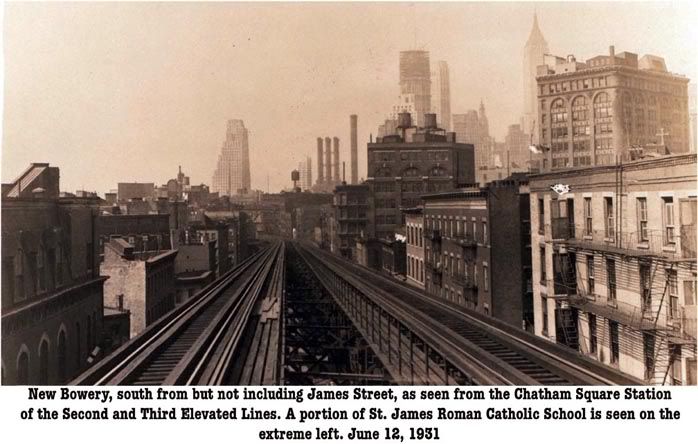
The New Bowery And James Street: 1931


Where once banana peddler's roamed

Yes, We DO Have Some Bananas


If you were dealing with the Italian and Greek merchants near James Street and Chatham Square in the early 1900's
There's a fruit store on our street
It's run by a Greek
And he keeps good things to eat But you should hear him speak!
When you ask him anything, he never answers "no"
He just "yes"es you to death, and as he takes your dough He tells you
"Yes, we have no bananas
We have-a no bananas today
We've string beans, and onions
Cabashes, and scallions,
And all sorts of fruit and say
We have an old fashioned tomato
A Long Island potato But yes, we have no bananas
We have no bananas today
Business got so good for him that he wrote home today,
"Send me Pete and Nick and Jim; I need help right away"
When he got them in the store, there was fun, you bet
Someone asked for "sparrow grass" and then the whole quartet
All answered "Yes, we have no bananas
We have-a no bananas today
Just try those coconuts
Those wall-nuts and doughnuts
There ain't many nuts like they
We'll sell you two kinds of red herring,
Dark brown, and ball-bearing
But yes, we have no bananas
We have no bananas today"

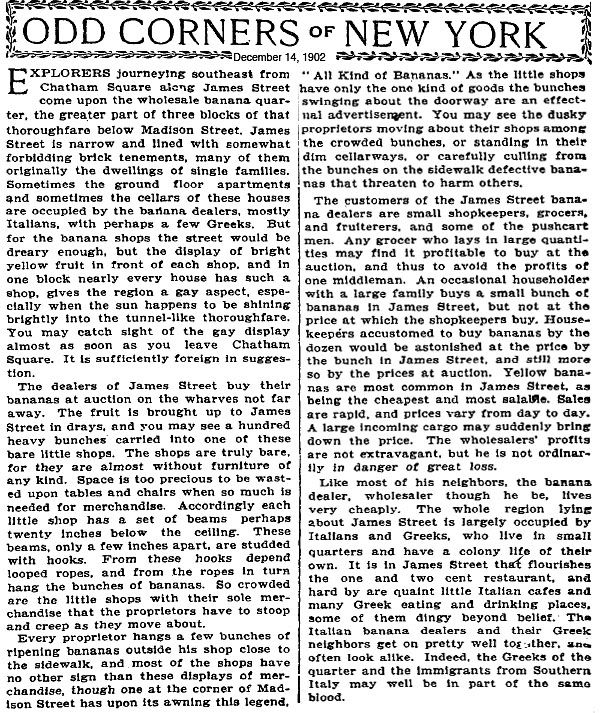
James Street Bananas: 1902


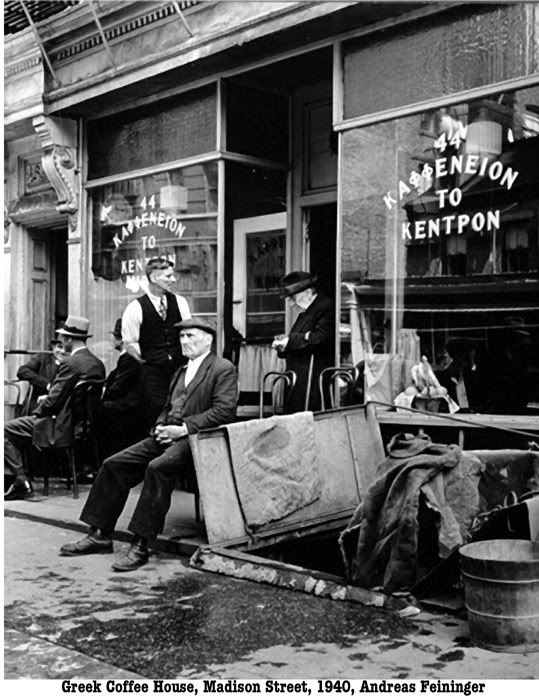
The 4th Ward Greeks, 1940: 44 Madison Street


This is where the Smith Projects are now, between Oliver and Catherine

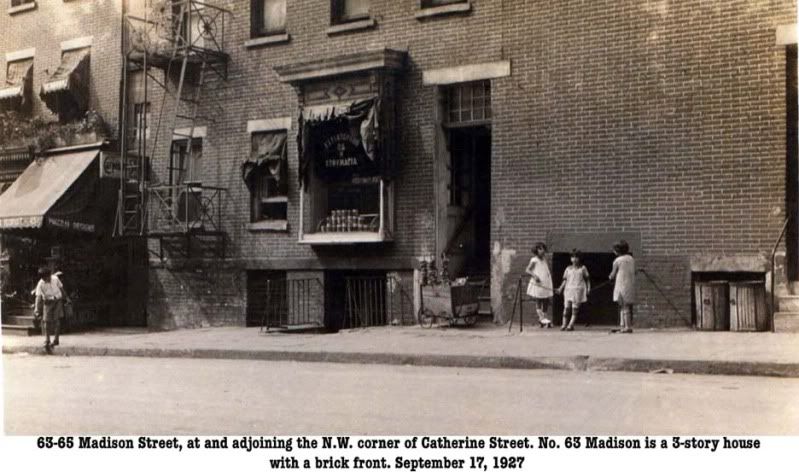
63-65 Madison Street: 1927


a high definition version of this picture would reveal that a Greek owned store is pictured in the middle here. To the left of the girls is an unmanned pretzel cart.
This phot is just to the right of the one in the previous post

59-61 Madison Street: 1929

Monday, April 27, 2009

Sunday In New York


Instead of the Greek Parade, Tompkins Square Park with my half Greek cousin and the last of the Fermans

Is There A KV Kalomoira?


I almost went to the Greek Independence parade yesterday to celebrate half my heritage. I only made it as far as the East Village. But I did see Kalomoira on tv with Ernie Anastas. But I was thinking that KV might have it's own Kalomoira
from wikipedia
Kalomoira (Greek: Καλομοίρα; born Marie Carol Sarantis, January 31, 1985, West Hempstead, New York, United States),also known simply as Kalomira or K-Moira, is an American singer of Greek descent who has achieved recognition in Greece and Cyprus following her participation and win on the Greek talent show Fame Story. Following Fame Story, she continued with a music career and has released four studio albums, represented Greece in the Eurovision Song Contest 2008, and hosted various television shows.
Kalomoira, known as Carol in America, hails from Nassau County, New York. She was born to Greek American restaurant owners Nikos (Nick) and Eleni (Helen) Sarantis on January 31, 1985 and has one sister.

Since childhood, Kalomoira's dream was to become a pop star. She took part in many extracurricular activities at school including drama productions and musicals. Her favorite instrument was the viola, which she studied for 9 years and played in the school orchestra.She was also Miss West Hempstead (Homecoming Queen) at her high school in 2003.
On a tip from her cousin, she entered and won second place at a music contest organized by WBLI Radio.Following her appearance, she participated as a supporting actress in several live shows with famous American artists, such as Jessica Simpson, LL Cool J and Jennifer Love Hewitt
Kalomoira entered the New York City auditions for Antenna's Fame Story 2 (licensed from Star Academy, a reality talent show similar to American Idol in the United States and Fame Academy in the United Kingdom) and was one of the two singers chosen from a group of 200 performers. Despite speaking primarily English, although nonetheless fluent in Greek, Kalomoira went to Greece after having completed one semester of college at Adelphi University where she was a music major, and competed on the three month long show. Kalomoira placed first and her professional singing career began.
After the New York City auditions Kalomoira went to Greece for the start of Fame Story 2. Kalomoira's first song was Katy Garbi’s “Μια φορά κι ένα καιρό” in which she swapped the lyrics “είμαι η Καίτη που αγαπούσες” (“I am Kaiti who you used to love”) with “είμαι η Καλομοίρα που αγαπούσες” (“I am Kalomoira who you used to love”). Her difficulties with Greek songs were not significant enough to hold her back.
Kalomoira singing on Fame Story
Following the success of her first performance, she performed the popular song "Stand by Me". The following week, the challenge became bigger as she performed the Greek song “H Γκαρσόνα” ("The Waitress"), which seemed totally out of Kalomoira's vocal and style capability[citation needed]. She was also told to perform Aliki’s song “Γατούλα” ("Pussycat"), written by Manos Hatzidakis. The songs became more challenging for the singer as her teachers in the academy pushed her to sing Greek songs[citation needed]. Her next songs were “Ανάβεις φωτιές” ("You are lighting fires") and "Dancing Queen".
The judges assigned Kalomoira with Barbara Streisand’s "Woman in Love", a song with special vocal requirements[clarification needed]. Kalomoira fared well, but in the week that followed, Kalomoira's rendition of Stavros Ksarhakos’ “Ένα πρωινό” ("One morning") left the judges unimpressed. Next, Kalomoira chose to perform "La Isla Bonita" by Madonna and managed to stay in the game. This was followed by a duet with another participant (Nikos Mihas) in "Gucci των Μασάι" ("Masai's Gucci"), which gave her a chance to remain in the show for another week.
Marinella’s "Γιατί Φοβάσαι" (Why are you afraid) was difficult for her[citation needed], but Kalomoira made it through to the next week’s "Περιττός" which was better received. She continued in the game with a performance of Britney Spears' "Oops!... I Did It Again". After many weeks of the competition, Kalomoira was one of the final six participants of the game with only two performances left. Her rendition of "Εϊ Καζανόβα" ("Hey Cazanova") equalled her success with Madonna’s "Express Yourself" in the final show. Kalomoira won the contest, earned 200,000 Euros and a recording contract with Heaven Music.

Wednesday, February 25, 2009

Greek School Kids Folk Dancing In 2007


Looks like it's down near South Street

1920: The Greeks At 44 Madison Street


This is just a small part of the building. It was about an even split of Italians and Greeks. Th building was torn down for the Smith Projects

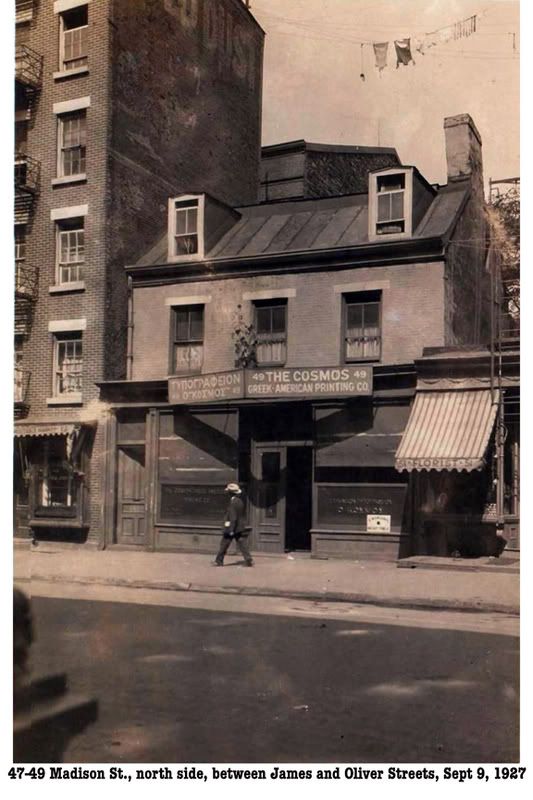
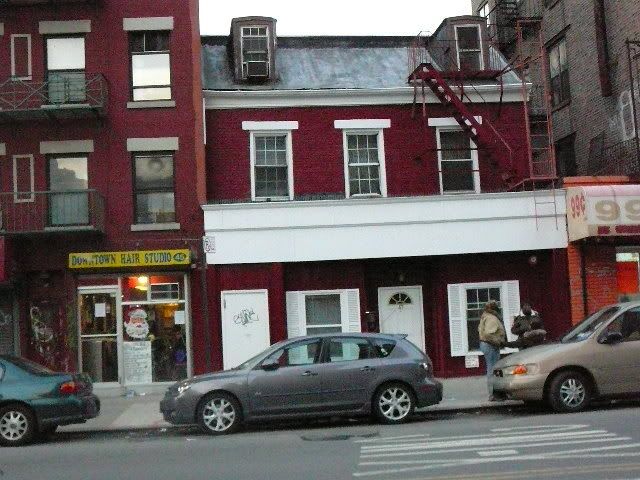
47-49 Madison Street: 1927


A Greek printer and the florist next door was probably Greek run.

Madison Street 1924: A Hub Of The Greek American Community


This old building at 47-49 Madison Street always fascinated me
from New York City and The Greeks,published i 1924
Pass rapidly under the arch of the bridge that extends from the Municipal Building to Brooklyn Bridge, near the Pulitzer Building which at the time of its erection was the tallest in the city, and is now dwarfed by buildings three times its height, pass on and you emerge to where you get a glimpse of the East River, and you are in a dark street, lined with pawn-shops and hardware shops on both sides, with dingy restaurants where saloons have been, and sulphur-smelling hotels, and drunkards decrepit and broken down, leering with shifty, watery eyes at you from every hallway, accosting you with demands for a cup of coffee and a cruller. The pullers-in of the second-hand stores cry their wares in your face, barring your way to the middle of the street. A Gipsy woman wants to tell your fortune. Half a dozen boys offer you papers. A Chinaman looks at you.
Forget that you are in New York. This is the lower part of a Levantine port. Cross one of the right-hand streets into Pearl Street. Walk up to the corner of Canal Street, after passing Fraunce's Tavern where Washington was received by his friends, and you are at the old Jewish Cemetery, which, according to the tablet on the arched door inside, beyond the huge iron fence, was inaugurated in 1656, and had been fortified during the Revolution. The cemetery is between an old wooden shanty inhabited by a Greek cobbler and an Italian grocery store on the corner. The gray and brown tombstones lean pitifully on one another as if looking for support in the last agony of their lives. Long lines of wash flutter diagonally across the burial-grounds. Colored aprons and children's dresses and underwear filled with the wind will make you think of what life is; a momentary inflation of a flexible shell and then deflation again. Thus the traveler has improved his mind by humbling himself.
Look up! Between Henry and Oliver Streets stands the massive square structure of the old Mariners Temple, which had originally been the Baptist Meeting-house in 1795. This part of Oliver Street, in rows of old red-brick houses, -is still inhabited by old Dutch families, who so much resent the foreign invasion about them that their children, if any, are seldom seen on the street. There are some wonderfully beautiful doors and copings in these old houses. The street is remarkably clean . . . but without any animation. The Greek and Italian children in the neighborhood call it Old Man's Street.
I say Greece, but I should perhaps say a Greek city; perhaps only a reproduction of the Greek quarters in Stamboul. Stamboul on the Hudson ! For though the down-town Greek section is in many respects the principal one, there are several other Greek quarters, the importance of the Madison Street district being chiefly in the fact that the Greeks living there and on the side streets leading toward the East River wharves are here with their families, while the other Greek quarters up town, between Twenty-seventh and Thirty-sixth Streets and Sixth Avenue, are only merchants' quarters. Their families are living in Greece, and their children are brought up there until they have reached the working age, when they are imported here to work, if "Patera" has not returned to Corfu or Candia a millionaire meanwhile. For whatever one may say of the Greek he is a very calculating and economical animal. It is cheaper to raise a family in Greece, where American dollars are translated into drachmas and lephtas. One can live there a month on what it would take to live here two days. The growing family is being visited every other year or so. It is absentee fatherhood with a vengeance.
One is struck on Madison Street by the innumerable coffee-houses. The windows are curtainless and the swarthy men inside play cards as furiously, as passionately, as if their lives depended on the turn of the next card. There are numerous small banking-houses, combined with barber-shop and tobacco-dealing facilities. The banker, between more important business, is keeping his fingers supple rolling cigarettes in the window of his establishment. On *the street men drag their babouches slowly.
The hurry, the noise and bustle do not affect them. They are accustomed to it from childhood. Born somewhere near other wharves, on the AEgean or the Ionian Seas, life there is at as rapid a tempo as here. Not because of individual hurry, but because of the simultaneous multitude of movements in different directions.
Madison Street, from Pearl Street to Market Street, is the main street of the principal Greek section of New York. At Market Street it ends, after thinning out at the fringe like a border town, where the Italians and the Jews are disputing for supremacy, with the Italians in the better strategic position. The boundary line at Market Street is marked by the Maternity Center. On the steps, after school hours, the older children wait for the doors to open so they can see their mothers within, and their new little brothers and sisters. It is an Italian Maternity Center. One might as well concede that, but the ground is still disputed. Close by the Maternity Center, in one building, is a Spanish barber in the basement, an Italian political association on the ground floor, and a Jewish congregation on the floor above that.
The streets branching out from Madison Street and Cherry Street, from Pearl Street on, are all occupied by Greek families. Only on the fringe toward South Street, which is the shore-line of the East River, are living Spanish families. They are mostly recent settlers, who cannot pay the high rents of the Spanish district further up town. They are wedging in in the continual displacement of group populations in the city. One can easily see the difference between the two peoples, not only in the signs on the Spanish store windows, but also in the bits of color that appear, and the red and green curtains with which the doors of the grocery stores are hung. The Spaniard loves to live behind curtains, the Greek in a show-case.
There are but few Greek stores. They are further up town. The first thing a Greek business man does when looking for a location is to ascertain there are not many Greeks living in the neighborhood. It is indeed a very difficult matter for one Greek to sell to another and make profit on the transaction.
The old houses are probably the most decrepit in the city. The rear houses especially seem unfit for human habitation, with their peeling walls and rickety stairs, and none of the modern accommodations. Even the comfort-rooms are down-stairs, as well as the water. Many of the oldest houses have no gas and are using kerosene lamps. It is only chance, and because the people living there have lived in similar conditions across the water, that fires do not occur more frequently in that district. Should anything happen, whether it begins on Cherry Street, the first house under the bridge, which is a wooden shack, or begins at the other end near Catharine Slip, the whole section might go up in flames ere the fleetest firemen could apply their hose to it. In such a holocaust I have no doubt many people would perish, for there is a great scarcity of fire-escapes or other means of saving oneself from such a catastrophe. It is interesting to note that according to official figures the density of population on the lower East Side is three times greater than the densest London quarters.
From Catharine Slip, from the corner of South Street, where the San Catharine Mission is, or from the mission-house at the corner of James Slip, standing under the sign over the barred windows, "You must be born again," one can see the spans o f three bridges, Brooklyn, Manhattan, and Williamsburg, from the same point. I know of no more magnificent sight at night when the bridges are lit; or early, on a misty morning with the gray buildings across the river rising like giant shadows into the dusky light above. It is worth while staying up late; worth while getting up early.