Showing posts with label morton white. Show all posts

Friday, April 10, 2009

Corrections 3: 72 Madison Street


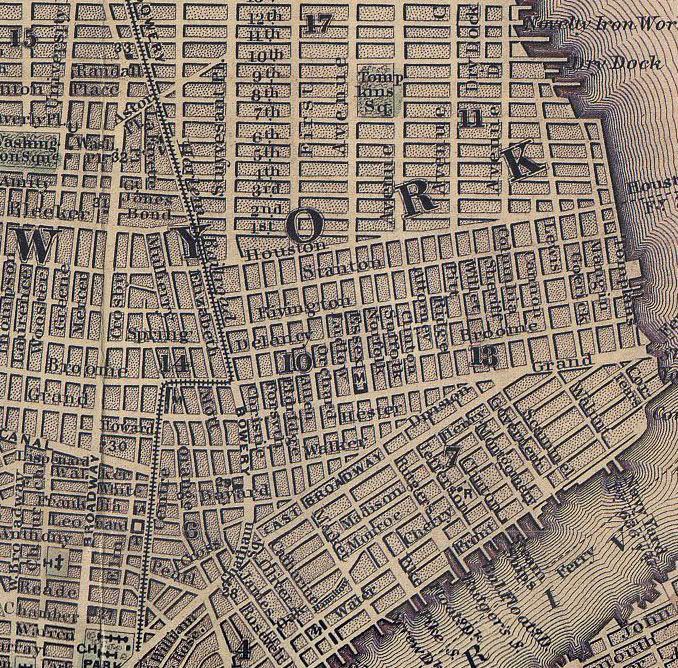
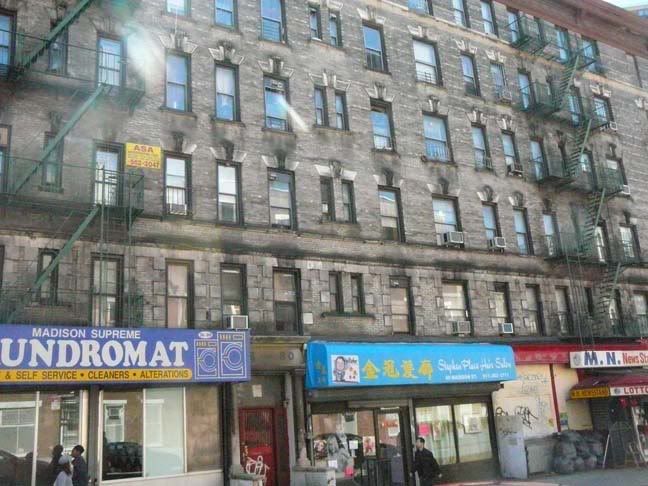
In a previous post I thought George Gogel and Morton White and his family lived in this apartment house, 76-80 Madison. They didn't, they lived at 72 Madison Street. That building was on the western side of Catherine. Len Polizzi, Nathan Steinfeld (Mike Zane's grandfather), and Hyman, Bertha, Solly and Lillian Sear (Barry Dolinko's mother) lived at 76-80 Madison.

Saturday, March 21, 2009

Councilman Robert Weisberger On The Job

Two articles: The first two pages deal with a protest to install a traffic light on Ave. D in 1953, and the second in 1954, about the renaming of a block near 17th Street in honor of Nathan Perlman
Weisberger Council

Thursday, March 19, 2009

Dr. Morton White Finds The KV Blog!

A page from Dr. White's memoir, A PHILOSOPHER’S STORY

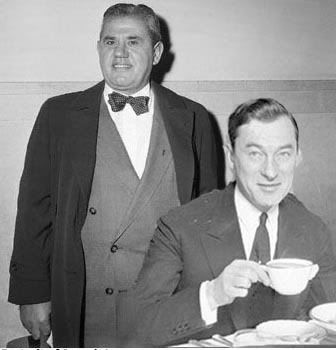
Two of the many interesting characters he's met, Socks Lanza and Mayor Jimmy Walker

A letter I received from Dr. White after I forwarded Princeton's Institute of Advanced Studies a chapter of Cliff's KV notes
Dear Mr. Bellel:
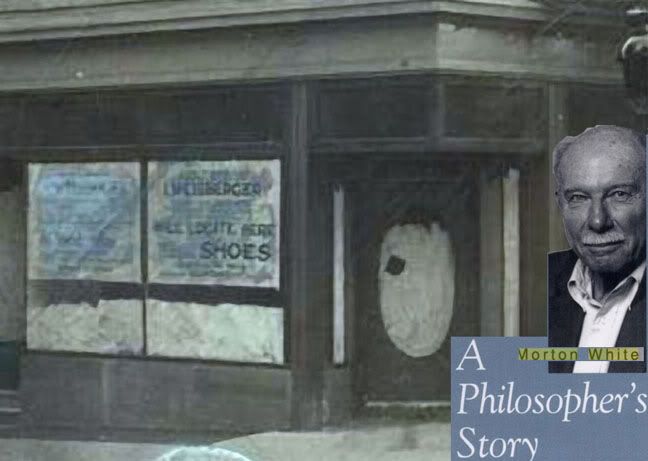
Thank you very much for that fascinating story and for that picture of my father’s (and earlier my grandfather’s) shoe store. The building, by the way, was one in which my father, my mother and I lived for many years. My recollection is that we began to live there in 1923—when I was six years old—until I left home in 1938, but I don’t remember how long my parents lived there before moving to Knickerbocker Village. They both died in 1969.
You may know that my father moved his store to Knickerbocker Village but I don’t remember in what year; you may also know that he was a member of the New York City Council while representing that part of Manhattan—during what years I no longer know.
Perhaps you are familiar with my memoir, A PHILOSOPHER’S STORY, published in 1999; if not, you will find in it some reminiscences of mine about life in that neighborhood before KV was built.
Again, many thanks for sending me that piece.
Sincerely, Morton White

A review of Philosopher's Story
Although a great many memoirs are being published these days, this autobiography by Morton White has special significance because professional philosophers seldom write their memoirs and, when they do, they rarely produce books as engaging as this one. As historian of ideas and a philosopher, White is able to situate his life in the deeper and broader intellectual currents of his time, and therefore the story of his experiences at Columbia, Harvard, and the Institute for Advanced Study is a brilliantly conceived contribution to the history of American philosophy in the twentieth century. Readers concerned with the development of higher education will be fascinated by White's description of the struggles over religion at Harvard in the 1950s, while historians of urban life will be much interested in his vivid account of his boyhood on the Lower East Side of New York. And students of pragmatism will learn much about the twentieth-century attack on the distinction between analytic and synthetic statements from a letter written to White by the Polish logician Alfred Tarski, and from the three-way correspondence of Nelson Goodman, W. V. Quine, and White reproduced in an appendix. The author's discussion of his contact with such influential thinkers as John Dewey, G. E. Moore, and Isaiah Berlin, and especially his extensive correspondence with Berlin, will further enhance the book's appeal to a broad audience. Indeed, White's autobiography should attract more attention among the educated public than any book written by an American philosopher in many years.--Peter H. Hare, SUNY Distinguished Service Professor of Philosophy and Editor, Transactions of the C. S. Peirce Society: A Quarterly Journal in American Philosophy.

Monday, March 16, 2009

Weisberger's Shoe Store: 1927

Morton White (Weisberger) Of 72 Madison Street


Cliff didn't know it but he broke the window of the shoe store that belonged to Morton white's father. We posted about Morton before, a most brilliant son of the LES who even knew Mazie from the Bowery

About Morton White, who is still alive in his 90's. I'm trying to contact him to collect any reward due
Morton White (born 1917) is an American philosopher and historian of ideas. He is both a central figure in the philosophical movement of Holistic Pragmatism and a noted historian of American philosophical thought. He was a professor in the Department of Philosophy at Harvard from 1953 to 1970, and since then has been at the Institute for Advanced Study in Princeton, NJ where he is currently professor emeritus.
White was born in the Lower East Side of New York City. White attended City College of New York as an undergraduate before doing his postgraduate studies at Columbia University, where he completed his Ph.D. in 1942 and was influenced by John Dewey. In 1949 he published Social Thought in America, a critical history of liberal social philosophy as represented by the ideas of Dewey, Oliver Wendell Holmes, Jr., Thorstein Veblen, Charles Beard, and James Harvey Robinson. When the book was republished in 1957 he added a preface in which he softened some of his criticisms, and he added an epilogue in which he attacked the religious liberalism of Reinhold Niebuhr and the conservatism of Walter Lippmann. "Time and recent events," he wrote, "have brought the liberal outlook under a very different kind of attack- an attack with which I have no sympathy- and I fear that my own critical observations might wrongly be associated with arguments, positions, and purposes quite foreign to my own." In his 1956 work, Toward Reunion in Philosophy, White attempted to reconcile the pragmatic and analytic traditions in American philosophy.
At Harvard, White was a colleague of Willard Van Orman Quine, and the philosophical views of the two are closely related, particularly in their rejection of a sharp distinction between a priori and empirical statements. But White rejects Quine's view that "Philosophy of science is philosophy enough." Using the framework of Holistic Pragmatism, White argues that philosophical inquiry can just as well be applied to cultural institutions beyond science, such as law and art.