Showing posts with label newsies. Show all posts

Saturday, April 17, 2010

Pulitzer: A Life in Politics, Print, and Power


from pbs
New Biography Looks at the Man Behind the Pulitzer Legacy By: Jeffrey Brown
Most of us have heard of the Pulitzer Prize, the annual awards honoring excellence in journalism. But what about the men behind it? Joseph Pulitzer was a penniless immigrant who arrived in the United States in 1864 speaking no English. He became a reporter, a politician, and most of all, a media baron who helped shape the history of the news business. Pulitzer's story is told in the new biography, "Pulitzer: a Life in Politics, Print, and Power." I recently spoke to its author, James McGrath Morris, who reckons that today "Pulitzer would be Twittering."
I heard James McGrath Morris speak at the Tenement Museum last Monday. Among the many things I learned was that the newsboy victory portrayed in Newsies was not really a victory.
so this wiki entry (bolded part) is not correct
The Newsboys Strike of 1899 was a youth-led campaign to force change in the way that Joseph Pulitzer's and William Randolph Hearst's newspapers compensated their child labor force. The strike lasted two weeks, causing Pulitzer's New York World to reduce its circulation from 360,000 to 125,000. The strike was successful in increasing the amount newsboys received by selling papers.
Newspaper boys, also called 'newsboys' or 'newsies', were the main distributors of newspapers to the general public from the mid-19th to the early 20th century in the United States. Standing on street corners, walking through neighborhoods and hawking their papers throughout every city, they first appeared with the rise of mass circulation newspapers. Newsboys tended to be among the poorest classes of society, often seen sleeping on the streets.
The newsboys were not employees of the newspapers but rather purchased the papers from the publishers and sold them as independent agents. Not allowed to return unsold papers, the newsboys typically earned around 30 cents a day and often worked until very late at night. Cries of "Extra, extra!" were often heard into the morning hours as newsboys attempted to hawk every last paper.
Newsboys were not often well received. In 1875 a popular writer of the period wrote, "There are 10,000 children living on the streets of New York....The newsboys constitute an important division of this army of homeless children. You see them everywhere.... They rend the air and deafen you with their shrill cries. They surround you on the sidewalk and almost force you to buy their papers. They are ragged and dirty. Some have no coats, no shoes, and no hat." However, the common ill-treatment of the newsboys was not a major concern of society.
The New York Times previously reported on newsboy strikes several years before the events of 1899, including those in 1884,1886,1887,and 1889.
In July 1899, a large number of New York City newsboys refused to distribute the papers of Joseph Pulitzer, publisher of the World, and William Randolph Hearst, publisher of the Journal. The strikers demonstrated across the Brooklyn Bridge for several days, effectively bringing traffic to a standstill along with the news distribution for most New England cities. Several rallies drew more than 5,000 newsboys, complete with charismatic speeches by strike leader Kid Blink.
So named because he was blind in one eye, Kid Blink was a popular subject among competing newspapers such as the New York Tribune, who often patronizingly quoted Blink with his dialect intact, attributing to him such sayings as "Me men is nobul." Blink and his strikers were the subject of violence, as well. Hearst and Pulitzer hired men to break up rallies and protect the newspaper deliveries still underway. During one rally Blink told strikers, "Friens and feller workers. Dis is a time which tries de hearts of men. Dis is de time when we'se got to stick together like glue.... We know wot we wants and we'll git it even if we is blind."
Although the World and the Journal did not lower their 60¢-a-bundle price, they did agree to buy back all unsold papers, and the union disbanded.
The Newsboys Strike of 1899 has been attributed with inspiring later strikes, including the Butte, Montana Newsboys Strike of 1914, and a 1920s strike in Louisville, Kentucky.
Some decades later, the introduction of urban child-welfare practices led to improvements in the newsboys' quality of life.
The Newsboys were fictionalized in 1942 by DC Comics as the Newsboy Legion, continuing in various forms to modern-day comics.
The events of the 1899 strike later inspired a Disney film Newsies, including a character named Kid Blink (who wears an eye patch).
The Newsboy strike is described in detail in the 2003 non-fiction book, Kids on Strike!.

Saturday, December 19, 2009

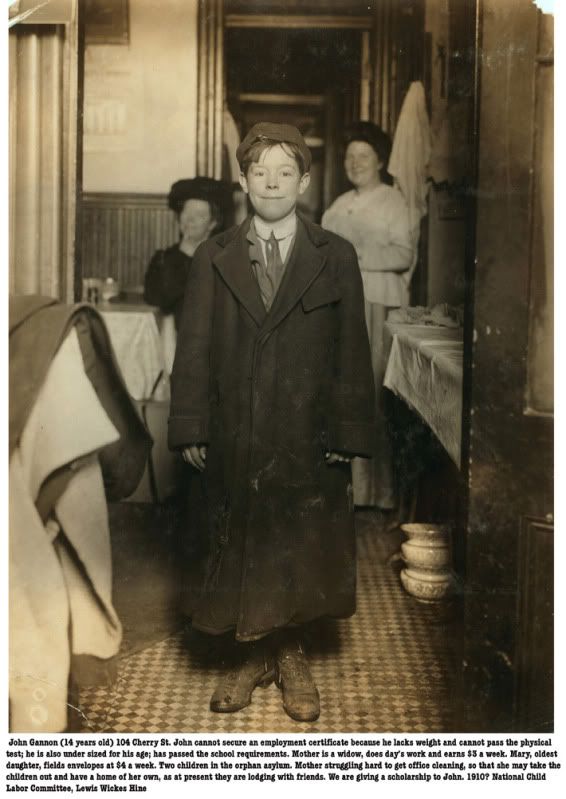
The Sad Fate Of John Gannon Of Cherry Street

Gannon Census
From John's World War One and Two registration cards. It looks like John has led a life spent in institutions, possibly as a result of the evaluation mentioned in the prior post. The sister who is his guardian may be the one pictured in that post as well.

John Gannon: 1910 Cherry Street Newsboy


Click on the image above to get a clearer view of text that accompanies the photo. I'm not sure if John was a newsboy or just one of the subjects of the Hine's series on working children at the turn of the last century. Living at 104 Cherry Street puts him just about on the KV "lung block" and near another subject of a 1913 Lewis Wickes Hine's photo, Jimmy Chinquanana
I'm not sure what was meant (from photo text) that a scholarship was recommended for John. For an orphan asylum?

Sunday, December 6, 2009

Newsies: The Film Script

Newsies Script

Benjamin Eisenberg: From Newsboy To Adult

Lewis Street Newsboy
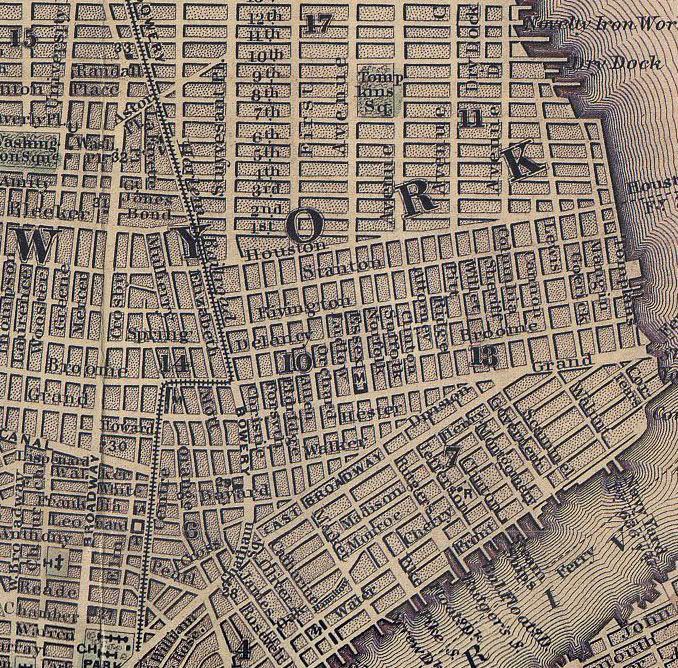
Benjamin and his newsboy brother have been mentioned before, but above I've combined many of those prior post resources with new images I've unearthed of his early 1900 address (27 Lewis Street) along with a map. More than likely he attended PS 110 on Cannon Street

1890-1899: A Compilation Of Articles About Newsboys

Newsboys Article
Note the addresses of some of these newsboys:
Albert Smith, fifteen years old, of No. 10 Cherry St.
Cornelius Boyle, thirteen years old, of No. 352 Water St.
Abraham Greenhouse, fourteen years old, of No. 31 Allen St.
Isaac Miller, thirteen years old, of No. 163 Ludlow St
Samuel Eisenberg, a fourteen year old boy, of No. 157 Orchard St.

Joy For Children During Christmas Week: 1915

Children's Aid 1915
Going back 100 years ago the city was populated with homes and schools for orphans and poor children who often worked as newsboys and newsgirls. There was one in the sixth ward on Elizabeth and Hester Street called The Italian School

Newsboy History Slide Show


Images from Library Of Congress. Most were photographs taken by Lewis Wickes Hine.
Music, The Work Song by Cannonball Adderley

Saturday, December 5, 2009

Newsies: School Project


I used youtube to create a more viewable version of the video previously posted back in December of 2007
A project I did with third graders using Newsies. They had visited an old Newsboy lodging house on 6th Street, between and Avenues B and C. Neighborhood history and architecture was the overriding theme of a school wide learning fair involving social studies and technology. They had watched Newsies and had done internet research and follow up writing and art projects, dress up and role playing. I did this with them as a little culminating event.

Newsies: Part 1


One of the best ways to study the 1900 era in NYC history with kids is through the movie Newsies. It's real-life setting was the newspaper publishing center in New York at the time, which was around Park Row. The closest newsboy lodging house was on Duane and Oak Streets in the Fourth Ward. I had posted a small clip from newsies before, now I notice that the entire film can be found, in parts, on youtube. Above is part 1
Newsies is a 1992 Disney live action film musical starring Christian Bale, David Moscow, and Bill Pullman. Robert Duvall and Ann-Margret also appeared in supporting roles. The movie gained a cult following after its initial failure at the box office. The film marked the directorial debut of Dirty Dancing choreographer Kenny Ortega (High School Musical) and featured the music of composer Alan Menken (Beauty and the Beast, The Little Mermaid, Aladdin).
Although the film was not originally intended to be a musical, it contains twelve songs and multiple dance sequences (for which the young cast trained for approximately 10 weeks). Musical highlights include "Carrying the Banner," "Santa Fe," "Seize The Day," and "King of New York."
Newsies was not a commercial success when first released; in fact, it ranked among the highest-costing and lowest-grossing Disney live-action films in the studio's history. Movie critic/historian Leonard Maltin even christened it "Howard the Paperboy" (in reference to another infamous box-office flop, Howard the Duck).
However, the picture gained fans when it was released on VHS and was played on the Disney Channel. After much petitioning, Newsies was released on DVD in 2002. It has since gained a modest yet enthusiastic cult following.
Newsies is based on the true story of the Newsboys Strike of 1899 in New York City. Thousands of homeless children are living in Newsboys Lodging Houses, including Manhattan newsboy Jack Kelly (Christian Bale), who is a regular newsboy selling newspapers for Joseph Pulitzer (Robert Duvall) and his paper, the New York World. Jack "Cowboy" Kelly has a dream of escaping NYC to go to Santa Fe, NM. David Jacobs (David Moscow) leaves school temporarily and joins the newsies along with his little brother Les (Luke Edwards) to help his family while his father is out of work because of a broken arm. Soon, Jack and David become good friends, David introduces Jack to his family, and Jack falls in love with Sarah, David's sister. Shortly afterward, the price of newspapers for purchase by the newsboys is raised 10 cents per 100 papers, decided by joint decision of Pulitzer and William Randolph Hearst.
Feeling they will be unable to bear the added cost, Jack Kelly organizes a strike with the aid of David Jacobs. As the protagonist, Jack Kelly struggles with his past as he forms an important friendship with David and his family. Between his dream of one day going to Santa Fe, New Mexico, and currently wanting to help his friends, he faces lots of difficult decisions involving money and lodging. Along the way, the boys are aided by newspaper reporter Bryan Denton (Bill Pullman) and vaudeville performer Medda Larkin (Ann-Margret), as well as being hindered by Snyder, warden of "The Refuge" juvenile detention facility (Kevin Tighe). Jack and the newsies gain the cooperation of every newsie from New York and Brooklyn to team up and strike against the big-shot newspapermen.

Sunday, November 29, 2009

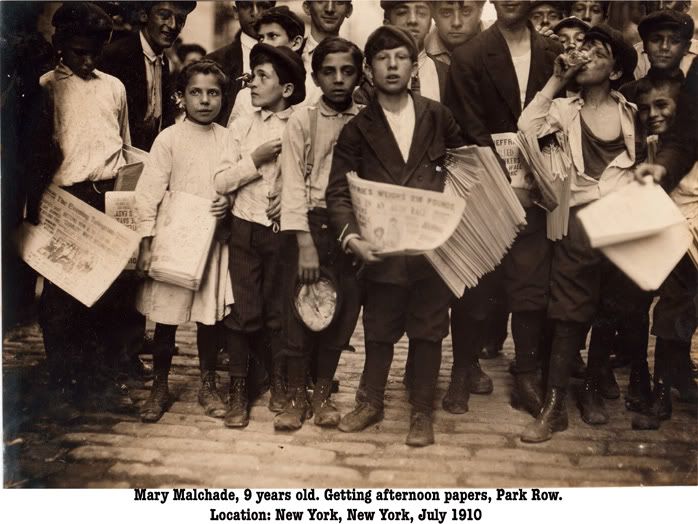
Mary Malchiodi Of The Fourth Ward: Part 2

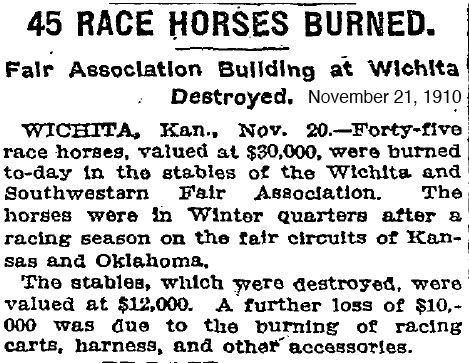
Here she is with her fellow news vendors a few months later than the previous photo. From what I can make out of the headline that the boy has on the left (I have a higher definition photo) it looks like the story referred to was the one below. I'm sure the dates given for the library of Congress photos may not be accurate. Newsies always wanted sensational stories to sell their "papes." Things haven't changed, especially in New York City with the Post and the News. I wonder what that boy on the right is swigging down?

Saturday, November 28, 2009

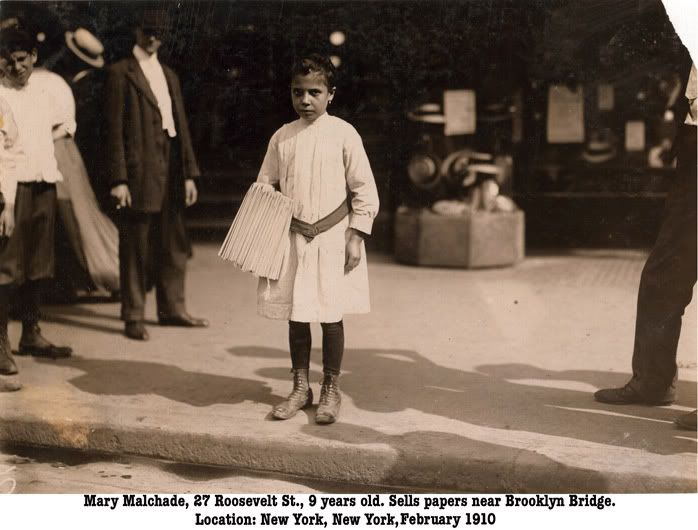
Mary Malchiodi Of The Fourth Ward: Part 1


Lewis Wickes Hine has more than one picture of Mary in his study of newsboys and newsgirls over 100 years ago. They can be found on the Library of Congress site I believe her name was misspelled there because the census has no one named Malchade, whereas Malchiodi seems to be the closest common spelling. It looks like Mary might be wearing a sibling's pair of shoes since they look far too big for her.

Monday, March 16, 2009

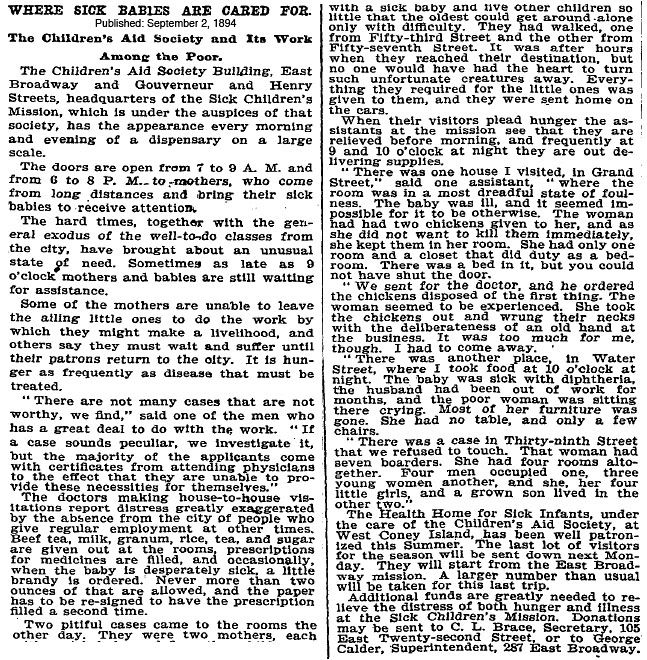
Children's Aid Society: East Broadway, 1894

"Where sick babies are cared for." "There was one apartment on Grand Street that was in a dreadful state."

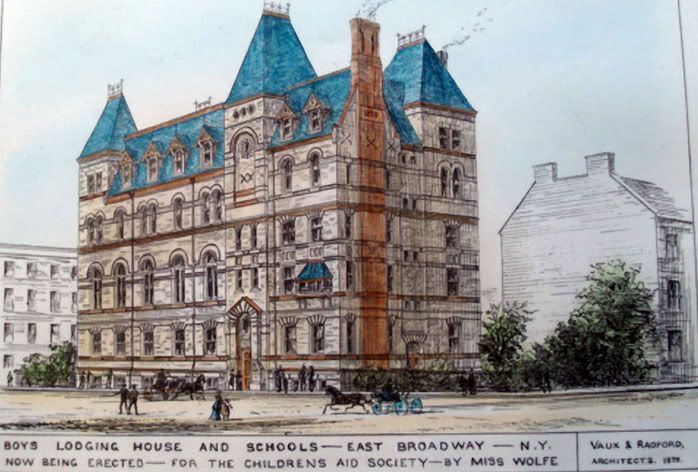
Children's Aid Society: East Broadway, 1875-?


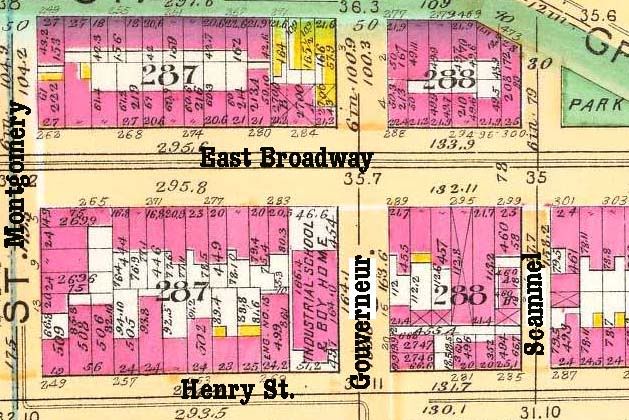
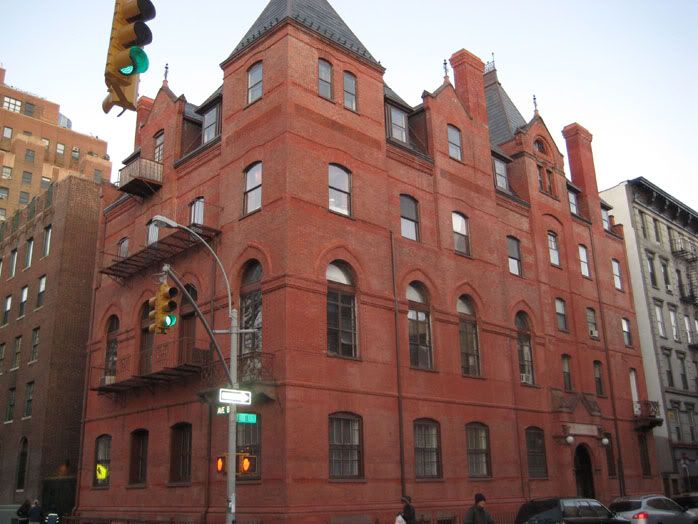
Evidently there was a branch of the Children Aid's Society on East Broadway and Gouverneur in the late 1800's. The architectural drawing has a 1875 date. On the 1891 map its called an Industrial School and Home locaed at 283 East Broadway. It probably also served as a newsboy lodging house

Newsboys And Lodging House History


I found this slide show buried in my hard drive from a few years ago and never posted it. I thought it could go with the current thread. Cannonball Adderly and the Work Song is the soundtrack. The pictures are mostly from the library of congress

Newsboy Lodging House: Tompkins Square

The report from it's landmark designation on May 16, 2000
Children Said Society

Ron Silver On The LES

Below: He attended ESHI, the East Side Hebrew Institute on Avenue B and 8th Street

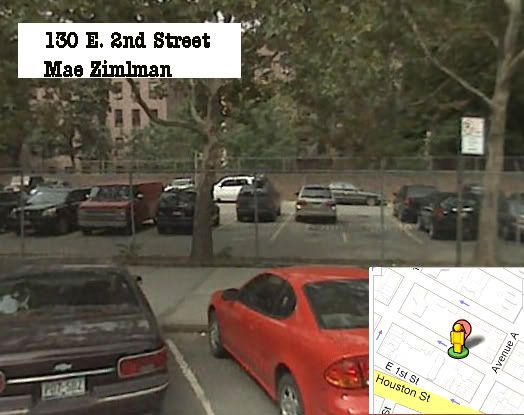
Below: His mother, May Zimelman, lived here in 1930. It's now part of the Village View Houses site. In the census she was listed as Mae Zimlman

About the former ESHI, from ephemeral ny
This Victorian Gothic/Queen Anne building is the third lodging house the Society opened, called the Tompkins Square Lodging House for Boys and Industrial School. Constructed on Avenue B and 8th Street in 1886, it housed 71 boys, according to the 1870 census, most between 12 and 15. The architect, Calvert Vaux, also designed Central Park. Vaux was committed to helping the poor and designed all of the Children’s Aid Society homes. Over the years, about 170,000 street kids passed through all the different lodging houses. The Avenue B building didn’t house kids for long though. By 1910 it became a school only, and in 1925 was sold to a Jewish congregation. Vacant in the 1970s, it was turned into apartments in 1977, then landmarked in 2000.

Thursday, December 13, 2007

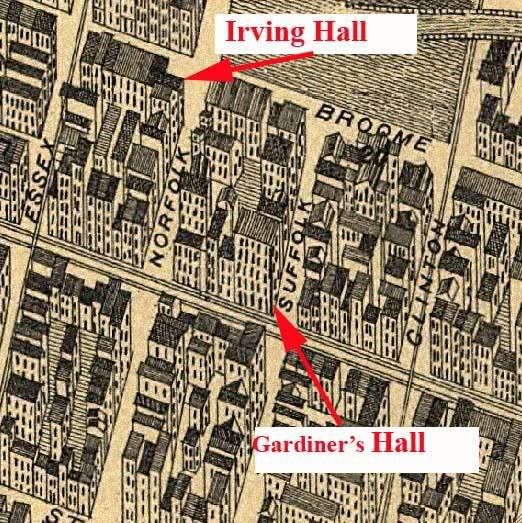
Irving Hall, Gardner's Hall And Bernstein's

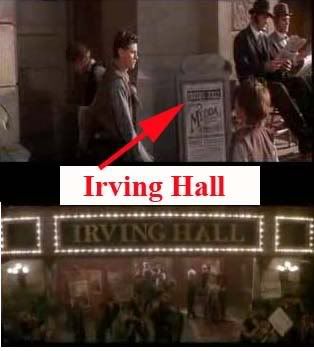
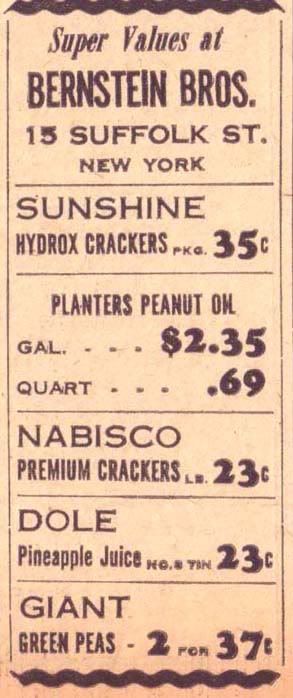
The map shows the 1903 location of the two halls mentioned in the news' reports about the Newsies (see below for the mention of Gardner's Hall) The movie even includes a Irving Hall as a site location. The question is would the Newsies go shopping at Bernstein's which was nearby :). The ad is from 1959
Had I known about the meeting I would have gone, since I lived at 76 Suffolk.
Here's the Tribune article about the meeting:
"Newsboys Form a New Union Elect a Man as Leader and Will Divide City Into Districts.August 3, 1899 There was a rally of newsboys at Gardner's Hall, at 21 Suffolk Street, last evening, to organize a new union and elect new officers. Abraham Lippman, who has a newsstand at Canal and Essex Streets, called the meeting to order. He is a grown-up man, and for some time he ran the meeting much to the disgust of Simon Levy, who was trying to wedge in a word without success. After some skirmishing the boys accepted a suggestion of Lippman's to have a full-grown man for a President, and elected James G. Neill, fifty years old. President Neill, in making his inauguration speech, said that the price maintained by some of the evening papers virtually imposed a tax on newsboys and newsmen, and the latter could not transfer the tax to the public as other dealers did the war tax. Mr. Neill suggested that all union boys should wear badges, and become affiliated with other labor organizations. He proposed that the city should be divided into districts and send delegates to a central union. The meeting adopted Mr. Neill's suggestions.Other officers were elected as follows: Vice President –"Racetrack" Higgins of Brooklyn; Secretary – Abe Cutler;Treasurer – Dave Ruben of Bleecker Street and the Bowery;Sergeant at Arms – "Yellow" Simon Levy. John Masin was elected head Captain, and will select his district Captains. A floral horseshoe was sent by William Reese, the colored lemonade seller in Printing House Square, for the best orator of the day. It was won by George J. Fabian."

Newsies: King Of New York


The boys are feeling pretty good because they stopped the "presses" on the first day of the strike. Thus they feel like Kings Of New York
MUSH:
A pair of new shoes with matchin' laces!

RACETRACK:
A permanent box at Sheepshead races!

SPOT CONLON:
A porcelain tub with boilin' water!

KID BLINK:
A Saturday night with the mayor's daughter!

RACETRACK:
Look at me
I'm the king of New York
Suddenly
I'm respectable
Starin' right at 'cha
Lousy with stature

JACK:
Nobbin' with all the muckety-mucks
I'm blowin' my dough and goin' deluxe

RACETRACK:
And there I be
Ain't I pretty?

RACETRACK and JACK:
It's my city
I'm the king of New York!

BOOTS:
A corduroy suit with fitted knickers

LES:
A mezzanine seat to see the flickers

SNIPESHOOTER:
Havana cigars that cost a quarter

DAVID:
An editor's desk for the star reporter

NEWSIES:
Tip your hat
He's the king of New York

DENTON:
How 'bout that!
I'm the king of New York

NEWSIES:
In nothing flat
He'll be covering
Brooklyn to Trenton
Our man Denton

KID BLINK:
Makin' a headline out of a hunch

DENTON:
Protecting the weak

RACETRACK:
And payin' for lunch

DENTON:
When I'm at bat
Strong men crumble

RACETRACK:
Proud yet humble

RACETRACK and DENTON:
I'm (He's) the king of New York

ALL:
I gotta be either dead or dreamin'
'Cause look at that pape with my face beamin'
Tomorrow they may wrap fishes in it
But I was a star for one whole minute

Startin' now
I'm the king of New York

DENTON:
Ain't ya heard?
I'm the king of New York

ALL:
Holy cow
It's miracle
Pulitzer's cryin'
Weasel, he's dyin'
Flashpots are shootin' bright as the sun
I'm one highfalutin' son-of-a-gun
Don't ask me how
Fortune found me
Fate just crowned me
Now I'm king of New York
Look and see
Once a piker
Now a striker
I'm the king of New York
Victory!
Front page story
Guts and glory
I'm the king of New York!

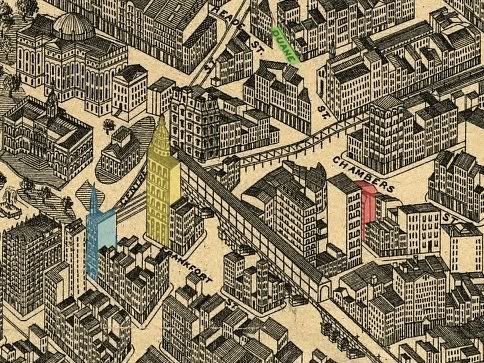
Newsboy Lodging House On 1903-5 Map

About the map from the nine duane site
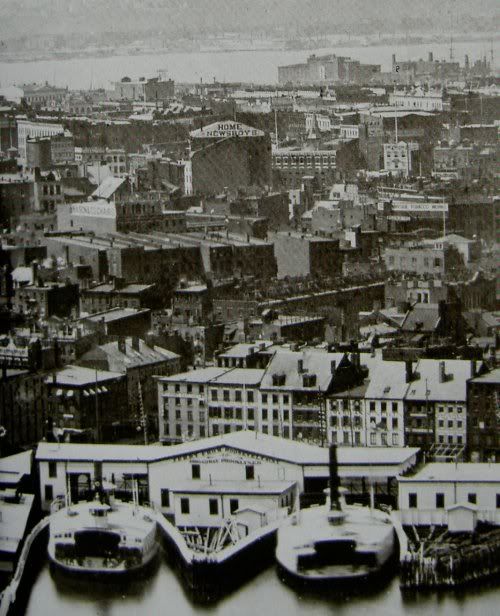
"This tiny (the full map is huge) piece of the map shows the City Hall Park/Newspaper Row area. I have colored some relevant portions of it. The red building is the DSLH (Duane Street Lodging House) (with the "Duane St." label highlighted in green). The tall building hiding it partially from view is the 10-story Rhinelander Building (erected 1893). The yellow structure is the World Building. The blue one is the Tribune; just next to it but hidden from our view is the Sun. You can see how close the DSLH was to Newspaper Row, although it is only relative (compare it to the zoom-out of the Beal photo to the right, which shows that the ground distance was still quite far).
The Library of Congress does not give a specific date for this map, labeling it only as "190-?" I've narrowed it down to this date range given that (if you look at the entire map), you can see the whole Williamsburg Bridge (completed 1903), but the Tribune Building is still shorter than the World (the Tribune's height was raised in 1905)."