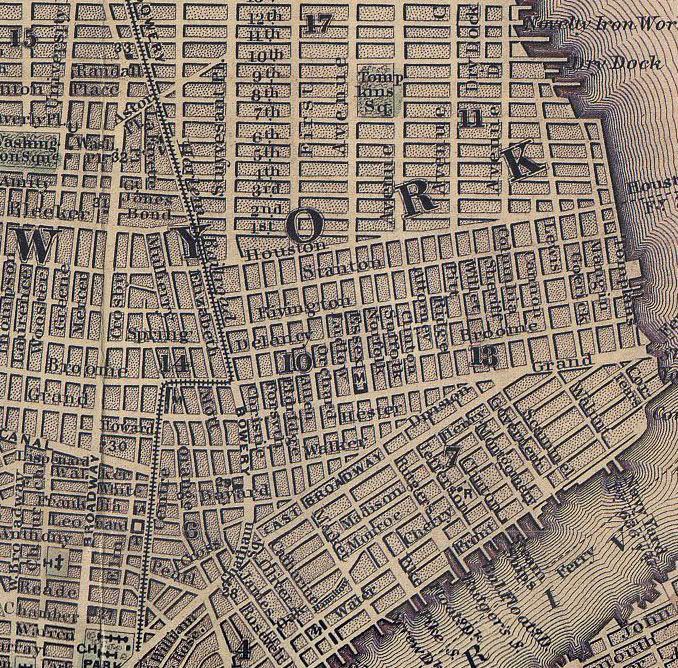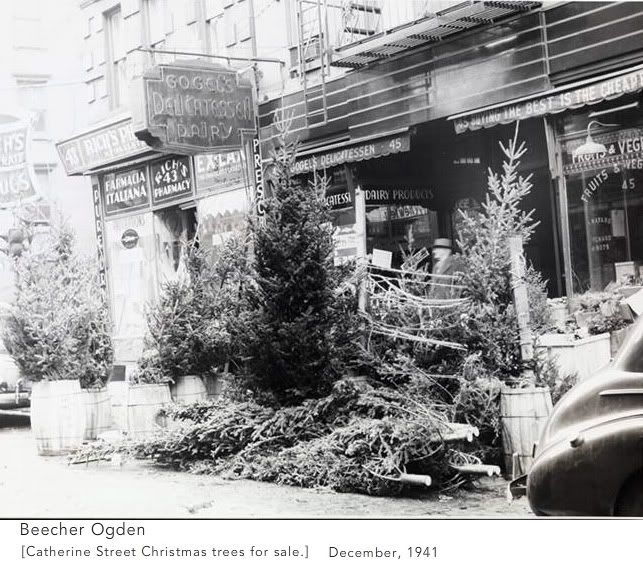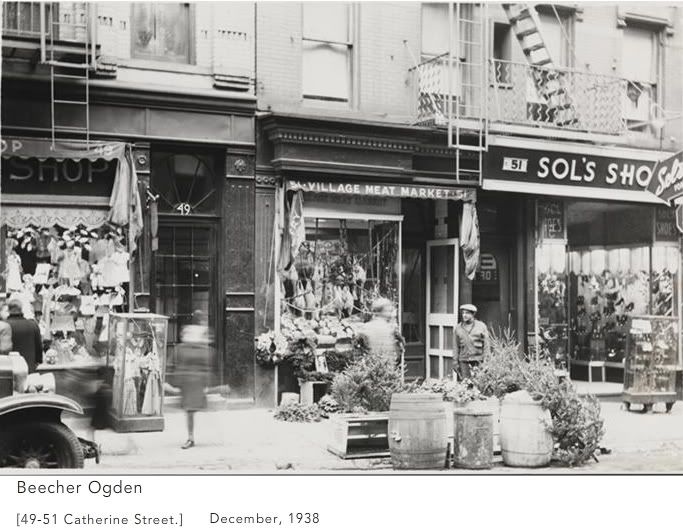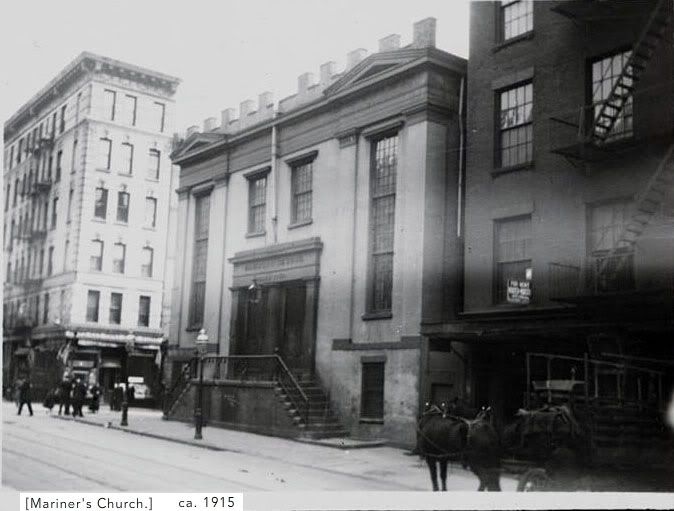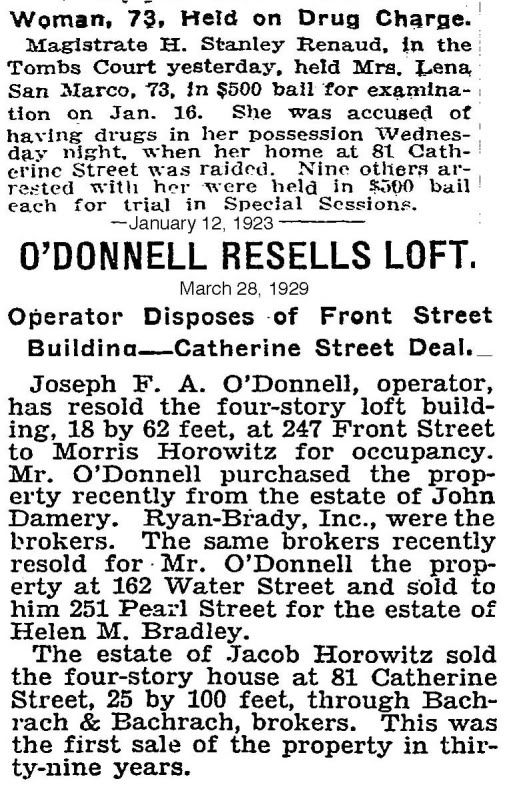
I would imagine the sale of 81 Catherine was to interests representing Fred French in anticipation of building of Knickerbocker Village.

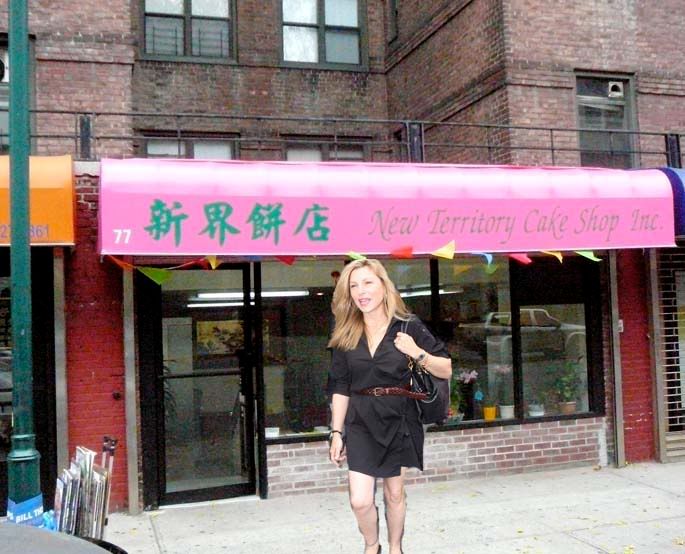
One of the largest baking empires in Queens was Hanscom bakeries, operated by a man who lived in Whitestone. Hanscom built six bakeries in Manhattan and one in the Bronx, designed by the prolific architect Horace Ginsbern. In 1937 the company starting building and opening bakeries in Queens — including the piece of artistic beauty shown here in the heart of cosmopolitan Jackson Heights. As Jackson Heights was developing, leading architects loved to work and design there. Two other Hanscom Bake Shops opened that year, one each on Greenpoint and Roosevelt avenues. By 1940 there were 14 in Queens, and a high of 21 stores in the borough by 1951. Suddenly in 1958 the entire chain of stores closed upon the death of Mr. Hanscom. Serious bakers were upset for many years as none of the bakeries’ delightful recipes were recorded anywhere and died withHanscom. Conversely, upon the death of Ginsbern several of the architect’s secrets were revealed. He was not American born, but Russian — his real name was Ginsberg — he did not go to Columbia Universityand did not holda degree in architecture. Yet, his great genius of modern design in Chelsea is landmarked today. A footnote: In 1984 another Hanscom Bakery went out of business after 101 years in Philadelphia, but it is not clear how or if the two companies were related to each other.An excellent blog on life in 1946 had a mention of Hanscom's
Hanscom bakeries throughout the city had egg-shaped cakes filled with chocolate butter cream, iced in chocolate and flower decorated. It served five for 85 cents. Aux Delices on Lexington and 62nd Street had edible sugar crystal panorama eggs; although Paddleford said she would just as soon eat her Easter bonnet as one of them. Breyers had eggnog ice cream but their frozen bunny molds and other prewar Easter frozen goods were absent. The German bakeries and confectionary shops along East 86th Street were stocked for Easter, according to Paddleford. Geiger's Vienna Pastry Shop and restaurant, 66 East 86th Street, had rabbits in all sizes, pushing wheelbarrows, driving pony carts, in automobiles, running and sitting. They were chocolate dipped and cost from 30 cents up. Marzipan eggs, chocolate dipped, started at 30 cents. Paddleford also singled out the bantam-sized eggs filled with nougat, and the chocolate eggs hand-filled with coconut cream, “the first we have seen." A few doors down, Wisconsin Farms, where they sold Milwaukee sausage and Wisconsin cheese and "a scad of small favors for Easter baskets and tables," had rabbits and "rock-a-bye babies" in marzipan egg shells at five cents apiece. Colored marzipan eggs were 10 cents. Unique chocolate bars with a rabbit scene molded into the chocolate were 49 cents. Popp and Kramers at 240 E. 86th Street made its marzipan fresh. The smallest eggs, chocolate covered at 12 to a pound, cost 10 cents apiece; quarter pound eggs were 30 cents, half pound were 60 cents and one pound cost a buck. They were all decorated. Solid chocolate rabbits went for 20 cents to $2 and chocolate eggs foiled wrapped and filled with chocolates were 35 cents to $3. Small marzipan eggs, varicolored, were $1.20 a pound.
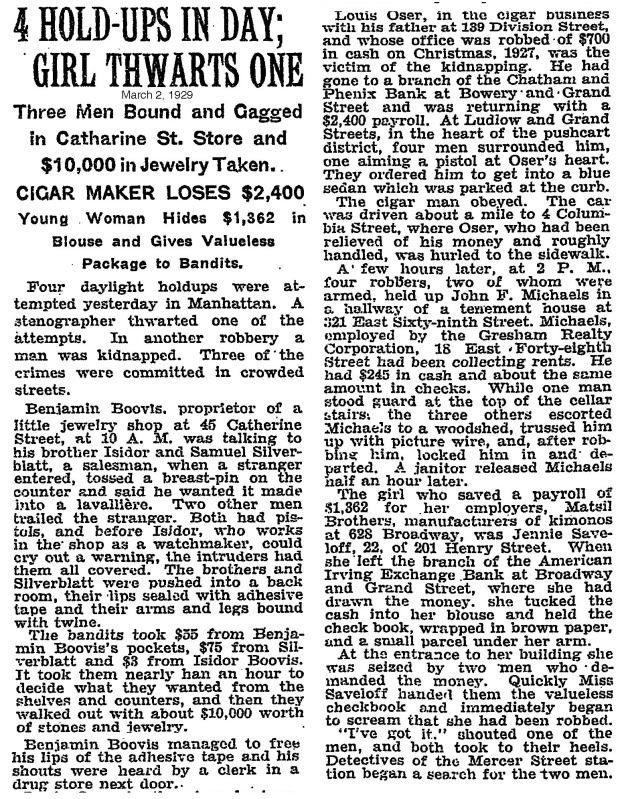
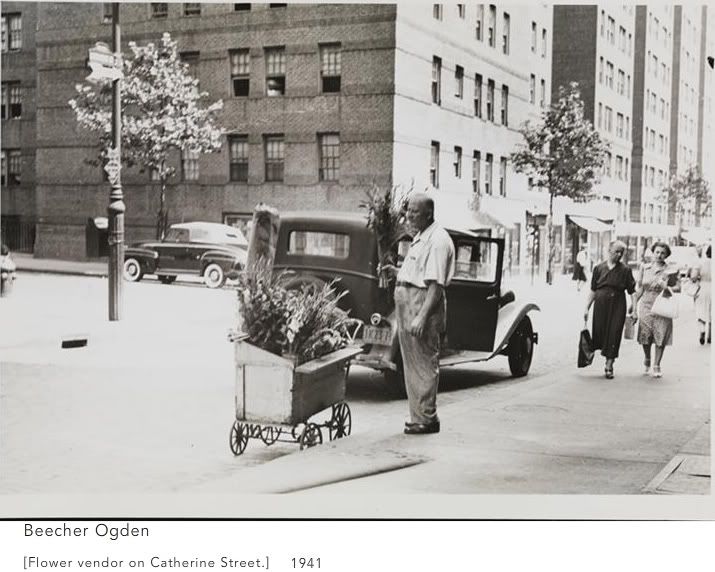
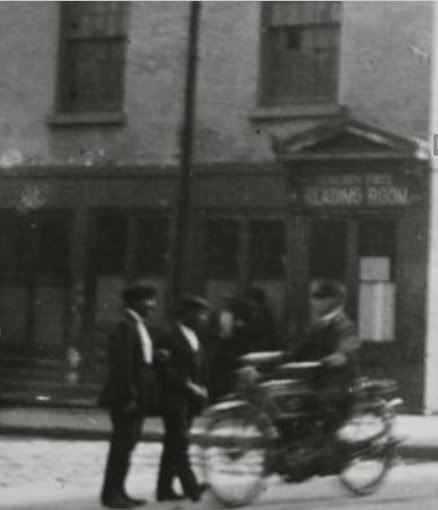
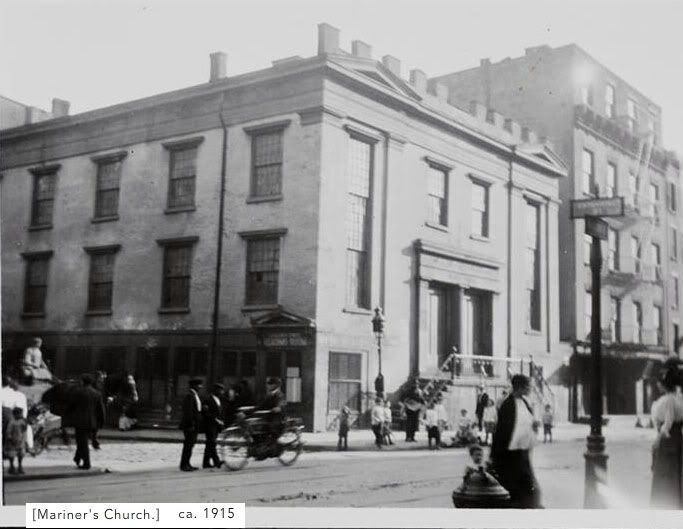

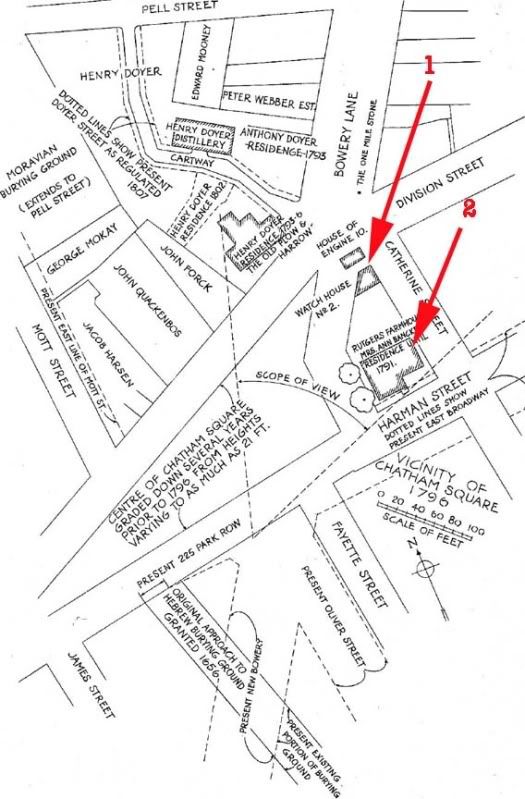
This parkland is named for Catherine Rutgers (1711–1779), wife of Hendrick Rutgers (b. 1712) and mother of Henry Rutgers (1745–1830), for whom Rutgers and Henry Streets in Manhattan and a university in New Jersey are named. Hendrick Rutgers named Catherine Street and Catherine Slip after his wife when this area was part of the Rutgers family estate. Daughter of Johannes De Peyster (1666–1711) and Anna Bancker (1670–1740), Catherine Rutgers gave birth to seven children including Henry, four of whom died young. In Catherine’s time, the surrounding area was home to the city’s elite Dutch mercantile families.
As with much of the land south of Pearl and Cherry Streets, Catherine Slip was originally under water. In the seventeenth, eighteenth, and nineteenth centuries, the edges of Manhattan were slowly extended through various landfill projects. A “slip” is a spot for sea vessels to dock, and Catherine Slip was once a port for boats and ferries. In the early 1800s, ferries carried passengers and carriages from Catherine Slip to Brooklyn.
The De Peysters were prominent, wealthy members of New York’s Dutch community. Johannes, Catherine’s father, was appointed mayor in 1698 and served four terms on the Board of Aldermen. Catherine’s uncle, Abraham De Peyster (1657–1728), one of the city’s wealthiest merchants, served as mayor from 1691 to 1693. Abraham also donated the land for the site of the second City Hall, built at Wall and Nassau Streets in 1704.
In 1732, Catherine married Hendrick Rutgers, son of a wealthy merchant and an ensign in one of New York’s six militia companies. Their youngest child Henry fought as a captain in the American army at the Battle of White Plains. Later in life, Henry Rutgers served as an assemblyman. In 1825, the former Queens College in New Jersey changed its name to honor the wealthy landowner, who donated $200 for a bell and a $5,000 endowment for the school. When Rutgers died in 1830, he left a third of his money to charity, but gave nothing to Rutgers College (later Rutgers University).
After his parents’ deaths, Henry remained in the Rutgers family mansion, dividing and leasing out much of the surrounding estate. Merchants and professionals, as well as shipbuilders, artisans, and craftsmen, moved into the area. As the neighborhood’s population increased, the runoff from the Fresh Water Pond to the west began to choke the streets with refuse. City officials filled in Fresh Water Pond in 1808, but problems persisted. Absentee landowners bought artisans’ former homes, subdivided them and packed them with tenants. In the late nineteenth century, works such as Jacob Riis’ How the Other Half Lives exposed the squalid tenement conditions along the Lower East Side. The resulting public outcry prompted the City to acquire and condemn many of the tenements. Today, the area boasts a number of courthouses and City buildings.
The title to the land now known as Catherine Mall was first vested in the City between 1686 and 1730. In the late nineteenth century, it served as a public market under the jurisdiction of the Manhattan Borough President. Workers from the Works Progress Administration, a Depression-era program aimed at reinvigorating the economy, planted London planetrees, installed benches, paved the lots, and reconstructed the park as a central mall space in 1939. Parks has maintained this parkland, officially named Catherine Slip Mall though commonly called Catherine Mall, ever since.


 Posts
All Comments
Posts
All Comments