Showing posts with label martin scorcese. Show all posts

Sunday, January 3, 2010

Martin Scorcese's Elizabeth Street

244 Elizabeth
The above images are from curbed, as is a segment from below

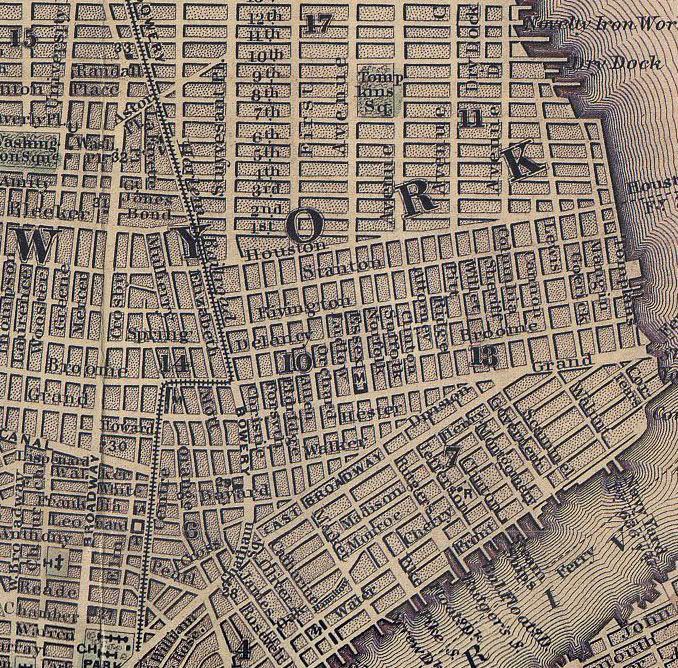
A curious reader recently inquired about the goings-on at 244 Elizabeth Street, a tired old tenement on the eastern edge of Nolita, noting that this one is "a building where the deadbeat tenants would sit around and BBQ and take over the street, but I noticed a roll down gate covering their front door, cinder blocks covering the ground floor windows and wood covering other windows in the building." Deadbeats? Harsh! We dug into our vast archives and found a tale stretching across the past century, with echoes of Scorsese and the Gangs of New York. Given what we discovered, the neighborhood's newly-arrived neighbors might want to brush up on their marinades, because it looks like the old-timers will soon be back.
Mobsters and mayhem, right this way.
244 Elizabeth, currently owned by the Department of Housing Preservation and Development, went into foreclosure back in the mid-70's. Now the building is being rehabbed as part of the Tenant Interim Lease Program, a city-sponsored community development initiative that "assists organized tenant associations in City-owned buildings to develop economically self-sufficient low-income cooperatives where tenants purchase their apartments for $250." High-paying neighbors will want to know that the cinder blocks and plywood now filling the facade are merely the interim design elements; they will give way to new windows and a full renovation. And very possibly the return of sidewalk BBQs.
If any nabe newbies are complaining now, imagine what they would have said a hundred years ago when this block was a target of the infamous Black Hand gang. Two doors down at 240 Elizabeth sat Pasquale Pati's Italian Bank; late in the afternoon of January 23, 1908, a bomb was set off in the bank's doorway as a way to extort cash from the banker and terrorize the neighborhood. On duty to combat the insurgents was NYPD's Lt. Joseph Petrosino, who gave his life in the on-going fight and is remembered at Petrosino Square a few blocks away. Forty years later this block was home to director Martin Scorsese, first at 241 Elizabeth and then later in a third-floor apartment facing onto Elizabeth at No. 253. There, from the fire escape where he slept on hot summer nights, Scorsese soaked up the activity on the mean streets below. Deadbeats and BBQs and all.

Martin Scorcese's Italianamerican: Part 1


Martin Scorsese's 1974 documentary on his parents, Catherine & Charles Scorcese.
gulley jimson's channel on youtube has a wealth of scorcese material
from wikipedia
Martin Marcantonio Luciano Scorsese (born November 17, 1942) is an American film director, screenwriter, producer, actor, and film historian. He is the founder of the World Cinema Foundation, a recipient of the AFI Life Achievement Award for his contributions to the cinema and has won awards from the Oscars, Golden Globe, BAFTA, and Directors Guild of America. Scorsese is president of the Film Foundation, a non-profit organization dedicated to film preservation and the prevention of the decaying of motion picture film stock.
Scorsese's body of work addresses such themes as Italian American identity, Roman Catholic concepts of guilt and redemption, machismo, and violence. Scorsese is widely considered to be one of the most significant and influential American filmmakers of his era, directing landmark films such as Taxi Driver, Raging Bull and Goodfellas—all of which he collaborated on with actor Robert De Niro. He won the Academy Award for Best Director for The Departed and earned an MFA in film directing from the New York University Tisch School of the Arts.
Martin Scorsese was born in New York City. His father, Luciano Charles Scorsese (1913–1993), and mother, Catherine Scorsese (née Cappa; 1912–1997), both worked in New York's Garment District, his father as a clothes presser and his mother as a seamstress.As a boy his parents would often take him to the movie theaters; it was at this stage in his life that he developed his passion for cinema. Obsessed with historical epics at an early age, at least two films of the genre, Land of the Pharaohs and El Cid, appear to have had a deep and lasting impact on his cinema psyche. Scorsese also developed an admiration for neo-realist cinema at this time. He recounted its influence in a documentary on Italian neorealism, and commented on how The Bicycle Thief alongside Paisà, Rome, Open City inspired him and how this influenced his view or portrayal of his Sicilian heritage. In his documentary, Il Mio Viaggio in Italia, Scorsese noted that the Sicilian episode of Roberto Rossellini's Paisà which he first saw on television alongside his relatives, who were themselves Sicilian immigrants, made a significant impact on his life. He has also cited the Indian neorealist filmmaker Satyajit Ray as a major influence on his career. His initial desire to become a priest while attending Cardinal Hayes High School in the Bronx was forsaken for cinema– the seminary traded for NYU Film School, where he received his MFA in film directing in 1969.