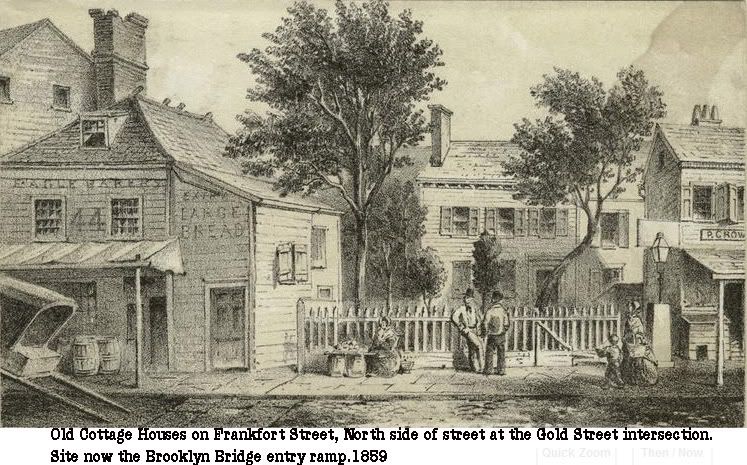
While researching Philip White’s life in postbellum New York City, Peterson used city directories to uncover that while White had moved his residence from Lower Manhattan to Brooklyn in 1870, his pharmacy remained in its same location in Manhattan until his death in 1891. Peterson wondered why, since he moved his home, White hadn’t also moved his business, either in 1863 in the aftermath of the Draft Riots (which traumatized the black community), or in 1867, when he married Elizabeth Guignon? So she decided to walk the streets where White’s home had once been located—and found the entrance ramp for the Brooklyn Bridge. To build the unsuspended approaches and anchorages leading up to the bridge’s span on the Manhattan side, “this required clearing six blocks between Chatham and Water and Frankfort and Duane Streets…Philip’s drugstore on the corner of Frankfort and Gold was saved, but his home on Vandewater Street was demolished” (311). City directories led to city maps which led to city streets which revealed urban renewal – and a crucial piece of Peterson’s story.View a booktalk by Professor Peterson on cspan She will we speaking at the Brooklyn Museum on Saturday February 4, 2012
Showing posts with label black history. Show all posts
Thursday, February 2, 2012
90 Gold Street: Site Of Philip White's Pharmacy
below from NYPL Digital Gallery, The New York Public Library
Carla Peterson talks about her ancestor Philip White in her book, Black Gotham: A Family History of African Americans in Nineteenth-Century New York City
Thursday, February 3, 2011
A Black History Month KV Special Edition: John Coltrane and Edward Strickland on Coltrane
Edward Strickland is famous in Knickerbocker Village history. He lived at 10 Monroe Street. Here's another posting about Strickland
below is an excerpt from an article Strickland wrote about Coltrane in the Atlantic in 1987
What Coltrane Wantedfrom Strickland's 1998 obituary
The legendary saxophonist forsook lyricism for the quest for ecstasy
by Edward Strickland
JOHN COLTRANE died twenty years ago, on July 17, 1967, at the age of forty. In the years since, his influence has only grown, and the stellar avant-garde saxophonist has become a jazz legend of a stature shared only by Louis Armstrong and Charlie Parker. As an instrumentalist Coltrane was technically and imaginatively equal to both; as a composer he was superior, although he has not received the recognition he deserves for this aspect of his work. In composition he excelled in an astonishing number of forms--blues, ballads, spirituals, rhapsodies, elegies, suites, and free-form and cross-cultural works.
The closest contemporary analogy to Coltrane's relentless search for possibilities was the Beatles' redefinition of rock from one album to the next. Yet the distance they traveled from conventional hard rock through sitars and Baroque obligatos to Sergeant Pepper psychedelia and the musical shards of Abbey Road seems short by comparison with Coltrane's journey from hard-bop saxist to daring harmonic and modal improviser to dying prophet speaking in tongues.
Bay State Banner
09-24-1998
Edward Strickland, 68, educator, artist, writer
Edward Strickland, professor of the psychology of visual arts, a friend to artists, and himself an artist and writer, died in the early morning of Sept. 16 at Deaconess Hospital. He succumbed to respiratory failure due to lung cancer. He was 68.
Throughout his life, in his painting, as an arts administrator and critic, and as a individual, Dr. Strickland sided with those who were struggling to achieve equity in society. He was generous with his time on behalf of such efforts, even though it took him away from his studio where he took an intense pleasure in immersing himself in the …
A woman stands among a smother of foliage, and the leaves around her stir, responsive to her voice. "It's as though she's singing a linden tree into existence," says Edward Strickland, the painter of the scene.
Strickland, through December, is presenting a 40-year retrospective of paintings and drawings in the handsome AAMARP Galleries on the fourth floor of the Ruggles Building of Northeastern University, at 11 Leon St. The retrospective represents the broad scope of his interests built on the dual foundations of psychology and the visual arts. An associate professor of psychology at the University of Massachusetts at Boston and former chair of the black studies department, …
Sunday, January 2, 2011
Thursday, October 15, 2009
The Fly Boys Of 1741
from Gotham by Mike Wallace and Edwin Burrows The pages describe the events leading up to the executions in the common of 1741 pictured in the previous post.
Gotham Fly Boys
Gotham Fly Boys
Just Around The Bend From Doyer's Bend
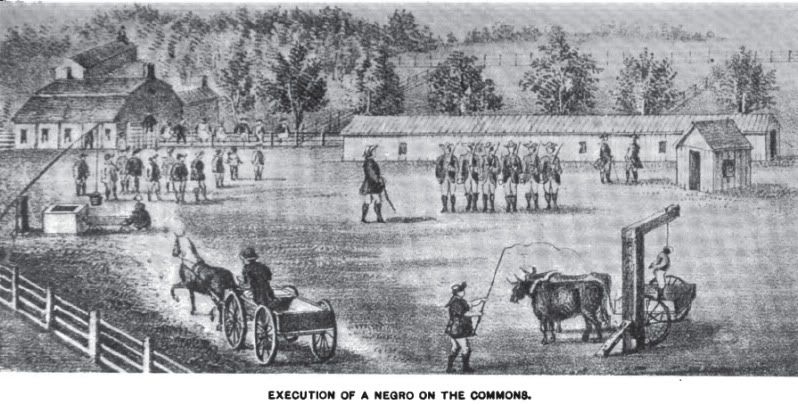
The common described above was near where Foley Square is now. The scene above may be picturing the executions of 1741. From my ny slavery tour google map
1741 Execution of Enslaved Africans (Foley Square). The site where enslaved Africans, free Blacks and White supporters accused of plotting the 1741 Slave Conspiracy were executed. White New Yorkers, afraid of another slave revolt, responded to rumors and unexplained fires with the arrest of 146 enslaved Africans, the execution of 35 Blacks and four Whites, and the transport to other colonies of 70 enslaved people. Historians continue to doubt whether a slave conspiracy ever existed.
Thursday, September 24, 2009
Tuesday, September 22, 2009
The Tappan Brothers And 122 Pearl Street
Tappan Brothers They were 19th Century New York Abolitionists. In 1834 their Silk Importing business was located at 122 Pearl Street
Saturday, September 19, 2009
Prominent Black Citizens In The 1830's
Many of them lived in the Fourth Ward. Jack Devoo was one of the "eel" dancers at the Catherine Market
Prominent Black 1830 Images from the ny divided exhibit
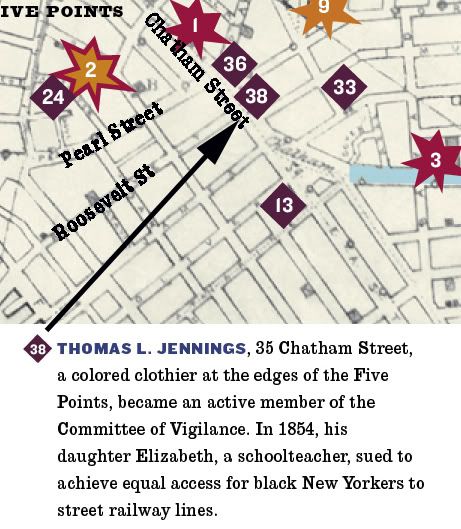
Thomas Jennings: 35 Chatham Street
below from wikipedia
Thomas L. Jennings (1791–1856) was a leading abolitionist. He was a free black tradesman who operated a dry-cleaning business in New York City, New York and was the first African American to be granted a patent.
Jennings' skills were so accepted that people near and far-off came to him to alter or custom-tailor objects of clothing for them. When he was thirty years old, in 1821, he was granted a patent for a dry cleaning process called "dry scouring." This enabled him to build up his business.
The first money Jennings earned was spent on the legal fees to purchase his family out of slavery, and then to support the abolitionist cause.
In 1831, Jennings became assistant secretary to the First Annual Convention of the People of Color in Philadelphia, Pennsylvania.
In 1857, Oscar Stuart, a slave owner, patented a "double cotton scraper." He did not, in fact, invent the double cotton scraper; historical records show that the only name given for the actual inventor was Ned, his slave. In his defense, Stuart claimed that "the master is the owner of the fruits of the labor of the slave, both manual and intellectual."
In 1793 and 1836, it was legal for both slaves and free Negroes to receive patents for their inventions. In a challenge to the patent, of Stuart vs. Ned, the Patent Office decided in Stuart's favor. They changed the law in 1858 to exclude the granting of patents to slaves, as they were not considered citizens.
Sunday, June 21, 2009
The Catherine Slip Market 1889: Where Slaves Used To Dance
from 11/30/07 from pseudo-intellectualism
The cartoon images from the slide show come from Patrick Reynold's great collection
of New York City history called the Big Apple Almanac There was once an active eel market on Catherine Slip in the 1800's. Black citizens engaged in a form of minstrelsy to earn a living and perhaps a free meal. The slide show is padded with an excerpt from an 1889 nytimes article about the area:
A Rodgers and Hart work:
Hawks and crows do lots of things,
but the canary only sings.
She is a courtesan on wings-
So I've heard.
Eagles and storks are twice as strong.
All the canary knows is song.
But the canary gets along-
Guilded bird!
REFRAIN
Sing for your supper,
And you'll get breakfast.
Songbirds always eat
If their song is sweet to hear.
Sing for your luncheon,
And you'll get dinner.
Dine with wine of choice,
If romance is in your voice.
I heard from a wise canary
Trilling makes a fellow willing,
So, little swallow, swallow now.
Now is the time to
Sing for your supper,
And you'll get breakfast.
Songbirds are not dumb,
They don't buy a crumb
Of bread,
It's said.
So sing and you'll be fed.
Labels:
big apple almanac,
black history,
catherine street,
Ward 4
Subscribe to:
Posts (Atom)