Showing posts with label transportation. Show all posts

Friday, May 1, 2009

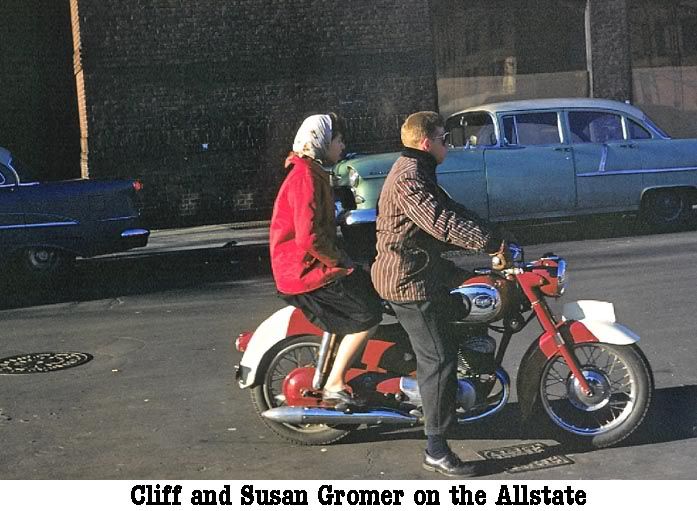
They Found Cliff's Old Sear's Allstate Motorcycle :)


Comments from the youtube post
The bike is NOT a 1984...it's a late 50's early 60's Allstate...roughly $249.00 new.

I have myself a 1954 Puch 250 SGS like this one on the vid but with Puchs own labels. I've just restored it and it runs well I'd say. One bad thing I've heard about them around here is that it has got serious heat problems when you drive it too hard.. though I've never had problems with that myself.

Then Corvairwild was right, it is the luggage compartment on the left side which he pointed at, the battery's on the other side, though the SGA, SGSA and also the MCH models had two batteries in the "luggage" because they needed extra power for the electric start (why you now needed that on a 250).

First since I am a Steyr Daimler Puch fan, so no offense 1949kf but what you forgot to tell was that this model came 53 and by then there were no japanese models in this class who stood a chance I'd say.. but I don't know why they made it until 1970 which they did..

I have a few go look by clicking my name. Tried to post one but it didn't work here...
clayboyrat

I owen 4 of these bikes. There fun to drive around town. Real head turners.
My brother owned a nice red Sears Allstate cycle in the 50's. Left handlebar 3 gear shift. Single cylinder but don't know what cc it was. Sears sold a lot of cycles and I think....."Monkey Wards" did too...maybe not.

Cliff Cycles


About the Sear's Allstate Motorcycles
Allstate was an American seller of scooters.
Sears resold vehicles from several manufacturers, rebadged with the Sears "Allstate" brand. Most Allstate models were scooters, but several motorcycles (and even a car) were sold under the Allstate marque. Vespa and Cushman scooters are the most commonly recognized Allstate models.
Producing its first scooters in the mid 1930s, Cushman went on to build a variety of small machines over the next 30 years, including the 1958 Cushman Eagle and CushmanPacemaker motorcycles.
Cushman was one of the few manufacturers of motorized vehicles permitted to continue civilian production during World War II, as its products were considered "energy savers" for those needing transportation to and from work.
During this time, and on into the postwar years, many a motorcycle enthusiast cut their riding teeth on a Cushman.
Cushman scooters of the 1940s were of the "enclosed" variety, with a shroud covering the engine. In 1949, the Eagle was introduced, which copied motorcycle styling themes with its "naked" engine, sprung saddle, contoured fenders, and teardrop fuel tank. Even whitewall tires were available.
Its 318-cc flathead single put eight horsepower through a two-speed transmission, the combination good for 50-plus mph.
Also offered at the time was the Cushman Pacemaker, which adhered to conventional scooter lines. Unlike the Eagle, Pacemaker used an automatic clutch and was powered by a smaller engine.
Earlier versions had curved, "bathtub" rear bodywork, but 1957 brought a square-cut design intended to look more modern. It met with mixed reviews.
In addition to its two-wheeled scooters, Cushman built other models as well. Often seen putting around golf courses and college campuses were its three-wheeled "pickups," while enclosed versions were popular for parking enforcement.
See the next page for more pictures of 1958 Cushman Eagle and Cushman Pacemaker motorcycles.

Cliff's KV Notes, Part 19: Wheels, Part 3


Years before I got my driver’s license, I always wanted a motorcycle. I read every Floyd Clymer book on bikes that I could get my hands on, including one that explained how to ride one. The Clymer books covered mostly English bikes, such as the Ariel Square Four, Excelsior and others not available in the U.S. But the basic controls were more or less universal.
I had my heart set on a BSA, which I thought stood for Boy Scouts of America instead of Birmingham Small Arms. I would eventually get one, as my second motorcycle, from Ghost Motorcycles in Long Island. But that would be way in the future.
Before getting my license, I was commuting to Brooklyn College by bicycle, or train in bad weather. Close by the college was a Jawa motorcycle dealer. Jawa was a Czech bike—basic transportation, nothing fancy. But the quality looked good, and it wasn’t too expensive. One of the salesmen took me for a ride on a scrambler—a high performance model in the line. I was hooked!
I convinced my father to drive out to Brooklyn with me and take a look at the bikes. He was all set to buy one for me, (course, I would have to pay him back) until he found out that the cost of insurance was the same as a car—over $300/year. And that was that. Until I met Howie Frankel.
Howie lived either in KV or in the neighborhood. He had a 2-stroke, single cylinder175cc Allstate motorcycle that he wanted to sell. The Allstate was made by Puch in Austria for Sears. The price wasn’t bad, and I told Howie I’d buy the bike, except for the insurance. No problem, he said. If you buy an Allstate bike, you can get Allstate insurance for $68/year. I checked it out, and he was right.
I rented an indoor parking spot in the garage on the corner of Pike and either Cherry or Water. The street level area of the garage was a repair shop that fixed private cartage garbage trucks. Two guys either owned or were employed there as mechanics. Andy was a short guy, who had a tall girlfriend who was a knockout. The guy was pretty dapper when he wasn’t dressed in his mechanic’s overalls. And it was pretty eye-opening to see what a short guy, with the right amount of self-confidence, could score. I believe his partner’s name was Sal. It must have been pretty tough to change a clutch on a garbage truck in the summer, what with the stench and all.
My friend Eugene Reiser had bought a Lambretta motor scooter before I bought the Allstate, and I got my feet wet on a motorized 2-wheeler on his ride. My bike’s parking spot was on the second floor of the garage, and there was a long ramp leading up from the street level. I had just completed the deal for the Allstate with Howie, and, on my first ride, motored over to the bottom of the ramp and it sized it up. Hmmmn, fairly long and steep. Better give it a lot of gas so it doesn’t stall. I grabbed a good handful of throttle and let out the clutch. My feet were still on the ground, and the bike just about shot up the ramp without me, nearly pulling my arms out of their sockets. But I managed to recover enough to make it to the second floor without having someone to call an ambulance.
I practically lived on that motorcycle, riding it everywhere. There were no helmet laws in ’58, so I never wore one. No special motorcycle test or license was required either. A regular “car” license was all you needed. I did take my mother and father for a ride, and I remember at one point, I had the motorcycle in our apartment in the “A” building. It was on newspaper in the living room. I think I had removed the gas tank prior to bringing it up in the elevator. I can’t believe my parents let this happen, but the specifics of the episode eludes me.
Soon after I got the bike, I wanted to expand my horizon from just normal riding. The sidewalk on Pike St.alongside garage had a lot of curb cuts for driveways. I thought it would be fun to speed down the edge of the sidewalk and see how high the Allstate would bounce into the air going over the cuts. I was going pretty good, when a police cruiser happened by. The two cops in the car saw me in the air and freaked out. This was obviously a first for them. But they weren’t amused, and issued my first traffic ticket—for driving on the sidewalk.
My sister Susan liked riding on the back seat of the Allstate, and I guess her most memorable experience was one particular blast on the South St. viaduct and up the FDR Drive. It was warm, and she was wearing just a blouse. We were doing maybe 70 MPH, and the wind tore open her blouse, leaving her rather, ahem, exposed. ‘Course I was looking ahead and had no idea what was happening. The wind was so loud that I couldn’t hear her even if she screamed. So up the drive we went, her open blouse flapping in the breeze, and giving the drivers we passed a really good eyeful. Guess it would have made a great ad—“I dreamed I rode a motorcycle in my Maidenform Bra.”
The next chapter of Cliff's KV Notes
The previous chapter of Cliff's KV Notes

Saturday, March 21, 2009

New York Transportation: 1951


This was meant to be a follow up to chapter 7 of Cliff's KV Notes that talked about buses.

Friday, March 13, 2009

Toy Trucks For Cliff


Since Marty Schefflin denied Cliff some of his favorite trucks to play with we are trying to make it up to him with the above. Images are from the buddy l museum site
from Eddie Kendricks, 1973
Ooh...
Ooh...
Ooh...
Keep on truckin', baby
I got to keep on truckin'
Got to get to your good lovin'
Huh...huh...huh...huh...huh...
Shame
A double shame on me, yeah
Love
Love, I let it control me, yeah
From just one kiss I am inspired
To lovers in time there's a fire
And I'll keep on truckin', baby
I got to keep on truckin'
I got to get to your good lovin'
Huh...huh...huh...huh...
Baby, its bad
It's so hard to bear
Yes, babe
You're hard to bear
I've got a fever rising with desire
It's my love jones and I feel like I'm on fire
And I'll keep on keep on truckin', baby
I got to keep on truckin'
Got to get to your good lovin'
Huh...huh...huh...huh...
Feelin' good
No, you can't stop the feelin'
No, not now
Ooh, ooh, ooh, ooh
Keep on truckin' on
Keep on truckin' on
Keep on truckin'
Keep on truckin' on
Keep on truckin'
Yes, I've got a fever rising with desire
It's my love jones and I feel like I'm on fire
And I'll keep on keep on truckin', baby
I'm the red ball express of lovin'
Diesel-powered straight to you, I'm truckin'
In old Temptation's rain, I'm duckin'
For your love through sleet and snow, I'm truckin', ooh
I'm the red ball express of lovin'
Diesel-powered straight to you, I'm truckin'
In old Temptation's rain, I'm duckin'
For your love through sleet and snow, I'm truckin'
Ain't nothin' holdin' me back nothin'
I'll keep right on, right on truckin'
Ain't nothin' holdin' me back nothin'
I'll keep right on, right on truckin'
Ooh, ooh, ooh, ooh, truckin'
Ooh, ooh, ooh, ooh, ooh, truckin'

Thursday, March 12, 2009

1946 Bus Ride


from the youtube description
Father and son travel by bus from New York to Pittsburgh in the days when bus travel still attracted elite passengers.

part 2 can be seen here

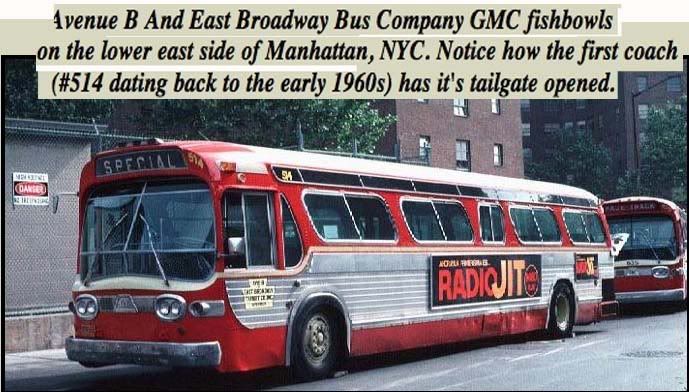
East Broadway Bus Near 367 Grand Street

Cliff supplied the first photo. 367 Grand is between Essex and Norfolk and is now part of the Seward Park Hosing Complex
367 Grand

Garaged East Broadway Buses

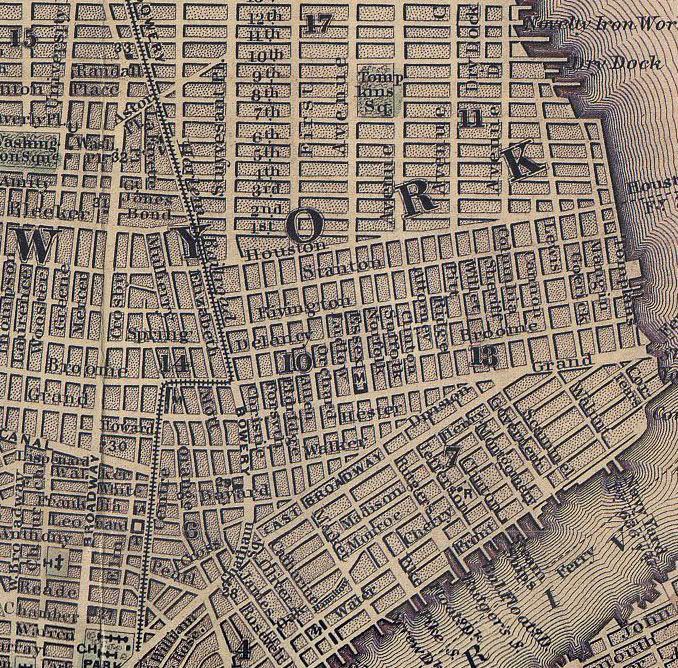
Cliff sent along a picture of some garaged East Broadway buses. According to Cliff this garage was at Cherry and Pike. Following the picture of the buses is a photo of the block from 1936 (the garage is on the right) and a map section from 1891
Ave b Garage

Wednesday, March 11, 2009

1940-41 Mack CL Bus Brochure

As described from the previous post this brochure talks about the buses, built in '32 lasting almost 9 years (at that point) on tough New York City streets. Note Cliff's descriptions of the
CL’s engine located inside the bus to the right of the driver, underneath a cover. There was a great big gearshift lever for the manual transmission, so a driver, in the course of his career must’ve made a million or more gear changes. The fare was a nickel which you dropped into a 3-arm turnstile.

mack-cl

Monday, March 9, 2009

An Old Mack AC Model Truck


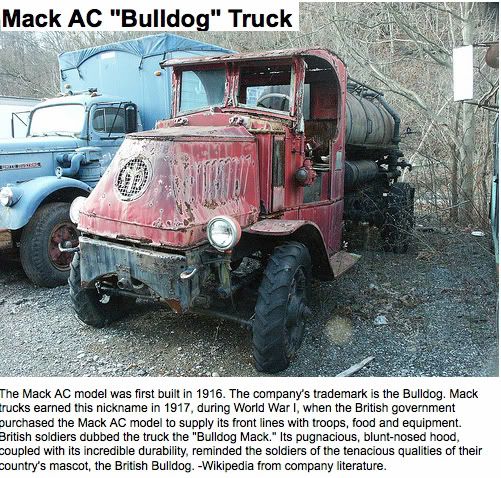
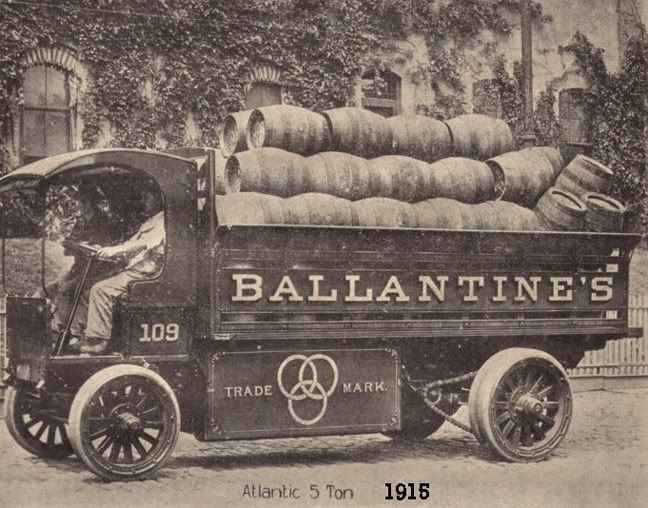
This Mack AC is pretty cool! It was July 2007's Truck of the month on ATHSLI.com, the web site of the Long Island Chapter of the ATHS. The owner of this Mack AC explained that the truck was converted by Ballantine Ale.
This truck is one of 50 for Ballantine Ale use. This conversion included a
Chevy Six engine and transmission, and a new hood and radiator.

A Tribute To Mack Trucks

Thursday, November 13, 2008

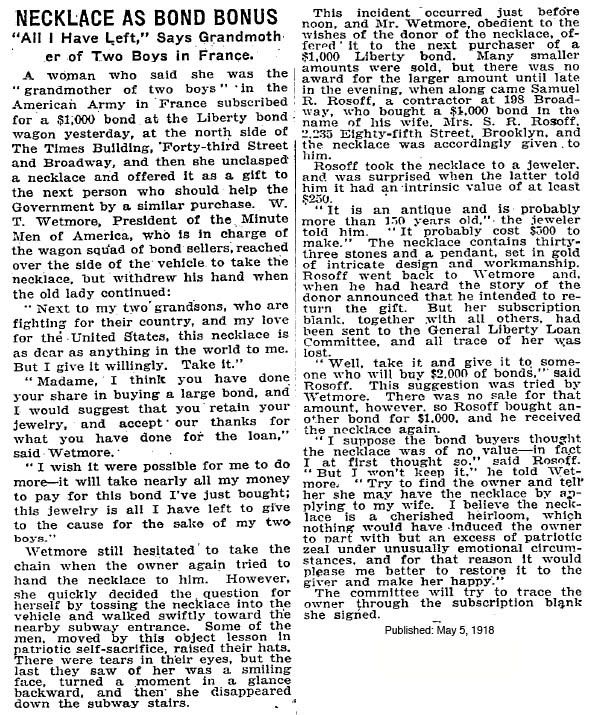
Sam Rosoff: Immigrant Transportation Scion


from Time Magazine, 4/08/1935
Last week a crowd gathered on the steps of New York County's Supreme Court House to witness a bankruptcy sale of the property of Hudson River Navigation Corp. Forced to earn a year's maintenance in four summer months, the 100-year-old concern went under in 1932, has since been operated at a loss by court trustees. Sole bidder for its assets last week was a contractor named Harry R. Pearley, whose offer of $100,100 was promptly accepted. Newshawks soon found that the real buyer was not Mr. Pearley but a fat and fabulous man named Samuel Rosoff who was pacing about at the fringe of the crowd. Asked why he bought it, Rosoff explained:
"I am interested in the welfare of the good old Night Line. I love the Hudson River."
The Hudson River Night Line used to carry some 200,000 passengers. 20,000 automobiles, 175,000 tons of freight annually between New York and Albany before it went bankrupt. Its four passenger ships are the finest of their kind afloat. The Berkshire, world's largest river steamer, accommodates 2.400 passengers, has 413 staterooms. Night liners take 12 hours to cover their 160-mile route. Last week Buyer Rosoff promised to build "swell new boats," put the line on its sea-legs.
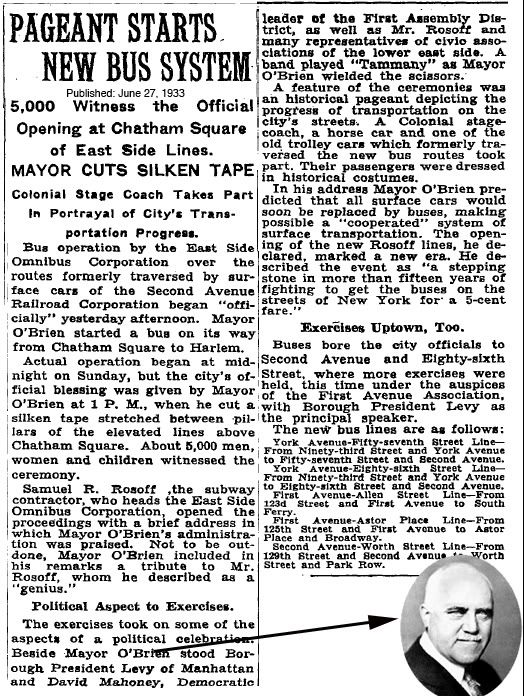
Samuel Rufus Rosoff was born in Minsk, Russia, 53 years ago. Aged u, he worked his way to the U. S. as a potato-peeler on an immigrant ship. A tough, dirty little boy who had never been inside a school, he sold newspapers, slept on warm sidewalk gratings, learned to read at the Public Library. One job led to another until Samuel Rosoff was building New York City subways, operating bus lines, brewing King's beer, buying race horses and making money hand over fist. Today he often carries $50,000 cash in his pockets, tells competitors: "Money talks." Shrewd at dealing with all kinds of politicians, he boasts: "I'm a member of Tammany Hall and proud of it. I'm also a Republican and proud of that. ... I haven't got education. What I got is what it takes to make guys with education do the job I want done."

Chatham Square 1933


As buses start replacing the elevated lines

Monday, April 14, 2008

The Avenue B Bus And Mark Glass' Father


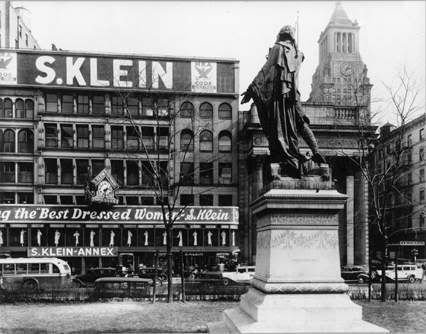
The recently found former LMRC'er Mark Glass had the distinction of having a father that drove our local Avenue B bus. It ran from Catherine and East Broadway to Klein's on 14th Street. I remember, though, that the return trip was along Avenue A. There's more on the Mark Glass story/fable over at pseudo-intellectualism

Monday, December 17, 2007

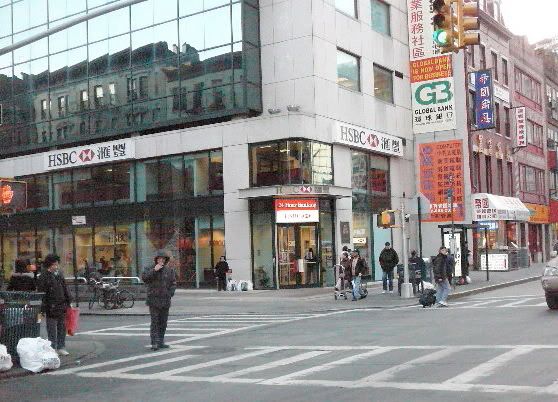
Where To Get The Avenue B Bus


If you wanted to go to Lelands' (previous post) or to S. Klein's on Union Square this where you would catch the Avenue B bus