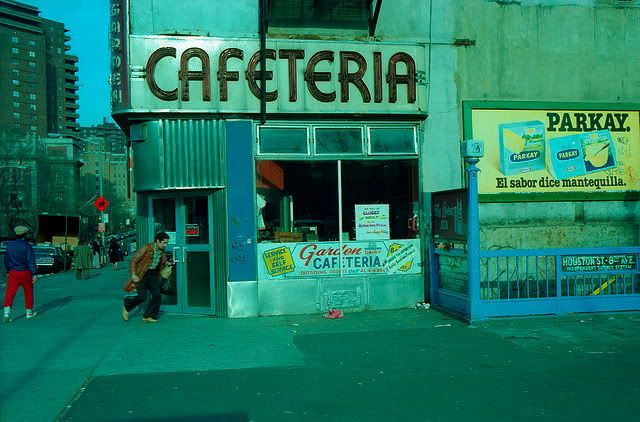
There's an exhibit on Bruce Davidson's photos of the Garden Cafeteria circa 1970 at the Jewish Museum until February of 2008
Isaac Bashevis Singer and the Lower East Side, Photographs by Bruce Davidson Exhibition
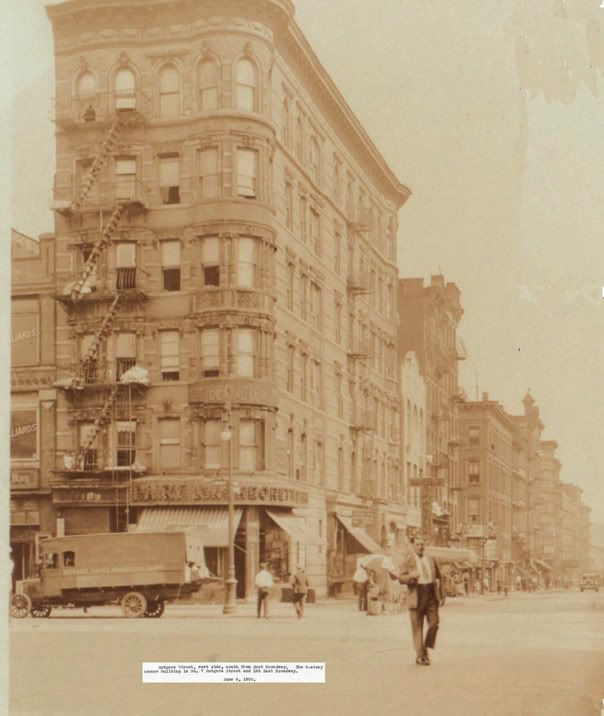
The Garden Cafeteria at 165 East Broadway and the corner of Rutgers Street, was one of the most storied places on the Lower East Side in its day. Adjacent to the offices of The Forvertz/ Forward Jewish Daily the cafeteria was a favorite of the paper's writers and poets, including Isaac Bashevis Singer, and so beloved was it that many believe that Leon Trotsky once frequented it, despite the cafe only being founded in 1941. The Garden closed in 1983 and was replaced almost immediately by the Wing Shoon Seafood Restaurant, which, like its predecessor, inspires community devotion.
Author and Nobel laureate Isaac Bashevis Singer and acclaimed photographer Bruce Davidson were friends and neighbors in their Manhattan apartment building. In 1972, they collaborated on a humorous and surreal film, Isaac Singer's Nightmare and Mrs. Pupko's Beard, based on a story by Singer. During and after production, Davidson photographed Singer in his apartment and around the Upper West Side.
The following year, Davidson took a series of photographs on the Lower East Side. He created a black and white portfolio titled The Garden Cafeteria, depicting denizens of the East Broadway restaurant that Singer frequented on his trips to The Jewish Daily Forward. Later, he photographed local merchants, rabbis, and storefronts on Essex and Orchard Streets.
The exhibition Isaac Bashevis Singer and the Lower East Side presents Davidson's Garden Cafeteria portfolio with an introduction by Singer, a selection of his portraits of Singer and selections from his Lower East Side series. Intimate and unflinching, Davidson’s photographs tell a moving New York story of émigrés and Holocaust survivors from the Lower East and Upper West sides of Manhattan.
Isaac Bashevis Singer (1904–1991), the most revered Yiddish writer of the twentieth century, produced fiction serialized in The Jewish Daily Forward as well as political commentary, popular journalism, plays, children’s books, and advice columns under assumed names. He was born in Poland and emigrated to the United States in 1935. Beginning with The Family Moskat (1950), his stories and novels were translated and published in English, bringing him to a wider audience in America and worldwide. In 1978 Singer became the ninth American and the only Yiddish writer to be awarded the Nobel Prize in Literature.
Bruce Davidson (1933- ) began to photograph at the age of ten in Oak Park, Illinois, and continued to further his knowledge and develop his passion at Rochester Institute of Technology and Yale University. In 1957, Davidson worked as a freelance photographer for Life magazine and in 1958 became a full member of Magnum Photos. From 1958 to 1961 he created such seminal bodies of work as "The Dwarf," "Brooklyn Gang," and the "Freedom Rides." He received a Guggenheim Fellowship in 1962 to photograph what became a profound documentation of the Civil Rights Movement in America. In 1963, The Museum of Modern Art in New York presented his early work in a solo show. In 1967 he was awarded the first grant for photography form the National Endowment for the Arts, having spent two years bearing witness to the dire social conditions on one block in East Harlem, published in 1970 under the title East 100th Street. Classic bodies of work from his 50-year career have been extensively published in monographs and are included in many major public and private fine art collections around the world. His most recent book is Circus (2007).
A modest restaurant, opened in 1911, the Garden was part hangout, part salon, famous for its hospitality to radical political activists (Emma Goldman, Leon Trotsky, and Fidel Castro are all said to have eaten there) and also to the journalists who wrote about them.
Note: The Garden was a regular Sunday destination for the Silverstein family of Knickerbocker Village. In April of 2007 a dozen ex KV "boys" gathered for a 40 year reunion lunch at Wing Shoon restaurant, the inheritor of the Garden space at 165 East Broadway





 Posts
Posts