Showing posts with label mountain greenery. Show all posts
Showing posts with label mountain greenery. Show all posts
Saturday, May 22, 2010
KV Greenery: May 13, 2010
Featuring an all Asian, very civilized, water balloon fight in Tanahey Park


Thursday, May 6, 2010
Mountain Greenery From The Dick Van Dyke Show
from tv.com
episode 28. The Sleeping Brother, First aired: 3/28/1962, Writer: Carl Reiner, Director: John Rich (II), Guest star: Richard Deacon (Melvin Cooley), Jerry Paris (Jerry Helper), Jerry Van Dyke (Stacey Petrie)
Rob tells Jerry that Stacey sleep walks, there is one problem Stacey needs to be awake to audition for Alan Brady. Rob plans a party for Stacey to see if he will make it on the show. Will Alan be there? Mel is asked to go to Rob's house but Alan will need to give up his poker game.
LES Greenery, May 6, 2010
In accordance with the Artie Shaw (born on the LES) centennial,
vocal by Lee Wiley, Artie Shaw's favorite singer
Shaw’s recollection of what it was like to be in bed next to the gorgeous Lee Wiley in 1938: “In bed, she would say things like, ‘You are lying next to the greatest ass in New York.’”from all about jazz
Born: October 9, 1915 | Died: December 11, 1975
Sensual and dignified, sophisticated and warm, Lee Wiley has inspired outbursts of sheer poetry from many a captivated listener. Her sound induces a “marvelous,” “ticklish” sensation, akin to “running your hand over a piece of fine Harris tweed,” marveled producer Dave Garroway. She “blows smoke rings, each note a puff that melts into wisps of vibrato,” conceptualized author Will Friedwald. Her voice and style “have long since made me extremely eager to go to bed with her,” disclosed critic James Frazier. Not content with this daring confession, he also bluntly labeled her “one bitch of a singer.”
Protested singer and Wiley scholar Barbara Lea: “She had more fire, more rhythm, more roughness, more silkiness, more deep personal warmth, than the job description of Pop Singer called for.” Asked writer Richard Hadlock, in an open letter to Wiley, “Lee, have you ever wondered why so many… from road-tough musicians to jaded pub-crawlers, act like kids on Christmas when they hear you sing?” (Wiley did wonder.) The eulogies could go on for pages, but the point is clear enough: Lee Wiley is a singer with a certain mystique.
The Wiley mystique was generated by both personal and professional circumstances, and further fed by some willful biographical manipulation by her musical associates, her record labels, and the artist herself. Nicknamed “Pocahontas” and characterized as regal by her friends, Wiley descended from the princess of a Cherokee tribe and from an English missionary who married an American parishioner... according to publicity material. Her birth date remains uncertain - initially given as 1915, then moved back to 1910, still more recently to 1908 - and revisionism has taken over the more sensational aspects of her biography (running away from home in the late 1920s, temporary blindness after a fall from a horse in the early 1930s, a near encounter with tuberculosis in the mid-1930s, etc,).
Her looks most certainly contributed to the Wiley allure. Her brother Ted once reported that everybody wanted to marry the tall, strikingly attractive Oklahoman with corn-colored hair and olive skin. (”Everybody” included the eight-times-married bandleader Artie Shaw, whose offer was declined by the twice-married singer.) One motivation for her long retirement (from about the age of 50 until the years preceding her death from cancer, in 1975) was the apparently high price that Wiley placed on physical attractiveness. It was her contention in 1971 that “singing includes a number of things ... aside from the voice ... these girls who are trying to get up on the bandstand at forty years old ... doesn't make any sense to me.”
An enigmatic personality likewise fueled the fascination. Various oral and written accounts paradoxically depict her as difficult and easy to work with; proud and/or bitter about the treatment received from the music business; heavily addicted to alcohol but outspokenly intolerant of other musicians' addictions; foul-mouthed, even unkind to other singers yet fiercely loyal to those within her own circle; hesitant while speaking though assured when singing. Friends and colleagues further portray her as a woman with a strong sense of integrity and a fierce sense of independence, traits that caused her to give up on various “golden” opportunities to further her career. The best documented of such opportunities happened in 1935 when she departed from a feature role in the top-rated Kraft radio show because its producers refused to give billing to composer Victor Young, who was then personal and musical partner.
Wiley's relatively small discography further contributes to her mythic status. Over a four-decade career, she recorded less than ten albums and about 40 singles; live and radio broadcasts make up for the remainder of her material in circulation. Thus her mystique stems not only from her biography and her persona, her looks and her sound, but also from a sort of bittersweet adoration accorded to great but under-recorded artists.
Monday, May 3, 2010
Two Bridges' Greenery
In a mountain greenery
where God paints the scenery
just two crazy people together.
While you love your lover, let
blues skies be your coverlet.
When it rains we laugh at the weather.
And if you're good
I'll search for wood
so you can cook
while i stand looking.
Beans could get no keener re-ception in a beanery.
Bless our Mountain Greenery home!
Sunday, June 1, 2008
Knickerbocker Village-Al Smith Greenery
Last but not least in the "May, Mountain Greenery" series of slideshow movies (in total there were 16). All can be found on pseudo-intellectualism
I exhausted my soundtracks. I found this one in the itune store. It's by an excellent Austin based singer named Mady Kaye. She used lyrics for the song I had never heard before. Next month's theme is "I Like New York In June, How About You"
Tuesday, May 27, 2008
Merchant's Concourse Greenery
#11 in the May "Greenery" series. Visual highlights include Target and Famous Dave's BBQ. Several ex KVer's live in close proximity to this shopping mecca in Nassau County
Mountain Greenery soundtrack from
2 March 1967 (Season 1, Episode 20)
Salute to the songs of Richard Rodgers and Lorenz Hart. All music program with no spoken dialogue. Songs include:
I Could Write A Book / The Lady Is A Tramp / Little Girl Blue / I Wish I Were In Love Again - Bobby Darin, Falling in Love With Love - Bobby Darin and The Supremes, Lover / With a Song in My Heart / My Romance / Blue Moon / Manhattan - The Supremes, Where or When / Thou Swell / Spring is Here / On Your Toes - Petula Clark, Any Old Place with You - Darin and Clark, My Heart Stood Still / Glad to Be Unhappy / Here in My Arms / Sing for Your Supper - The Mamas and the Papas, Slaughter on Tenth Avenue - The Doodletown Pipers with Count Basie and His Orchestra, Dancing on the Ceiling / Give It Back to the Indians - Peter Gennaro, Johnny One Note -Peter Gennaro with Count Basie and His Orchestra, Wait till You See Her - The Doodletown Pipers, Mountain Greenery - Cast. Quincy Jones was the musical director.
Saturday, May 24, 2008
City Hall Greenery
Another installment (10 so far) of my "month of may mountain greenery series." I'm running out of soundtracks. This one is by Tony Bennett. Not all of them are on Knickerbocker Village, the complete collection is on my pseudo-intellectualism blogsite, Look for the mountain greenery tag. I felt this "installment" belongs here because of the proximity to Knickerbocker and to the old City Hall Bowling Alley location (now J&R Music). It was regular Saturday morning destination of my friends and I.
Wednesday, May 21, 2008
Greenpoint Greenery
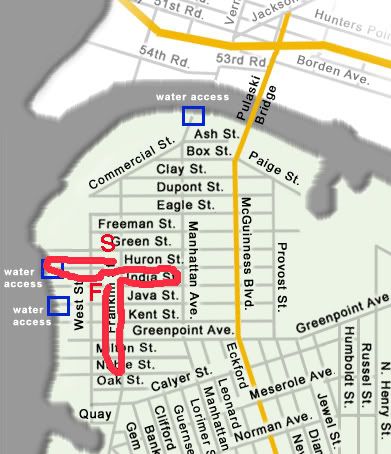 A Knickerbocker Village author celebrating his 59.5 year birthday joined me on a Greenpoint walking tour. Using information from Adrienne Onofri's Walking Brooklyn we traversed the path indicated. Highlight's included the view from the pier, the Astral Apartments, the Mechanics and Trader's Bank and great coffee and dessert at the Brooklyn Label.
from greenpunkt
A Short History of Greenpoint Brooklyn
In 1645 the streets of New Amsterdam, at the southern tip of Manhattan, were muddy and raucous with the sound of livestock and fowl. On a small path, north of town, young girls washed linen in a stream where today Maiden Lane crosses lower Manhattan. And, after three long years of bloody conflict with the Algonquin Indian tribe, a peace settlement had finally been achieved between the Indians and the Dutch Colony.
It was in that year (1645) that Dirck Volckertsen bought a peninsula of salt marsh, meadows and sandy beachline from the Dutch West India Company. Volckersten, known as “Dirck the Norman”, built a house atop a small knoll which stood just west of the present day intersection of Calyer and Franklin Streets. The house, as was typical of early Dutch settlements, bore the influences of contemporary Dutch architecture. Construction materials were limited, and so Dirck Volckersten took the stones from the fields, and the wood from a nearby forest to build the house.
By 1777, as the American Revolution raged, four new homesteads were built on the quiet and isolated land. Two homesteads were owned by brothers (Abraham and Jacob Meserole), while the other homes were owned by Jacob Bennett, Jonathan Provoost, and Jacobus Calyer. Each of these houses abutted a plot of farm land, and their harvests were brought by family boat to market at the southern end of Manhattan.
The landscape of the point, in these early years, was significantly different than it is today. Steep bluffs, some 100 feet tall, dropped into the East River between Java and Oak Streets. Just north of present day Huron Street, formed by the outflow of Newtown Creek, a scraggly point of marsh grass extended out into the river, giving the point its name. That point is now gone, as are the many streams, with fish and blue crabs, that drained the marshes and fed Newtown Creek.
Much of this change can be attributed to the arrival of Neziah Bliss, a resolute visionary. In 1834, after having purchased some 30 acres of land, Bliss had this southern portion of Greenpoint surveyed. Although surveyed for streets and lots, the first house was not constructed until late fall 1839. The interim between survey and construction might best be explained by the isolation of Greenpoint. Prior to the completion of what was named the Ravenswood, Green-Point and Hallet’s Cove turnpike, access to the land of Greenpoint was, at best, inconvenient. The turnpike ran along present day Franklin Avenue. As with the land survey, the turnpike was predominantly funded by Neziah Bliss.
Across the river, New York City was a burgeoning metropolis. Beginning in 1820, an enormous and overburdening influx of foreigners poured into the United States, and the preferred port of entry was New York Harbour. With the vast influx of foreigners, as well as a depression settling on the cities inhabitants, crime and poverty skyrocketed. By 1832, cholera joined the army of ills besetting Manhattan. Cholera was shortly followed by fire and insurection. It is of no surprise then, that following completion of the Ravenswood, Green-Point and Hallet’s Cove turnpike that Greenpoint's population rose rapidly.
With the opening of the turnpike in 1839, Neziah Bliss next set out to establish a ferry service between Greenpoint and Manhattan. Up to this point, all conveyeance between Greenpoint and New York City, was conducted on a system of privately owned skiffs. By 1848, Bliss had procured a lease from the City of New York, and by 1850 an established ferry system departed from the base of Greenpoint Avenue to 10th street on Manhattan.
Concurrent with the opening of the turnpike and the ferry service, the formerly isolated community of Greenpoint transformed into a center for shipbuilding and shipwrights. Shipbuilding facilities sprouted all along the Greenpoint waterfront, as did houses to house the shipwrights that worked in them. By 1850, twelve seperate shipyards lined the Greenpoint waterfront, employing thousands of workers.
In response to the turnpike, shipyards, and the influx of new inhabitants, the town of Greenpoint soon developed. In 1848 the first school of Greenpoint opened near Kent and Manhattan Avenue. The first general store opened on the turnpike (present day Franklin and Freeman streets) in 1850, with the installation of gasslights to the town in 1854. Saint Anthony's church, which stands as a kind of emblem of Greenpoint, was erected in 1874.
In 1862, the most famed of all the ships assembled in Greenpoint was launched from the Continental Iron Works yard (located at Calyer and West Street). This was the USS Monitor, the world's first ironclad, turreted warship, measuring 173' long and displacing over 900 tons. On March 9th, 1862 the USS Monitor engaged with the CSS Virginia in one of the most significant naval battles of the Civil War. Although niether side decisively won the battle, naval warfare was forever changed: the history of wooden warships had ended.
Other industries established themselves contemporaneous with the shipbuilding industry in Greenpoint, including printing, pottery, gas, glass, rope, pencil and iron manufacture and production. In 1867, the Astral Oil Works refinery was built (the Astral Apartments were later built to house its employees). Soon followed the American Manufacturing Company, with its interconnecting pedestrian bridges that still cross above West street today. In 1872, Faber Pencils also opened a factory in Greenpoint (between Greenpoint Avenue and Kent Street, on Franklin).
Although the Greenpoint shipbuilding industry declined following the Civil War, other industries remained, and bouyed its economy.
Wednesday, April 30, 2008
Brooklyn Heights Greenery
Some surprise views, Knickerbocker from across the river and possibly Brooklyn based author, Paul Auster.
The music: Torme sings this great Lorenz Hart lyric:
On the first of May
it's a moving day;
spring is here, so blow your job-
throw your job away;
Now the time to trust
to your wonderlust.
In the city's dust you wait
must you wait?
Just you wait;
In a mountain greenery
where God paints the scenery
just two crazy people together.
While you love your lover, let
blues skies be your coverlet.
When it rains we laugh at the weather.
And if you're good
I'll search for wood
so you can cook
while i stand looking.
Beans could get no keener re-ception in a beanery.
Bless our Mountain Greenery home!
Simple cooking means
More than French Cuisines
I've a banquet planned which is
Sandwiches and beans
Coffee's just as grand
With a little sand
Eat and you'll grow fatter, boy
`smatter boy? Huh, huh! `Atta boy.
In a mountain greenery,
Where God paints the scenery
Just two crazy people together.
How-how-how-how-how we love sequestering
Where no pests are pestering
No dear momma holds us in tether
Mosquitoes here,
Won't bite you dear,
I'll let them sting, me on the finger!
Beans could get no keener reception in a beanery
Bless our mountain greenery,
Far from life's machinery
Bless our mountain greenery home!
Subscribe to:
Posts (Atom)


 Posts
Posts