ROBERT SANTANGELO, EX-JUDGE ON THE STATE SUPREME COURT By JOAN COOK Robert V. Santangelo, a former State Supreme Court justice and the prosecutor in the Seabury corruption investigations in New York City in the 1930's, died Wednesday at United Hospital in Port Chester, N.Y. He was 87 years old and lived in Rye, N.Y., and Highland Beach, Fla. Justice Santangelo was a jurist for more than 30 years. He was first appointed to Magistrate's Court, in 1934. Later he was elected judge of the First District Municipal Court in Manhattan in 1951 after he was appointed to fill an unexpired term. He held the post for 20 years, then served in Civil Court for 10 years. He spent his last five years as a jurist in State Supreme Court, retiring in 1967. He was an assistant district attorney in Manhattan from 1924 to 1933. But he was perhaps best known for his role in the Seabury investigations in 1931 and 1932. The inquiries led to the defeat of Tammany Hall and the election of Fiorello H. La Guardia as Mayor in 1933. Justice Santangelo had been a partner in the law firm of La Guardia, Sapinsky before joining the District Attorney's office, and remained a personal friend of Mr. La Guardia's throughout his life. He was a graduate of the College of the City of New York and Columbia Law School. He is survived by his wife, the former Juliette Petronio; two sons, Francis, of Harrison, N.Y., and Robert Jr., of Rye, N.Y.; a brother, Dr. George Santangelo of Harrison; four sisters, Jean Fabri of Manhattan, Louise Pizzutello of Fort Lauderdale, Fla.; Vera Melarano of Scarsdale, N.Y., and Eleanor Roosevelt of Staten Island; six grandchildren and two great-grandchildren. A funeral service will be held today at 10:30 A.M. at Corpus Christi Church, Port Chester, N.Y.His son Robert has this web site
Showing posts with label judge lupiano. Show all posts
Showing posts with label judge lupiano. Show all posts
Saturday, October 1, 2011
1951: Mayor Impelliteri Swears In Robert Santangelo Of 9 Monroe Street
santangelo-1951
9 Monroe Street was the site of Kremo's, Judge Lupiano, a former KVer is mentioned in the article as well.
Justice Santangelo was a 4th Warder and politician of merit. From his 1984 obituary


Sunday, April 4, 2010
Dr. Paul Sarubbi: Who's Who In Knickerbocker Village History
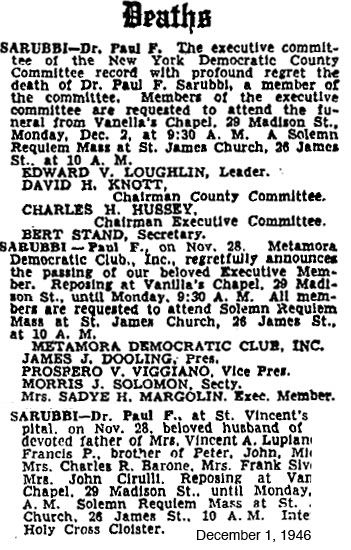 The above is from a 1946 obituary.
Dr. Sarubbi was Judge Lupiano's father-in-law. In addition to being a physician he was a local elected official. He also lived at 40 Monroe Street in Knickerbocker Village.
Judge Vincent Lupiano: A Follow Up

I was pleased to find out that the Lupiano family discovered the blogposts about the Judge. Above is a close-up from a grouping of pictures posted previously
from the Judge's son Vincent who is seen above as a young boy in the 1950 photo from Life Magazine
I was stunned to see the story and pictures of my father, Vincent A. Lupiano, in the March 10, 2010, issue of KV. I have hardcopies of the pictures which show my father, mother and sister, as well as the whole family. Those photos were taken in my grandparents’ (father’s side) basement in Brooklyn, and I have no idea who took them and where they wound up. I believe it was either a Christmas or Thanksgiving dinner. It had to be around 1950 because I appear to be about 10 years old and my sister five. I remember being terribly bored!
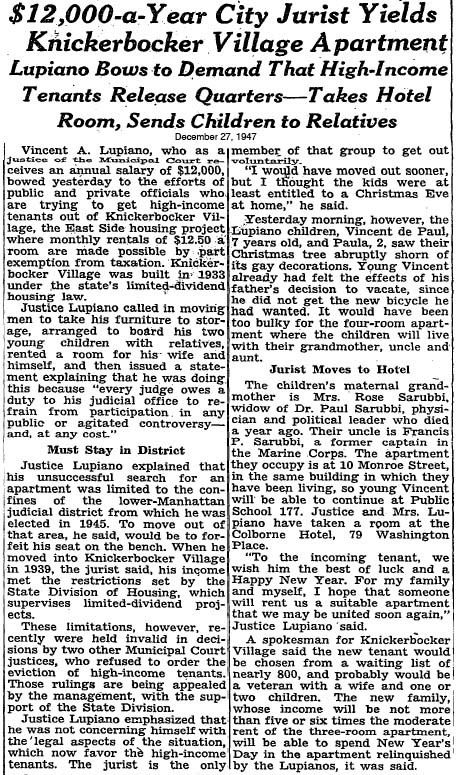
I have very fond memories of KV. My favorite grandfather (mother’s side) lived there. He was a surgeon and had lived in a brownstone on Cherry Street; his office was on the ground floor. He sold the brownstone and moved into KV. I have very vivid memories of my uncle coming home to KV from the war. The apartment was filled with friends and family waiting for him to arrive. It was 1945, and I was about five. In fact, I have a picture of me and my uncle in the courtyard of KV. He’s wearing his Marine Corps uniform with captain’s bars taken a few days after he came back from the Pacific. The biggest story was an article the Daily News wrote about my father condemning him for living there because, relatively speaking, his salary was too big for someone living in KV. The article said he should move out and make room for another family. He was a judge then and his salary was above average, and the publicity wasn’t very good. As a result, we moved out in 1948 on a day that dropped nearly 30 inches of snow on the city. We moved to 302 West 12th Street in the Village. I could go on and on about KV. Thanks for giving the pictures and story such prominence.-Vince
Thursday, March 18, 2010
Lower East Side Politics
Politics Les
Judge Lupiano and his father-in-law Paul Sarubbi are mentioned along with Tammany Hall,
mobsters and all kinds of ethnic and racial machinations.
from Political Parties and the State by Martin Shefter
Judge Lupiano and his father-in-law Paul Sarubbi are mentioned along with Tammany Hall,
mobsters and all kinds of ethnic and racial machinations.
from Political Parties and the State by Martin Shefter
Judge Lupiano In The News
Lupiano Articles
As for the first article it wound up to be true that Impelliteri would be a factor. He did win the mayoralty in 1950 running on the Experience line. Judge Pecora is mentioned. He was in the news recently. More on that.
In the second article, looks like Judge Lupiano was not a union favorite judge.
As for the first article it wound up to be true that Impelliteri would be a factor. He did win the mayoralty in 1950 running on the Experience line. Judge Pecora is mentioned. He was in the news recently. More on that.
In the second article, looks like Judge Lupiano was not a union favorite judge.
The Road To Knickerbocker: Judge Lupiano
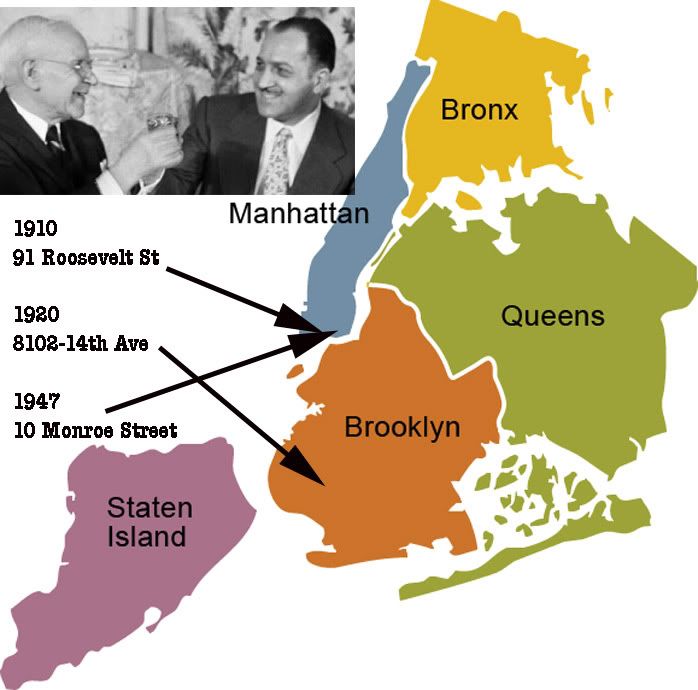
I'm always fascinated about how people came to live in KV. In many cases people followed the usual immigrant road away from the lower east side as their economic situation bettered. Knickerbocker reversed the trend because people saw a good housing value as well as an opportunity to be closer to downtown work.
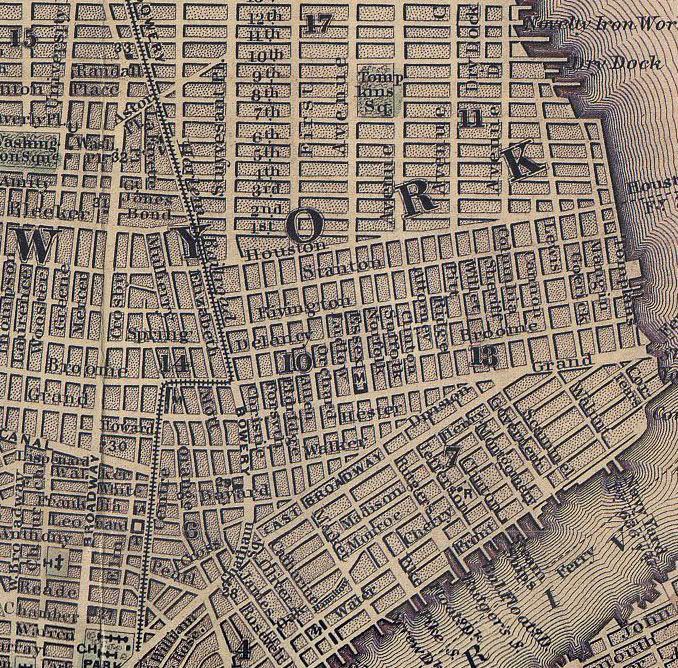
The above map showed how Judge Lupiano started out in the Fourth Ward on Roosevelt Street and then came back when he became a lawyer and then a judge.
Sunday, March 14, 2010
Judge Vincent Lupiano: 1950 Photo Essay
Lupiano Life
from a December 1950 photo essay in Life Magazine by Al Fenn. I believe it coincides with Lupiano's election to the New York City Court.
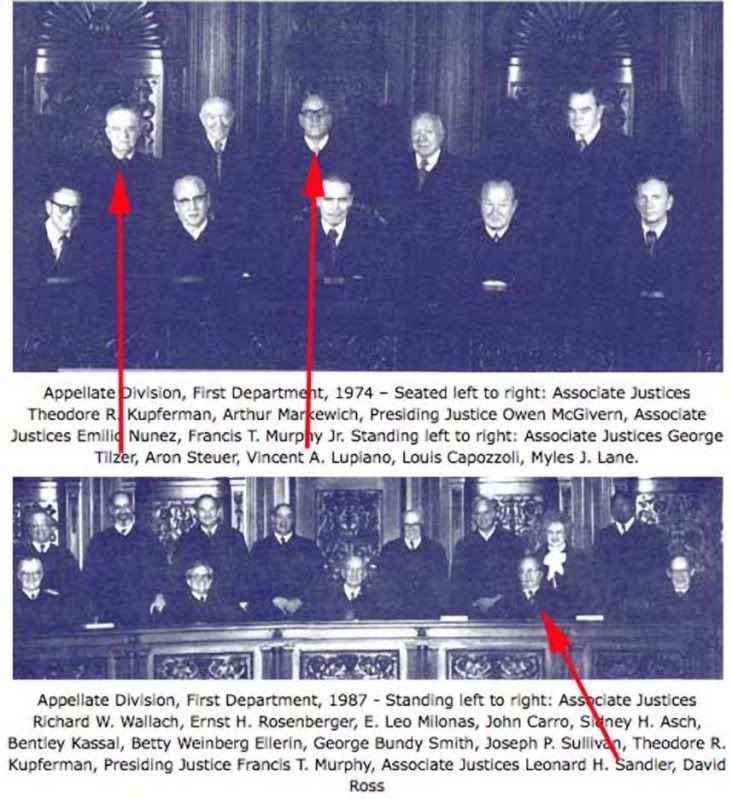
from the new york state centennial court site
from a December 1950 photo essay in Life Magazine by Al Fenn. I believe it coincides with Lupiano's election to the New York City Court.
from the new york state centennial court site
VINCENT A. LUPIANO
Associate Justice 1974-1982 Born: 1908
Died: September 15, 1982
Upon Justice Vincent A. Lupiano’s induction into the New York State Supreme Court, his father, Dominick Lupiano, who had been operator of the justices’ private elevator in the New York County Supreme Court Building for 42 years, came out of retirement to operate the elevator his son took on the day of his installation. His father’s "dream came true" for his son.
Vincent A. Lupiano was born in New York City in 1908. He attended DeWitt Clinton High School and graduated from New York University. He was an accomplished pianist, and his musical talent helped him pay his way through college and law school. He received his law degree from Fordham University School of Law in 1931.
From 1931 to 1944, Lupiano practiced law in New York City. He was elected a New York City Municipal Court Judge in 1944 and served there until 1950, when he was elected to the New York City Court. Four years later he was elected to the Supreme Court. In 1974, Justice Lupiano was appointed by Governor Malcolm Wilson to the Appellate Division First Department, where he remained until his death in 1982.
In 1974, the Columbian Lawyers Association honored Justice Lupiano with its Charles A. Rapallo Award in recognition of his "judicial excellence."
Justice Lupiano was married in 1939 to Roselle Sarubbi Lupiano, with whom he had two children. He died on September 15, 1982, at age 74.
Who's Who In Knickerbocker Village History: Judge Vincent Lupiano
In the Kefauver hearings of 1951 Judge Lupiano was mentioned. Evidently his father in-law, Dr. Paul Sarubbi, was friendly with Frank Costello
He denied having said a kind word for Loscalzo whom O'Dwyer later appointed judge, although he admitted that Loscalzo had come all the way out to a golf course to see him and ask him to put in a good word and introduce him to Kennedy. Nor had he had anything to do with proposing Louis Valente as candidate for surrogate. The luncheon which he attended with Mancuso, Generoso Pope, Sr., DeSapio, and Judge Valente was to plan their part in a charity drive in which Pope was interested. But Costello couldn't remember what the charity was. The drive had never taken place; nor could Costello remember what part he was supposed to have taken in it, or what assignments the other political leaders had. Driven to admitting that this was contrary to his executive session testimony, Costello finally would not deny specifically that the subject of the Valente candidacy had ever come up. He simply couldn't remember. Nor would Costello admit that he had ever said a kind word for Judge Lupiano, a son-in-law of his friend, the late Dr. Sarubbi. He conceded that he might have said over the telephone that he thought maybe Sarubbi wanted to make a judge out of him.
That Costello's influence has continued down to the present day was the impression of Charles Lipsky, a friend of O'Dwyer, who testified that when O'Dwyer said he would not run in 1949, he got Sherman to take him out to see Costello in an attempt to win Costello's support for his candidate for mayor. The following year when O'Dwyer resigned and there was to be a special election, Lipsky stated, he tried to get Adonis to see Costello on the same errand.
Subscribe to:
Posts (Atom)


 Posts
Posts