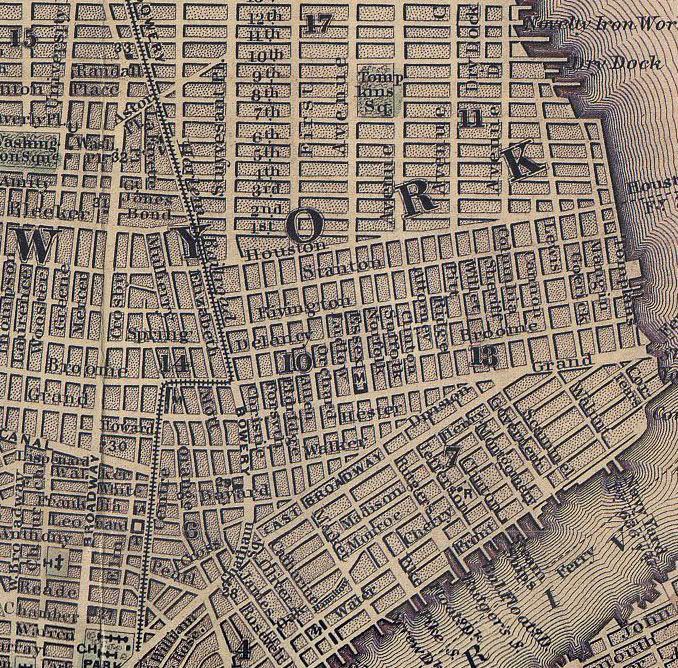
from the University of Nebraska Library Collection
Duck Cover Comic
Showing posts with label duck and cover. Show all posts
Showing posts with label duck and cover. Show all posts
Sunday, June 21, 2009


Duck And Cover 2
Duck and Cover was a civil defense film (sometimes also characterized as a social guidance film or propaganda) produced in 1951 (but first shown publicly in January 1952) by the United States federal government's civil defense branch shortly after the Soviet Union began nuclear testing. Written by Raymond J. Mauer and directed by Anthony Rizzo of Archer Productions and made with the help of schoolchildren from New York City and Astoria, New York, it was shown in schools as the cornerstone of the government's "duck and cover" public awareness campaign. The movie states that nuclear war could happen at any time without warning, and U.S. citizens should keep this constantly in mind and be ever ready.
The US government contracted with Archer to produce Duck and Cover. The film is now in the public domain, and as such is widely available through Internet download sources, as well as on DVD.
The film starts with an animated sequence, showing an anthropomorphic turtle walking down a road. A chorus sings the Duck and Cover theme:
There was a turtle by the name of Bert
and Bert the turtle was very alert;
when danger threatened him he never got hurt
he knew just what to do...
He'd duck! [gasp]
And cover!
Duck! [gasp]
And cover! (male) He did what we all must learn to do
(male) You (female) And you (male) And you (deeper male) And you!'
[bang, gasp] Duck, and cover!'
The attack.
While this goes on, Bert is attacked by a monkey holding a string from which hangs a lit stick of dynamite. Bert ducks into his shell in the nick of time, as the dynamite goes off and blows up both the monkey and the tree in which he is sitting. Bert, however, is shown perfectly safe, because he has ducked and covered.
The film, which is about 10 minutes long, then switches to live footage, as a narrator explains what children should do "when you see the flash" of an atomic bomb. The movie goes on to suggest that by ducking down low in the event of a nuclear explosion, the children would be safer than they would be standing, and explains some basic survival tactics for nuclear war.
Duck And Cover
I'm sure the dog tags was related to the fear of nuclear war in the 50's and 60's
Duck and Cover was a suggested method of personal protection against the effects of a nuclear weapon which the United States government taught to generations of United States school children from the late 1940s into the 1980s. This was supposed to protect them in the event of an unexpected nuclear attack which, they were told, could come at any time without warning. Immediately after they saw a flash they had to stop what they were doing and get on the ground under some cover—such as a table, or at least next to a wall—and assume the fetal position, lying face-down and covering their heads with their hands. Similar instructions were given in 1964 in the United Kingdom by Civil Defence Information Bulletin No. 5. and, in the 1980s, by the Protect and Survive series.
Proponents argued that thousands could be saved through this precaution, without which people would instead run to windows to find the source of the big flash. During this time a shock wave would cause a glass implosion, shredding onlookers.
Similarly, "Drop, Cover and Hold On" is taught in areas prone to earthquakes. Schools in some tornado-prone areas of the United States also practice tornado drills that involve children squatting and covering the backs of their heads.
The United States' monopoly on nuclear weapons was broken in 1949 when the Soviet Union tested its first nuclear device, and many in the government and public perceived that the United States was more vulnerable than it had ever been before. Duck-and-cover exercises quickly became a part of Civil Defense drills that every American citizen, from children to the elderly, practiced to be ready in the event of nuclear war. In 1950, during the first big Civil Defense push of the Cold War; the movie Duck and Cover was produced (by the Federal Civil Defense Administration) for school showings in 1951. At the time, it was believed the main dangers of a Hiroshima-type nuclear blast were from heat and blast damage: radioactive fallout itself was not clearly identified until 1954, after the Castle Bravo nuclear-weapon test in the Marshall Islands caused sickness and death in Japanese fishermen on the Lucky Dragon fishing vessel.
The advice to "duck and cover" holds well in many situations where structural destabilization or debris may be expected, such as during an earthquake or tornado. At a sufficient distance from a nuclear explosion, the shock wave would produce similar results and ducking and covering would perhaps prove adequate. It would protect the face (particularly the eyes) from the intense heat of a detonation. It would also offer some protection from flying glass and other small, but dangerous, debris. However, within a considerable radius—depending on the explosion's height and yield—ducking and covering would offer negligible protection against the intense heat, shock waves, and radiation following a nuclear explosion. People in this range would have little opportunity to duck and cover before being killed by the blast. The technique offers no protection against fallout. However, the technique assumes that after the initial blast, a person who ducks and covers will move to a more sheltered area. It is a first response only.
In U.S. Army basic training in the 1970s, soldiers were taught to fall immediately down, covering face and hands and using their bodies to shield their weapons from the heat of the blast.
The exercises of civil defense are now seen as having less practical use than psychological use: to keep the danger of nuclear war high on the public mind, while also attempting to assure the American people that something could be done to defend against nuclear attack.
These messages, including children's songs, were used to educate the young public in case of nuclear attack.
Ducking and covering does have certain applications in other, more natural disasters. In states prone to tornadoes, school children are urged to 'duck and cover' against a solid inner wall of a school, if time does not permit seeking better shelter—such as a storm cellar—during a tornado warning. The tactic is also widely practiced in schools in states along the West Coast of the United States, where earthquakes are commonplace. Ducking and covering in either scenario would theoretically afford significant protection from falling or flying debris.
In an earthquake, people are encouraged to "drop, cover, and hold on": to get underneath a piece of furniture, cover their heads and hold onto the furniture. This advice also encourages people not to run out of a shaking building, because a large majority of earthquake injuries are due to broken bones from people falling and tripping during shaking. While it is unlikely that "drop, cover and hold on" will protect against a building collapse, buildings built in earthquake-prone areas in the United States are usually built to earthquake "Life Safety" codes[citation needed], and a building collapse (even during an earthquake) is rare. "Drop, cover and hold on" may not be appropriate for all locations or building types, but many experts agree it is the appropriate emergency response to an earthquake in the United States.
Saturday, June 20, 2009
A KV Father's Day 2009
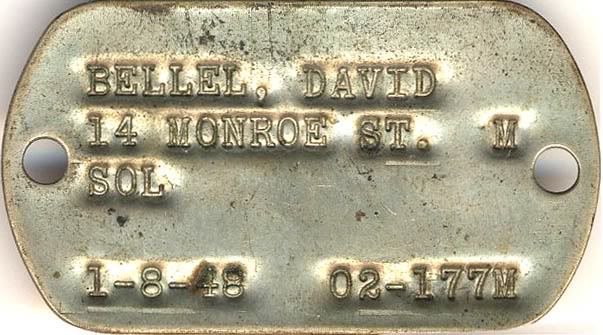
Cleaning up my basement I found this among the stuff I salvaged from my parents apartment. I wonder what the 02 next to PS 177 means? Maybe the school district it was in then?
From Elinor:
PS 177 WAS in Community District 2.....I taught for short while in PS 42 on Hester St. and that was District 2 also.
from Cliff
02 on your dog tag could be the postal code. KV addresses back then, before the days of Zip Codes, was New York 2, NY.
Subscribe to:
Posts (Atom)


 Posts
Posts