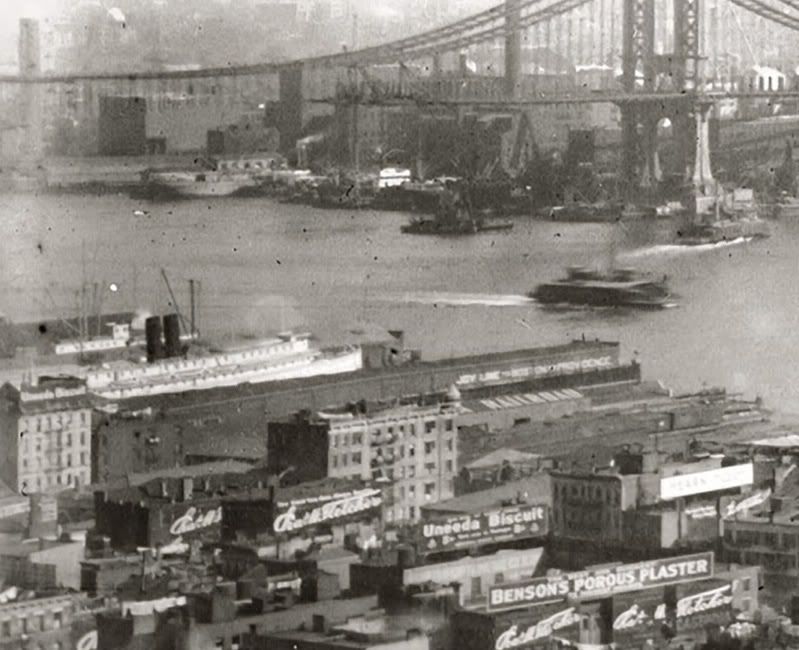
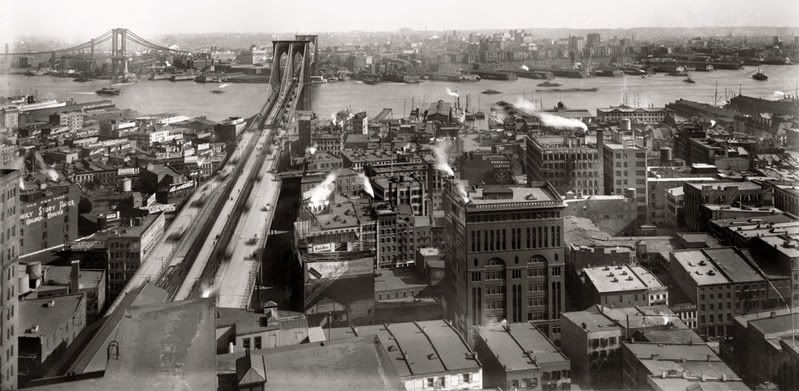
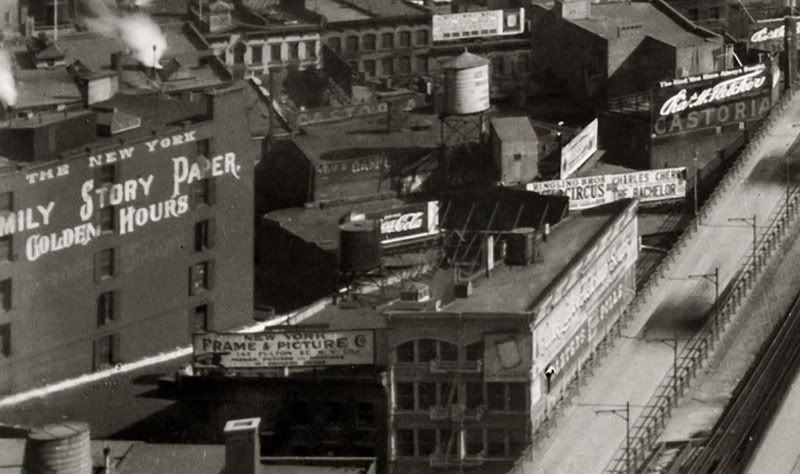
A viewing of this site's archival photos can't help but reveal all of the painted advertising on the building sides. It also reveals that people were pretty obsessed with "regularity" as
Fletcher's Kastoria was dominant. Those painted on signs were the primary print media of the time. Many of those ads are still around, but they're fading fast. Sometimes "new" ones become revealed when an adjoining building is demolished, but now everything is getting demolished. The images from the above movie (the audio is Brenda Russell's) were taken over 5 years ago, mostly by Frank Jump, and some of them have vanished. BTW, the Zaccaro Real Estate Ad is from the family of John Zaccaro, Geraldine Ferraro's husband. I believe he owned property on Market Street at one time
Frank Jump's site is an encyclopedic source of these ghost signs and there's plenty of accompanying history. The site loads slowly because of that. Frank now has a
blog site as well. Here's a nytimes article about Frank from 2005:
Painted Signs, Relics of a Bygone New York, Become Even More Rare
By JOSEPH BERGER
They are hieroglyphics of a bygone New York, writings on walls redolent of a time when women wore corsets, nearly every parlor seemed to have a piano and buggies couldbe hired for a genteel ride up the avenue once a blacksmith shod the horses.
Signs painted on the sides of humdrum brick buildings advertised such wares and services, in bold block letters accompanied occasionally by an evocative sketch. Amateur archaeologists can still unearth them, faded and weathered as they are, by hey evoke the exuberant period of American capitalism," said Kathleen Hulser, public historian of the New-York Historical Society. "Consumer cultures were really getting going and there weren't many rules yet, no landmarks preservation commission or organized community saying: 'Isn't this awful? There's a picture of a man chewing tobacco on the corner of my street.' "
While a century ago, preservation groups viewed the signs as vulgar interlopers, some now want to sustain them. They seem like remnants of "a more civilized time," Ms. Hulser said.
The city's Landmarks Preservation Commission, however, has decided that it will not protect what it calls "ghost signs," according to Diane Jackier, a spokeswoman. "The commission protects architectural features and the commission does not consider the painted signs a significant feature," she said. No one has applied for a landmark designation for a painted sign in years, Ms. Jackier said.
Signs that are threadbare but still visible recall workhorse department stores like Gimbels and Hearns and men's clothing shops like Rogers Peet. They evoke a time when apartment buildings like the Warwick Arms at 101 West 80th Street trumpeted ULTRA MODERN APARTMENTS with GLASS SHOWER ENCLOSURES and when bowling alleys like McLEAN BOWL-O-DROME, which opened in 1942 along the Yonkers border, lured customers by boasting of air-conditioning.
At a three-story brick building at 109 West 17th Street that is now a Japanese furniture shop, wording painted on the exterior alerts buyers to a former incarnation of the building: TO LET /CARRIAGES COUPES HANSOMS VICTORIAS LIGHT WAGONS/ HORSES BOARD BY THE MONTH.
According to Walter Grutchfield, 69, one of three buffs who maintain Web sites devoted to photographs of the signs, the building was a livery stable from 1900 to 1905, owned by Patrick Logan, whose Irish roots are detectable in stone clover leaves set into niches in the building's facade.
Not too far away on the side of 151 West 19th Street is white Italic lettering alongside a sketch of a scissors for Griffon SHEARS SCISSORS. Griffon Cutlery Works, which also sold nail files, tweezers and manicure sets, used the building as its headquarters from 1920 into the 1960's.
The scissors suggest that homemakers typically did their own sewing well into the 1960's, an observation corroborated a few blocks north along Seventh Avenue with a sign for Necchi sewing machines, complete with a drawing of a machine with gracefully curving legs.
A sales office for Necchi, an active Italian company, opened at 154 West 25th street in 1949, but has long closed.
Charles Scribner III, whose family founded the legendary publishing house that bears his name, said that every time he drove down Ninth Avenue toward the Lincoln Tunnel, he delighted in the SCRIBNERS sign on the side of a 14-story red-brick building at 311 West 43rd Street.
For him, it recalls the glory days when Scribner's, now known as the Scribner imprint of Simon & Schuster, published Edith Wharton, Ernest Hemingway and F. Scott Fitzgerald.
The building, which opened in 1907, was the publisher's printing plant and warehouse - Hemingway's shotgun shells were also stored there - and Scribner's sold it 1955 when, like other companies, it found printing in New York too expensive.
"There were probably boxes of the first edition of 'The Great Gatsby' stored there that would now be worth more than the building itself," Mr. Scribner said, noting that a jacketed first edition of the book sells for $150,000.
The tearing down of old buildings in Times Square has given some once-obscured old signs a fleeting exposure. One of the last signs in the area - for J.A. KEAL'S CARRIAGE MANUFACTORY REPAIRING on Broadway and 47th Street - was suddenly revealed around 1998 when the adjacent building was torn down. But it was concealed again the next year once a new building began rising on the same spot.
The Bronx is still a gold mine, but construction to fill in the gaps in streets once plagued by arson is hiding or destroying many signs. Murals for the laxative Fletcher's Castoria were once ubiquitous in working-class areas and one in yellow lettering can still be seen on 134th Street between Alexander and Lincoln Avenues.
But an 80-year-old Castoria mural on 180th Street and Belmont Avenue is no longer visible. One of the quainter Bronx signs, NEMUTH BLACKSMITH WELDING, can still be glimpsed on a ramshackle garage-like building on Halperin Avenue in the Eastchester section.
Along Bruckner Boulevard, a handful of lingering signs, like the one for JEWEL PIANO CO., attest to the South Bronx's fame as a hub of piano manufacturing before World War I. According to the Bronx Historical Society Web site, piano manufacturing began to die off with the advent first of phonographs, then radio, then television. The last plant closed in the 1970's.
Until recent years, an ESTEY PIANO CO. sign just below the clock on a late 19th-century building popularly known as the Clocktower hinted at the lyrical age when every home seemed to have a piano. But the building has been rented out for residential lofts, and the Estey sign has been scrubbed away.
Older signs are being preserved, virtually, through the Internet. Frank H. Jump, a 45-year-old Brooklyn schoolteacher, sells photographs of the signs for $750 each through his Web site, www.frankjump.com. A favorite is the gold-on-blue sign at 147th Street and Frederick Douglass Boulevard for Omega Oil, a snake-oil concoction once used for sunburn, weak backs and stiff joints.
As someone who received a diagnosis of AIDS 22 years ago, he sees the painted signs as "metaphors for survival." So he was heartbroken to see another favorite, a spectral azure sign advertising a 19th-century laundry whitener, RECKITT'S BLUE/ THE PUREST AND BEST, on a three-story building at 622 Washington Avenue in Brooklyn, obscured by a new building. It had once been featured in articles about his curious obsession.
"That one hurt the most," he said.




 Posts
Posts