Showing posts with label crime. Show all posts
Showing posts with label crime. Show all posts
Thursday, September 8, 2011
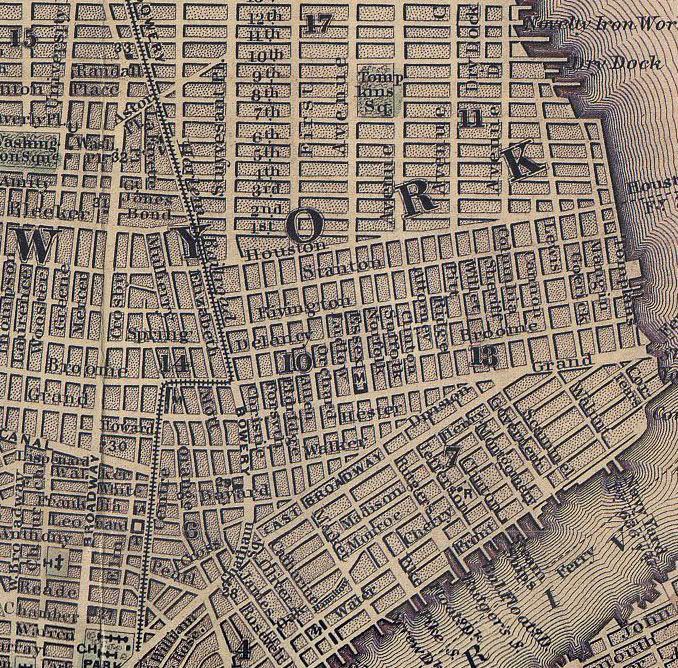
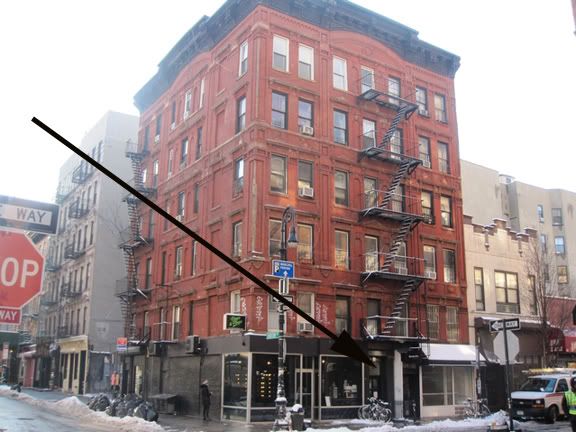
101 Stanton Street


Tuesday, August 16, 2011
John Monforte, Dean Of Sing Sing's Prisoners

Early NYC Arrestees
from the nytimes of 8/14/11
Arrested 1900
I did a search to see if any of these came from the "crime laden" Fourth Ward.
Only possible hit was John Alexander, who in 1920 was living in a flophouse at 100 Bowery. His ancestry was from Russia.
Arrested 1900
I did a search to see if any of these came from the "crime laden" Fourth Ward.
Only possible hit was John Alexander, who in 1920 was living in a flophouse at 100 Bowery. His ancestry was from Russia.
Tuesday, May 17, 2011
Thursday, April 22, 2010
Ten Cents A Dance And Taxi Dance Halls
The evils of 1920-1930 lower east side and other neighborhood Dance Halls was alluded to in a previous post
an excerpt from an article in the nypress
an excerpt from an article in the nypress
"Fighters and sailors and bowlegged tailors
Can pay for a ticket and rent me
Butchers and barbers and rats from the harbor
Are sweethearts my good luck has sent me."
—Rodgers and Hart, "Ten Cents a Dance" (1930)
Richard Rodgers and Lorenz Hart could easily have been using the Orpheum as a model when they described the "pansies and rough guys, tough guys who tear my gown" in their caustic take on the dime-a-dance, or "taxi-dance" phenomenon, which reached its peak during the 1920s and early 30s. Practically forgotten today, the taxi dancer was a famous type, spawning not only the hit song but an eponymous 1931 movie starring that perennial bad girl of pre-Hays Code days, Barbara Stanwyck. Taxi-dancing—the name derived from the "more time, more money" model of a cab ride—was for many women an alternative to the narrow set of opportunities prescribed them in the first decades of the 20th century. Since dancers customarily earned 40 to 50 percent of each 10-cent dance ticket (hence the term that evolved during taxi dancing's early days, "nickel hoppers") energetic young women in the late 1920s could easily take home up to $40 a week.
Though patronizing in spots and saddled with the "reformist" tone of his day, sociologist Paul Cressey gives one of the most vivid period accounts of human interaction, or lack thereof, in establishments like the Orpheum, in his 1932 book, The Taxi-Dance Hall:
"As soon as the girl receives a ticket from the patron, she tears it in half, gives one part to the ubiquitous ticket-collector; and the other half she blandly stores with other receipts under the hem of her silk stocking—where before the evening is over the accumulation appears as a large and oddly placed tumor. She volunteers no conversation…"
While certain dancers made quiet arrangements to meet their clients at a later time, most could not be classified as prostitutes. In fact, at better-known establishments such as the Orpheum, rules against "mingling" (socializing with men away from the dance floor) were rigidly enforced, and no liquor was served—even after the repeal of Prohibition. Although sailors and other military personnel accounted for a large portion of the Orpheum's clientele, every so often a young man of society, such as Allan Carlisle, great-grandson of famed detective agency founder Allan Pinkerton, would elope with one of its dancers. On the whole, taxi dancing, at the Orpheum as well as in Manhattan's 238 other dance halls (by a 1924 count), was considered a viable profession, albeit one that lurked outside the bounds of respectability.
This is not to say that the taxi-dance hall was without its exploitative elements. The disquieting image of a pedometer, coiled tightly around a female ankle, anchors a two-page spread devoted to the Orpheum (named only as a "famous taxi dance ballroom on Broadway," but identifiable through photos) in the Boston Sunday Globe of November 22, 1936. Pedometers, the article explains, are not used all the time, but the management employs them occasionally "to check which girls are working." The depiction of women as human chattel, as items for purchase, continues with an extolment of the hall's variety:
Monday, April 5, 2010
Saturday, April 3, 2010
Joseph Cohen: 171 Ludlow Street
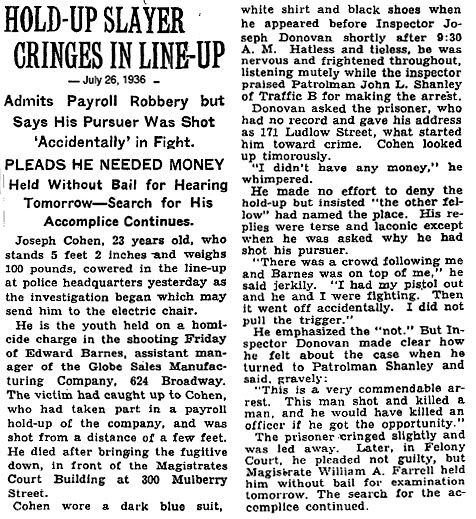
I wonder where Cohen was living at 171 Ludlow, unless it changed from a stable sometime between 1933 and 1936.
Wednesday, September 9, 2009
600 Arrested In Raid On Dance Hall: Feb. 16, 1921

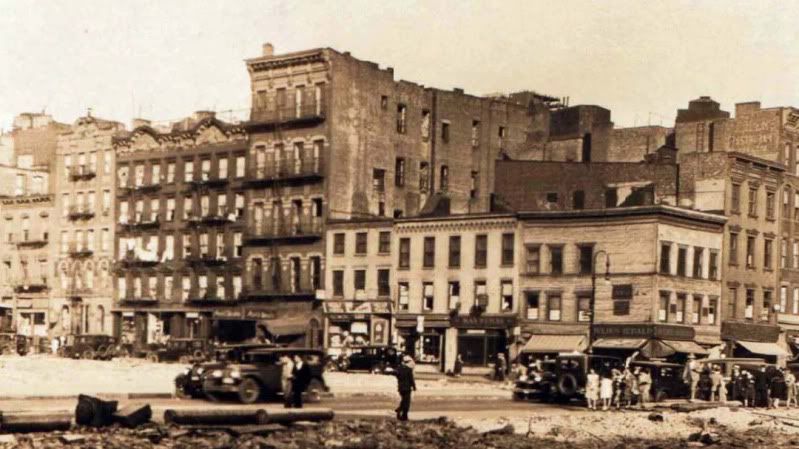
Somehow I forgot to post the above article with below a close up version of the picture from a previous post Things must have been smoking at that "smoker." The picture is circa 1930 when buildings were being demolished for Sara Delano Roosevelt Park. The Odd Fellows Hall is the six story building in the middle with the awning.
Thursday, September 3, 2009
Monday, June 22, 2009
Trunk Theft At 116 Madison Street: April 17, 1928
116 Madison Trunks 1928
I think that there must have been a luggage store concentration around the bowery and Division Street at that time. If you zoom in and look closely this picture from a previous post may bear that out.
I think that there must have been a luggage store concentration around the bowery and Division Street at that time. If you zoom in and look closely this picture from a previous post may bear that out.
Drug Raid In The Fourth Ward: Sept 7, 1921
Drug Raid Lspain
Note how parts of the Fourth Ward were then called Little Spain
Note how parts of the Fourth Ward were then called Little Spain
Thursday, July 10, 2008
Who's Almost Who In Knickerbocker Village History: Louis Lepke Buchalter
unlike the case of Isadore Zimmerman, Lepke's demise was not a miscarriage of justice.
I found Lepke (Louis Buchalter) living at 217 Henry Street in 1910. The clip is from a pretty bad biography starring Tony Curtis as Lepke.
Louis "Lepke" Buchalter (12 February 1897 – 4 March 1944) was a Jewish- American mobster of the 1930s. He is the only major mob boss ever to have been executed by state or federal authorities for his crimes.prison on 4 March 1944.
Born in 1897 to Eastern European immigrants on the Lower East Side of Manhattan, Buchalter took on the nickname "Lepke" at an early age. The name was an abridgement of the affectionate diminutive "Lepkeleh" ("Little Louis" in Yiddish) his mother had called him when he was a small boy. By 1919, at the age of only 22, he had already served two prison terms.
Upon his release, he teamed up with his childhood friend, Jacob "Gurrah" Shapiro, gradually gaining control of the garment industry unions on the Lower East Side. He used the unions to threaten strikes and demand weekly payments from factory owners while simultaneously dipping into union bank accounts. His control of the unions later evolved into a general protection racket, extending into such areas as bakery trucking. The unions were an extremely profitable venture for him, and he kept a firm hold on them even after becoming an important figure in the organized crime world.
In the early 1930s, Charles "Lucky" Luciano, Lepke, and John "Johnny The Fox" Torrio, (the former Chicago boss and mentor of Al Capone), formed a loose alliance. To take care of any problems that arose, Luciano's associates Benjamin "Bugsy" Siegel and Meyer Lansky formed Murder, Inc. Originally a band of Brooklyn killers, they were highly effective and eventually used to fulfill most murder contracts. Control of the group soon passed to Lepke and Albert "Mad Hatter" Anastasia, as Siegel and Lansky had larger concerns to deal with. Murder, Inc., the name given to it by the media in the 1940s, was credited with carrying out numerous contract killings throughout the country, including the slaying of Dutch Schultz.
As many as a hundred corpses have been attributed to Lepke[citation needed]. Some of the hitmen at Lepke's disposal included Abe "Kid Twist" Reles, Seymour "Blue Jaw" Magoon, Frank "Dasher" Abbandando, Harry "Happy" Maione, Albert "Tick-Tock" Tannenbaum, and Harry "Pittsburgh Phil" Strauss (known as "Pittsburgh Phil" despite his having no known connection to that city). The killing of Dutch Schultz on 23 October 1935 was a major killing for the group, as was the murder of Louis "Pretty" Amberg the same day.
Buchalter's downfall began in the mid-1930s when he went on the run from both the FBI, who wanted to arrest him on a narcotics charge, and from New York City special prosecutor Thomas E. Dewey, who wanted him tried for his syndicate activities. He was tricked by a childhood friend into surrendering to the federal government in exchange for his not being turned over to Dewey. Buchalter was sent to Leavenworth Federal Penitentiary in Kansas on a 14 year term for narcotics trafficking. The sentence was later extended to 30 years on account of Buchalter's involvement in union racketeering.
Even more serious legal problems and consequences followed for Buchalter in 1940. That year, the state of New York indicted him for a murder committed over four years earlier, on 13 September 1936. On Sunday morning, a crew of Murder, Inc. killers, acting on Buchalter's orders[citation needed], had gunned down Brooklyn candy store owner Joseph Rosen. Rosen was a former garment industry trucker whom Buchalter had forced out of business. He had aroused Buchalter's ire by failing to heed Lepke's warnings to keep quiet and leave town. Rosen allegedly began threatening to expose Lepke and his vast crime operations to special prosecutor Thomas E. Dewey.
Buchalter's order for the Rosen hit had been overheard by Abe Reles, who turned informant for New York State in 1940 and fingered Buchalter for four murders. Brought back from Leavenworth to Brooklyn to stand trial for the Rosen slaying, Buchalter's position was worsened by the testimony of Albert Tannenbaum. Four hours after they were handed the case, the jury arrived at a verdict at 2:00 a.m. on 30 November 1941, finding Buchalter guilty of first degree murder. The penalty at the time for such a crime in the state of New York was death by electrocution. Also convicted and sentenced to death for the same crime were two of Buchalter's lieutenants who had participated in the planning and carrying out of the Rosen murder, Emanuel "Mendy" Weiss, and Louis Capone (no relation to Al).
Buchalter's conviction took place in December 1941, and the New York Court of Appeals, upon review of his case, upheld his conviction and death sentence in October 1942. At the time, Buchalter was serving his racketeering sentence at Leavenworth Federal Prison, and New York state authorities demanded that he be turned over to them for execution. Buchalter resisted, managing to remain in Kansas and out of New York's hands until finally extradited in January 1944. Buchalter and his lieutenants Weiss and Capone were electrocuted within minutes of each other at New York's Sing Sing
Wednesday, June 11, 2008
Sunday, June 1, 2008
Musketeers Of Pig Alley
In keeping with recent "crime" thread
DW Griffith's 16 minute film, 'The Muskateers of Pig Alley' was produced in 1912, and is credited as being the first gangster film ever committed to celluloid. It was apparently influenced by the nationwide press attention of the murder of gambler Herman Rosenthal, and the subsequent trials of Harry Horowitz (Gyp The Blood), Louis Rosenberg (Lefty Louie), Jacob Seidenschmer (Whitey Lewis),Dago Frank and Liet. Charles Becker. Griffith was intrigued enough to take his camera to the Lower East Side and cast, apparently, actual street hoods and gangsters from the neighborhood as extras to authenticate his footage alongside his principle actors. While thematically has very little to due with the Rosenthal case, it was the first time the Lower East Side became a central backdrop to a story on film. It's a fascinating window into the past regardless if the use of actual criminal types was just early studio marketing savvy or the truth.
Another Griffith landmark and what could reasonably be considered the first gangster film ever made. Clearly this exercise in realism is the predecessor of the crime movies of later generations, The film is about a poor married couple living in New York City. The husband works as a musician and must travel often for work. During one of his away trips, he is robbed by a gangster. Later, he gets caught up in a shootout and recognizes one of the men as the gangster who took his money. Now he wants it back.
The film was released on October 31, 1912 and re-released on November 5, 1915 in the United States. The film was shot on location in New York City, and reportedly used actual street gang members as extras during the film.
Griffith shot the film on location and cast actual gangsters like 'Kid' Brood and 'Harlem Tom' Evans to play in the rival gangs. According to the Biograph Bulletin of October 31, 1912: "This picture production, which does not run very strong as to plot, is simply intended to show vividly the doings of the gangster type of people."
The episodic plot begins in "New York's other side ", "where a poor musician goes off to improve his fortune." On the way home, he shows his earnings to a friend in the street. The Snapper Kid, Chief of the Musketeers, sees the full wallet, follows the musician, hits him over the head, and takes the money. After recovering, the musician goes out to find his money, leaving the little lady, his girlfriend, worrying about his safety and the rent. A friend comes to cheer up the little lady and takes her to a dance - the gangster's ball. A respectable-looking gangster invites the little lady for a drink and slips a drug into it. The Snapper Kid watches the scene and stops the little lady before she downs the drink, thus provoking a gang war. During the shootout, the musician sees the gangster and grabs his money back during the confusion of the battle. The police break up the fight and arrest everyone but the Snapper Kid. He escapes to the little lady's flat, reminds her that he saved her from being drugged and invites her out. She refuses and says she'll stay with her husband. The gangster shrugs it off, thinking she must be crazy to prefer the musician, and leaves. A cop nabs him and begins to arrest him for taking part in the gun battle, but the Snapper Kid says he has an alibi - he was visiting his friends. The little lady and the musician back up the Kid's story because, as the title card reads, "One good turn deserves another". The Kid makes a gesture of friendship with his hands and goes out. After a title, "Links in the system", a mysterious hand slides into the picture from out of frame and gives the Snapper Kid some money. The couple embrace, and the film ends.
Griffith pictured the Snapper Kid sympathetically. Elmer Booth portrays a likeable, tough, coarse thief and killer. Lillian Gish has said that Elmer Booth was a distinct precursor of James Cagney. Like gangsters played by Cagney, the Snapper Kid is short, powerful, explosive, and expressive with his body, face and gestures. He is violent and quick to act in movements that snap out like his name. He is good-natured about the little lady's rejection, sly enough to avoid going to jail, wise enough not to fight in the Big Boss's place, and constantly putting plans into action to get what he wants. He exudes a healthy self-confidence and is proud of the snappy way he dresses. Griffith's mixing of a firm sense of realistic detail and a romantic bias have shaded the Chief of the Musketeers as more chivalrous than the movie gangsters who followed, but the Snapper Kid launched the central character of the genre - a sympathetic gangster - and the movie gangsters who followed shared many of his traits.
The Lower East Side locations in Musketeers provide an appropriate setting for the birth of the genre. "New York's other side", as a title describes the setting, is comprised of dingy rooms and hallways, saloons, narrow streets teeming with immigrants, and underworld alleyways filled with garbage cans, dust, and debris. City textures and dark places predominate. The action takes place around the bottoms of buildings, and we never see the sky. There are no country or uptown alternatives for the Snapper Kid - no penthouse aspirations. The gangster genre began in the slums, and the people who lived there appreciated the film. Billy Bitzer, who was Griffith's cameraman regularly and who shot MUSKETEERS, recalled an early preview of the film: "Another way we learned was through tryouts. Tryouts were usually in remote theatres, and it was to our advantage to be there. One memorable tryout was held in a converted store in the Lower East Side Jewish section of Manhattan. It was in 1912 for The Musketeers of Pig Alley, an early gangster film with Elmer Booth, much of which was filmed in that locale. We got very strong and favourable reactions - it was one of the first realistic films, one of our best."
Saturday, May 31, 2008
Who's Almost Who In Knickerbocker Village History: Meyer Lansky 2
I put together a compilation of images of Lansky in addition to his locations on the LES
Who's Almost Who In Knickerbocker Village History: Meyer Lansky
I always thought Meyer's LES roots were further "uptown" than they really were. According to the following, part of a recent Lost and Found entry by the Times' James Stevenson, he lived at 546 Grand Street (now part of the Grand Street Co-ops) and went to school at the old PS 34 on Broome Street.
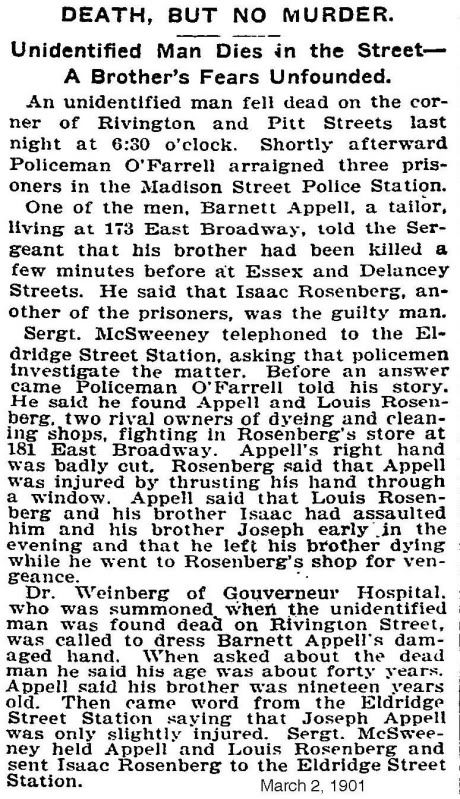
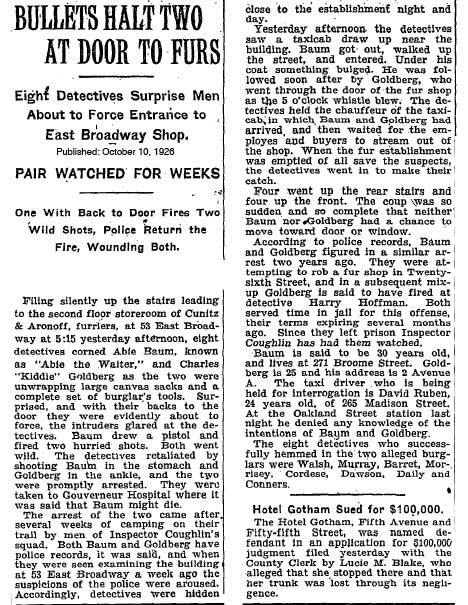
53 East Broadway: Furrier Thieves Foiled
In 1914 the cops were ready for Abie "The Waiter" Baum and Charles "Kiddie" Goldberg.

Subscribe to:
Posts (Atom)


 Posts
Posts