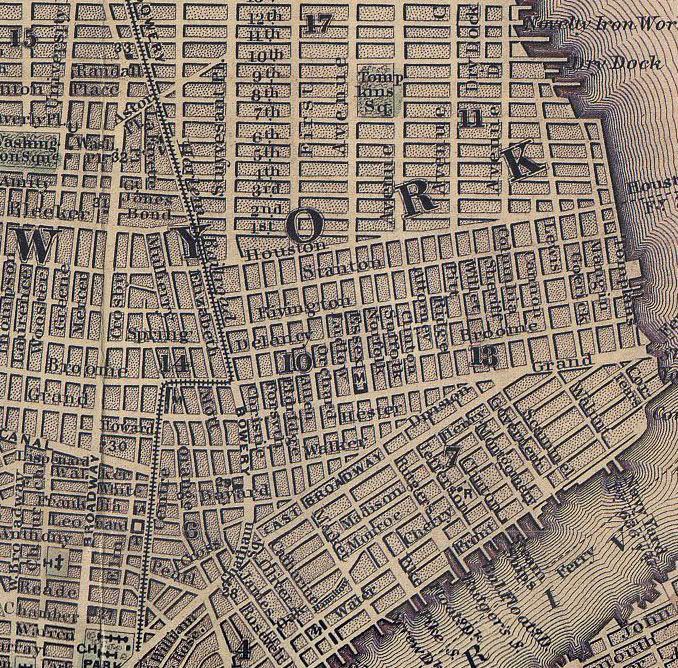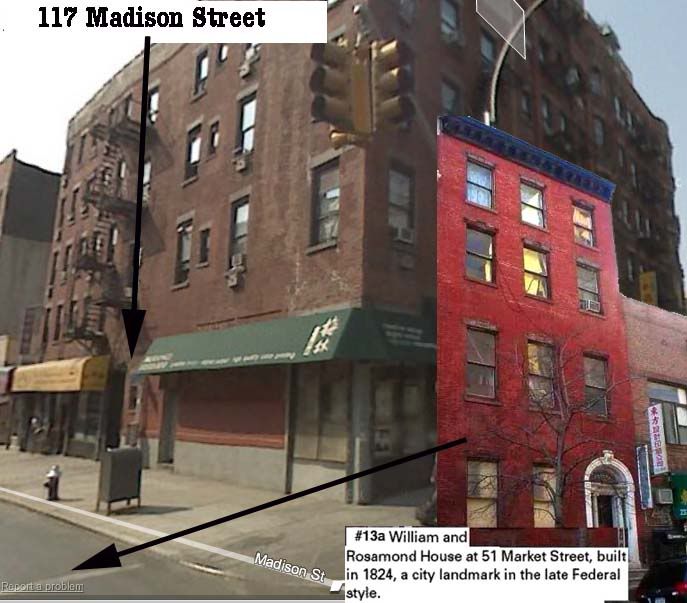
The site of Dr. Amos Pollard's Fourth Ward residence. Perhaps in 1834 when Pollard lived there the building may have looked like the historic 51 Market Street house.

In the southern part of Texas, in the town of San Antone,
There's a fortress all in ruin that the weeds have overgrown.
You may look in vain for crosses and you'll never see a one,
But sometime between the setting and the rising of the sun,
You can hear a ghostly bugle as the men go marching by;
You can hear them as they answer to that roll call in the sky:
Colonel Travis, Davy Crockett and a hundred eighty more;
Captain Dickenson, Jim Bowie, present and accounted for.
Back in 1836, Houston said to Travis:
"Get some volunteers and go fortify the Alamo."
Well, the men came from Texas and from old Tennessee,
And they joined up with Travis just to fight for the right to be free.
Indian scouts with squirrel guns, men with muzzle loaders,
Stood together heel and toe to defend the Alamo.
"You may never see your loved ones," Travis told them that day.
"Those that want to can leave now, those who'll fight to the death, let 'em stay."
In the sand he drew a line with his army sabre,
Out of a hundred eighty five, not a soldier crossed the line.
With his banners a-dancin' in the dawn's golden light,
Santa Anna came prancin' on a horse that was black as the night.
He sent an officer to tell Travis to surrender.
Travis answered with a shell and a rousin' rebel yell.
Santa Anna turned scarlet: "Play Degüello," he roared.
"I will show them no quarter, everyone will be put to the sword."
One hundred and eighty five holdin' back five thousand.
Five days, six days, eight days, ten; Travis held and held again.
Then he sent for replacements for his wounded and lame,
But the troops that were comin' never came, never came, never came.
Twice he charged, then blew recall. On the fatal third time,
Santa Anna breached the wall and he killed them one and all.
Now the bugles are silent and there's rust on each sword,
And the small band of soldiers lie asleep in the arms of The Lord.
In the southern part of Texas, near the town of San Antone,
Like a statue on his Pinto rides a cowboy all alone.
And he sees the cattle grazin' where a century before,
Santa Anna's guns were blazin' and the cannons used to roar.
And his eyes turn sort of misty, and his heart begins to glow,
And he takes his hat off slowly to the men of Alamo.
To the thirteen days of glory at the seige of Alamo.
POLLARD, AMOS (1803-1836). Amos Pollard, chief surgeon of the Alamo garrison, son of Jonas and Martha (Martin) Pollard, was born at Ashburnham, Massachusetts, on October 29, 1803. He was raised in Surry, New Hampshire, and graduated from the medical school of the Vermont Academy in Castletown, Vermont, in 1825. Pollard lived for a time in Greenbush, New York, and then spent the years 1825 to 1834 practicing medicine at various locations in Manhattan. He married Fanny Parker in 1828, and they had one daughter. His wife died in 1831. In 1834 Pollard traveled to Texas by way of New Orleans.
He settled in Gonzales, Texas, and took part in the fight for the Gonzales `come and take it' cannon, the opening skirmish of the Texas Revolution, on October 2, 1835. He later marched on San Antonio de Béxar as a private in Capt. John York's volunteer company. On October 23, 1835, he was appointed surgeon of the regiment by Stephen F. Austin.
After the siege of Bexar Pollard remained in the town as chief surgeon of the Texan garrison, on the staff of Lt. Col. James C. Neill. He cared for the sick and wounded of the garrison and also set up a hospital within the Alamo. On February 23, 1836, Antonio López de Santa Anna's Mexican army besieged the Alamo. Pollard died in the battle of the Alamo on March 6, 1836, probably defending the Alamo hospital. A portrait of him was done sometime before he moved to Texas. Besides Travis, Bowie, and Crockett, he is the only Alamo defender of whom a portrait was done from life. A copy of the portrait is on display in the Alamo.
Mexico had a marketing problem. Soon after gaining independence from Spain, in 1821, the young republic desperately wanted to populate its northern state, Texas, to solidify its grip on a huge, lawless territory that the Spanish had never effectively colonized. But few “interior” Mexicans south of the Río Grande wanted to move to the Texas province, largely because it was inhabited by Apaches and Comanches, who were not looking for neighbors. So Mexico offered U.S. settlers cheap land—on the condition they swear allegiance to Mexico and convert to Catholicism. (A good many settlers no doubt failed to abide by those conditions.) Ultimately, says historian William C. Davis, “the Anglos would pose a greater threat than ever the Comanches had.”
Not only did the Mexican government offer land grants to any person or family who agreed to settle in Texas; it also, under the Mexican Constitution of 1824, guaranteed that newcomers would pay no taxes for at least seven years. And to sweeten the deal, Mexico—despite having abolished slavery in the republic—would allow Anglo settlers to bring along with them any slaves they already held.
Before long, immigrants were arriving from nearly every state east of the Mississippi, as well as from France, Germany, Ireland, Denmark, England and Scotland. Edwin Hoyt, author of The Alamo: An Illustrated History, writes that typical settler Dr. Amos Pollard, a New York City physician with a failing practice, awoke one morning in 1834, read an advertisement for land in Columbia, Texas, and set out almost immediately to claim some for himself. Pollard, who would die at the Alamo, where he had served as doctor, settled alongside blacksmiths and trappers from Tennessee, an Irish artist, a Frenchman who had served as a soldier in Napoleon’s army and jailbirds from Alabama. Most of the newcomers, according to Hardin, were “descended from America’s first revolutionaries, and many had fought with Andrew Jackson in 1815 at New Orleans” against the British.


 Posts
All Comments
Posts
All Comments