Marvin Julian Miller was born in the Bronx on April 14, 1917, and grew up in Flatbush rooting for the Brooklyn Dodgers. His father, Alexander, was a salesman for a clothing company on the Lower East Side in Manhattan, and as a youngster Marvin walked a picket line in a union organizing drive. His mother, Gertrude Wald Miller, who taught elementary school, was a member of the New York City teachers union.
from the john sterling blog
10 things school children should know about the late Marvin Miller
1. In 1966, when he formed the MLB Players' union, the average salary was a stinking $19,000.
2. Over the last 20 years, he was consistently screwed out of being elected to the Hall of Fame by rigged committees of bitter owners and toadie sportswriters.
3. Joe Morgan once said, of Miller's exclusion from the Hall: "They should vote him in and then apologize for making him wait."
4. Before taking over the Players Union, he worked with the Machinists, the UAW and the Steelworkers.
5. In his first bargaining agreement in 1968, he increased the MLB minimum salary from a pitiful $6,000 to $10,000.
6. That was the first minimum salary increase in two decades.
7. He seized on the fact that Charlie Finley had welched on Catfish Hunter's contract, freeing him to sign with the Yankees.
8. He recognized that too many free agents at once would drive down the value of players; thus, he set up a system where only a few would hit free agency each year.
9. At the end, Miller grew fed up with the votes for Cooperstown. He said, "At the age of 91, I can do without farce."
10. He led his union through three strikes and two lockouts. The final record: 5-0.
Barry passed late last night. Author Michael Egan writes about Commoner's importance on his blog.
An biographical excerpt from book rags
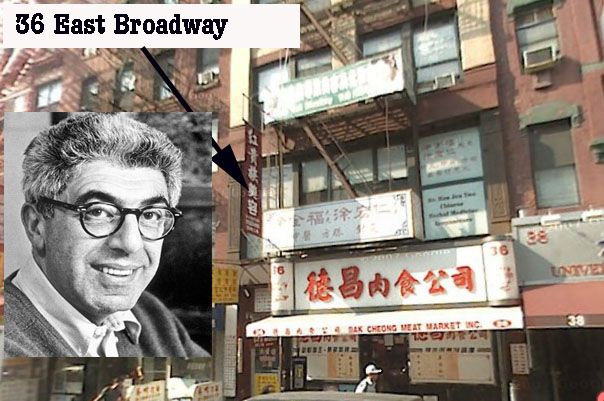
Barry Commoner was born in Brooklyn, New York, on May 28, 1917. His parents were Isidore Commoner, a Russian immigrant tailor, and Goldie Yarmolinsky Commoner. During his childhood in East New York and Flatbush , Commoner demonstrated a keen interest in science. He spent his spare time scouring city parks for specimens he could examine under his microscope...... Doing some detective work on ancestry I discovered his father
had a tailoring business at 36 East Broadway in 1918. He also had a business at 20 East Broadway and 66 New Bowery (now St. James Place).
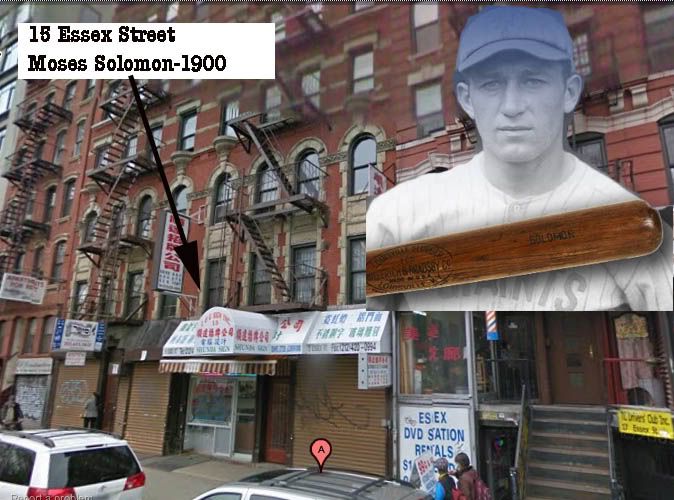
Moses Solomon was born on December 8, 1900 in New York City. He was the son of Russian immigrants, Benjamin and Anna Solomon. The elder Solomons were married in Russia in 1884 and came to the United States in 1891. They had eight children in all and Moses was the fifth of the eight. In 1906, the family moved to Franklin, Ohio and Benjamin worked for a junk dealer. Moses also worked for the dealer and is listed in the 1920 census as a time keeper for the dealer.
A year later, Moses played baseball for the Vancouver Beavers in the Pacific Coast International League. He played in 115 games and batted .313 with 13 homers. Not bad for a first year in professional ball. He only played in a few games in 1922 but still batted .303. But it was 1923 that would make him a legend.
By 1923, he had signed to play for the Hutchinson Wheat Shockers in the Southwestern League, a Class C league. He played mostly first base for the Wheat Shockers and had one of the most memorable seasons in minor league history. In 134 games, he batted 527 times, piling up 222 hits for a .421 average. He hit 40 doubles, 13 triples and 49 homers. The 49 homers set a minor league record and only the great Babe Ruth had more in professional baseball.
McCarthy heard of Solomon's exploits and amidst much hoopla, purchased his contract and brought him to the Giants in September of 1923. He made his major league debut on September 30 and played two games. In eight at bats, he had three hits including a double and drove in a run. It would be the only two games he would ever play in the major leagues.
The Giants found out about an aspect of Solomon's game that would prove to be his undoing. He couldn't field. The same minor league season where he set the record for home runs, he made 25 errors. He made an error in the two games he played in the outfield for the Giants. He was the Ron Bloomberg of his time. All hit, no field.
Moses Solomon continued after the 1923 season to bang around the minor leagues. He played through 1929 and batted over .300 three times, but his total home run output of all those seasons did not come close to totaling as much as his 49 in 1923 alone. One source indicates he also played football, but no record can be found as such.
By 1930, he is listed in the census as being back in Franklin, Ohio with his wife, Gertrude and two young children. His occupation is listed as, "Agent." His Wiki page states that he went into real estate and did quite well. The Rabbi of Swat died in Miami, Florida in 1966.
Moses Solomon (or Mose) only played two games in the major leagues, but not many people could state that his career ended with a .375 average. Imagine if the guy with the .313 minor league career batting average could have caught the ball. His minor league record of 49 homers was broken in 1924 by Clarence Kraft who hit 55. Kraft didn't hold the record long himself as a guy named Tony Lazzeri (you may have heard of him) hit 60 in 1925.
Abraham David Beame was born in London on March 20, 1906, to Polish-Jewish parents who had fled Warsaw, then part of Czarist Russia. His father, Philip Birnbaum, a Socialist revolutionary who barely escaped arrest, went directly to New York, while his mother, Esther Goldfarb Birnbaum, stopped in London to give birth and joined her husband three months later. In New York, the family name was changed to Beame. Abraham's mother, who had two more sons and a daughter, died in 1912; his father remarried and had two more children.
The boy, called ''Spunky'' for his scrappiness, grew up in a crowded cold-water flat on the Lower East Side. Childhood friends said he was an outstanding student at Public School 160. At the High School of Commerce, where he graduated at the top of his class, he had perfect scores in the state Regents bookkeeping exams and showed an extraordinary ability to absorb data and memorize facts.
He was always working. One early morning job was to go through tenements, waking people who had no alarm clocks. During his high school years, he worked evenings in a paper factory, studying during his dinner hour. He roller-skated to school and work to save subway fare. His father took him to Socialist party meetings, and he remembered Eugene V. Debs, who ran for president five times.
At 15, he met Mary Ingerman over checkers at the University Settlement House on Eldridge Street. Seven years later, after he graduated from City College with an accounting degree in 1928, they were married.
They lived in Brooklyn for the next 45 years, first in a two-family house in Crown Heights, where they raised their sons, then in a modest apartment near Prospect Park. They spent summers at rented cottages in Belle Harbor, on the Rockaways in Queens.
My rational, he was a Birnbaum before his named was changed to Beame.
On a stage, Mason seems to shed weight and worry. And years, although the question of his age is touchy; he insists that he's 51 in spite of good evidence that he is 55. There is a protective conspiracy in the family to hide Jackie's birth date. His brother, Rabbi Bernard Maza, who is quite willing to say that Jackie was, from youth, a comic and an intellectual nonentity in the family ("You didn't know he existed") is unwilling to reveal Jackie's age. "We don't believe in numbers," the rabbi explains. "It's bad luck to count your blessings by numbers. But getting back to Jackie's comedy. Now we think he's a genius. Then...?"
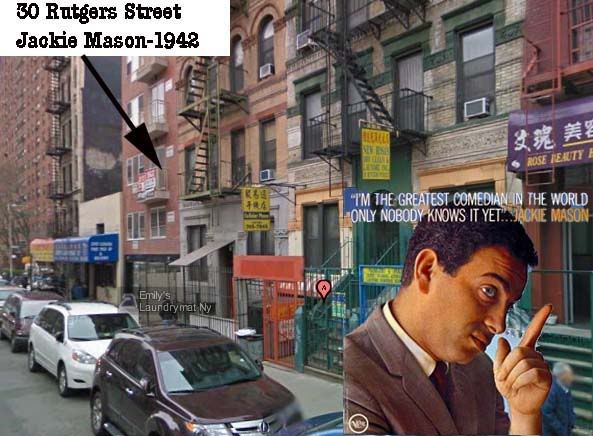
Jackie Mason was born Jacob Maza to a rabbi who came from Minsk and eventually settled on the Lower East Side of Manhattan. "My father, Eli, and my father's father, and my father's father's father—as far back as anyone can remember, all rabbis," says Jackie. There were two younger sisters (Gail and Evelyn) in addition to three brothers (Joseph, Gabriel and Bernard). "My three brothers all became rabbis, and I became a rabbi. I had no choice. It was unheard of to think of anything else. But I knew, from the time I'm 12, I had to plot to get out of this, because this is not my calling. I am not so sure about God, but I knew for certain that I worshipped the young girls, and this could get me into big trouble."
Jackie's gift for satire appeared relatively late in his life. "He was always the most serious person at the table," says his sister-in-law Malka Maza. "He only wanted to talk politics." Says Jackie: "My brothers were all brilliant and I was a shmuck. Every time I opened my mouth they told me to shut up. So I hung out with guys on the corner—Sol, Nat, Irving. Compared to them I was a genius."
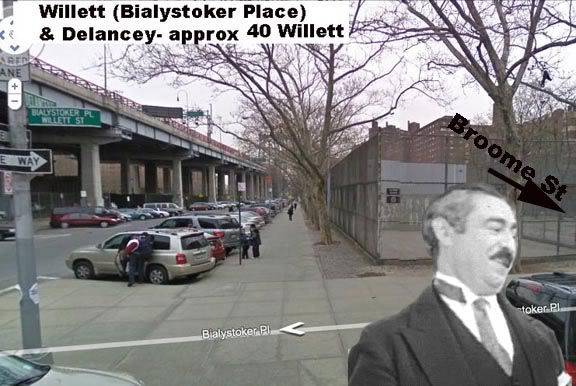
Louis Sorin (1893–1961) was born and died in New York, New York. As a young boy he lived at 6 Willett Street which is about a block and a half south (to the right) of the site above and about a mile from KV. He appeared in 15 films between 1929 and 1961. He was also a prolific theatre actor, notably appearing on Broadway in more than 20 productions between 1923 and 1952.
Sorin is perhaps best known to modern audiences for his performances as Roscoe W. Chandler in The Marx Brothers film "Animal Crackers" (a role he also played onstage), and as Mr. Manicotti in the 1956 Honeymooners episode "Mama Loves Mambo".
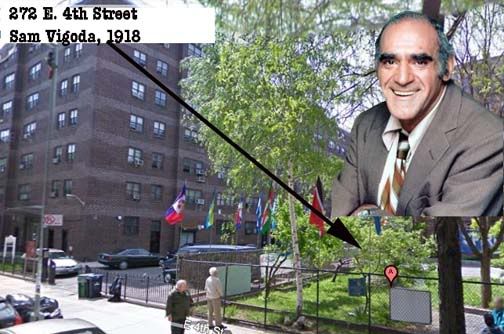
btw, Tessio is not Italian. Abe was born in 1921, but in 1918 has father was living at the above address.
Later the family moved to Brownsville.
About Abe:
Abraham Charles "Abe" Vigoda; (born February 24, 1921) is an American movie and television actor. Vigoda is well known for his portrayal of Sal Tessio in The Godfather, and for his portrayal of Detective Sgt. Phil Fish on the sitcom television series Barney Miller from 1975–1977 and on its spinoff show Fish that aired from February 1977 to June 1978 on ABC. Vigoda was still also appearing on Barney Miller at the same time as he was on Fish during the 1976–1977 TV season; at the start of the 1977–1978 season, his character retired from the police force and left Barney Miller to focus full time on the spinoff.
He made regular appearances as himself (usually in skits relating to his "advanced age") on the television show Late Night with Conan O'Brien, including a cameo on that show's final episode.
Vigoda was born in New York City, the son of Lena (née Moses) and Samuel Vigoda, Jewish immigrants from Russia. His father was a tailor and his brother, Bill Vigoda, was a comic-book artist who drew for the Archie comics franchise and others in the 1940s.
Vigoda was married once, to Beatrice Schy from February 25, 1968 until her death on April 30, 1992. They had one child, a daughter, Carol. Vigoda gained fame through his supporting character roles, notably as elder mobster Salvatore Tessio in The Godfather (1972). He gained further fame playing Detective Sgt. Phil Fish on Barney Miller, and then led its brief spinoff Fish until it was canceled in 1978. Before Barney Miller, he made a few appearances on the ABC TV soap Dark Shadows. He has also appeared in several Broadway productions, including Marat/Sade (1967), The Man in the Glass Booth (1968), Inquest (1970), Tough to Get Help (1972), and Arsenic and Old Lace (1987). His trademark hunched posture and slow delivery of lines made him appear older than he really was.
On January 23, 2009, Vigoda appeared live on The Today Show. He said he was doing well, joked about previous reports of his death and in fact announced he had just completed a voice-over for an H&R Block commercial to air during the Super Bowl. On December 30, 2009 Vigoda was invited back to The Today Show to appear live on the set for Matt Lauer's birthday party. Vigoda was warmly greeted by Lauer who called him "our favorite guest of all times" on the show. Vigoda then sat and discussed his long career with Lauer.
Vigoda appeared alongside Betty White in a Snickers commercial that debuted during Super Bowl XLIV on February 7, 2010.[5] The actor has also been honored with pop culture references, many in connection with false reports of his death (see below). Jazz bassist Eric Revis's song "Abe Vigoda" appears on saxophonist Branford Marsalis's 2009 album Metamorphosen.
Not a cardboard god, but in my opinion a musical one. I chose a foreign language version of the above clip, Shaw's band playing behind Astaire and Eleanor Powell, for better resolution. I once speculated on a LES connection to Artie Shaw, but I couldn't find out where he lived in his earliest years. Now coinciding with his 100th birthday a new biography of Shaw provides the missing information. He was born on May 23, 1910 and his first home was at 255 E. 7th Street, between C and D. Later he moved to 43 Avenue C, between 3rd and 4th Streets. He may have gone to PS 15 just around the corner. He lived there until 1918, moving then to New Haven. A year later my mother would be born and lived within two blocks of Shaw's birthplace. Elinor Hecht's grandma had her chicken market nearby as well. excerpts from the nytimes review of Three Chords For Beauty's Sake, The Life of Artie Shaw by Tom Nolan
Artie Shaw, the swing era’s other great clarinetist, knew just about every romantic self-immolator in the history of jazz. He roomed with both Bix Beiderbecke and Bunny Berigan, he hired Billie Holiday to sing with his band and — at least by his own account — he turned down Charlie Parker’s bid to join his saxophone section. (“I said, ‘Bird, you couldn’t play in my band, you’re too much of an individualist!’ ”) Superficially, Shaw couldn’t have been less like these doom-bound drunks and drug addicts. In “Three Chords for Beauty’s Sake,” Tom Nolan’s absorbing if somewhat sketchy new biography, we see him drunk exactly once — when he was in his teens and a prankish band mate fed him shots of rye with beer chasers — and once, at about 20, “half-stoned” on weed with Berigan. Thanks to clean living, good luck and, surely, a measure of cussedness, Shaw lived to be 94 and died, in 2004, the way Robert Frost recommended: “Better to go down dignified / With boughten friendship at your side / Than none at all. Provide, provide!” He even kept his sense of humor, or at least his memory of an old Myron Cohen joke. His personal assistant (who stayed with him for 11 years, sometimes by dint of repeating the word “mortgage” to himself) and his home-hospice caregiver were changing the old man’s bedclothes during his last days and asked if he was comfortable. “I make a living,” he said. He did, too. Though Nolan’s book doesn’t say so, Shaw’s estate was probably worth around $3 million, and he hadn’t played on a record for half a century.
Yet “Three Chords for Beauty’s Sake” is as grimly fascinating as any story of a young flameout dying in the gutter. Shaw spent his first 44 years acquiring artistic mastery — Ray Charles called him “one of the greatest musicians that ever lived” — as well as money, fame and an array of America’s choicest sexual trophies. ......
He was born Avraham Ben-Yitzhak Arshawsky, on Manhattan’s Lower East Side, in 1910; his immigrant parents called him Arthur. The family moved to New Haven, Conn., where he was taunted for being Jewish; where his father, a tailor, abandoned them; and where he heard a vaudeville saxophonist perform a tune called “Dreamy Melody.” Arthur would have been around 13 (Nolan doesn’t tell us exactly). Within two years, he’d saved up, bought a sax of his own, taught himself to play and gotten himself expelled from school to make his living with it, under the hyper-American name Art Shaw. By the time he was 21, he’d also mastered the clarinet and was playing in the CBS Radio Orchestra. “They used the best musicians in New York,” he said, “for some of the worst music.” In fact, he had such contempt for the gig, which most musicians would have regarded as a godsend during the Depression, that he staged the first of his many retirements — to a farmhouse in Pennsylvania with no electricity or running water, where he earned money by cutting firewood and began writing a novel. How conflicted was he? Let him tell you. One day he nearly chopped off a finger, and “the very first thought I had was, ‘I’ll never have to play the clarinet again.’ ” Many years later, just before his last retirement, one of his sidemen noticed the same ambivalence. “It’s one of those strange contradictions: he seemed much happier when he was playing — but he hated to play.”
Leonard Lopate's interview with Hugh Ambrose on 4/13/10
Hugh Ambrose tells the story of the intertwined lives of four U.S. Marines and a U.S. Navy carrier pilot during World War II. His book The Pacific, companion to the HBO miniseries, the real-life stories of men who fought in the Pacific--from Bataan, Midway, and Guadalcanal to Peleliu, Iwo Jima, and Okinawa to the survivors’ return home.
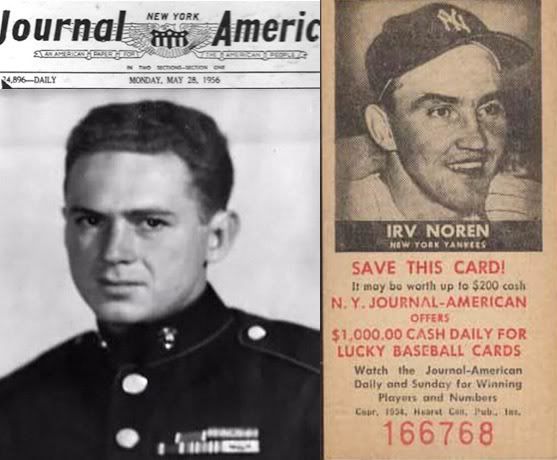
Leckie worked at the Journal American. He walked the streets of the 4th Ward.
his bio
Robert Leckie (December 18, 1920 – December 24, 2001) was an American author of popular books on the military history of the United States. As a young man, he served in the Marine Corps with the 1st Marine Division during World War II. His experiences as a machine gunner and intelligence scout during the Battle of Guadalcanal and later campaigns are said to have greatly influenced his writing.
Leckie was born in Philadelphia, Pennsylvania on December 18, 1920 to an Irish Catholic family of eight children. He grew up in Rutherford, New Jersey. He began his professional writing career, before World War II, at age 16 as a sports writer for The Record of Hackensack in Hackensack.
In 1941, the day after the attack on Pearl Harbor, Leckie enlisted in the United States Marine Corps. He served in combat in the Pacific theater, as a scout and a machine gunner in the 1st Marine Division. He participated in every major 1st Marine Division campaign except Okinawa. Robert Leckie was wounded by blast concussion on Peleliu and evacuated, ending his combat tenure.
Following World War II, Leckie worked as a reporter for the Associated Press, the Buffalo Courier-Express, the New York Journal American, the New York Daily News and The Star-Ledger. His first and best-selling book, Helmet for My Pillow, a personal war memoir, was published in 1957.[3] Leckie subsequently wrote more than 40 books on American war history, spanning from the French and Indian War (1754–1763) to Desert Storm (1991). Robert Leckie died in 2001 after fighting a long battle with Alzheimer's Disease.
Leckie's war memoirs, Helmet for My Pillow, along with Eugene B. Sledge's book With the Old Breed, formed the basis for the 2010 HBO series The Pacific, the successor to Band of Brothers. He was portrayed in the miniseries by James Badge Dale.
It's a stretch. I'm pretty sure Joe had relatives living in the 6th Ward at 79 Baxter Street going back to 1910. Possibly Joe lived there as well. The family name was Curcuruto. Apologies for skit's political incorrectness.
About Joe Kirk Joe Kirk (b. Ignacio "Nat" Curcuruto in New York, New York, October 1, 1903 - d. Los Angeles, California, April 16, 1975) was a U.S. radio, film, and television actor who was best known for playing the role of Mr. Bacciagalupe on The Abbott and Costello Show. Kirk was a regular voice actor on Abbott and Costello's radio show during the World War Two and post-war era of the 1940s. In addition to his ongoing—and best-known role—as Mr. Bacciagalupe, the highly excitable Italian neighbor, Kirk played many other bit parts on the show as well. As Mr. Bacciagalupe, Kirk spoke with a thick Sicilian-American accent; his surname was pronounced in the Sicilian manner, ("Bach-galoop"), not in "proper" Italian, as ("Bachia-galoop-eh"). When excited, Mr. Bacciagalupe frequently made improvised asides in Sicilian dialect, which were obviously appreciated by many in the audience. Lou Costello, who was Sicilian American himself, also understood these side-remarks, and sometimes could not stay in character, but laughed along as well.He also took small roles in television shows such as Adventures of Superman, Sheriff of Cochise and U.S. Marshal, before retiring from show business in 1958. To his family, Joe Kirk was known by his birth name, Ignacio Curcuruto or Nat Curcuruto. He was one of four children -- Letitia, Philip (1902 - 1995), Nat (1903 - 1975), and Josephine -- born in New York City to the Sicilian immigrants Giuseppe ("Joe") Curcuruto and Elvira Puglisi Curcuruto (1882–1977). He was married to Marie Katherine Cristillo (1912–1988), who was the sister of Lou Costello and daughter of the producer Sebastian Cristillo. After their marriage Marie was known interchangeably as both Marie Curcuruto and Marie Kirk. The couple had two sons.
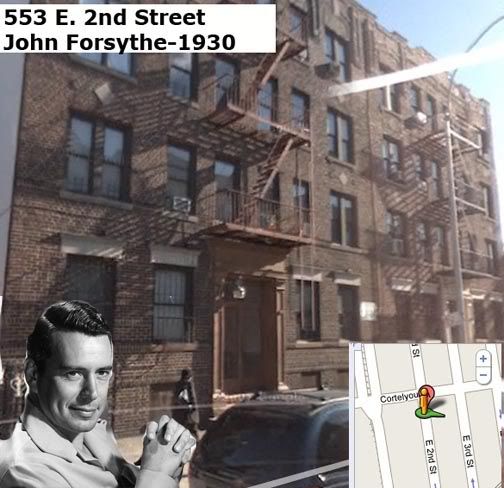
John earns the distinction by going to Abraham Lincoln High School, a destination for many KVer's who made the move to Brighton Beach to the Warbasse and Trump Houses in the mid sixties. And a great memory from Paul Levine:
Since you mentioned John Forsythe in KV blog, I thought I'd share a PS 177 connection and a couple of degrees of separation. He was in an episode of a Kraft show; it escapes what it was called, possibly Kraft Mystery Theatre or something. He was starring in an episode and they needed a playground scene. The advance crew came to 177 and selected a few kids from our class to be in the scene. It was shot in Coleman Oval and I had to bring my baseball glove the scheduled day to have a catch with someone in my class during the scene. We were in the background during filming and John Forsythe was in the foreground with a couple of actors. It was one of my greatest days at 177: got to skip class, have a catch AND got paid for it.
postscript, the episode was:
Kraft Mystery Theater" Go Look at Roses. It aired on Wed, September 11th, 1963 and starred John Albright, Norman Fell, John Forsythe and Cathleen Nesbitt
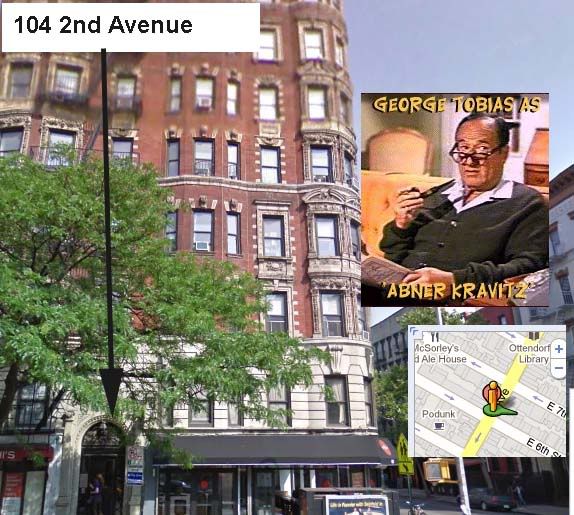
George is living at this address in 1910. In 1920 he's living at 314 E. 5th Street, where PS 15's school yard is now.
George Tobias began a colorful life on luly 14, 1901, on New York's Lower East Side. Coming from a theatrical family, he started his own career at the age of fifteen at the Neighborhood Playhouse in New York. At nineteen, he went into a Provincetown Playhouse production of The HairyApe, a new Eugene O'Neill play that was destined to become an American classic. Shortly afterward, he was chosen for the original Broadway cast of What Price Glory by Maxwell Anderson and Laurence Stallings. The play was highly successful, and George stayed with it from 1924 to 1926. He later appeared in such plays as The Road to Rome, The Gray Fox, and Elizabeth the Queen, and went on to work in summer stock with Jose Ferrer. When he returned to New York, he landed in another new production that was to become one of Broadway's all-time hits, You Can't Take It with You. From 1937 to 1939, Tobias played the Russian ballet master in the famous George Kaufman-Moss Hart comedy, then he went on to the musical Leave It to Me! with Mary Martin (famous as Peter Pan, George Tobias and mother of I Dream of Jeannie's Larry Hagman).George then came to Hollywood to make movies for MGM, including Ninotchka (1939), which years later became a hit on Broadway in a musical version called Silk Stockings (1957, with Don Ameche and Hildegard Neff). Silk was turned into another MGM film with Fred Astaire and Cyd Charisse. George was in all three versions For many years he was under contract to Warner Brothers and appeared in Yankee Doodle Dandy (1942) and Air Force (1943) for the studios, as well as Mission to Moscow (1943) and My Sister Eileen (1955), a Columbia release which also featured Dick York. Tobias made several other movies, including The Set Up (1949), Ten Tall Men (1951), The Glenn Miller Story (l954), The Seven Little Foys (1955), Marjorie Morningstar (1958), and The Glass Bottom Boat (with Alice Pearce in 1966). In addition to his regular role as Abner on Bewitched, Tobias made many other TV appearances, including a continuing part in Adventures in Paradise from 1959 to 1962, and with former Bewitched costar Sandra Gould on the Bewitched sequel, Tabitha, in which they both reprised their Kravitz roles. Though Abner may have been a softer role for him to play in any series, Tobias was active and rugged in real life. Tobias was quite the equestrian. He owned and trained many horses, loved to play polo, and was a volunteer mounted policeman. In fact, according to Bewitched costar David White, the off-screen Abner was a sheriff out in Peach Blossom, California, where he lived. "He had a badge and everything," recalled White. "He Was told that if he ever saw something suspicious, he should call it in. I mean, he had a two-way radio in his jeep, and I guess he used to be quite the rambler out there."
George Tobias, who co-starred in this enjoyable Walsh film, was born on the lower east side not too far away from Jimmy Cagney. He's the character playing horseshoes with Jimmy.
Raoul Walsh was a great director and ahead of his times in his views on race, as mentioned above, in a fascinating analysis. My father always enjoyed his films and so did I and now I understand a little better why. He was born in New York City in 1888 but I don't think it's the Fourth Ward, but the upper west side. Who knows, maybe his parents had their origins there.
Sequence analysis of They Died with Their Boots On (1941, dir. Raoul Walsh), #911 (51) in the Shooting Down Pictures project. Commentary by Matt Zoller Seitz, film critic for the New York Times and host of The House Next Door
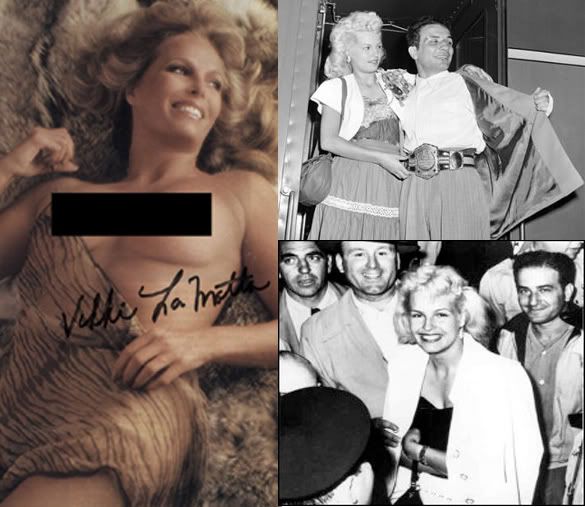
born Beverly Thailer to a Jewish family in The Bronx, New York in 1930, Vikki spent some time in Knickerbocker Village. In her heyday she was considered as beautiful and sexy as Marilyn Monroe and she still looked pretty good in her 50's. Also a very nice person. an excerpt from a 2006 article about Vikki's autobiography
A Fitting Tribute to Vikki LaMotta, By Aaron Tallent. At first thought, Knockout by the late Vikki LaMotta and Thomas Hauser conjures up images of a nude, motorcycle-bound Anika Rodman on the cover of Worse Than He Says He Is: White Girls Don’t Bounce. I know, I know. Don’t judge a book by its cover. But athlete spouse’s autobiographies historically have given us little reason not to. In Anika’s case, her book was a direct response to Dennis Rodman’s Bad As I Wanna Be, which also featured its author sitting naked on his own motorcycle. Often, these authors only have a book deal because a publisher wants dirt on the ex, and the narrative is often a ghostwritten hatchet job. Most are also written out of desperation, as the spouse usually has a reputation to defend and bills to pay. LaMotta, the ex-wife of former middleweight champion Jake LaMotta, did not fall into these categories for several reasons. A stunning beauty, she married Jake when she was 16 years old with a baby on the way and had two more children with him. As his wife, she saw him win the middleweight title and saw him through his subsequent self-destruction. He did not make it easy for her and beat her frequently even after she left him. Her first date after divorcing Jake in 1957 was with Johnny Carson. Her first boyfriend was mob boss Sam Giancana. She married again in 1962 to a singer named Tony Foster and had one child with him, but the marriage would not last. In the late 1970s, she worked closely with Martin Scorsese and Robert DeNiro in the making of Raging Bull. Not only was she trying to help them achieve accuracy, she was simply trying to keep Jake from sullying her name. After the movie was released, she posed for Playboy at the age of 51. The success from that allowed her to launch Vikki LaMotta Cosmetics, which enabled her to remain financially stable until her death in January of 2005. While the book was released earlier this year, it was finished almost two decades ago. In the book’s introduction, Hauser explains that he and LaMotta worked on her life story in 1986 and 1987, and that she “was painfully honest about some of the horrifying experiences that she endured.” When the finished book received a publishing offer, LaMotta balked, uncomfortable with how the revelations would settle with her family and friends. “Maybe after I’m gone,” she told Hauser. After LaMotta’s death, her son, Harrison Foster, called Hauser seeking a copy of the manuscript. After reading it and absorbing many untold stories about his mother, he contacted Hauser and asked him to reconsider publishing the book as a tribute to her.
I was pursuing the possibility that there could be a Jon Stewart/KV connection. Not quite. He was born Jonathan Stewart Leibowitz. His paternal great-grandfather had a shoe store on Rivington Street and his paternal grandfather was a cab driver. On his mother's side his grandfather was Nathan Laskin, a struggling immigrant who owned a series of small businesses in New York. I had some email correspondence with John's dad Donald to see if there was any family connection to KVers Joe and Stephen Leibowitz or Harry Liebowitz. No luck.
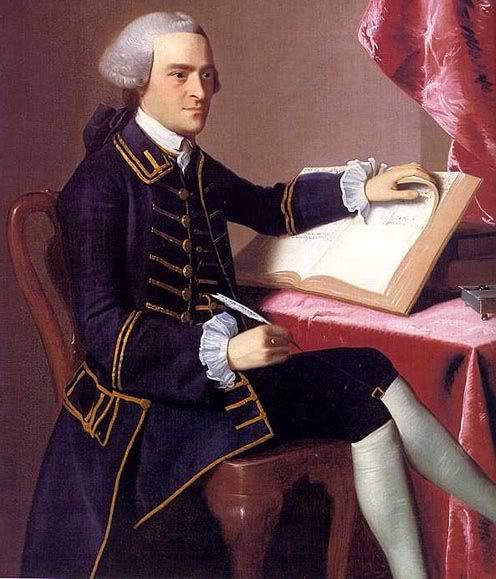
POLLARD, AMOS (1803-1836). Amos Pollard, chief surgeon of the Alamo garrison, son of Jonas and Martha (Martin) Pollard, was born at Ashburnham, Massachusetts, on October 29, 1803. He was raised in Surry, New Hampshire, and graduated from the medical school of the Vermont Academy in Castletown, Vermont, in 1825. Pollard lived for a time in Greenbush, New York, and then spent the years 1825 to 1834 practicing medicine at various locations in Manhattan. He married Fanny Parker in 1828, and they had one daughter. His wife died in 1831. In 1834 Pollard traveled to Texas by way of New Orleans. He settled in Gonzales, Texas, and took part in the fight for the Gonzales `come and take it' cannon, the opening skirmish of the Texas Revolution, on October 2, 1835. He later marched on San Antonio de Béxar as a private in Capt. John York's volunteer company. On October 23, 1835, he was appointed surgeon of the regiment by Stephen F. Austin. After the siege of Bexar Pollard remained in the town as chief surgeon of the Texan garrison, on the staff of Lt. Col. James C. Neill. He cared for the sick and wounded of the garrison and also set up a hospital within the Alamo. On February 23, 1836, Antonio López de Santa Anna's Mexican army besieged the Alamo. Pollard died in the battle of the Alamo on March 6, 1836, probably defending the Alamo hospital. A portrait of him was done sometime before he moved to Texas. Besides Travis, Bowie, and Crockett, he is the only Alamo defender of whom a portrait was done from life. A copy of the portrait is on display in the Alamo.
Mexico had a marketing problem. Soon after gaining independence from Spain, in 1821, the young republic desperately wanted to populate its northern state, Texas, to solidify its grip on a huge, lawless territory that the Spanish had never effectively colonized. But few “interior” Mexicans south of the Río Grande wanted to move to the Texas province, largely because it was inhabited by Apaches and Comanches, who were not looking for neighbors. So Mexico offered U.S. settlers cheap land—on the condition they swear allegiance to Mexico and convert to Catholicism. (A good many settlers no doubt failed to abide by those conditions.) Ultimately, says historian William C. Davis, “the Anglos would pose a greater threat than ever the Comanches had.” Not only did the Mexican government offer land grants to any person or family who agreed to settle in Texas; it also, under the Mexican Constitution of 1824, guaranteed that newcomers would pay no taxes for at least seven years. And to sweeten the deal, Mexico—despite having abolished slavery in the republic—would allow Anglo settlers to bring along with them any slaves they already held. Before long, immigrants were arriving from nearly every state east of the Mississippi, as well as from France, Germany, Ireland, Denmark, England and Scotland. Edwin Hoyt, author of The Alamo: An Illustrated History, writes that typical settler Dr. Amos Pollard, a New York City physician with a failing practice, awoke one morning in 1834, read an advertisement for land in Columbia, Texas, and set out almost immediately to claim some for himself. Pollard, who would die at the Alamo, where he had served as doctor, settled alongside blacksmiths and trappers from Tennessee, an Irish artist, a Frenchman who had served as a soldier in Napoleon’s army and jailbirds from Alabama. Most of the newcomers, according to Hardin, were “descended from America’s first revolutionaries, and many had fought with Andrew Jackson in 1815 at New Orleans” against the British.
If you read through his autobiography you can see that his formative years were spent hanging out either in, or very close to, the Fourth Ward, as a newsboy and then as a teen reporter. from Luc Sante
Samuel Fuller had ink in his veins, just like the hero of his 1952 newspaper epic, Park Row. After all, he started working as a copy boy when he was fourteen or so, and at seventeen he was the youngest crime reporter in the country, employed by the most daring and scurrilous tabloid America has ever seen, the New York Evening Graphic. When that paper folded (under the combined impact of a number of libel suits), he moved to California and soon began supplementing his salary by writing film scripts, selling his first in 1936, when he was just twenty-four. Five years later he was in the movie business full-time, and he directed his first picture, I Shot Jesse James, in 1949, not long after he got out of the service. In Hollywood he was clearly drawing on another part of his brain—he was a wildly visual and visceral filmmaker, and one of the great masters of the moving camera—but he never shed his reportorial instincts. He knew how to sell a story as well as tell one, how to hit hard and not let go. Every one of his movies has a built-in banner headline. Pickup on South Street has a nominal subject as timely as any in the morning paper in 1952—PICKPOCKET HEISTS RED SPY MOLL––although today we might be more inclined to see it as PICKPOCKET FINDS LOVE, CHEATS DEATH. The Commie angle, besides being practically de rigueur for Hollywood that year, was a surefire means of injecting fear and trembling into the proceedings, by introducing a faceless, inhuman evil to contrast with the peccadilloes of the workaday American crook. That the picture is barely political can be demonstrated by the fact that, in France, where the Communist Party was a significant presence nobody wanted to offend, Pickup was released as Le Porte de la drogue—the villains became drug smugglers—with changes made only to the dubbed dialogue. What is at stake, after all, is nothing as high-flown as The American Way (“Are you waving the flag at me?” pickpocket Skip McCoy asks the FBI agent grilling him); rather, it is the possibility of a force so morally alien that, like the child molester in Fritz Lang’s M, the law and the underworld can be united, however briefly, against it. McCoy is played by Richard Widmark, whose face could illustrate the dictionary definition of insolence. One look at him and you don’t even need the backstory to know why the cops want to send him up the river for good. Although he went on to play a wide variety of characters in his career, he was initially typed by his screen debut, which was also his first starring role, in Henry Hathaway’s Kiss of Death (1947), in which he kicks an old lady down the stairs. Here it is the old lady who nearly does him in, although their relationship is complex—she is, for all dramatic intents and purposes, his mother. Playing the part is the inimitable Thelma Ritter, who was unsurprisingly nominated for an Oscar for the role (it was the fourth of her six nominations in a twelve-year span; she never won). Ritter, only nine years older than Widmark, took the stereotypical Apple Annie character and over the course of her career made a Russian novel out of it. Here she is pathetic, cold-blooded, kittenish, stalwart, cunning, and tender, sometimes all at once. The love interest is supplied by Jean Peters, who is awe-inspiringly ripe—you imagine wardrobe having to gaffer-tape her dress every morning, to keep her from bursting out of it. Peters may not have been the greatest line-reader who ever lived, but she exudes sex so palpably, you can smell the pheromones. (She lost the fifties erotica sweepstakes to the forces of blondeness, alas, and gave up and married Howard Hughes.) The locations are few but well chosen. A street, a subway station, a Chinese restaurant, a precinct-house office, an apartment (with that forgotten urban-thriller resource, the dumbwaiter)—put them together and presto! you have New York City and its teeming masses. Richard Widmark’s home is something else again, though: a bait-and-tackle shack on stilts, connected to South Street by a swinging bridge. It seems like a preposterous idea today, when New York’s function as a port has been all but erased, but (although I could almost swear I’ve seen a Berenice Abbott photograph of it from the 1930s) it was close to preposterous then, too. The shack is a bubble cantilevered off the tip of the material world, the bridge leading to it passing through the wall of sleep. In the midst of a zillion urban-grit signifiers, the shack cues viewers to the numerous fantasy elements of the story, not least the Red spy subtheme, but also the crooks themselves, who come from The Threepenny Opera by way of Damon Runyon. The shack is the beyond, but given that it is a real shack, roughly carpentered and battered by weather, it is also—what might be Fuller’s heraldic device—the embodiment of contradiction. Fuller is crude and subtle, blatant and deep, unschooled and spilling over with ancient lore, harsh and plaintive, cynical and so attuned to complicated human emotions, you can’t accuse him of being merely sentimental. Pickup on South Street, it follows, is a penny dreadful with a hundred layers of felt meaning—the kind you register subcutaneously, without requiring professors to dissect and explicate it. If film noir is a genre in which tin-pot crimes are merely the outer manifestations of the churning unconscious, then Pickup on South Street is quintessential noir. Like so many of the worthwhile products of the American 1950s, it is a work of reverberating complexity, wrapped up to look like a candy bar.
Knickerbocker Village at the 2010 Conference on New York State History, June 4
click on picture above for conference schedule
All copyrights acknowledged. For research and educational purposes only.
June 1974
PS 177: June, 1959, Nancy with Mrs. Jonas
About Knickerbocker Village
I found that a recurring topic on my blog, Pseudo Intellectualism, would be my memories of the wonderful place I grew up in on the Lower East Side, Knickerbocker Village. I lived there from 1952-1964. There has also been an avalanche of new information coming in from my old friends through our group emails. All of this has refreshed our collective minds and I decided to shift my old posts (from the last two years) to this dedicated site as well as add new recollections. Hopefully other lost KVer's can arrive here and feel free to share as well. Note 1: Many posts are an outgrowth of history projects I did with kids while teaching on the LES. Note 2: As this blog has evolved it has also become a view of life in NYC during the 50's and 60's. You can contact me at davidbellel.mac.com.
Stewie Brokowsky R.I.P., photo by Murray Schefflin
Help In Understanding Various Blog Posts, The KV Mind Map: Click On Image Below
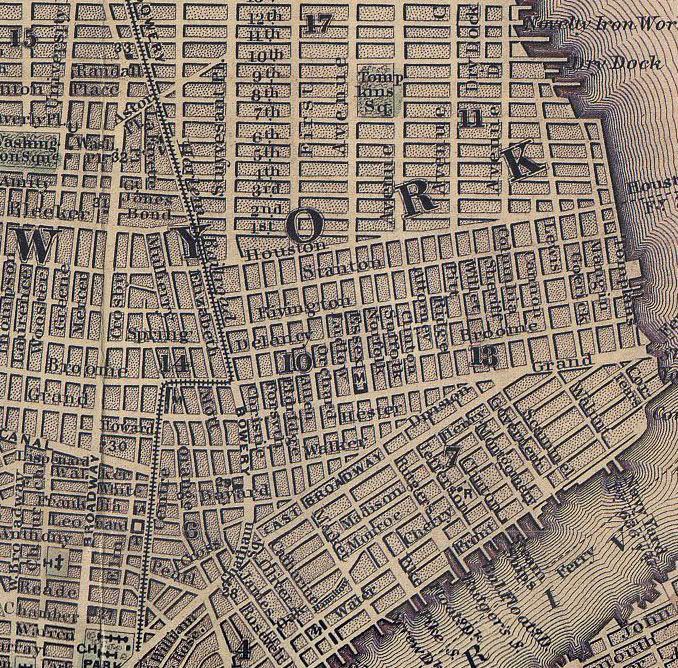
1847 LES Ward Map Section: A Geographic Tool For Locating Blog Posts
Click For A Better View
Deep Thoughts
#1. Annie Dillard talks about her fascination with science and minerals in particular. Then she goes on to details anecdotes concerning various Americans who became obsessed with the possibility of discovering valuable or interesting mineral deposits or rock formations within or close to their home environments. She speaks about men - almost all these scientific minded people are male - who discover veins of coal, copper, bauxite, and so on. She depicts the ordinariness of their fascination and the fact that it tapped into the extraordinary. Like nature had these incredible finds waiting to be unearthed all around. People who could see the worth of what was all around them or, in some cases, beneath them, excavated and found, just beneath the surface of their obsessive preoccupations, depths of riches and fascination. So in exploring the history of KV we go back into what had been the ordinary and find it layered in a criss-cross of historical significance. A transmutation of the lung block, redeemed as a bold social experiment tinged with ambitions as immodest as a revolution and as commonplace as sandwiches - ordinary though it may be but still - the most delicious sandwiches of the twentieth century. Buried beneath the surface of the KV heritage are connections to so may aspects of our culture and NYC's greatness as to be not only unfathomable but irrefutable. Do you know what I'm saying here?
Son Of Salvatore
FAQ's: Click On Image
KV Honorary Members (And Their Corresponding Sponsors)
Tim Russert-Mark
George Carlin-Allan
Paul Newman-David
Pete Seeger-Bob
John F. Kennedy Jr.-Joe
To be is to do - Plato To do is to be - Socrates Do be do be do - Frank Sinatra
Yes. I was thrown out of the Canal theater a number of Saturdays for rolling on the floor, in the aisles laughing. I think one of the movies that prompted my gaiety was "Psycho" - the shower scene. What can I tell you? I guess I wasn't tuned into the mood. At the time. Also saw many rock and roll movies at the Canal, Elvis films and the Murray the K fests. Saturday I often would go there with Joey Maldonado and his cousins. We would load up on candy by the quarter pound from that obscure bakery that was just around the corner on Madison Street, quarter block from Catherine - around the corner from the Brokowsky's fruit store, Gogol's and the pharmacy on the corner. Next to the newstand. Remember? By the bus stop. See what I'm saying? (In your mind, can you see it?) Bakery had golden and tan tile design but couldn't hold a candle to Savoia. No marble floors either.
guest memorist Howie: the first movie I ever went to was at the Tribune Theatre (near City Hall, now by the site of Pace University), a Disney cartoon 'Lady and the Tramp', also remember going there with Ronnie, David and maybe Paul, think it was '62 to see 'Safe at Home' starring Mickey Mantle and Roger Maris....I saw 'The Time Machine" with David at the Canal theatre in 1960 (academy award to George Pal - special effects), we were so taken by the notion of time travel that we proceeded to go home and build a time machine...somehow we got hold of some wood, nails, rope and wheels..after a couple of days the time machine started to take shape although it looked remarkably like a pretty decent scooter so we decided it needed a safe haven and hid it in a pit on Monroe St...one that we were able to climb...on the third day the time machine was stolen from the pit...we never saw it again...probably in the year 3000 by now..
guest memorist Neal Hellman on BLT's (the non Ref Luncheonette variety) A great B.L.T. is a complex eatable symphony. One in which all the parts maintain their individuality, yet at the same time, surrender their tasty nuances in the true spirit of gastronomic gestalt and dwell as one.This equinox I choose Sumano's Bakery Ciabatta bread. Though I was skeptical about it's naked, pale texture, I felt it would toast up well and its many crevices would add some fun places for the mayo to go.With the mayonnaise choice I have to stay with tradition and of course go with Hellmann's though for some reason it's known west of the Mississippi as “best foods”. Please do not waste my time with this hippie safflower oil concoction or some other type of healthy alternative. For when it comes to mayonnaise for my Ultimate B.L.T. there is no east or west, there is only Hellmann's…. case closed. My ingredients are now all together, but the intense work has just begun. For now without the correct timing and the correct application of all the ingredients, my ritual could easily plummet into a spiritual abyss. All ingredients must sit together (as one) at room temperature as I invoke the spirit of all the great B.L.T. makers in all the luncheonettes in the greater metropolitan area of New York. I heat my cast iron skillet (using a Teflon pan would be heresy) to a comfortable medium heat. I lay the bacon down 4 strips per sandwich and as I do the strips greet the metal with a friendly sizzle “hello”. As they are slowly cooking I cut the tomato's, neither too thin or too thick and lay them down ever so gently on a plate to await their glorious marriage. The lettuce has been carefully washed and spun with all traces of ribs removed. The mayonnaise jar is open and waiting to join this eatable canvass. Once the bacon is turned the toast swings into action. It has to be brown all the way but with no traces of crusty darkness.As the toast is finishing I remove the bacon and pat it down with a paper towel. Now it's time to assemble my edible equinox creation. Mayo on both pieces of toast, then the tomato's and I prefer the lettuce between the tomato and the bacon, for I feel it's texturally more secure that way. I don't want an immediate confluence of tomato and bacon; I like the lettuce to work as a buffer. Here's where many folks really go askew: they push the bread down so hard that the bacon is crushed. No, no a thousand times no. One must gently, ever so gently caress the concoction together. After which one will take a sharp knife and make a diagonal cut. A straight cut is what people from small towns in Nebraska and Ohio do. Those of use who are members of the B.L.T. illuminati always make a diagonal cut. The masterpiece will then be placed on a plate and then consumed in a way as to enjoy the warm and crunchy (yet still pliable) bacon, the exploding sensation of a dry farm Molino tomato, the juicy lettuce, the condiment-ing mayonnaise and ever so supportive bread. My first Ultimate B.L.T. goes to my neighbor for her birthday. With that offering I realize now that I am truly invoking the Japanese Equinox celebration of Hign-e. Yes with my ultimate B.L.T. offering I am illustrating the six perfections: perseverance, effort, meditation, wisdom, observance of precepts, and giving.
KV Journeyman
11/13/07: Even standing in the cold rain, the Baroque facades on these buildings are fantastic. Brussels has some of the best architecture in the world, all types, all styles. Standing in the middle of the main town square one is overwhelmed with the magnitude of detail and size.
11/14/07: I am currently in Brugge in NW Belgium. It appears to be a quiet town with all old and small buildings, perhaps pre-Victorian, with a network of canals similar, but without the gondolas and singing rip-off-the-tourist gondoleers. I'll learn more tomorrow as we get a tour prior to dinner.
12/5/07: Just finished a fresh grilled tilapia sandwich while sitting outside looking at the expansive white sands of Clearwater Beach and the far reaches of the Gulf of Mexico, realizing I am flying back to DC tomorrow morning into the remnants of the latest Alberta Clipper to wreak havoc on the Nation's Capitol. Enough to upset the strongest and staunchest among us.
Time Magazine: 10/15/1934
Smack in the middle of the slum-mulligan of Manhattan's lower East Side two barefaced, rectangular apartments rear their bricks twelve stories into the air. Jointly christened Knickerbocker Village, they cover four whole city blocks. Between the two units is a concrete playground, and within each will be a garden. Each of the 1,593 apartments has wooden parquet floors, electric refrigeration, tiled bathrooms, outside windows. The elevators are self-operating. Rentals range from $22.50 for 2½ rooms on the ground floor to $87.50 for a 5½-room penthouse. Average is $12.50 a room. Knickerbocker Village will cost about $9,000,000, and with the exception of Rockefeller Center is the only large structure which Manhattanites have noticed abuilding these last two years. Last week it was ready for occupancy.
Because Knickerbocker Village is also Manhattan's first experiment in government-financed, low-cost housing, RFC's Chairman Jesse H. Jones, East-Sider Alfred E. Smith, many a minor wig gathered in its banner-decked playground to mark the day. Said Al Smith: "I was tempted to swap the Empire State Building." Chairman Jones thumped the tub of slum clearance. Informed that the first of the two units was already 95% rented, while the second unit (to be opened Dec. 1) was 50% rented, he waved an expansive hand at the holiday bunting, declared: "I know of no ... safer investment for public funds than to clear about 500 acres of your slums."*
Whether or not Knickerbocker Village was a fitting inspiration for such official rejoicing was last week a red hot sociological question.
In 1929 Realtor Fred Fillmore French began buying land on the lower East Side. By swearing his 42 brokers to secrecy and using dummy corporations, he managed to get some 15 acres for $5,000,000. Then in 1931 he announced a grandiose scheme for the erection of a $50,000,000 development for junior Wall Street executives. At this point he found that he could not get credit. At the same time Fred F. French Operators, Inc. began passing its dividends on $14,000,000 of preferred stock. The project remained only a scheme with a staggering upkeep in land taxes.
When Congress authorized the RFC to make loans on slum clearance projects, Realtor French picked out the worst block in his holdings and ecstatically presented it to Mr. Jones as a worthy subject for clearance. His choice was "Lung Block," so called because of its high tuberculosis mortality rate. On it lived 650 families. In its backyards were seven jakes. On this fester Mr. French proposed to build a low-cost housing project. Mr. Jones agreed to do business, and RFC lent 85% of the required $9,000.000.
Average cost of "Lung Block" to Knickerbocker Village was high: $3,116,000, or $14 per square foot. The tax assessment was therefore reduced by two-thirds to bring the monthly room rental down to the $12.50 stipulated by the RFC. Because the average rental on "Lung Block" had been about $5 a room, Knickerbocker Village remained a low-cost housing project only in the minds of the white collar workers, who proceeded to fill it.





 Posts
Posts