Showing posts with label cliff's kv notes. Show all posts

Thursday, May 7, 2009

Cliff's KV Notes, Part 20: Wheels, Part 4


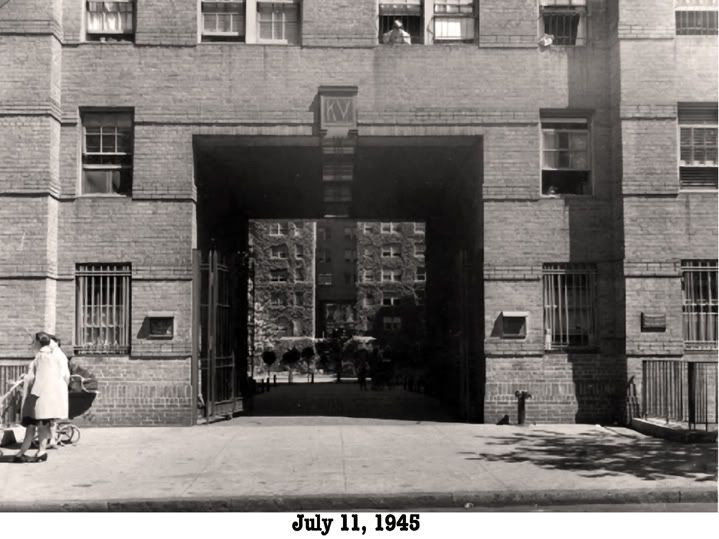
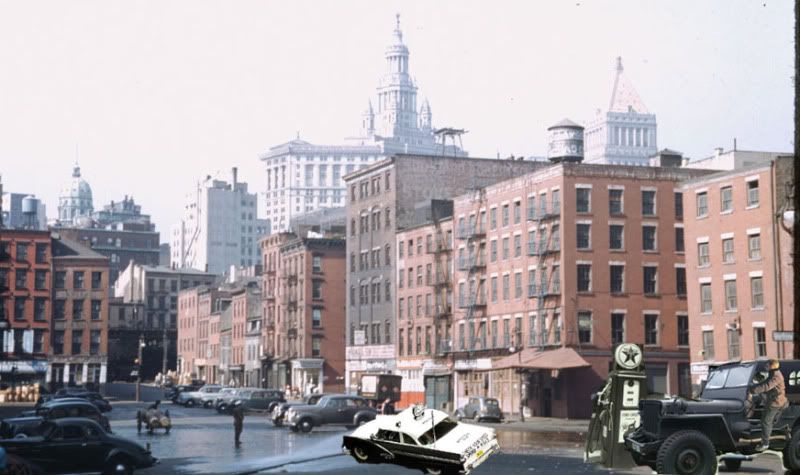
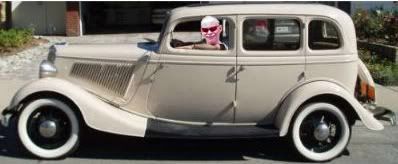
Above, I tried to recreate a visual. I'm not too far off on the era, but that's not South Street and Clinton, it's South Street and Peck Slip

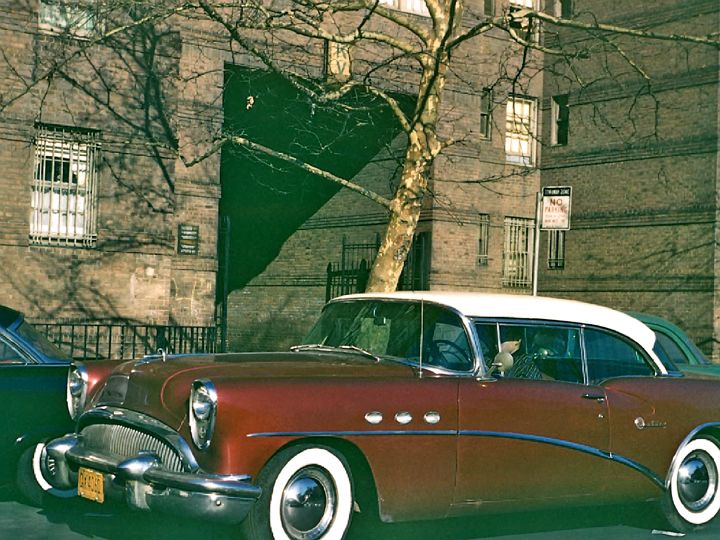
When we got our first car in 1958—a 1954 Buick Century, we bought our gas at the Texaco station on South St. around Clinton/Jefferson Sts. At the time, the owner (I believe his name was Sam), was turning the business over to his son, Steve. Steve gave us 5 cents off a gallon, which is why we went there. Steve was slick. When we needed a new set of tires, Steve tried to sell us a new set of inner tubes, so he could make an extra $6, although there was nothing wrong with our old ones (they had a few patches, but they didn’t leak.) Steve’s logic went like this:” you wouldn’t take a bath and not change your underwear, would you?”
We initially parked in the small lot on Monroe near Catherine, and then moved to an inside spot in the Esso garage on South and Market. The Esso station had a Jewish mechanic named Max, who must have been a dropout from Mohel school—he was a real butcher. The night guy at the Esso was Frank, a short guy who was always chomping on a cigar butt.
Since all the guys my age I knew had moved out of KV by ’58, I was hanging out with Ben Grey, Marvin Kefer, Dave Wiseltier, and Marty Gross. ‘Course those names might not mean anything to you younger readers, and I could have been hanging out with George Washington and Fiorello LaGuardia (hey, I know those guys) for all the difference it would make. Marv was driving his father’s (Charlie) ’56 Dodge wagon, which he said was pretty fast. So the first thing we did was drag race his wagon against my Buick with the three portholes. The Buick won, but not by much. Ben Grey, though had the coolest cars—first an Austin-Healy 3000 sports car, then a ’57 Chevy convertible.
We’d be hanging out at either the Esso or Texaco gas stations while the Italian Dion-wannabes were doo-wopping it up on street corners or in the KV basement.
In 1959, I bought a new Jeep (army-style) from a dealer on Dykeman St. in Manhattan. Like I a needed a 4-wheel-drive in Manhattan. I thought the Jeep was cool because it had three stalks coming out of the floor—the 3-speed shift, a 4WD lever and a Low range lever. I did have fun taking it on the sand at Bergen Beach in Brooklyn. I’d make a circle track in the sand, going over it a few times until it became a circle rut. Then, I put the Jeep into Low range, pull out the hand throttle a wee bit, jump out and walk a distance away. The Jeep would follow the ruts in the sand, chugging along all by itself at 2 MPH with no driver inside and no one in sight. It was a real mindblower to people passing by.
With its low gearing, the Jeep was pretty quick up to about 50 MPH or so. One night, when we were hanging out at the Texaco station, Marv and I drove the Jeep over to the right of the FDR Drive. There was a long dead-end street to the right of the park, and there was a cop car sitting at the end, facing north, obviously goofing off. At that instant I got an Epiphany. I knew that I could blast down to the end of the street, make a bootleg U-turn by locking the rear wheels with the handbrake, and nail it back south, and the cops would come after me. And I knew with the certainty that the sun would rise the next day, that I could make it back inside the Texaco station, out of sight, before the cops could hit South St. and be able to see me. So that’s what I did, and of course it worked. We watched the cops go flying by the Texaco on South St. in pursuit of an invisible Jeep. Lots of laughs.
Eventually, the cops returned to their original spot to goof off. Then Marvin said that he wanted to try it. I had my doubts, but there is actually little to do when you’re hanging at a gas station. So I gave him the wheel. Marv, blasted down the dead-end street, and just wasn’t sharp enough with his U-turn. I knew right there that he had blown it by a couple of seconds. Sure enough, the cops hit South St. just as Marv was turning into the Texaco. And they saw us.
The cops weren’t too happy, especially when they were looking for the owner of the Jeep who was taking his time in the washroom. We all had a little discussion when I finally came out, but no tickets were issued.
That’s it for the wheels portion, but I’m gonna throw in a small bonus because you’re all such nice folks. I can’t remember a lot of the details of the following story, but the important points stand out in my mind. And I gotta warn you that it’s kind of Gross.
I think it was a Yom Kippur evening. All the guys were hanging out after shul, and for some reason we all started drinking. I forget whose apartment we were in, but Marty Gross kind of passed out on the bed. The rest of us were still able to walk, and I got this amazing idea. Wouldn’t it be cool if we got one of those wire trash cans that were on street corners and slipped it around Marty on the bed. Imagine—waking up inside a trash can—one of the best stunts I thought up all week.
Me and one of the other guys climbed into my (actually my mother’s) Buick and set out in search of a trash can that wasn’t too full or too gross. It would be Gross enough in the morning (yuk, yuk). We found one, and had quite a time wrestling it into the back seat of the car. You have no idea how big those suckers are until you try to wrap your arms around one.
We did manage to get the can into the apartment without getting busted, and we did slip it around Marty, sleeping like a baby. I left to go home at that point, so I missed the payoff of Marty waking up inside the trash can, complete with the garbage that it contained when we found it. Hey, it sure beat doing homework!
The previous chapter of Cliff's KV Notes

Friday, May 1, 2009

Cliff's KV Notes, Part 19: Wheels, Part 3


Years before I got my driver’s license, I always wanted a motorcycle. I read every Floyd Clymer book on bikes that I could get my hands on, including one that explained how to ride one. The Clymer books covered mostly English bikes, such as the Ariel Square Four, Excelsior and others not available in the U.S. But the basic controls were more or less universal.
I had my heart set on a BSA, which I thought stood for Boy Scouts of America instead of Birmingham Small Arms. I would eventually get one, as my second motorcycle, from Ghost Motorcycles in Long Island. But that would be way in the future.
Before getting my license, I was commuting to Brooklyn College by bicycle, or train in bad weather. Close by the college was a Jawa motorcycle dealer. Jawa was a Czech bike—basic transportation, nothing fancy. But the quality looked good, and it wasn’t too expensive. One of the salesmen took me for a ride on a scrambler—a high performance model in the line. I was hooked!
I convinced my father to drive out to Brooklyn with me and take a look at the bikes. He was all set to buy one for me, (course, I would have to pay him back) until he found out that the cost of insurance was the same as a car—over $300/year. And that was that. Until I met Howie Frankel.
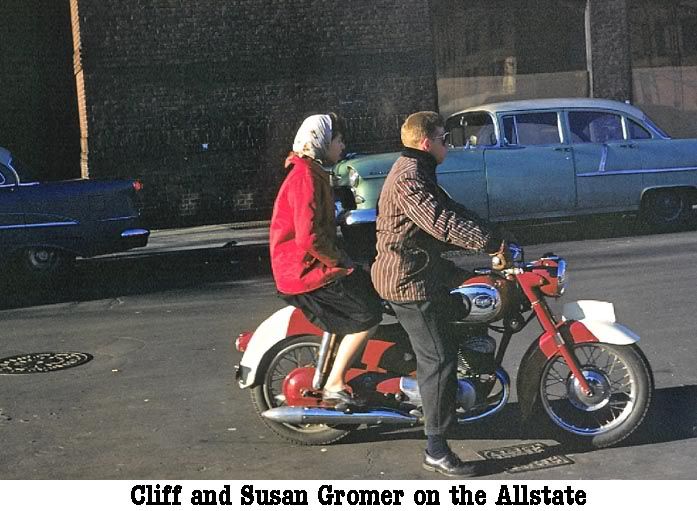
Howie lived either in KV or in the neighborhood. He had a 2-stroke, single cylinder175cc Allstate motorcycle that he wanted to sell. The Allstate was made by Puch in Austria for Sears. The price wasn’t bad, and I told Howie I’d buy the bike, except for the insurance. No problem, he said. If you buy an Allstate bike, you can get Allstate insurance for $68/year. I checked it out, and he was right.
I rented an indoor parking spot in the garage on the corner of Pike and either Cherry or Water. The street level area of the garage was a repair shop that fixed private cartage garbage trucks. Two guys either owned or were employed there as mechanics. Andy was a short guy, who had a tall girlfriend who was a knockout. The guy was pretty dapper when he wasn’t dressed in his mechanic’s overalls. And it was pretty eye-opening to see what a short guy, with the right amount of self-confidence, could score. I believe his partner’s name was Sal. It must have been pretty tough to change a clutch on a garbage truck in the summer, what with the stench and all.
My friend Eugene Reiser had bought a Lambretta motor scooter before I bought the Allstate, and I got my feet wet on a motorized 2-wheeler on his ride. My bike’s parking spot was on the second floor of the garage, and there was a long ramp leading up from the street level. I had just completed the deal for the Allstate with Howie, and, on my first ride, motored over to the bottom of the ramp and it sized it up. Hmmmn, fairly long and steep. Better give it a lot of gas so it doesn’t stall. I grabbed a good handful of throttle and let out the clutch. My feet were still on the ground, and the bike just about shot up the ramp without me, nearly pulling my arms out of their sockets. But I managed to recover enough to make it to the second floor without having someone to call an ambulance.
I practically lived on that motorcycle, riding it everywhere. There were no helmet laws in ’58, so I never wore one. No special motorcycle test or license was required either. A regular “car” license was all you needed. I did take my mother and father for a ride, and I remember at one point, I had the motorcycle in our apartment in the “A” building. It was on newspaper in the living room. I think I had removed the gas tank prior to bringing it up in the elevator. I can’t believe my parents let this happen, but the specifics of the episode eludes me.
Soon after I got the bike, I wanted to expand my horizon from just normal riding. The sidewalk on Pike St.alongside garage had a lot of curb cuts for driveways. I thought it would be fun to speed down the edge of the sidewalk and see how high the Allstate would bounce into the air going over the cuts. I was going pretty good, when a police cruiser happened by. The two cops in the car saw me in the air and freaked out. This was obviously a first for them. But they weren’t amused, and issued my first traffic ticket—for driving on the sidewalk.
My sister Susan liked riding on the back seat of the Allstate, and I guess her most memorable experience was one particular blast on the South St. viaduct and up the FDR Drive. It was warm, and she was wearing just a blouse. We were doing maybe 70 MPH, and the wind tore open her blouse, leaving her rather, ahem, exposed. ‘Course I was looking ahead and had no idea what was happening. The wind was so loud that I couldn’t hear her even if she screamed. So up the drive we went, her open blouse flapping in the breeze, and giving the drivers we passed a really good eyeful. Guess it would have made a great ad—“I dreamed I rode a motorcycle in my Maidenform Bra.”
The next chapter of Cliff's KV Notes
The previous chapter of Cliff's KV Notes
Wednesday, April 22, 2009

Cliff's KV Notes, Part 18: Wheels, Part 2


So I’m writing about cars and motorcycles, because I didn’t know any Jewish gangsters back then. Sorry. But first, an unrelated story. So I take a few liberties. When I used to go to the Pike St. shul during the High Holy Days, some of my friends attended the schul on Eldridge St. When I asked my grandfather about that schul, he didn’t say anything and just shook his head. Years later I heard a joke, that I guess summed it up:
A Jew was shipwrecked and spent 20 years alone on a deserted island. He was finally rescued, and as he was being led to the shoreline and the boat that would bring him back home, he told the boat captain that he wanted to show him something. He led the captain into the jungle to a small clearing. And there was a miniature schul, complete down to the smallest details—windows, seats, even a miniature ark with tiny Torahs inside. The captain was very impressed. This is fantastic, he said. I’ve never seen anything like it. Then the Jew said he wanted to show the captain one more thing before they embarked, and they both trekked deeper into the jungle to another clearing. And there was a second synagogue, exactly like the first, down to the smallest detail.
“What’s this?” asked the captain.
“This? This?” exclaimed the Jew. “This is the schul,” (and he spat--Ptooey!) “This is the schul I DON’T go to!”
Now that that’s out of my system, I’m going to tell you the Uncle Harry story that I promised you last time (remember?). It’s out of the timeline synch (I was out of KV and living in Sunnyside, Queens at the time), but so what? Uncle Harry had driven our then-new, used ’54 Buick back to KV for us. So that’s my excuse.
Harry I. Rothman was the principal at P. 87, and later P.S. 98, both in Manhattan. His wife, Miriam was a retired NYC school English teacher. Both very prim and proper and very well respected. But, Harry did have a good sense of humor. They lived in a doorman building on W. 81st St. off Central Park West. They did not own a car at the time, so we would pick them up in our Buick and take them to family functions in New Jersey.
I owned another car, at the time—an off- white ’34 Ford Sedan—just like the one in the “Bonnie and Clyde” movie—the car they got shot up in. My car was a real roach. It looked so-so on the outside, had no headliner inside, but had nice original Mohair seats. Instead of having a college decal on the rear window, I got individual letter decals and spelled out “Elmira Reform School,” on the rear window.
I somehow convinced my aunt and uncle to take them to a family function in this wreck. When I picked them up in front of their building, the doorman couldn’t believe it. Here was Harry and Miriam, dressed to the nines, climbing into this jalopy with “Elmira Reform School,” on the back window. Not the usual kind of ride for a well-respected public school principal to be seen in.
We got to the function OK. So it was a little bumpy. There was a threat of rain, and my Aunt Miriam carried an umbrella. Now, that ’34 Ford kind of leaked in the rain. It had a soft insert in the roof, and no matter how much goop I smeared on it, the roof still leaked. When we started back home, it started to rain, hard. And the roof leaked a little. Harry and Miriam were getting a little wet in the back seat, so Miriam opened up her umbrella inside the car. Beeg mistake! The top of the umbrella tore through the soft roof, and the roof now leaked a lot. Then the rain stopped and she closed the umbrella. It was hot, and the interior began to steam up, so I cranked open my driver’s window. While it wasn’t raining, there were still some huge puddles in the roadway. At one of those puddles, we passed a truck going in the opposite direction. The truck kicked up a wall of water, something like Niagara Falls, and it came through my open window like a tsunami. All the water went over my shoulder and I didn’t even get wet. But it all ended up in the back seat. I didn’t want to look, but I did hear strange noises coming from back there. Then, to add insult to injury, we hit some nasty bumps.
When we finally arrived back on West 81st St., the same doorman was still on duty. He had seen an elegantly dressed and poised couple enter into their chauffeured “limo” several hours earlier, but what emerged now from the rear compartment almost defied description. Two people thoroughly soaked and completely disheveled, looking for all the world like they had just stepped out of a Bendix washing machine.
The previous chapter of Cliff's KV notes

Cliff's KV Notes, Part 17: Wheels, Part 1


While KV had a lot to offer, I figured that the world outside KV had even more to offer. Outside of public transportation to routine destinations, such as school, it was wheels that really helped sever the KV umbilical cord. My first wheels was a Rudge bicycle that was nearly as tall as I was. My parents had bought it on Cortland St, and they pushed it back to KV. It made a clicking sound, so they thought something was wrong, and they pushed it back to Cortland St. They were told that the sound was normal, so they pushed the bike back again to KV. The genre of bike was loosely referred to as an “English Racer,” although it wasn’t. But it was pretty slick compared to my friend Eugene Reiser’s American-made Schwinn. The Rudge had a neat Sturmey-Archer 3-speed gearshift lever on the right handlebar. It operated a cable that changed the internal gears inside the rear hub. There was no pedal brake, handlebar levers controlled front and rear cable-operated brakes, also slick. Okay, so I couldn’t lock and skid the rear wheel like Eugene could. Big deal.
With Eugene as the usual point man, I discovered the great ride of the FDR Park that ran from Gouveneur St. up to 23 St. Then it was riding in traffic up to the U.N. building. One of our usual destinations was the long pier that jutted out into the East River at Clinton or Jefferson St. The United States Trucking Co. would park their big flatbeds that hauled huge rolls of newsprint to the Journal-American building on that pier. The pier was deserted on the weekends, so Eugene and I would ride down, hop in the trucks, put them in gear and drive them around (within the confined spaces between the other parked trucks) using the starter motor and battery power. We had fun shifting gears and turning the wheel. When the battery died, we just grabbed another truck.
On one bike trip, out to Clove Lake Park in Staten Island during Passover, our moms packed us matzoh sandwiches for lunch. I had cream cheese on regular matzoh (the cheese acted as a sort of glue to hold everything together.) Poor Gene. His mother made him a chopped egg sandwich on egg matzoh, of all things. Egg matzoh was pretty fragile stuff to begin with. We arrived at the park, rode around and sat down to eat. I opened my lunch bag and pulled out my sandwich. Eugene opened his bag, and I still remember the look on his face as all he saw was crumbs. I couldn’t stop laughing.
Eventually, I got another bike, which I rode to Brooklyn College before I got my driver’s license. I could make the trip from KV to the college in about 45 minutes—usually better than the subway. One of the crazy things I used to do, for the ultimate adrenaline rush (up to that point) was to ride down to the Battery during the week at around lunch time, and then ride full speed back down narrow Nassau St. I would go so fast, that no one ever saw me until I was past them. I counted on not being seen, because then people do stupid things (‘course what I was doing couldn’t be considered as stupid). But I never hit anyone or had an accident. Believe me, it was a real rush.
Since no one in our family had a car, my mother and I went to the AAA driving school on, I believe, 63rd St. on the west side. She was the one that wanted a car over my father’s strong objections (he knew what was in store). I wanted to learn on a stick, and I drove the school’s ’58 Pontiac Star Chief with a 3-speed column shift. My mother drove an automatic. My mother was a terrible driver. She failed her driving test, and when I went with her to practice in her ’54 Buick, I wore a crash helmet. I thought it was funny. She didn’t.
We bought the car before my mother or I had our licenses. My father knew a used car dealer, Crestline Motors, way out in Queens, like maybe Fresh Pond Rd. We went out by subway. The dealer said he had selected two cars for us to look at. I didn’t know squat about cars, and my mother knew even less. He had a ’57 Chevy plain Jane 210 model, which I think was the bottom of the line, and a ’54 Buick Century. What a neat car—a hardtop with a cream roof and Titian red bottom. The dealer took me for a ride, and from the passenger seat, the car felt fast. And well it should. I didn’t know it at the time, but the Century model used the small, light Special body with the big Roadmaster 4-barrel carburetor V8 engine. To an 18-year-old kid, it was the cat’s teats.

We came back to the dealer with my Uncle Harry to drive the car home It had a bad fuel pump and it kept stalling. But we made it. We parked the Buick in that small 6-8 car lot on Monroe St. near Catherine. I have a separate Uncle Harry story for an upcoming installment (just to keep all of you coming back). When I was practicing for my road test, Alfred Grey, who lived in our building (“A”), was a friend of my father’s, and would ride with me on occasion. Gray was the head of the Motor Vehicle Bureau in Manhattan on Worth St. If you remember the DMV office back then, there were huge black and white photos of car wrecks posted below the counters. Maybe they wanted you to think twice about applying for a driver’s license. We were tooling down Second Ave. and Grey made the remark, “If you can drive on Second Ave., you can drive anywhere.” My father had no desire to drive anywhere.
My mother was such a bad driver that she retired a legion of guardian angels who asked for another assignment. It’s really a miracle she survived her driving career. She wiped out two hubcaps on one of those turns on the West Side Highway, probably avoiding flipping or crashing by a whisker. She took out a tree (which she had to pay for) in New Jersey. My sister was in the car and she went nuts. I mean, you’re supposed to drive on the road, not on the sidewalk—at least that’s what it says in the New York Sate Driver’s Manual.
‘Course, I wore out my share of guardian angels, too. Not because I was a bad driver, but because I was a good driver—too good for my own good. Like the time I went for a late night drive and ended up in Far Rockaway, or was it just Rockaway. I was bombing along a deserted Beach Channel Drive—a really great 2- or 3-lane road and the Buick was in its stride at 90 MPH. Things are going great, when all of a sudden the road ended. I mean it necked down into a one-lane 90-degree turn, and there was a fence and a dropoff. I couldn’t believe what I was seeing. What a stupid road. And I know there’s no way I’m getting out of this. So I’m on the brakes with both feet and trying to coax those stupid skimpy bias-ply tires to turn, please, and save my butt. The Buick had soft coil springs front and rear and the car really leaned in the corners. On this one I thought I heard the door handles scraping the ground. The only way I made it through that corner was by divine intervention—one of many such interventions. After that stunt, I granny-footed it back home, just happy to be alive. Until the next time. Maybe I should have taken a harder look at those Motor Vehicle photos.
The next chapter of Cliff's KV notes
The previous chapter of Cliff's KV Notes
Monday, April 13, 2009

Chemistry Lesson With Farmer Gray


Who knows, maybe this Farmer Gray film shown in the basement movie theater inspired Cliff and Eugene's chemistry experiments?

You Must Whip It


The original I found on youtube had no sound. I added more footage and a soundtrack
Crack that whip
Give the past the slip
Step on a crack
Break your mommas back
When a problem comes along
You must whip it
Before the cream sits out too long
You must whip it
When somethings going wrong
You must whip it
Now whip it
Into shape
Shape it up
Get straight
Go forward
Move ahead
Try to detect it
Its not too late
To whip it
Whip it good
When a good time turns around
You must whip it
You will never live it down
Unless you whip it
No one gets away
Until they whip it
I say whip it
Whip it good
I say whip it
Whip it good
Crack that whip
Give the past the slip
Step on a crack
Break your mommas back
When a problem comes along
You must whip it
Before the cream sits out too long
You must whip it
When somethings going wrong
You must whip it
Now whip it
Into shape
Shape it up
Get straight
Go forward
Move ahead
Try to detect it
Its not too late
To whip it
Into shape
Shape it up
Get straight
Go forward
Move ahead
Try to detect it
Its not too late
To whip it
Whip it good

from wikipedia
The Whip was a ride originally designed and built by W.F. Mangels Company of Coney Island, New York. William F. Mangels patented the ride in 1914 and it soon became an extremely popular ride. It consists of two circular wheel-like turn-table platforms on opposing sides of a rectangular base.Motors turn a cable that leads a number of 2/3 person seater cars that are attached, around a laminated wooden track.The ride follows the track while the cable turns. When the car reaches one of the turn-table platforms, the speed picks up forcing riders to on side as the car whips around the corner. Whips with 8, 10, or 12 cars were available. At least two 16-car models exist, one operating at Kennywood and the other in storage at Knoebels. The whip is commonly found at older, historic parks.
A children's version was also built, dubbed the children's roto-whip. A roto-whip is in a circular motion that whips the cars as it goes around. They are exactly the same as the full-scale Whip, but smaller and fit for young children. These children's whips are ironically more common today than the the full-scale versions.
The Whip's name could lead many to believe it is an aggressive thrill ride. But most are actually very tame. The normal minimum rider height requirement is 46 inches tall unless with an adult at most parks, even though most whips are rarely aggressive rides. The version at Knoebel's has non-lockable restraints, and riders can easily get out during the ride's rotation, which may add reason to these restrictions.
One of the oldest Whips operating today is the Whip at Dorney Park & Wildwater Kingdom in Allentown, PA. It was manufactured in 1918. The Whip at Playland (New York) in Rye, NY was made in 1928, and is one of the park's oldest rides. Another installation of a classic Whip is at Knoebels Grove in Elysburg, PA. This whip, called the "Whipper" was originally installed at a park in Hunlock Creek, PA called Croops Glen moved to Knoebels in the 1940s after that park closed. These rides have become increasingly rare. There are a small hand-full located in the North-Eastern united states.
A modern version Whip is currently manufactured by Sellner Manufacturing, which also makes a modern version of the famed Tilt-a-Whirl ride. An example of one of these is at Hersheypark in Hershey, PA. The modern version is a bit aggressive compared to the older versions, adding to the thrill of the ride.

Cliff's KV Notes, Part 16: That's Entertainment


image from shorpy
A nice change of pace from the playground, tossing stuff off the KV roof and generally being a nuisance whenever I had the chance, were the rides that came to Cherry St. The two I remember were the Whip and the Swing. They were like a miniature portable Coney Island. Each ride was attached to a truck. The Whip had maybe six cars that were pulled around an oval track by a chain. They went slow on the straights and whipped around the two ends of the oval. From a post-toddler’s perspective, it was pretty cool.
There were two Swing rides. One was mechanical; the other was pushed by hand. The Swing was U-shaped with 3-4 rows of seats on each side. It would rock back and forth. You got the best ride in the top row, but it was kind of scary because you rocked over so far, you felt like you were going to fall out of the seat. But even the wimpy bottom row gave a decent ride, so you could relax and enjoy without the fear in the top row.
Then there were the movies. KV had a basement room that showed 16mm sound films. It cost maybe 15 cents to see some black and white Farmer Gray flicks. Farmer Gray humor was the farmer and his goat spitting in each other’s face. I also remember seeing The Frank Sinatra war propaganda movie, “The House I Live In,” featuring Frankie boy singing the title song. It was a pretty boring movie, except for the war footage of a U.S. bomber knocking out a Japanese battleship. That was very cool. The KV movie would also attract kids from outside KV.
We didn’t go to the Loew’s Canal much, preferring the Tribune Theater. Our family would walk back and forth to the Tribune, my father being a bit on the tight side. My favorite flicks were the Randolph Scott westerns. Good action, and he had a cool accent.
Other fun things were the Cub Scouts—Troop 236 in the Educational Alliance on East Broadway. I don’t remember much of what I did, but I do remember that none of the adult scouts could demonstrate how to start a fire by rubbing two sticks together. Actually, they used a string to spin a piece of wood in a small wooden base. The heat from the friction was supposed to ignite the fluffy tinder that was packed around the base. Finally, the honcho scout, with all the medals and badges and ribbons and such was able to do it.
Part of the Henry St. Settlement was Pete’s House, where there was a photo darkroom. My friend, Eugene Reiser had introduced me to photography, and also the darkroom facilities at Pete’s House. They used DeJur Enlargers, and one day Mr. DeJur himself showed up, French accent and all.
I also had a ChemCraft chemistry set, while Eugene had a Gilbert chemistry set. He’d show me stuff like burning powdered sulfur, that I’d duplicate with my own set. Forget the experiments that were printed in the chemistry set instruction book. We wanted to do stuff that violently fizzed, smoked and exploded. Eugene’s most impressive experiment was filling a test rube half full of nail polish remover, and heating it over the alcohol burner. The vapors would ignite and you’d have this neat flaming test tube. Very impressive. I couldn’t wait to try that at home.
The bottom shelf of our bathroom medicine cabinet contained my mother’s nail polish remover (acetone), so I was all set. My father was sitting in the living room reading the paper, while I was in my bedroom doing the mad scientist bit. Poof! The acetone ignited, with some pretty high flames.
I couldn’t wait to show my father this marvel of modern chemistry. Using ChemCrafts’ supplied test tube holder, I proudly carried the “Olympic Torch” into the living room. “Look Dad,” I said. And he did—just as the bottom of the test tube fell out, and the burning acetone setting the rug on fire. I couldn’t believe my eyes. I was dumbfounded. That didn’t happen to Eugene.
But my father was quick, jumping up and stamping out the flames. I don’t remember what happened to me. Maybe I just blocked it out.
Eugene had a set of Lionel electric trains. I had American Flyer. We combined our sets to make a long run. But watching the trains going round and round got boring after a while. So we decided that train wrecks would be more fun. A head-on crash would be the easiest to engineer. Eugene put a small rubber ball on the tracks where the engines would bash into each other. The ball was supposed to prevent serious damage to the trains. The lighter Lionel was faster than the American Flyer, so Euge calculated where the ball should be placed to compensate for the speed difference. Worked like a charm. Crashes definitely were more interesting.
That Eugene—shoulda been a rocket scientist.
The next chapter of Cliff's KV Notes
The previous chapter of Cliff's KV Notes

Saturday, April 11, 2009

The Chimney In The East Court And Herman Bogdish


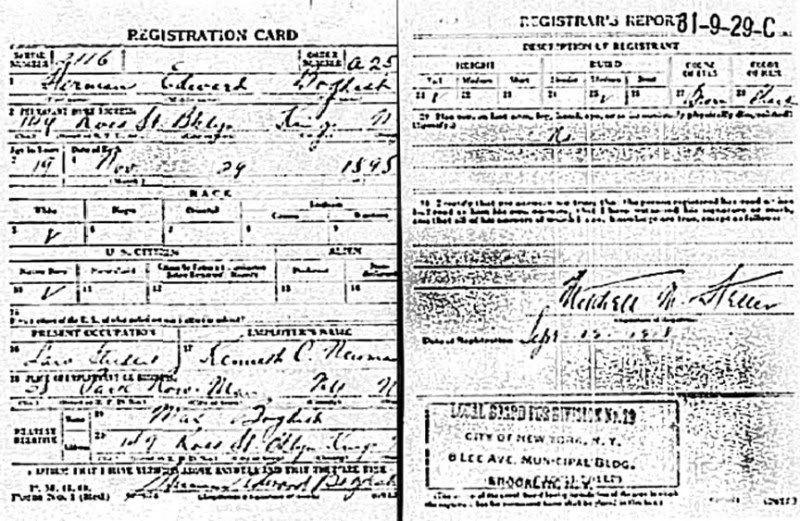
Above is Herman Bogdish's WW1 draft card. At the time was a law student

Cliff talked about the chimney and the balls he retrieved from Herman Bogdish in Chapter 13 of Cliff's KV notes
Herman evidently was an interesting character who passed away in 1991 at the age of 91.
From Cliff
As far as I know, Herman wasn't married. He was a lady's man and had a blond girlfriend that my father said was his "sister." Herman retired early, living off his investments. In the summer, he spent a lot of time at the Brooklyn beaches which resulted in a very deep tan.

Wednesday, April 8, 2009

Cliff's Intermission Prize


He gets to attend the big "KV" high school event with one of the all time KV beauties, Cookie Orvis.
Cookie, Cookie don't lend me your comb. Cookie, Cookie why don't you come home?

Cliff's KV Notes, Part 15: Editorial Intermission


KV has lost it. If you didn’t live there prior to the early 1950s, you don’t know what you’re missing. KV was built not as a sterile “housing project,” but with style, art deco touches, and wonderful details—from the small black buttons on the lobby intercom to the mailboxes with the horizontal slit near the top so you could drop in a note, to the vertical slits in the middle so you could see if you had mail. Sure you could pop open the door with a screwdriver, but non one did that. It all gave KV a distinctive personality. Kids have an appreciation for details that are often overlooked by adults.
When I lived in KV, the gates were never closed. The doors in the basement didn’t have supplemental chains and padlocks. There was an overall feeling of warmth, safety and security. That started to change in the early ‘50s when tenants first began to install additional locks on their apartment doors. In AH8, we even got one of those security devices that used a bar that braced against the door.
Looking at some of the reunion photos that Dave has posted, and from my own visits back to KV in later years, the atmosphere has changed radically. KV has gone from being a mellow, laid back, beautiful creation (from my childhood perspective) to something like a fortified “Green Zone.” There were gates everywhere. The only thing missing were armed checkpoints (VARE ARE YOUR PAPERS?!!)
Elevator door windows, once clear glass now bear a steel web—one of a multitude of changes. Much, if not all of the original beauty envisioned by the designers has been sacrificed on the alter of safety and security. The warmth has long vanished.
Maybe the folks growing up in KV today will form their own attachment to the present day village. Yeah, I know the world changes, and there were the folks who thought the world was going to hell when the automobile started replacing the horse (maybe the thought was that cars were cold and sterile while horses were warm and friendly).
All I know is, that if I was growing up in KV today, 55 years from now I don’t think I’d have anything to say about it.

Dave's editorial reply

Having revisited there a lot I agree it's not as beautiful as it was, but it still has its charm and attractiveness. It's also the worse for wear and tear. The courtyard is very well kept with tasteful plantings and the hallways are very clean. It's one of the few places left in Manhattan with affordable rents. Security? That unfortunately is a 21st century fact of life. Lack of warmth perhaps is a modern day deficiency everywhere. I didn't live there in those glory years of the 30's and 40's and I must have missed out on that attention to detail "gene" (I'm certainly thankful that Cliff has his) but I think it's a universal phenomenon that people look back on the past and imbue it with wonderful qualities that it may not have always had.


Cliff's editorial reply, reply
Dave-
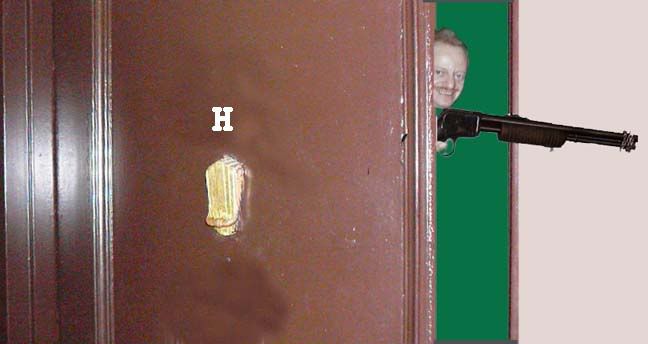
I can't agree with your reply. When KV was built, all the details were designed as a blend of form and function. The aesthetic elements were an intentional part of the plan. All the changes and modifications after the fact to the original design were for function (safety, security etc) and were done so at the expense of the original aesthetic elements. If you were to take, let's say, the outside elevator (both the inside and the outside of the door) and also an apartment door, and compare the original with the present, I believe that an objective evaluation of the "pleasingness of design" would prove my point. The size and fonts of the letters and numbers marking the floors and the apartments had style back then. They are bigger, blockier, and OK, more easy to read now. But they lack style. Too bad you can't compare the original door knocker with the one you show with the "Guns & Roses" installlment. The original had simple elegance compared to the gaudy, horsey present one.
I could go on and on.
Of course KV is not the exception. If you look at the original pre-war Bronx apartments on the Grand Concourse and compare them to the present day, the differences would be just as evident.
Take cars as another example. A '30s Duesenberg compared to a modern Ford Taurus. The Ford is more practical and functional. But which is more beautiful?
Sure, beauty is in the eye of the beholder, and we tend to glorify the past. But design and style still can be judged in their own right.

The previous chapter of Cliff's KV notes

Tuesday, April 7, 2009

Cliff's KV Notes, Part 14: Guns & Roses


Actually, this installment has nothing to do with roses, unless one of the six or so readers of this series wants to send me some. I just thought it would be a more catchy title than “The Night I Almost Shot My Grandmother.”
I don’t know what the gun laws are now in New York City, but back in 1958, you could legally own a long gun, so long as you were 18 years old and registered the gun with the City. There was a gun store and shooting range downtown on Warren St. (I think 22 Warren St.), and I bought a Stevens .22 caliber semi auto carbine, which I duly registered. I don’t know if KV had any of their own gun laws, but it probably wouldn’t have made any difference. Seems like there were a lot less gun crazies running around back then, and I never got a second look, toting my carbine inside its soft case, when I traveled down to the range to fire off a box or two of .22s.
I kept the gun, unloaded, in its case, inside my bedroom closet. We were living in AH8 at the time.
One night, about one or 2 a.m. I was awakened by a key being turned back and forth in our lock. Our apartment door was dad-bolted, so whoever had the key couldn’t come in. I ran to my parents’ bedroom and woke my father.
“Dad, there’s someone trying to break into the house.”
He jumped out of bed and started for the door. I said, “Wait, let me get my gun.” He agreed.
You loaded the Stevens through a tube located under the barrel. My hands were shaking as I spilled a box of .22s on my bed and managed to get only about 6 or 7 rounds down the tube.
My father and I took off towards the door, and he sort of crouched while he slid back the dead-bolt and flung open the door. The carbine already was raised to my shoulder, live round in the chamber, safety off and finger on the trigger. I tensed even more, and started to put more pressure on the trigger as my father flung open the door. And there stood…nobody.
About this time, my mother came out of the bedroom and asked what was going on. When we told her, she got kind of annoyed at us and said it must be grandma. Seems that my grandmother used to stay out late at times playing cards with “the girls.” This irked my grandfather to the point where he would lock her out of the apartment (BE6). This must have been one of those times. We walked to the stairway, and sure enough, there was grandma sitting on the steps, at a loss as to what to do next.
Both my grand parents lived well into their 90s. But I always wonder what would have happened if I had seen my grandmother standing in the doorway when my father flung open the door. Good thing she wasn’t.
The next chapter of Cliff's KV Notes

The previous chapter of Cliff's KV Notes
Cliff's Slide Show 2


Images referenced from Cliff's KV Notes 13: a 1950 era Henry J, the cover of the Compleat Practical Joker, an old wind up phonograph with a metal needle and a speaker in the arm and Stuyvesant gym teacher and football and wrestling coach, Murl Thrush. I had him as a teacher as well. Some day I'll tell a funny story about me and coach Thrush.

Superduperman


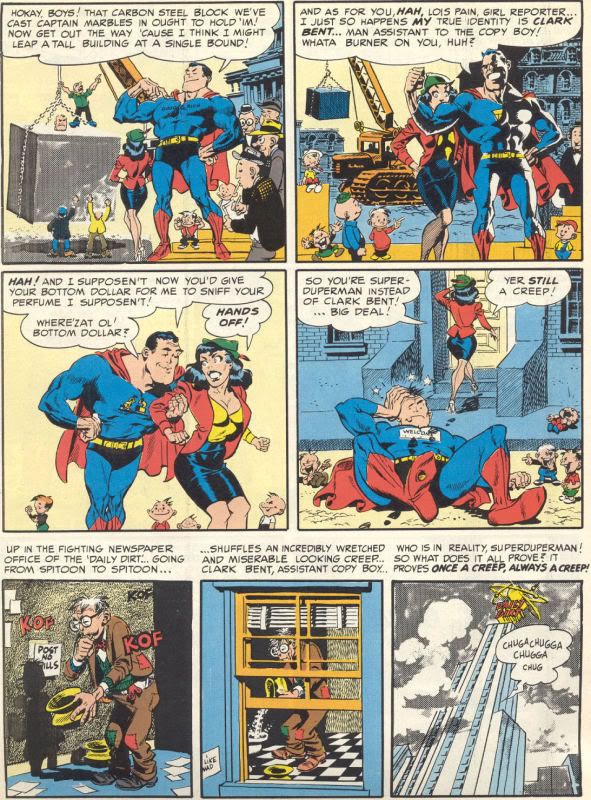
From Mad Magazine, a favorite of Cliff. Mentioned in Cliff's KV Notes

Monday, April 6, 2009

The Henry J And Other Forgotten Cars


Cliff's tormented 6th grade teacher Aaron Werner at PS 177, discussed in Cliff's KV Notes, drove a Henry J

from wikipedia:
The Henry J was an American automobile built by Kaiser-Frazer Corporation and named after its chairman, Henry J. Kaiser. Production of six cylinder models began in July, 1950, and four cylinder production started shortly after Labor Day, 1950. Official public introduction was September 28, 1950.
The car was the brainchild of Henry J. Kaiser, who sought to increase sales of his Kaiser automotive line by adding a car that could be built inexpensively and thus affordable for the average American in the same vein that Henry Ford produced the Model T. The project also included a lot of government "designing" as various provisions of the 1949 government loan to Kaiser-Frazer specified various particulars of the vehicle. Kaiser-Frazer would be in violation of the loan terms unless the car in its base form retailed (including Federal tax and retail delivery preparation charge) for no more than $1,300.00. It had to seat at least five adults, it had to be available for retail sale no later than September 30, 1950, and had to be capable of going at least 50 miles per hour for sustained periods of time.
To accomplish this, the Henry J was designed to carry the fewest possible components, and built from the fewest number of parts. To save body stamping costs, early Henry Js did not have rear trunk lids; owners had to access the trunk by folding down the rear seat. Another cost saving measure was to offer the car only as a two-door sedan with fixed rear windows. Also lacking in the basic version were glovebox, armrests, passenger side inside sun visor and flow-through ventilation.
Power for the Henry J was delivered by a four-cylinder 68 hp engine; later models were available with an L-head six cylinder 80 hp engine. Engines were supplied by Willys-Overland; the four cylinder motor was the same engine used in the CJ-3 series Jeeps with only slight modifications to component parts; the block and internal components were interchangeable with the CJ-3 jeep.
In 1952, Kaiser began selling rebadged Henry Js through Sears, under the nameplate of Allstate. Allstates were nearly identical to Henry Js but carried a unique grille, hood ornament, hubcaps, identification badges and interior trim, and Allstate-brand tires and batteries. After two years of disappointing sales, Sears dropped the car. The car was also available in Japan from 1951 to 1954, through a licensing deal with East Japan Heavy-Industries, part of the Mitsubishi group.
The Henry J proved to be a disappointment for Kaiser. While the Henry J was priced low, a Chevrolet 150 could be bought for a few dollars more, and the price included operating rear windows and a trunk lid. The Chevy, Ford and other "low priced" competitors were also larger cars, offering more interior room. Kaiser-Frazer started offering the deck lid as part of an "Accessory Group" (preferred equipment group) during the 1951 model year, and a variety of other dress-up items but major advertising still focused on operating costs at a time when gas was unrationed and at about 27 cents a gallon. Sales declined each year the car was marketed. While the Henry J was inexpensive for consumers, its manufacturing and labor costs were high. Henry J. Kaiser had hoped to make a profit through volume; however, the cars' slow sales negated his plan.
While sales of the Nash's compact Rambler were successful, it was partly because Nash marketed it as an accessory-loaded convertible. The Henry J was a plainly-trimmed two-door sedan; consumers understood the difference between "inexpensive" and "cheap" and they perceived the Henry J in a negative fashion.
Front view. Note custom signal lights and painted grille insert and hood spike.
With the acquisition of Willys-Overland's vehicle operations in early 1953 by the Kaiser Manufacturing Company division of Kaiser-Frazer (the division changed its name at that time to Willys Motors, Incorporated), management decided to discontinue the car at the end of the 1953 model year. Efforts to sell off remaining vehicles were unsuccessful, resulting in an abbreviated run of Henry J automobiles by Kaiser Motors (Kaiser-Frazer got a corporate name change in May 1953) as 1954 models, using up more of the incomplete 1953 models scattered around the Willow Run, Michigan factory.
Frank Zappa recalls in his autobiography the torment and horror of travelling cross-country sitting on the bench-like rear seat of a Henry J (he called it an "ironing board from hell") in the 1950's.

John Pizzarelli's Much Better Version Of Avalon


The youtube description:
Guitar demon John Pizzarelli tackles a Don Sebesky arrangement of 'Avalon' with the Thilo Wolf band.

Al Jolson's Avalon


The song of Al Jolson's that Cliff referred to in Cliff' KV Notes. I agree with his assessment of Jolson
from youtube user kachzvi18
Although "Rose of Washington Square" was one of 'Jolie's' last film roles, playing 2nd fiddle to Alice Faye and Tyrone Power, JOLSON literally STEALS the show from both of them! Here is the deleted scene from the film , featuring Jolson singing a medley: APRIL SHOWERS and AVALON!

I found my love in Avalon
Beside the bay.
I left my love in Avalon
And I sailed away.
I dream of her in Avalon
From dusk till dawn.
So I think I'll travel on
To Avalon.
Every morn' my memories stray
Across the sea where flying fishes play.
And as the night is falling
I find that I'm recalling
That blissful all-enthralling day.
Beside the bay.
And I sailed away.
I dream of her in Avalon
From dusk till dawn.
So I think I'll travel on
To Avalon.

Cliff's KV Notes, Part 13: A Little Mischief Music, Maestro


I wouldn’t consider myself a “bad” kid, but when I realized that there was “life outside the box,” I was curious about boundaries of an even “bigger box.” I guess, like most toddlers, I listened to my parents and went along with the program. After all, at the age of about five, I was no match for my father, or my mother, or my grandparents for that matter. But I found a conformist existence to be boring. I think the first time my imagination took a detour was before I was five, and was sitting in my favorite place—under the kitchen table in HG9. Observing my mother going about her chores in the kitchen, it appeared that her back was in close proximity to the refrigerator much of the time. Now, I as best as I can remember, I think I tried to tie her apron strings to the refrigerator door handle, which at the time seemed like a hoot.
My first exposure to life outside the hum-drum conformist box, was in 1945, when my father brought home our first phonograph. You couldn’t get anything during the war, and he came across a guy selling (non-electric) phonographs that you wound up with a big handle. The circular head at the end of the arm contained the speaker and the steel phonograph needle, which had to be changed fairly frequently. Spare needles came in a small paper packet.
Along with this small phonograph, my father bought a bunch of 78 rpm records. Included was Al Jolson recordings of “Dixie,” “I left My Love in Avalon,” and others. I never cared for Jolson’s voice. But what really got my attention, was a few Spike Jones records, including “The Laughing Record,” which I thought was stupid, and “Laura,” which was really funny, among others. What opened my eyes with Spike Jones, was that it was OK to spoof on convention. Years later, Spike Jones was featured on the “Colgate Comedy Hour” TV show. Maybe I was nine or so at the time. It was the funniest thing I had ever seen, and I remember literally rolling on the floor, clutching my sides, tears rolling out of my eyes and trying to catch my breath from laughing so hard. His best bit was doing a skit that spoofed one of the sponsor’s products, Halo Shampoo.
My second life-changing event occurred at the Chatham Sq. Library. I happened to pull out a book, “The Compleat Practical Joker,” by H. Allen Smith. This book really pushed the boundaries of the “bigger box.” I believe that this was the only hard cover book that I borrowed from the Library. The Dr. Seuss books didn’t count, because my mother had borrowed them for me on her library card.
My third life-changing event occurred in high school (Stuyvesant), when “Mad” comics (“Superduperman” was the best) hit the scene. Believe me, “Mad’ went downhill when it became a magazine. I remember in one of the issues, there was a reference to a “Thurl Mush.” The writer must have gone to Stuyvesant, because we had a gym teacher named Murl Thrush. Couldn’t have been a coincidence.
But back to KV. Somewhere along the line, I had received one of those joke “Peanut Brittle” cans. When you unscrewed the top, three cloth-covered spring “snakes” jumped out. Pretty neat. I thought it would be cool to stick one of those snakes in the green police call box attached to the wall of St. Joseph’s on Monroe St. I remember waiting for the coast to be clear, opening the box and jamming the spring inside and closing the door. The problem was that the spring pressure kept opening up the door and the snake fell out. I remember working on the problem for a while, but I can’t remember if I got the door to stay closed, or I just wrote it off.
But I even had more fun with gravity, even without knowing who Isaac Newton was. The “H” building had two staircases. One was square shaped, so you could look over the rail and see all the way down to the basement level. Which was an open invitation to drop stuff down. This was easier than throwing stuff at people (see previous installments) because nobody chased you. I used to take the garbage out to the incinerator from our apartment (one of my chores to justify my room and board). The garbage bag was an open brown paper bag from Gogel’s, so it was easy to pick out promising missiles, and take a detour to the stairway, after dumping the rest of the garbage down the chute. The best objects were burnt-out light blubs. They made a great crashing noise when they hit nine floors down and imploded. Some of the other “bombs” hit one of the railings on the trip down, but that was cool too, as they would create a shower of schmutz.
Then I discovered the KV roof. Actually, I was introduced to the roof, by my longtime best friend, Eugene Reiser. Euge (I never called him “Gene,”) showed me the stairs leading from the penthouse floor to the roof, and the door with some kind of warning about no one being allowed on the roof. But hey, we were living outside the box.
The view from the roof was spectacular, with vistas at all four points on the compass. But that got kind of old after 10 minutes, so to keep up our interest, we started tossing stuff off the roof. We began with some of the pebbles that were on the roof, and graduated to water-filled milk containers. We never hit anyone (I think we might have tired, though, minimizing any consequences of such actions in our immature minds). We’d also unscrew light bulbs from the stairways and drop those off, too.
Then Eugene came up with a “plan.” We’d “get” the guard in the “40” court, by bombing the guard house with light bulbs, and then “bombs away” with the water filled milk containers when he came out. Worked like a charm, even though we didn’t actually hit him. We did get nailed one time, when Eugene was about to show me how one of the fire extinguishers worked. He had lifted the big brass extinguisher from its perch when we were interrupted by a KV guard. Euge managed to get us off the hook by telling the guard that he just wanted to see “how heavy” it was. Close call.
A side note on KV guards. Two stand out. One was “Jimmy,” a retired NYC cop who lived with his wife on our floor when we were in HG9. Jimmy, who guarded the “10” court, was one of the nicest guys you’d want to meet. I knew him personally. Some years later, I and a few of my cronies were walking through the basement and found the door to the bicycle room open. We went in, started riding around on the bikes, and one thing led to another, and we ended up throwing the bikes around. Jimmy appeared at the door. I really felt ashamed, like I had let him down. But he cut us a break and didn’t report us. Another good guy was “Brady” in the “40” court.
One other stunt that worked rather well was the “poor man’s mustard gas.” Actually, pepper gas. I had picked up somewhere along the way, that if you took a wad of cotton, stretched it out so it was thin, poured cayenne pepper on it, lit it with a match and blew out the flame so it just smoldered, it would create fumes that literally would choke you. Seemed like a good idea, so I tried that in the elevator when we lived in AH8. I got the cotton going, placed it in the elevator and than retired to my apartment.
The elevator went down to I believe the 4th floor, where Mary, a friend of my sister got on. She was coming up to visit my sister. When she reached our apartment she almost needed emergency treatment. Her eyes were watering, she could hardly catch her breath, and of course, she didn’t know what happened. ‘Course I proudly told her of my experiment, realizing she was in no condition to retaliate.
In the sixth grade, my teacher, Aaron Werner, would confiscate “Spauldeens” that were brought into class. This I thought was a great injustice. So I thought of an idea to make Werner look a little foolish. The guy drove a Henry J, and that, in my mind made him look foolish enough. Anyhow, I had a collection of dead balls that I received from one of my father’s friends, Herman Bogdish. Herman lived on the first floor in an apartment that overlooked the incinerator chimney in the playground. The kids would bounce balls off the corner of the chimney where it hipped down, and some of the balls would get caught in the window guard of Herman’s apartment.
Now getting 6 or 7 balls out of my apartment when I went to school wasn’t as easy as you’d think. My mother would check my pockets before I left to make sure I was “clean” (no water guns, balls, or other potential class-disrupting items). One of my jackets had a torn pocket liner, so I was able to stuff balls through the opening and they would collect around the back of the jacket between the outside and inside linings. It got past my mother. In class, I emptied the balls inside my desk.
After a while, I’d toss a ball in the air, not too high, but enough for Werner to notice. He took it away. A few minutes later, ball No. 2 appeared, and the scenario would repeat itself. After ball No. 3, the rest of the class began to take notice, and Werner started to become irritated. By ball No. 6, no one was paying any attention to Werner, all eyes being fixed on the ever-appearing balls and the increasing frustration of Werner.
Now, as any older brother will tell you, younger sisters were created with the sole purpose of being the object of any evil that came to mind. The most notable incident along this line is when Eugene and I thought it would be fun to see if we could flush my sister Susan down the toilet. She was kind of feisty, so it took some doing to get a handle on her and get her in close proximity to the flushing toilet. We didn’t actually get to stick her head into the bowl (we got it close), but her histrionics were satisfying enough, that we did not need to proceed any further.

The next chapter of Cliff's KV Notes

The previous chapter of Cliff's KV Notes

follow up.
I wrote to Cliff and asked him how he diverted Werner's attention so that he didn't notice that Cliff was the one doing the tossing

He answered:
The point was to have him notice so he'd confiscate them. The idea was to have him keep taking them away--the class would get a kick out of it and he'd look foolish in front of the class.

Boy that little guy had Moxie.

Friday, April 3, 2009

Cliff's Slide Show


That Cliff's mom in one of the pics. In the background you can see Hanscome's Bakery on Catherine Street. I wonder why Gene Reiser looks so unhappy? I asked Cliff about the great color on those 1953 pictures.
Those pix are scans I made from original slides--Kodachrome 25. that stuff was unbeatable, and held up all these years without fading.these shots are virtually untouched

from Cliff: about the pictures with the teacher
For all the Stuyvesant H.S. fans out there--
This is Philip Abramowitz--notorious French teacher.
I was in the class of '57.
Abramowitz was famous for his ridiculous insults.
these are two I heard personally--
"If someone opened up your head, they'd find nothing but a vacuum."
"Your brains belong in the old monkey house."

Wednesday, April 1, 2009

Cliff's KV Notes, Part 12: Games People Play


Before I get into this installment, I want to throw something out there. I believe, early on, that there was one mailing address for all the buildings in the “10” court—“10 Monroe St..,” and another, “40 Monroe St.” for all the buildings in the “30” court. For evidence, check out Dr. Leon Sussman’s address on his letterhead: --40 Monroe. Check out my address on my war ration book—40 Monroe. Dr. Sussman was in the “E” bldg., and I was in the “D” bldg. at the time. The “F” bldg. is actually designated as 40 Monroe.
When we moved to HG9, I have a very vague recollection (I can push my 68-year-old memory only so far) that our address was 10 Monroe, and it soon was changed to 12 Monroe. While KV did have a package room, maybe they also had a post office on site, otherwise sorting the mail would have been a nightmare for the folks at Knickerbocker Station (unless the change came when the Knickerbocker Station PO opened up—just a guess).
My earliest recollection of being “out there,” must have been before I was five years old. The health gurus of the day professed that kids needed milk and sunshine to survive. My mother would take a wide-mouth jar, like a Mason Ball jar, fill it with milk, wrap wax paper around the top and then screw on the cover. We would stand on Cherry St. next to the playground, and my mother would yak with all the other yentas out there and periodically force-feed me this now-warm milk. Once in a while I’d get a treat—literally. Treat potato chips, probably from Gogels. The chips came in a long thin wax-paper bag and they were the greasiest, saltiest chips you could imagine. Must’ve been fried in lard enriched with extra cholesterol.
The health gurus also said that ultraviolet light was healthy for growing kids (right—especially very fair-skinned ones). So I remember getting a couple of UV sessions at Dr. Kaufman’s office. They did protect your eyes with goggles, so I give them credit for that. I remember a strong smell of ozone, which I rather liked. I guess the UV thing came after vibrators were introduced for the ladies to “relieve tension.”
When I was finally cut loose from my mother’s apron strings, there were all kinds of neat things to do. When I graduated from the monkey bars in the playground, the next challenge was the pits. KV is full of pits, as they were called. They allowed basement rooms to have windows. Getting down into a pit was easy, getting back up was more of a challenge. The first hurdle was climbing over the railing. What’s the big deal, you ask. Well, there are all kinds of things going on in kids’ minds that adults would never suspect. Like, “what if I climbed over the rail and slipped and fell down into the pit.” See? All kinds of fears that have to be overcome. Like I said, getting down was easy. When I got stuck down there, one of the big kids would save the day by climbing over the rail and lowering his foot. I’d grab onto his shoe and get a lift up to safety. I’m sure Bob Wilson “gave me the boot” on one or more occasion.
The king of the pits was the deepest one in KV. I believe was on Monroe St. It was the kiddie equivalent of scaling Mt. Everest, only in reverse. It wasn’t something to be taken lightly the first time around. It took a while to psyche myself up, but I knew I had to try it, having conquered all the lesser pits in KV. But I had watched how the other kids made it up, and I gave it a shot. Obviously I’m here to tell about it.
I’d be allowed out of the apartment “to go play” for 2-3 hours. And I had to be back at a certain time. I didn’t own a watch (that came in the second grade) so I’d have to keep asking people the time.
There were two crazes I remember—pea shooters and water guns. All the kids had them at the same time. Water gun fights were cool. We’d chase each other all over the neighborhood, and we’d refill our guns from the slop sink in the incinerator rooms. ‘Course the sink faucets didn’t have handles so only the janitors could turn them on. But we quickly figured out that a roller skate key would do the trick.
The peas shooters were large plastic straws that you loaded with split peas or white beans that came in a box from the grocer. The best part was raiding the Brownies—this was the junior contingent of the Girl Scouts (the equivalent of the Cubs Scouts to the Boy Scouts), and they held their activities in one of the basement rooms. The door was usually open. So it was a simple matter of quietly creeping up and firing off a salvo or two and then running like hell. The whole deal was made infinitely sweeter because my sister was one of the Brownies in the room.
My father introduced me to the world of Spaulding (pronounced “Spauldeen”) by teaching me to play handball against the wall of the Journal-American Building on South St. The Smith houses, with its handball courts hadn’t been built yet. But when it was, I would spend hours on the courts. Handball was my game.
KV had a really great playground., and I’ve never seen a better swing set. The hard rubber seat was connected to the frame with metal rods joined together by eye hooks. At the top, the rods were just hooked, not captivated, into the frame. I always feared that on high altitude arcs, in the millisecond at the top of the arc when the rods went slack, that one of the hooks could slide out, and I’d be launched onto Monroe St. I spent many hours on those swings. It was the closest a 5 or 6-year old could get to flying. After a rain, the rods would grow a slight coating of rust, which would rub off on my hands. Small price to pay. I also developed blisters and then calluses from pumping those bars to pay for my ride—also well worth it.
I remember two instances—one sitting on the swing, the other looking out my apartment window. A loud drone that continually grew in intensity. I looked up, and the sky was filled with U.S. bombers flying over KV at a fairly low altitude. Talk about impressive. Another thing anyone who spent some time in the playground would remember, is the firing up of the incinerator. To the right of the playground (when facing Monroe) was a brick chimney that poured out heavy black smoke from the incinerator. The air would take on an acrid smell and flakes of soot, and particles of grit would filter down onto the playground.
Sitting on the swing facing Cherry St. I could observe the older kids sitting on the green covered bench. They’d be joking and poking one another. One kid, taller than the others, seemed to have a position of authority and respect. He was very self-composed. Now, while younger kids sort of scrutinized the older kids, older kids just ignored younger kids. My mother told me that this tall kid’s name was “Punch.” He had a sister named “Judy.” I never got the connection to the marionettes Punch & Judy. I just thought those were their names.
In 1983, I took my 8-year-old son, Jonathan, down to the Brooklyn Bridge area to see the centennial celebration fireworks. The South Street viaduct was closed to traffic and was packed with people. There wasn’t a good viewing vantage spot left. I told my son, that I had a “secret spot” that would give us a front-row seat for the fireworks—the roof of KV. We went into the lobby of the “L” building to ride up to the penthouse. From there we would climb the stairs to the roof. I don’t know why I chose the “L” building, instead of one closer to Cherry St. Maybe it was because I used to date a girl in that building and wanted to see if the last name was still on the intercom list—it was.
Anyway, you know how over the years people change, but also remain the same? When my son and I walked to the elevators, there was a tall guy standing there. I recognized him as Punch, even though I hadn’t seen him in almost 40 years.. I couldn’t resist.
“Excuse me, but is your name “Punch?”
The guy looked shocked.
“Punch? Nobody’s called me that since the ‘50s…no, the ‘40s!”
He introduced himself—Bob Wilson. Then he tried to figure out who I was. I told him not to bother. Big kids always ignored little kids.
In the playground, my favorite game was punchball. I remember that David Schecter and I were about the only ones who could punch a ball all the way back to the flagpole. Another “Spauldeen” game was bouncing the ball off the chimney where it hipped down into a point. You could whack a really high fly ball off that.
Back to the dirt area around the flagpole--the arena for two other games: marbles and “Charge.” I always lost all of my marbles, and would have to buy another box from the K&K for my next day’s trouncing. The way “Charge.” Was played, was that one guy would stand by the flagpole, while everyone lined up at the edge of the dirt. He would yell “Charge,” and the object was to run across to the other side of the dirt area without being tagged. If you were tagged, you joined the guy in the center, until there was only one man left—the winner. Sort of like “The Night of the Living Dead
The next chapter in Cliff's KV Notes
The previous chapter of Cliff's KV Notes
Saturday, March 28, 2009

Cliff's KV Notes, Part 11: What's In Store

When you’re a hyper-active 8-year old, there are only so many things you can do inside an apartment (HG9 in this case) to keep yourself amused. The intercoms worked back then, and they were still the original black finish, , not having been painted over wall-color.. When I pushed the little black button, I got a live person on the other end, so I’d freak out and hang up. Or I would just pick up the earpiece and listen to the activity in the lobby. My pet project was trying to punch a hole in my bedroom floor so I could peek down out the occupants in HG8. Using a hammer and a screwdriver, I got through the parquet flooring but was stopped cold by the “hard stuff” underneath.
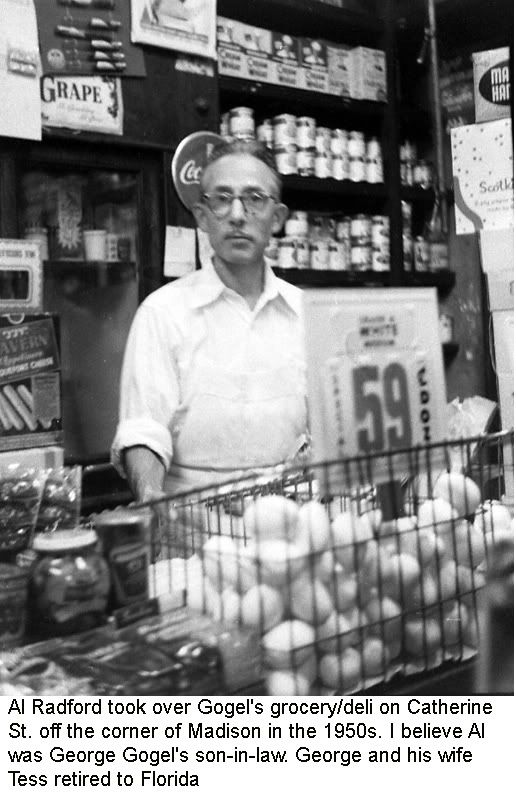
So the big deal was getting out of the apartment. And like most middle class folks, that meant shopping. I remember Macy’s and Gimbels with their creaky wooden escalators and the constant bonging bell. But let’s stick closer to home. The store we most frequented was Gogel’s grocery and deli off Madison on Catherine. George Gogel and his wife Tess worked behind the counters. It was a comparatively small store compared to Kremo, for example. I could never figure out why my mother and father selected a particular store when there was more than one of the same variety. Birnbaum had a Kosher butcher shop in the neighborhood, but for some reason my mother took her meat shopping business to Barney’s Kosher butcher on Suffolk off Delancey.
Barney was a short guy who made his ‘L’s” sound like “W’s” So you got wiver instead of liver. Barney had a tall partner, named Hy. They sold freshly killed chickens, and it was pretty cool to see them eviscerate the bird and all the neat stuff that was inside there.
But, back to Gogel’s. George was a client of my father (a lawyer), and the guy at Kremo was not. So that probably figured into the equation. George was a rotund, very pleasant guy, and his wife was equally pleasant. Even though the store was small, they seemed to have everything you asked for. It was cool seeing them use the reacher to pull down products off the higher shelves.
George wrote down the price of each item with the pencil that he kept behind his ear, on the classic brown paper bag. Everything was added up by hand. There was never an adding machine in the store, and the cash register just rang up the total. Gogel’s introduced me to real New York bagels and Italian bread. I was trusted to venture out to Gogel’s on my own, especially on Sunday mornings when my parents could count on a little uninterrupted time together.
Moving down Catherine to the corner of Monroe, was the Normandie Pharmacy. There were at least three pharmacies that I remember in the neighborhood. Normandie, Rich’s on Catherine and Madison and J. Savarese, which was the one we had our prescriptions filled at. I remember splitting an ice cream soda (one glass, two straws) with Linda Trichter when I was even younger. I probably got the idea from an Andy Hardy movie. I remember the adults in the store at the time thought it was “cute.”
Continuing down Catherine, there was Herman’s toy store. Kitty Herman was a classmate of my sister, Susan. Then there was the barber shop, where I got my first haircut. My mother saved a lock of my (then) platinum blonde hair. Al, the old guy, would cut my hair after putting me in a booster seat. I guess the first milestone in my life came when I graduated from the child seat into the adult chair (you’d think he’d give me a certificate or something). Al would strop his straight razor on the big leather strap attached to the chair, and he’d get hot lather from a small black machine. He used the razor to trim the hair on the back of my neck.
The slicked-back look was just coming into vogue, and it was referred to as a “DA” haircut. My father told me the DA stood for “duck’s ass.” My mother would always tell me to tell the barber “close on the sides and not too much off the top.” This day, when I entered the barber shop, I told Al that I wanted a DA haircut. He couldn’t take me, so he passed me off to his son, Pete. I remember Pete as much mellower that Al. Pete even escorted me back to the “H” building when I got lost exploring the KV basement one day. So anyhow, Al starts talking to Pete in Italian, which I don’t understand, but he throws in one phrase in English—“District Attorney” (DA) haircut. ‘Course I didn’t have the hair for that style, so Pete talked me out of it. Oh well, “close on the sides and not too much off the top.”
Moving up to Monroe St, and heading towards Market, there was St. Josephs, but being Jewish, I didn’t know much about it. But it was cool to look inside when the doors were open. Then there was Jimmy’s candy store. Jimmy was a guy maybe in his 40s, who wore glasses with one lens permanently fogged. He hand-packed Reid’s ice cream into square _- and pint containers. Good stuff, that Reid’s. Better than the packaged Breyer’s stuff at the Normandie. Jimmy had two gumball-type vending machines out front. One held tiny red Pistachios, and the other contained “Indian nuts” (pine nuts) as they were called. Unlike the Pistachios, the Indian nuts were sealed in a shell that you had to crack with your teeth—a lot of work, and you usually ended up with bits of shell in your mouth with the nut meat—not pleasant.
Further down on Monroe was a Chinese hand laundry that my father brought his shirts to. The place smelled almost like a bakery, and you got your shirts back with a wide blue paper band around it. This place had a bamboo lattice separating the customers from the workers. I couldn’t figure it out. It didn’t look sturdy enough to stop someone from busting through if they had a mind to. I guess they were paranoid.
Crossing Monroe St. to the KV side, there was the Gotham Cleaners, right near the K&K. The store was below street level, and you walked down a shot flight of stairs. Gotham’s door usually was open, and for some reason, I would throw stuff into the store, and then run when the owner came out to chase me and yell. I don’t know why I did it, I didn’t have anything against the guy. Maybe it was just something to do. And I did it, every chance I got. The owner was the only one working the front, and he’d run out like he was on a leash, going only so far—usually just to the top of the stairs before he turned back. This guy really had it in for me. Not that I could blame him
One day, after firing off a salvo or two of schmutz into the guy’s store, I was ready to take off as usual, when I was distracted by something going on across the street. I paused just long enough to feel this big hand clamp down hard on my shoulder. I knew it was the end. Retribution for my sins. My life flashed before me and I peed in my pants. I knew I was going to die right there.
Actually the Gotham guy didn’t kill me (otherwise all this would have been ghost-written—but you wouldn’t have known that). We had a little chat, and in return for sparing my life, I promised to take my “business” elsewhere.
The next chapter in Cliff's KV Notes
The previous chapter of Cliff's KV Notes