Monday, June 2, 2008
Neal Hellman: The Dulcimer Man
The KV Journeyman is back again traveling the world spreading the gospel of energy savings through energy star products (or so he says). Currently he's in Sacramento. The thought occurred to me he could be close to California's (in Felton) KV man at large, Neal Hellman. However, it's about 120 miles away. Surprisingly when I checked out Felton on youtube I wandered onto a video made by a dulcimer student of Neal's


I Like New York In June: Brooklyn Botanical Gardens
The first of a new series. 6/1/08 was a really beautiful day. Many of the pics are raw material for several panoramas to follow. I might as well start with the best version, Sinatra's with Nelson Riddle
The song is from the movie musical Babes on Broadway (1941) and has music by Burton Lane and lyrics by Ralph Freed.
I like New York in June, how about you?
I like a Gershwin tune, how about you?
I love a fireside when a storm is due.
I like potato chips, moonlight motor trips, how about you?
I'm mad about good books, can't get my fill
And James Durante's looks give me a thrill
Holding hands in the movie show, when all the lights are low
May not be new, but I like it, how about you?
A questionable link to Knickerbocker? This version includes Jimmy Durante of Catherine Street. I'm not the type to be awestruck by nature, but it really saddened me to think of those who are no longer with us who certainly would have.
Who's Almost Who In Knickerbocker Village History: Patty Duke
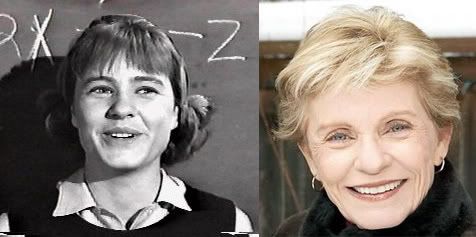
Yes, I know it's a stretch, but she was born in Bellevue Hospital in 1946 and I traced her father's 1930 residence to 335 East 25th Street.
From her biography at her web site:
Anyone could look at her brilliant work in classic films such as The Miracle Worker, ground-breaking television like My Sweet Charlie, and the eternally fun-to-watch Patty Duke Show and Valley of the Dolls and think they know this actress known to the world as Patty Duke. But there is a lot more to her story than what is seen on the screen. The teenager, and later woman, who seemed to possess everything any American ever wanted: fame, fortune, and respectability, has lived a life far from most of the various characters she has played over the years. This is the story of a tortured young girl who beat all of the odds, to become one of the greatest survivors of our time. This is the story of Anna Patty Duke Pearce.
Born in Bellevue hospital on December 14 1946 , Anna Marie Duke was the youngest of three children to be born to John and Frances Duke. The Duke’s lived on a modest income, with John working several jobs, most frequently as a cab driver. Anna’s recollections of her father are mostly positive. No matter what he was doing, he never went without a smile on his face. Frances , however, was suffering from severe undiagnosed depression. On top of her own mental disorder, Frances would frequently get fed up with John’s over-drinking and eventually kicked him out of the house around the time Anna was six.
Anna Marie would rarely ever see her father again. But little did she know until many years later, that John would quit drinking and save up enough money to buy a “standing room only” ticket at Broadway’s The Playhouse Theatre, where The Miracle Worker, starring his twelve-year-old daughter, was playing. He watched his little girl brilliantly perform the role of Helen Keller on stage several times but because of his fear of interfering with her seemingly now-charming life, never did he go backstage.
The Original Cousins
The lyrics:
Meet Cathy, who's lived most everywhere,
From Zanzibar to Barclay Square.
But Patty's only seen the sights
A girl can see from Brooklyn Heights --
What a crazy pair!
But they're cousins,
Identical cousins all the way.
One pair of matching bookends,
Different as night and day.
Where Cathy adores a minuet,
The Ballet Russes, and crepe suzette,
Our Patty loves to rock and roll,
A hot dog makes her lose control --
What a wild duet!
Still, they're cousins,
Identical cousins and you'll find,
They laugh alike, they walk alike,
At times they even talk alike --
You can lose your mind,
When cousins are two of a kind
from wikipedia,about the show:
from 1959-1963. First aired 9/18/59. The Patty Duke Show was, atypically for the time, filmed in New York and not in Hollywood. This was done because Duke was only 15 when the series began, and California's strict child labor laws curtailed the number of hours that child actors could work. New York, by contrast, did not have such stringent laws, thus allowing producers to devote more time to the production—a distinct advantage, since Duke effectively carried the show. Duke was to turn 18 during the 1965-66 television season; consequently ABC wanted to shift the show's production to Hollywood. To the network's displeasure, Duke was reluctant to make the move; at the time, she was in the midst of breaking off her relationship with her managers, who were insisting upon the move. Nonetheless, a few of the last shows were in fact filmed on the West Coast.
The show's theme song, which has since been parodied many times over in pop culture, illustrates the two girls' differences: Cathy adores the minuet, the Ballet Russe, and crêpes Suzette, while "Patty loves to rock 'n' roll; a hot dog makes her lose control."
Cousins
Despite the fact that we played for LMRC (Lower Manhattan Republican Club), all of the KV blog executive board members are Democrats
from moveon.org
from moveon.org
Knickerbocker Village Bargains
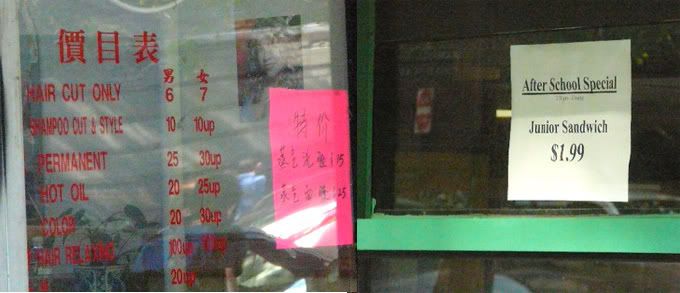
$6 haircuts (and just as good as the $17 ones from my Russian barber in Brooklyn) from 13 Monroe (formerly Pete's and Joe's) and $1.99 after school heroes at Blimpie's on Catherine Street.
Sunday, June 1, 2008
Catherine Street Panoramic Scene
A panoramic scene connecting a panoramic movie of Catherine and Cherry Street to a panoramic movie of Catherine and South Street
1950's Rheingold Beer Ad
My beer is Rheingold the dry beer.
East side. West side
End of town and down
Rheingold extra dry beer is the beer of great reknown
Friendly, freshening Rheingold
Always happily dry
The green clear taste you want is in Rheingold
From Lexington to Madison and on both sides of Park
They ask for Rheingold extra dry before and after dark
From Coney to Connecticut on Flatbush Avenue
From Jersey scenes way out to Queens
They sing as millions do
Think of Rheingold whenever you buy beer.
It's not bitter, not sweet, it's the extra dry treat
Won't you try extra dry Rheingold beer?
from the nydailynews of 4/17/08
Putting in a plug for the golden age of catchy 'Jingles'
Thursday, April 17th 2008, 4:00 AM
Mark Burnett's new summer reality series for CBS, "Jingles," sounds at first like it will only extend one of the most annoying trends in television: program-length promotions all dolled up as entertainment.
The eight-episode "Jingles" will have contestants compete each week to write the best original ad jingle for some featured product - meaning it starts out being what "The Apprentice" devolved into: a quasiinfomercial.
And I don't care. If "Jingles" helps revive one of the great arts of American popular culture - the ad jingle - I don't care if it promotes tobacco companies, the Mercury Dumping Association and the Dangerous Chinese Toys consortium.
I just want a world where ad jingles can flourish again.
Is that too much to ask?
If you have watched more than 20 minutes of TV in your life, you know what I mean, because you carry ad jingles in your head.
You don't remember your spouse's birthday, but you can sing: Plop plop fizz fizz/Oh what a relief it is or My beer is Rheingold the dry beer/Look for Rheingold whenever you buy beer.
You know Double your pleasure, double your fun and You can trust your car/To the man who wears the star. You know the tune of "I Love New York" and "Be All That You Can Be."
It takes only one note before you recognize the IO Cable jingle or "1-800-Empire."
If you're 40 or older, you will carry the voices of the Jolly Green Giant and Tony the Tiger for the rest of your days.
Terrifying? Nah. Harmless. What's depressing is that those touchstones are disappearing.
Three years ago, Eric Korte, music director of the ad agency Saatchi & Saatchi, told the Boston Globe that more than half his clients now just wanted to license existing songs. A decade earlier, 90% wanted original music. "The jingle," he said, "is dead." Historically, you see how that could happen. The jingle was developed for radio, which had no visual component. After TV came along, the impressive thing is that jingles stayed prominent for as long as they did.
That's exactly why they deserve to remain. Jingles are a deceptively difficult art, one in which the writer must convey a product identification and a memorable association for that product in a dozen words or less. Then set it to a catchy tune.See the U.S.A./In your Chevrolet. Maybe it's just a dream to keep ad jingles in our national DNA. Maybe Mark Burnett can help make it a reality.
Knickerbocker Village-Al Smith Greenery
Last but not least in the "May, Mountain Greenery" series of slideshow movies (in total there were 16). All can be found on pseudo-intellectualism
I exhausted my soundtracks. I found this one in the itune store. It's by an excellent Austin based singer named Mady Kaye. She used lyrics for the song I had never heard before. Next month's theme is "I Like New York In June, How About You"
Musketeers Of Pig Alley
In keeping with recent "crime" thread
DW Griffith's 16 minute film, 'The Muskateers of Pig Alley' was produced in 1912, and is credited as being the first gangster film ever committed to celluloid. It was apparently influenced by the nationwide press attention of the murder of gambler Herman Rosenthal, and the subsequent trials of Harry Horowitz (Gyp The Blood), Louis Rosenberg (Lefty Louie), Jacob Seidenschmer (Whitey Lewis),Dago Frank and Liet. Charles Becker. Griffith was intrigued enough to take his camera to the Lower East Side and cast, apparently, actual street hoods and gangsters from the neighborhood as extras to authenticate his footage alongside his principle actors. While thematically has very little to due with the Rosenthal case, it was the first time the Lower East Side became a central backdrop to a story on film. It's a fascinating window into the past regardless if the use of actual criminal types was just early studio marketing savvy or the truth.
Another Griffith landmark and what could reasonably be considered the first gangster film ever made. Clearly this exercise in realism is the predecessor of the crime movies of later generations, The film is about a poor married couple living in New York City. The husband works as a musician and must travel often for work. During one of his away trips, he is robbed by a gangster. Later, he gets caught up in a shootout and recognizes one of the men as the gangster who took his money. Now he wants it back.
The film was released on October 31, 1912 and re-released on November 5, 1915 in the United States. The film was shot on location in New York City, and reportedly used actual street gang members as extras during the film.
Griffith shot the film on location and cast actual gangsters like 'Kid' Brood and 'Harlem Tom' Evans to play in the rival gangs. According to the Biograph Bulletin of October 31, 1912: "This picture production, which does not run very strong as to plot, is simply intended to show vividly the doings of the gangster type of people."
The episodic plot begins in "New York's other side ", "where a poor musician goes off to improve his fortune." On the way home, he shows his earnings to a friend in the street. The Snapper Kid, Chief of the Musketeers, sees the full wallet, follows the musician, hits him over the head, and takes the money. After recovering, the musician goes out to find his money, leaving the little lady, his girlfriend, worrying about his safety and the rent. A friend comes to cheer up the little lady and takes her to a dance - the gangster's ball. A respectable-looking gangster invites the little lady for a drink and slips a drug into it. The Snapper Kid watches the scene and stops the little lady before she downs the drink, thus provoking a gang war. During the shootout, the musician sees the gangster and grabs his money back during the confusion of the battle. The police break up the fight and arrest everyone but the Snapper Kid. He escapes to the little lady's flat, reminds her that he saved her from being drugged and invites her out. She refuses and says she'll stay with her husband. The gangster shrugs it off, thinking she must be crazy to prefer the musician, and leaves. A cop nabs him and begins to arrest him for taking part in the gun battle, but the Snapper Kid says he has an alibi - he was visiting his friends. The little lady and the musician back up the Kid's story because, as the title card reads, "One good turn deserves another". The Kid makes a gesture of friendship with his hands and goes out. After a title, "Links in the system", a mysterious hand slides into the picture from out of frame and gives the Snapper Kid some money. The couple embrace, and the film ends.
Griffith pictured the Snapper Kid sympathetically. Elmer Booth portrays a likeable, tough, coarse thief and killer. Lillian Gish has said that Elmer Booth was a distinct precursor of James Cagney. Like gangsters played by Cagney, the Snapper Kid is short, powerful, explosive, and expressive with his body, face and gestures. He is violent and quick to act in movements that snap out like his name. He is good-natured about the little lady's rejection, sly enough to avoid going to jail, wise enough not to fight in the Big Boss's place, and constantly putting plans into action to get what he wants. He exudes a healthy self-confidence and is proud of the snappy way he dresses. Griffith's mixing of a firm sense of realistic detail and a romantic bias have shaded the Chief of the Musketeers as more chivalrous than the movie gangsters who followed, but the Snapper Kid launched the central character of the genre - a sympathetic gangster - and the movie gangsters who followed shared many of his traits.
The Lower East Side locations in Musketeers provide an appropriate setting for the birth of the genre. "New York's other side", as a title describes the setting, is comprised of dingy rooms and hallways, saloons, narrow streets teeming with immigrants, and underworld alleyways filled with garbage cans, dust, and debris. City textures and dark places predominate. The action takes place around the bottoms of buildings, and we never see the sky. There are no country or uptown alternatives for the Snapper Kid - no penthouse aspirations. The gangster genre began in the slums, and the people who lived there appreciated the film. Billy Bitzer, who was Griffith's cameraman regularly and who shot MUSKETEERS, recalled an early preview of the film: "Another way we learned was through tryouts. Tryouts were usually in remote theatres, and it was to our advantage to be there. One memorable tryout was held in a converted store in the Lower East Side Jewish section of Manhattan. It was in 1912 for The Musketeers of Pig Alley, an early gangster film with Elmer Booth, much of which was filmed in that locale. We got very strong and favourable reactions - it was one of the first realistic films, one of our best."
Subscribe to:
Posts (Atom)


 Posts
Posts