Monday, June 23, 2008

When Marimba Rhythms Start To Play


Time for a cha cha break
When marimba rhythms start to play
Dance with me, make me sway
Like a lazy ocean hugs the shore
Hold me close, sway me more
Like a flower bending in the breeze
Bend with me, sway with ease
When we dance you have a way with me
Stay with me, sway with me
Other dancers may be on the floor
Dear, but my eyes will see only you
Only you have that magic technique
When we sway I go weak
I can hear the sounds of violins
Long before it begins
Make me thrill as only you know how
Sway me smooth, sway me now
Sway me, make me
Thrill me, hold me
Bend me, ease me
You have a way with me
Sway with me
Sway (sway) (Sway)
Other dancers may be on the floor
Dear, but my eyes will see only you
Only you have that magic technique
When we sway I go weak
I go weak
I can hear the sounds of violins
Long before it begins
Make me thrill as only you know how
Sway me smooth, sway me now
Make me thrill as only you know how
Sway me smooth, sway me now
Make me thrill as only you know how
Sway me smooth, sway me now
Sway me
Sway me
Sway me now

Joshua Prager Inteview


Looking back I think St. Joseph's must have stolen LMRC's signs. :)

The Giants Win The Pennant

Echoing Green:The Untold Story of Bobby Thomson, Ralph Branca and the Shot Heard Round the World


Julius Rosenberg listened to the game from Death Row at Sing Sing. So did George Carlin, a 14 year old, from his apartment on 121st Street
from amazon's review
October 3, 1951, 3:58 p.m., Polo Grounds, New York City: "Branca throws. There's a long drive. It's gonna be, I believe—the Giants win the pennant!" That's the way New York Giants' announcer Russ Hodges described what is arguably the greatest moment in American sports, the shot "heard round the world," as the Giants defeated the Dodgers to win the National League pennant. Prager, a senior special writer at the Wall Street Journal, has written a brilliant narrative not only about the most famous homerun in baseball history but also about the mystery that haunts it. Americans love a conspiracy, be it the grassy-knoll variety or perhaps a more innocuous one, like the stealing of baseball signs. For that is at the crux of this book: did the Giants know what the Dodger pitchers were going to throw before they threw it? (It should be pointed out that there is no baseball rule prohibiting stealing the opposing team's signs.) Prager, who first broke this story for the Wall Street Journal in 2001, tells a tale worthy of a "Deep Throat." The sign heist was ingeniously simple—all that was involved was a telescope, a buzzer and an isolated bullpen catcher.The baseball story is exciting, but Prager concentrates on what happened to the protagonists: Ralph Branca, the pitcher, forever branded a loser; Bobby Thomson, the phlegmatic gentleman, equally haunted by his heroics. We see the change in Branca when he learns the truth years later from Sal Yvars and the bitterness it engendered toward Thomson, a God-fearing man uncomfortable with his legal cheating. Finally we see a reconciliation between old adversaries, who became business partners, lucratively exploiting their infamy, becoming friends along the way.Although Prager does have a tendency to overpsychoanalyze both ballplayers, he paints a marvelous portrait of New York City baseball in the tradition of The Boys of Summer and Summer of '49, bringing to life once again a genuine piece of Americana.

Sunday, June 22, 2008

On The Radio....July 30, 1957


No not Donna Summer, but Linda Babits with the LENA Symphony Orchestra from East River Park at 8:30 PM on WNYC. Otherwise you can listen to the Cardinals vs. the New York Giants on WMCA

Not This Day In KV History: June 24, 1909, The Wedding Of The Pickle King's Daughter

Read this document on Scribd: karpwedding

Saturday, June 21, 2008

Russert Wins Vote To Become Honorary KVer


The poll is closed and the result was 7-4 in favor. I estimate there were a few more pro votes that were sent to me as emails but never entered on the poll.
The screen door slams
Mary' dress waves
Like a vision she dances across the porch
As the radio plays
Roy Orbison singing for the lonely
Hey that's me and I want you only
Don't turn me home again
I just can't face myself alone again
Don't run back inside
Darling you know just what I'm here for
So you're scared and you're thinking
That maybe we ain't that young anymore
Show a little faith there's magic in the night
You ain't a beauty but hey you're alright
Oh and that's alright with me
You can hide 'neath your covers
And study your pain
Make crosses from your lovers
Throw roses in the rain
Waste your summer praying in vain
For a saviour to rise from these streets
Well now I'm no hero
That's understood
All the redemption I can offer girl
Is beneath this dirty hood
With a chance to make it good somehow
Hey what else can we do now ?
Except roll down the window
And let the wind blow
Back your hair
Well the night's busting open
These two lanes will take us anywhere
We got one last chance to make it real
To trade in these wings on some wheels
Climb in back
Heaven's waiting on down the tracks
Oh-oh come take my hand
We're riding out tonight to case the promised land
Oh-oh Thunder Road oh Thunder Road
Lying out there like a killer in the sun
Hey I know it's late we can make it if we run
Oh Thunder Road sit tight take hold
Thunder Road
Well I got this guitar
And I learned how to make it talk
And my car's out back
If you're ready to take that long walk
From your front porch to my front seat
The door's open but the ride it ain't free
And I know you're lonely
For words that I ain't spoken
But tonight we'll be free
All the promises'll be broken
There were ghosts in the eyes
Of all the boys you sent away
They haunt this dusty beach road
In the skeleton frames of burned out Chevrolets
They scream your name at night in the street
Your graduation gown lies in rags at their feet
And in the lonely cool before dawn
You hear their engines roaring on
But when you get to the porch they're gone
On the wind so Mary climb in
It's town full of losers
And I'm pulling out of here to win

Who's Almost Who In Knickerbocker Village History: Mel Brooks


Another stretch? Though Mel grew up in Williamsburgh, as he describes in the above video,
his grandfather and father lived at 202 Henry Street, now Gouverneur Hospital.
One biography states:
Born Melvin Kaminsky in Brooklyn, New York, USA, to Russian-Jewish parents Maximillian Kaminsky and Kate "Kittie" Brookman. Brooks' grandfather, Abraham Kaminsky, was a herring dealer who immigrated in 1893. He and his wife Bertha raised their ten children on Henry Street on the Lower East Side of New York City.
When Brooks was two years old, his father died of kidney disease at age 34. A year later, in 1930, Kittie Kaminsky and her sons Irving, Leonard, Bernard and Melvin were living at 365 S. 3rd St. in the Williamsburg neighborhood of Brooklyn, NY.
As a child, Mel was a small and sickly boy. He was bullied and picked on by his peers. By taking on the comically aggressive job of "Toomler" in various Catskills resorts, he overcame his childhood of bullying and name calling.
He went to school in New York. For elementary, he went to Public School 19 . For middle school, he went to Francis Scott Key, Jr. High. Brooks graduated from Abraham Lincoln High School.

Another biography:
Mel Brooks was born Melvin Kaminsky at 515 Powell Street in Brownsville, June 28, 1926. He was always funny whether standing on a street corner in Brownsville or hanging out in Feingold’s Candy Store, eternally searching for the “bestest” egg creme. His “wise” remarks often got him in trouble, especially with the P.S. 19 teachers. When he was a little older the family moved to Brighton Beach where they lived a few doors away from famed drummer Buddy Rich, who taught Mel to play drums. Then the family moved to 111 Lee Street in Williamsburg where Mel attended Eastern District High School. Brooks served as a corporal in the U.S. army in North Africa during World War II. Part of his duties was defusing landmines in areas before the infantry moved in. Mel changed his name to Brooks (taken from his mother’s family name of Brookman) and went into show business, starting out as a stand-up comic. He switched to comedy writing.

Despite the conflicting biographies, I know the part about his father on Henry Street is true because I found the census records online.

Harry Golden: Part 3, Little Hungary

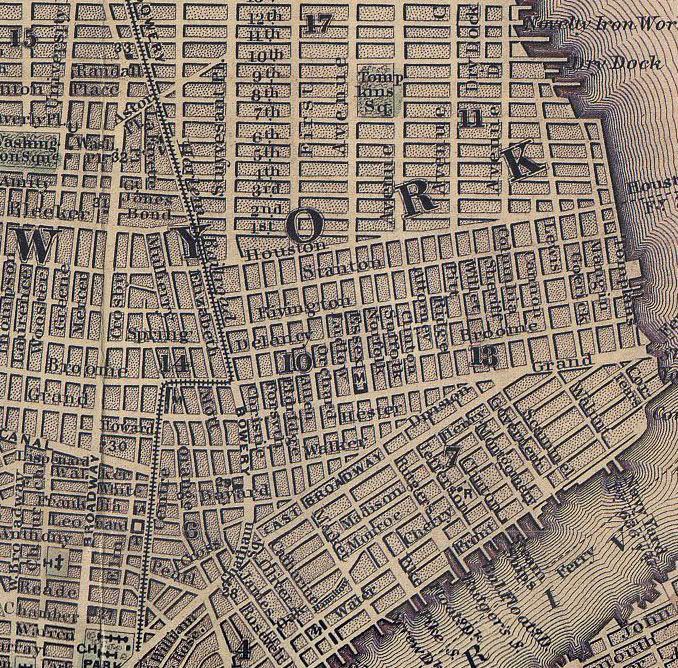
Back to Harry Golden. His building is no longer there-just about the entire west side of Eldridge, between Delancey and Rivington is gone. There are some old tenements left on the west side, where University Settlement is located. In his book Harry mentions that he worked as a newsboy and that one of his best days for sales was the day that Archduke Franz Ferdinand, heir to the throne of the Austro-Hungarian Empire, was assassinated. This occured in 1914 and it was the event that led to World War I. Harry was selling papers in front of the Little Hungary. What was Little Hungary? It was a very famous catering hall and social club at 257 Houston Street. Currently it houses a day care center. A picture of it is above. In a close up view you would notice some elaborate ornamental work on its facade. An internet search didn't turn up any old photos of the building, but I did find some archival menus as part of the NYPL collection.

Harry Golden: Part 2

from 2005 from pseudo-intellectualism
I finally got a chance to scan part of Harry's book. Here's the section where he mentioned the Little Hungary restaurant on Houston Street. His reference is within the context, "Where were you when.........some important event happened" For him it was the assassinatiion of Archduke Ferdinand and the subsequent start of World War I. For my parents, I guess it was Pearl Harbor. For my generation I think it was "Where were you when you heard that Kennedy was shot?" I remember being dismissed early from Stuyvesant in my senior year. It was the Friday before the big Stuyvesant vs. Clinton football game and there had been a rally in the auditorium. For the current generation it has to be 9/11. BTW the last slide has an excerpt from a different book entitled, "Matinee Tomorrow" that recalls a 1910 New Year's Eve party at Little Hungary. Sounds like it was a pretty fancy place.

Who's Almost Who In Knickerbocker Village History: Harry Golden

From 2005 from pseudo-intellectualism
Here's a guy worthy of respect. Harry Golden was born in 1902 in Mikulintsy (Ukraine). His last name was actually Goldhirsch His father, Leib Goldhirsch, left Mikulintsy in 1904 for Winnipeg, Canada. The family came to New York City in 1905. Harry was a stockbroker and in 1929 his brokerage house went bankrupt. He came to Charlotte ( N.C. ) In 1941 and began to write about and speak out against segregation. From 1942 to 1958, Golden published a newspaper containing his views. It was called the Carolina Israelite. He was widely acclaimed as a writer and humorist and won numerous awards, but his opinions evoked constant criticism from people who disagreed with his belief in racial equality. One of his books, "Only in America," became a best seller in 1958. Harry attended the old PS20 on Eldridge and Rivington and an autographed book of his is part of the library's collection. I was reading that book today and learned some fascinating things, e.g. each block had their own gangs e.g. The Rivington Streeters, the Eldridge Streeters, etc. Jewish boys so feared wandering into Irish neighborhoods that it effected their swimming ability. At the turn of the century The Irish ruled the neighborhoods adjoining the East and Hudson River. The book mentioned that Harry lived on Eldridge Street, between Delancey and Rivington. Above is the census of 1910 with the Goldhirsh family at 171 Eldridge Street. Harry was Hyman. I'll check soon to see if that building is still there.

KV Brewing Tips


I received an email with this extraordinary expert testimony on coffee brewing from KV's "Son of Seth." It may mark the beginning of a new thread called "KV Helpful Tips"
I joined it with some complementary video.
I recently had the opportunity and the pleasure to journey over to the upper East side and visit with Allan and Vivien in their new digs on East 91st Street. While we were there, it just so happened, Allan expressed the desire for a cup of coffee and Vivien asked if I would do the honors and prepare a cup for each of us as, as it turned out, we all were bone tired from an exhausting hike through the environs of LES earlier in the evening. We had spent some time surveying rooftops circa Houston Street, collecting unclaimed Seconds and here and there a Spaldeen or two. So, let me leave off with the dilly dallying and get straight to the point here. I entered their kitchen apprehensive that they might not have the accoutrements that I generally favor in such circumstances. To my delight, I was able to locate a single cup Melitta, filters, requisite well-preserved and robust Bustelo blend coffee in the customary yellow and red can and, of course, a generous supply of freely running tap water. First I let the water run. In order to make a good cup of coffee you’ve got to have well-exercised water that is not craving a gallop, this will – it you attempt to use unexercised water – create a bitter taste lacking entirely in what the Japanese like to call “umami’ – or colloquially speaking, “deliciousness.” And the whole point of this little maneuver is to prepare an outrageously delicious cup of coffee and, right now, in this instance, I am attempting to pass on to you all the way to do so. So I allowed the water to run free for a good twenty minutes which, according to my chiropractor, is the gold standard for aerobic activity. I then filled the Al and Viv's English style electric water kettle with crystalline clear NYC tap water and pushed the button to allow the appliance to do what it does so well. At this point, it’s surely a matter of patience that comes to the fore. Stopping the machine before the water has had a chance to reach a uniform boiling point would, in a flash, degenerate the taste of the final cup in such a manner that it would be difficult for me to sympathetically portray my own feelings towards the individual who, after having gone to the trouble of purchasing a world-class electric kettle, then decided to prevent it from doing its job. That would be intolerably offensive and I refuse to entertain the possibility that any of the KV brethren or sistren, actual or honorary, would commit such an egregious error. So, having exercised the requisite patience, you‘ve got yourself a pot of water that has not only boiled but whose molecules have atomized, turned to steam and returned to liquid. These are well-excercized H-2-0 specimens each duly trained and ready to fulfill their coffee mission. Next you take the kettle and pour it over the grounds neatly arranged in the Melitta filter sitting atop the first cup. Then you replace the ground and repeat the process twice successively to obtain the three cups – this demonstration will yield three cups of A-1 world class brew. Once you’ve got the coffee in the cups you are ready to begin the oxidization procedure which is what is going to take your ordinary but excellent cup of joe into the taste stratosphere. Taking three empty cups along with the three, now full coffee cups you carefully pour the coffee, slowly in a single file stream approximately one-sixteenth of an inch in diameter, from the filled to the empty cups. You now have three newly filled cups and three newly emptied cups. Repeat the procedure so that the once filled cups become the newly filled cups. And, again, fill the once empty cups by pouring the twice filled cups into the once emptied cups. Repeat this procedure until each cup has contained and been emptied of coffee five times. At this point, the oxidization levels of the coffee will have peaked. There will be no reason to continuing to pour the coffee back and forth but if you are a little like me, you’ll find yourself continuing another five times for good luck and just because it’s good clean fun. But in any case. If the lucky drinkers have a taste for milk and sugar in their coffee, do your best to convince them to opt for a soy substitute because, let’s face [referencing Allen’s email circa 6 weeks ago] dairy has its drawbacks. As far as the sugar goes, be tolerant. If someone feels they need to sweeten their coffee, resist being judgmental. It will be a good exercise in self-control and besides if you feel obligated to make an issue over a bistle of sugar what kind of neighbor are you anyway? If they ask for sugar give them sugar. That’s the final answer there. So. Once you’ve squared away the add-ons you are ready to sit back and relax and that is just what Allen and Vivien and I did, enjoying a magnificent view of the lights of Manhattan, seen from the 26th floor of what, in most respects, could justifiably be described as nirvana. We sat sipping our brew. In silence for a while but each meditating on the moment and coming, I believe, to the conclusion that, of all the elements, neither the exquisite taste of the coffee, nor the expansiveness of the view could match the comfort of the friendship and sense of community that we enjoyed in that rare moment. So, follow the recipe exactly, but remember. Food isn’t everything. In case you missed that I’ll repeat it one more time. Food isn’t everything.