Friday, October 3, 2008

Maverick Is His Name


I wonder whether John and Sarah know who the real Maverick is? Nevertheless, they are also living on "jacks and queens"
Who is the tall, dark stranger there?
Maverick is the name.
Ridin' the trail to who knows where,
Luck is his companion,
Gamblin' is his game.
Smooth as the handle on a gun.
Maverick is the name.
Wild as the wind in Oregon,
Blowin' up a canyon,
Easier to tame.
Riverboat, ring your bell,
Fare thee well, Annabel.
Luck is the lady that he loves the best.
Natchez to New Orleans
Livin on jacks and queens
Maverick is a legend of the west.
Riverboat, ring your bell,
Fare thee well, Annabel.
Luck is the lady that he loves the best.
Natchez to New Orleans
Livin on jacks and queens
Maverick is a legend of the west.

an excerpt about the show from wikipedia. I never watched Maverick. I watched the Steve Allen Show instead
Maverick is a comedy-western television series created by Roy Huggins that ran from September 22, 1957 to July 8, 1962 on ABC and featured James Garner, Jack Kelly, Roger Moore, and Robert Colbert as the poker-playing traveling Mavericks (Bret, Bart, Beau, & Brent). Moore and Colbert were later additions, though there were never more than two current Mavericks in the series at any given time, and sometimes only one. Maverick presented James Garner as Bret Maverick (1957-1960), an adventurous gambler roaming the Old West, Jack Kelly as his equally skilled brother Bart Maverick (1957-1962), and Roger Moore as English-accented cousin Beau Maverick (1960-1961). James Garner was the only Maverick in the series during the first seven episodes, and the show is credited with launching Garner's career. Maverick often bested both The Ed Sullivan Show and The Steve Allen Show in audience size. Series creator Roy Huggins inverted the usual screen-cowboy customs familiar in television and movies at the time by dressing his hero in a fancy black broadcloth gambler's suit, an outfit normally reserved in western films for villains, and allowing him to be realistically (and vocally) reluctant to risk his life, though Maverick typically ended up forcing himself to be courageous, usually in spite of himself. The first broadcast episode of Maverick, "War of the Silver Kings," was based on C.B Glasscock's "The War of the Copper Kings," which relates the real-life adventures of copper mine speculator F. Augustus Heinze. The real-life copper king ultimately went to Wall Street. Huggins recalls in his Archive of American Television interview that this Warners-owned property was selected by the studio as the first episode in order to cheat him out of creator residuals. Bret Maverick frequently flimflammed adversaries, but only criminals who actually deserved it. Otherwise he was scrupulously honest almost to a fault, in at least one case insisting on repaying a debt that he only arguably owed to begin with (in "According to Hoyle"). Maverick was not a particularly fast draw with a pistol, but like all TV cowboy heroes of the era, it was almost superhumanly impossible for anyone to beat him in any sort of a fistfight (perhaps the one cowboy cliché that Huggins left intact, reportedly at the insistence of the studio). Critics have repeatedly referred to Bret Maverick as "arguably the first TV anti-hero," and have praised the show for its photography and Garner's charisma and subtly comedic facial expressions.

Thursday, October 2, 2008

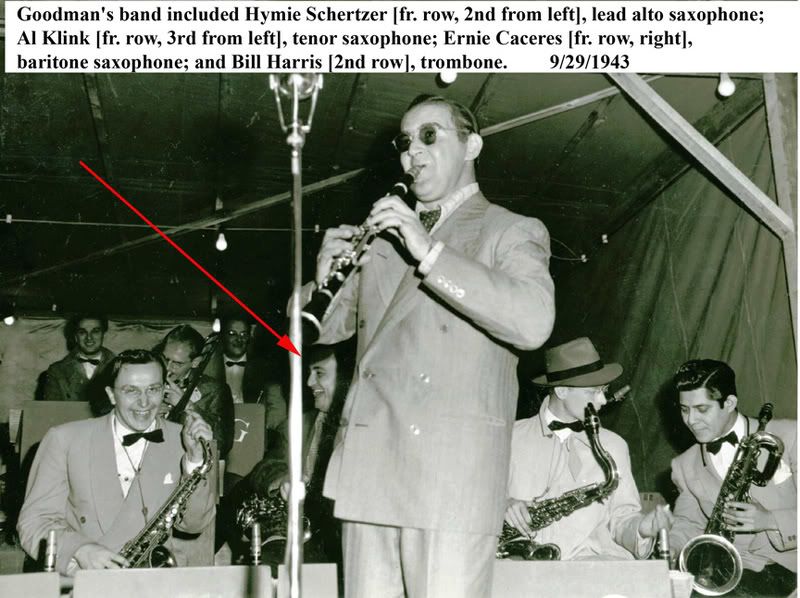
Who's Almost Who In Knickerbocker Village History: Hymie Shertzer


This is the only picture I could find of Hymie Schertzer, or Shertzer. It's a shame that very little exists about him on the internet. He was an outstanding reed player both for Tommy Dorsey and Benny Goodman in the 30's, 40's and I believe in the 50's. He was born in 1909, no mention of his passing away exists.

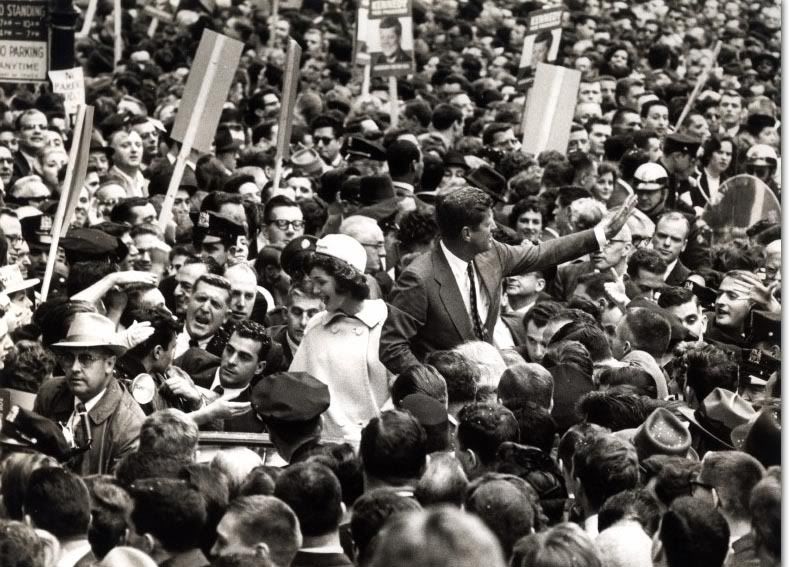
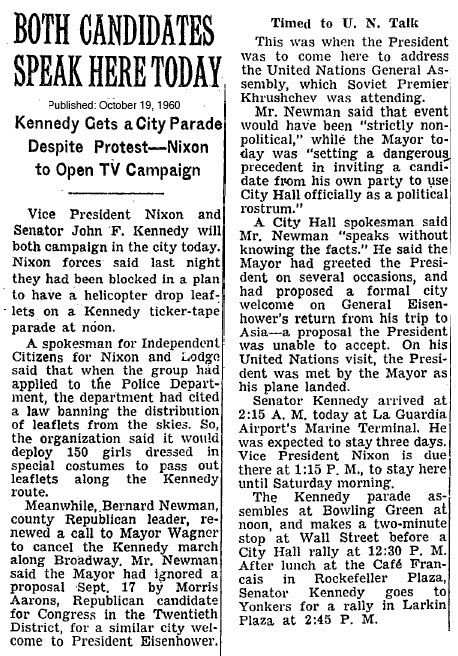
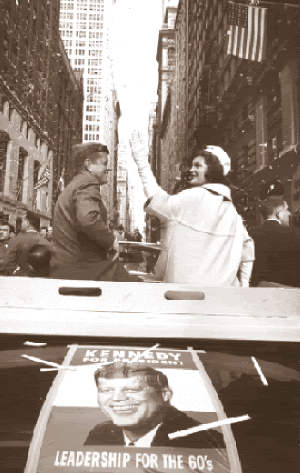
John Kennedy Visits New York City: October 19, 1960


I'm not sure whether the visit referred to in this KV chatter post was from October 28th or this date.

Wednesday, October 1, 2008

1944: Greenwich Village, Not Knickerbocker Village


from the prelinger archives:
An amateur film made in Manhattan, New York City during World War II, showing a Greenwich Village street art exhibition, a scene from what looks to be Washington Heights, springtime at Coney Island, and Greenwich Village stilled by a snowstorm.

The film was originally silent. I gave it an all Nat King Cole soundtrack

KV Chatter: John Kennedy Visits The Lower East Side, October 28, 1960


On one of Kennedy's 'drive by's' along South Street, a group of my classmates (Howie?? were you there? Bruce Bueller I think) Norma, Tina, Eleanor, Ilene Block, etc, skipped lunch and went to see Kennedy. We saw him, ran back to school late and told everyone. Our 6th grade teacher, Miss Meier, wasn't too thrilled, but to us, it was awesome. We saw him wave from his car as he was standing......anyone else see him?
Yes, I cut out of either JHS 22 on Houston St. and saw Kennedy along South St.

Who's Almost Who In Knickerbocker Village History: Hymie Schertzer


The tune is Hawaiian War Chant. The band is Tommy Dorsey's. The movie is Ship Ahoy from 1942. Eleanor Powell is the dancer. Ziggy Elman solos on trumpet. It would be a real stretch for Buddy Rich to make the almost who category. He was living in Brooklyn in 1930 at 1977 E. 27th Street. Hymie Schertzer (or Shertzer) is part of the saxophone section. He might even be the soloist. He was 20 years old and living at 139 Delancey Street in 1930 and listed as a musician in the census. It's possible he was an early Seward Park graduate.

KV Chatter: Mickey Schwerner And Shirley Chisholm


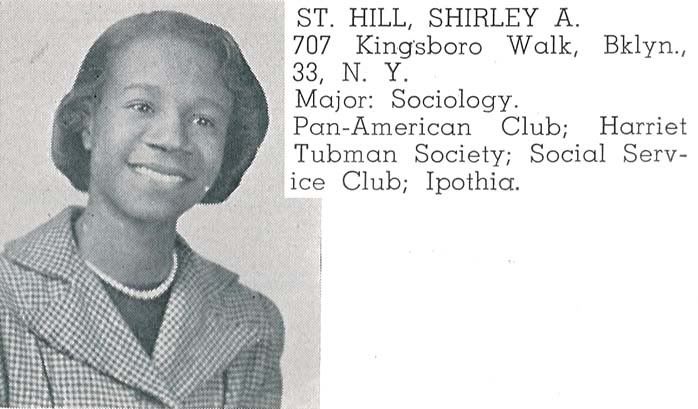
Shirley Chisholm, from her 1946 Brooklyn College yearbook

from a recent email from Sarah
I came to the conclusion a long time ago that we had a very very special and vivid childhood. So there's stuff worth remembering. I have come to know people who went to very prestigious private grammar schools all over the country and our education at 177 is head and shoulders above theirs. We had all kinds of people immediately around us and by the time we were out of 6th grade we were worldly! Do you guys recall that Shirley Chisholm was a nursery teacher at Hamilton Madison House? That Micheal Schwerner, who was lynched along with Goodman and Cheney also was associated with that settlement and visited us at Camp Madison Felicia? The whole civil rights era was happening around us. Kennedy was driving by our windows on his way to the UN. While other kids in other parts of the country were visiting donut factories on class trips we were in the greatest museums.

Zephyr


There's a new KV great-grandchild named Zephyr. As Steve Allen would say, "I kid you not." I wonder whether this song was the inspiration
Can I get your hand to write on
Just a piece of lead to bite on
What am I to fly my kite on
Do you want to flash your light on
Take a look its on display - for you
Coming down no not today
Did you meet your fortune teller
Get it off with no propellor
Do it up its always stellar
What a way to finally smell her
Pick it up its not to strong - for you
Take a piece and pass it on
Fly away on my zephyr
I feel it more then ever
And in this perfect weather
Well find a place together
Fly on my wing
Riddlin on liberator
Find a way to be a skater
Rev it up to levitator
Super mainly aviator
Take a look its on display - for you
Coming down no not today
Fly away on my zephyr
I feel it more then ever
And in this perfect weather
Well find a place together
In the water where the scent of my emotion
All the world will pass me by
Fly away on my zephyr
Well find a place together

Dina Merrill, Not Nancy


On the joining of Nancy Merrill to our list, one older KV timer asked."Wasn't she famous for being on game shows a long time ago?" Some nostalgia from 1963

Monday, September 29, 2008

And The Beat Goes On


Today we found Nancy Sing Bock.
Thanks for letting me know what this is about. I lived in the Smith Projects. Many of my friends in my classes in elem school lived in Knickerbocker Village. It's great you are getting people from the old neighborhood back in touch with one another. I will check out your blog.

Today Nancy Merrill found us
Just found this site and love it.
I was a KV resident from 1953 to 1983. Went to Nursery school in the basement, PS 177, Camp Madison Felicia, Hamilton House, PS 12 and Seward Park.
Loved the pics from the reunion but wished you had put names with faces. I only recognized Paul Levine. Please let me know when the next one will be.
My sister Patti and brother Jimmy grew up there too. Please list Patti and I in your roll call. Jimmy passed away Dec. 2005.

Above is a video of Gene Krupa battling Buddy Rich on a Sammy Davis Jr. special. The audio is Buddy's daughter Cathy with the Buddy Rich Band. Lew Meyers should enjoy, besides I never did like Sonny and Cher.
Drums keep pounding a rhythm to the brain
La de da de de, la de da de da
Charleston was once the rage, uh huh
History has turned the page, uh huh
The mini skirts the current thing, uh huh
Teenybopper is our newborn king, uh huh
Chorus
The grocery store's the super mart, uh huh
Little girls still break their hearts, uh huh
And men still keep on marching off to war
Electrically they keep a baseball score
Chorus
Grandmas sit in chairs and reminisce
Boys keep chasing girls to get a kiss
The cars keep going faster all the time
Bums still cry "hey buddy, have you got a dime"
Chorus

Dedication of the Five Points’ Mission House,” New-York Daily Times, June 18, 1853


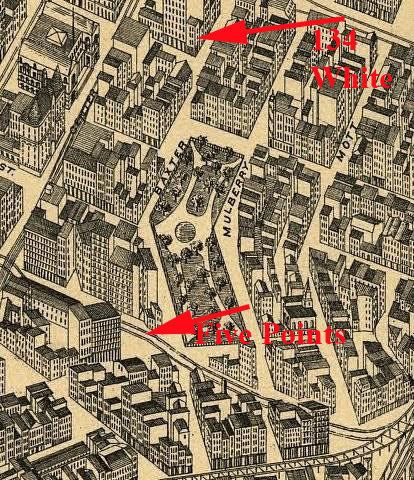
The map is from 1903. The web source of the article is the lost museum
This newspaper article describes the 1853 opening of the Five Points Mission House, a Methodist mission located in one of New York City’s most impoverished neighborhoods. The article illustrates the attitudes that motivated urban missionary work in an “infected district of the City” that was predominantly Catholic, and reflects how Protestant evangelism, poor relief, and reform went hand in hand during the antebellum era. The Five Points’ Mission House, erected on the site of the Old Brewery, was opened yesterday afternoon with religious services, as the centre of missionary and humanitarian enterprize in that infected district of the City. Notwithstanding the excessive inclemency of the weather, a very numerous and highly respectable audience, the majority of whom were ladies, assembled in the Chapel of the Mission House. The children of the schools attached to the Mission were also in the room, and sang some simple hymns during and after the services. Amongst the several clergymen who participated in the proceedings we noticed: Rev. Dr. Bangs, Dr. Floy, Rev. J. B. Wakeley, and S. Martin-Dale. Messrs. Heath and Devois, Missionaries on their way to California, were also among those present. After the usual religious exercises, the Rev. Dr. Floy (of the Madison street M. E. Church,) delivered an appropriate discourse . . .It should be borne in mind that the house they stood in was erected solely for the relief of the poor. Nor was all that toil and trouble expended merely that the wretched sons of want might there find a home; nor was it in order that the little children, once running wild through this most wicked quarter of this wicked city, might be taken in there and taught to read and write. Its object was not to supply merely temporal wants. It had a holier end in view—one that, in the present day, was too much forgotten—for at this very period there was a widely diffused kind of infidelity that would place the temporal benefits of the poor above their spiritual wants, and inculcated as the paramount duty, that to clothe the naked and feed the hungry were the first labors of Charity. It would be far from his intention to say anything against that kind of charity either. But he would go much further—he would have the Charity exhibited by the Redeemer, who, during this mission, labored more to supply the necessities of the immortal soul, than those of the frail mortal body. Charity such as that was simply the teaching of pure Christianity, and for such an object, primarily, that building had been erected. He yielded to no man in his firm devotion to that phase or form of Christianity which he, in his ministration, was called upon to preach, and at whose altars he was a listener. But he never would unite himself to such an undertaking if its objects were merely sectarian—the elevation of one sect over another, or the promotion of any form of religious bigotry. The object of the enterprise was not that men might be made Methodists, but that they might be made members of Christ’s Church, and walk in the way of His law. Then as of secondary importance their temporal wants might be supplied, and, subsequently, if they should seem it good to them to seek Heaven in the same path in which the Methodists do, so much the more certainly would harmony be insured. Dr. F. then went on to speak in regard to the civilizing influences of Christianity. The knowledge of Christian truth removed ignorance much more efficaciously than mere secular instruction. . . .Rev. J. B. Wakely briefly addressed the meeting, stating that the Society was at present in debt some $15,000, and urged its friends to be liberal and open-hearted in their contributions for its aid. . . .

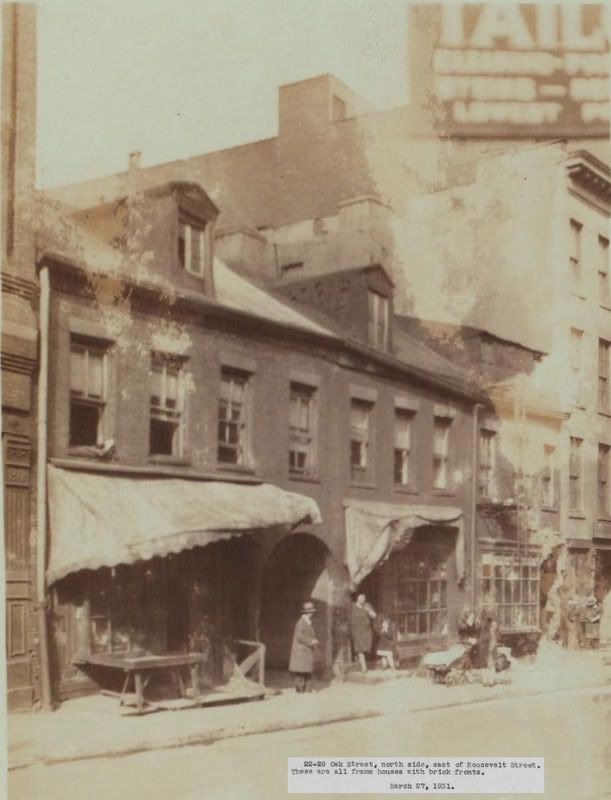
Oak Street: 1931


The view is looking east towards Oliver and Catherine. The smaller houses (22-24 Oak) were between Roosevelt Street and James Slip. The Clinton residence, mentioned on the previous post, may have looked like them. The image comes from the nypl digital collection