Thursday, December 4, 2008


Wednesday, December 3, 2008
Lee Marvin
LEE MARVIN (1986) interviewed by John Gallagher In a rare and comprehensive interview conducted one year before his death, the legendary star reminisces about John Ford, John Wayne, Robert Aldrich
Marvin was born in New York City, New York, the son of Lamont Waltman Marvin, an advertising executive and the head of the New York and New England Apple Institute, and his wife Courtenay Washington Davidge, a fashion writer and beauty consultant. His father was a direct descendant of Matthew Marvin, Sr., who emigrated from Great Bentley, Essex, England in 1635 and helped found Hartford, Connecticut.
Marvin studied violin when he was young. As a teenager, Marvin "spent weekends and spare time hunting deer, puma, wild turkey and bobwhite in the wilds of the then-uncharted Everglades." He attended St. Leo Preparatory College in St. Leo, Florida after being expelled from several schools for bad behavior.[citation needed]
Marvin left school to join the U.S. 4th Marine Division, serving as a sniper. He was wounded in action during the WWII Battle of Saipan, eight months prior to the Battle of Iwo Jima. Most of his platoon were killed during the battle. This had a significant effect on Marvin for the rest of his life. He was awarded the Purple Heart medal and was given a medical discharge with the rank of Private First Class. Contrary to rumors, Marvin did not serve with Bob Keeshan during World War II.
A father of six, Marvin was married twice. His first marriage to Betty Ebeling began in February 1951 and ended in divorce on January 5, 1967; during this time his hobbies included sport fishing off the Baja California coast and duck hunting along the Mexican border near Mexicali. He then married Pamela Feeley on October 18, 1970 and remained her husband until his death. During the 1970s, Marvin resided off and on in Woodstock, New York, and would make regular trips to Cairns, Australia to engage in marlin fishing.
He died of a coma-induced heart attack, and is interred at Arlington National Cemetery.
M Squad
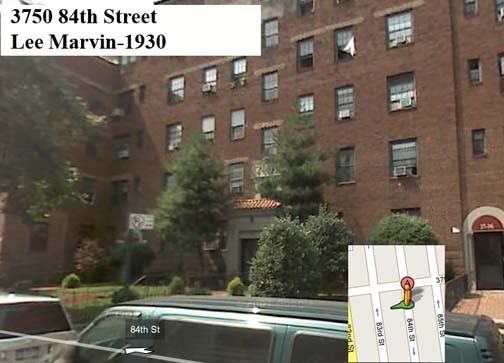
So how do you go from Clinton Street in the 1930's to M Squad? I was researching the jazz musician Benny Carter and discovered that he was responsible for some of the music for the show. Also the KV slugger sent me a suspicious chain email about Mr Rogers' fighting with Lee Marvin and Bob Keeshan (Captain Kangaroo) at Iwo Jima. Snopes proved it was false. That led me to Lee Marvin and discovering that he was born in NYC. Could he be? No, he's not. He was born in Jackson Heights.
M Squad was broadcast originally from Sept 1957 to June 1960, a total of 117 episodes. It was a 30 minute show on Friday nights at 9PM on NBC. More on M Squad from timeless music:
One of the most memorable of the early television police dramas, M Squad debuted in 1957 running for three seasons on NBC.
There were many black and white crime dramas competing for viewers in the late fifties, notably Dragnet, Arrest and Trial, and Checkmate. M Squad stands apart because of its unique combination of story, production values, musical score and a great cast portraying crime fighters getting down and dirty on the mean streets.
Lee Marvin, a decorated WW II Marine veteran of the South Pacific, where he received the Purple Heart in the Battle of Saipan, stars as Lt. Frank Ballinger, a no-nonsense Chicago plainclothes cop in the elite M Squad Division. The Squad's (M-for Murder) task is to root out organized crime and corruption in Americas Second City. Marvin's portrayal of a tough undercover officer, whose perseverance and potential for violence, but with utter cool, permeates each gritty episode, gave Marvin name recognition with the public, and did much to make him a star. He would go on to many starring roles (The Dirty Dozen, Cat Ballou) and to win a coveted Oscar for Best Actor.
Frank Ballinger's boss, Captain Grey, is played by Paul Newlan, a fine actor who brings weight and substance to the role of running the M-Squad. It is perhaps his most memorable role.
In addition to the regular cast, a who's who of television luminaries and stars-to-be made guest appearances on the show. Among the guest stars were Angie Dickinson, Charles Bronson, Janice Rule, Leonard Nimoy, Ed Nelson, DeForest Kelley, H.M. Wynant and a young Burt Reynolds.
But it wasn't just the crisp, taut story lines and great cast that made M Squad memorable.
First, it was shot in gritty, film-noire style black and white. The excellent high contrast cinematography brings Chicago to life, with all of its easily recognizable landmarks, swanky penthouses on Lake Michigan, and the seedy darker side of the city. In fact, M Squad did for Chicago what the Naked City did for New York
Second was the musical score.
In keeping with the film noir look of the series, the producers enlisted conductor Stanley Wilson to lead the orchestra in arrangements by legendary jazz men Benny Carter, and a young John Williams, (Star Wars). For the second season, the great jazz artist Count Basie wrote the enduring "M Squad Theme".It was a perfect marriage of image and sound.
Tuesday, December 2, 2008
90-96 Clinton Street Today
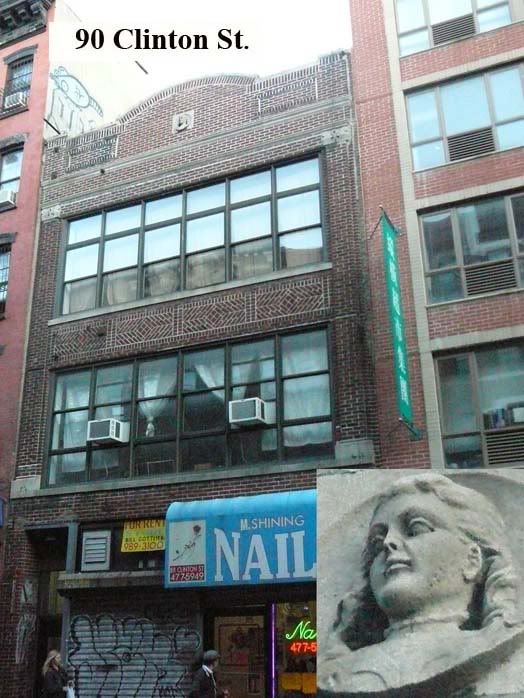
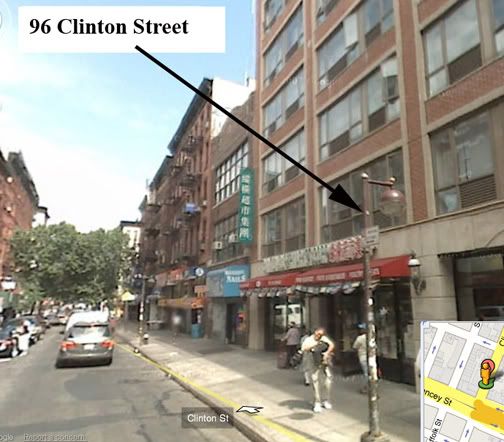
This is what the Clinton Hall and the Clinton Theater (Clinton Palace) look like today.
Only the Clinton Hall (90) retains the original appearance. The insert is a magnification of the head at the top of the building
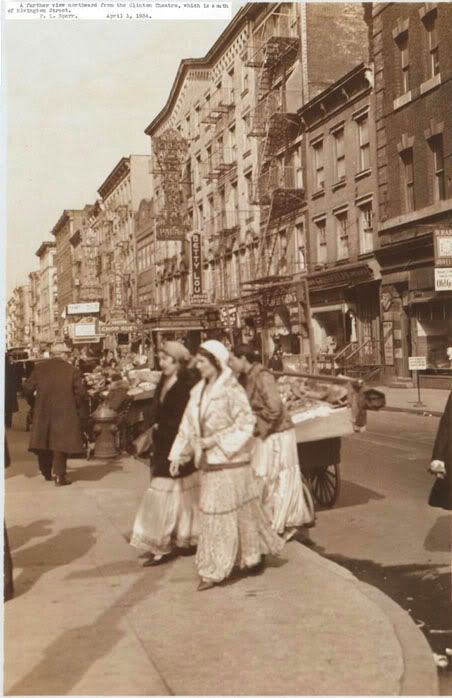
Cantor Joseph Rosenblatt
I found a video of Joseph Rosenblatt on youtube. He evidently died shortly before the film he starred in was shown on Clinton Street. About him
1882 - 1933 Joseph Rosenblatt was born on May 2nd 1882 in Biela Tserkov, in the Ukraine. He came from a long line of Chazanim and his father was a cantor in Kiev. Yossele sang from a very early age. He became a member of his father's choir and was soon declared to be a 'wunderkind,' traveling throughout the Austro-Hungarian Empire, performing at countless synagogues. At the age of 12 he met Taubele Kauffman and at the age of 18 Yossele married her and soon after accepted the position...
He is generally considered to be the uncrowned king of cantorial music. People often refer to him just as "Yossele," a Yiddish diminutive of Josef.
There is a famous joke about a Cantor who calls himself the Third Yossele Rosenblatt... When he's asked who the Second Yossele Roseblatt might be, in great offense he retorts, "There could BE no Second Yossele Rosenblatt!"
Rosenblatt's greatest hit was his recording of "Shir Hama'alot," Psalm 126, to a tune composed by Minkowsky. This psalm is said on festive occasions, just before the "Grace after Meals." This cheerful melody became so popular, that soon it was considered to be the traditional tune for this psalm. When the State of Israel was looking for a suitable National Anthem, Rosenblatt's "Shir Hama'alot" was proposed as a serious candidate.
Monday, December 1, 2008
Clinton Street, Between Delancey and Rivington 1936
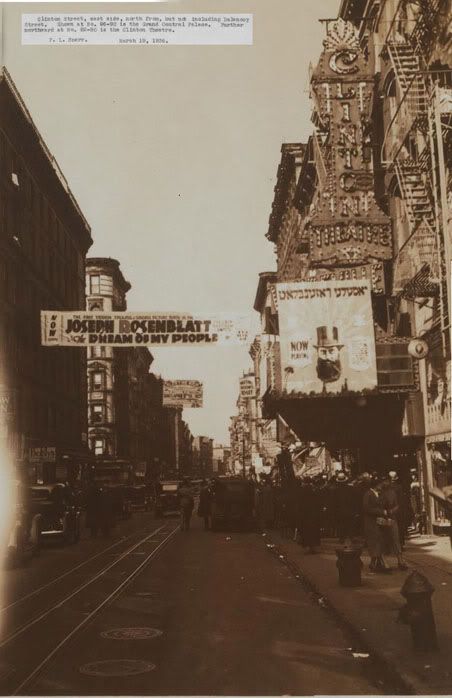
Appearing at the Clinton Theater (92 Clinton Street) on that day was Joseph Rosenblatt
1882 - 1933 Joseph Rosenblatt was born on May 2nd 1882 in Biela Tserkov, in the Ukraine. He came from a long line of Chazanim and his father was a cantor in Kiev. Yossele sang from a very early age. He became a member of his father's choir and was soon declared to be a 'wunderkind,' travelling throughout the Austro-Hungarian Empire, performing at countless synagogues. At the age of 12 he met Taubele Kauffman and at the age of 18 Yossele married her and soon after accepted the position...
He is generally considered to be the uncrowned king of cantorial music. People often refer to him just as "Yossele," a Yiddish diminutive of Josef.
There is a famous joke about a Cantor who calls himself the Third Yossele Rosenblatt... When he's asked who the Second Yossele Roseblatt might be, in great offense he retorts, "There could BE no Second Yossele Rosenblatt!"
Rosenblatt's greatest hit was his recording of "Shir Hama'alot," Psalm 126, to a tune composed by Minkowsky. This psalm is said on festive occasions, just before the "Grace after Meals." This cheerful melody became so popular, that soon it was considered to be the traditional tune for this psalm. When the State of Israel was looking for a suitable National Anthem, Rosenblatt's "Shir Hama'alot" was proposed as a serious candidate.
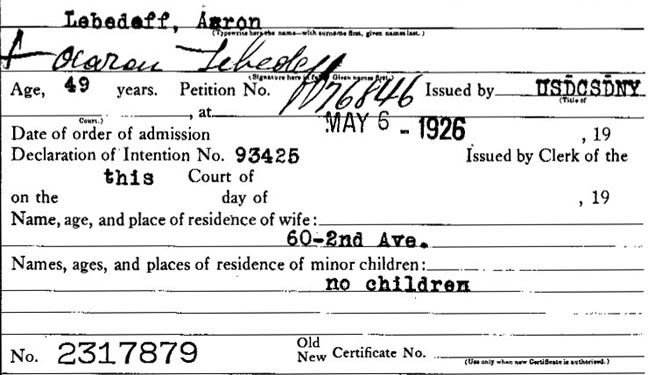
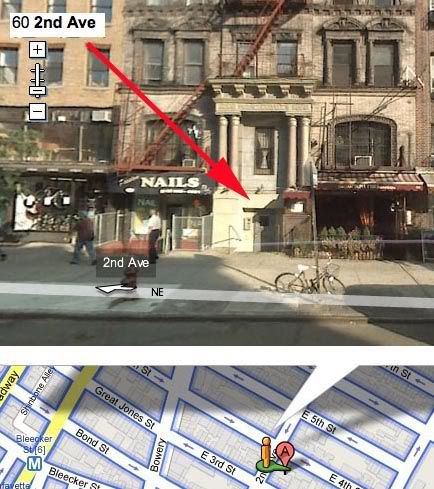
Aaron Lebedeff
A big favorite of my mother's and my grandmother Dora Ferman, aka Bobbi.
an excerpt from a site devoted to Lebedeff In the video Lebedeff is on the left and Alexander Olshanetsky is on the right.
Aaron Lebedeff was clearly the most popular entertainer at the height of his group's vaudeville stage in the 1920s and also the most influential with his audience. Unlike his Swedish and Italian counterparts, however, Lebedeff's popularity rested less on his characterizations than on his stage presence, which was marked by unbounded exuberance and dash. The message he conveyed, however, was similar to that of the other vaudevillians, dwelling on nostalgia for the shtetl, the old country village, as a generic rather than a specific locale and thereby remaking his immigrant audience Lebedeff was fortunate in entering the Jewish vaudeville in 1920, when the Yiddish comedy stage was entering its era of greatest popularity, with large houses, prolific composers, and a growing demand for supporting actors and actresses. As an art form, the theater had emerged originally after the turn of the century, through the efforts of Jacob Adler, Jacob Gordon, David Kessler and others, but it did not assume its more popular character until after Gordon's death in 1910. Although a group led by Maurice Schwartz revived the more sophisticated drama in 1918, the popular theater continued to grow, attracting numerous patrons. The leader of that latter genre and the major promoter of early Yiddish vaudeville was Boris Thomashevsky, who as noted above opened his magnificent National Theater on the Lower East Side, at Second Avenue and Houston Street, around World War I. About twenty other Yiddish theaters in the city competed with the National for good acting talent, a situation to which Thomashevsky responded by becoming something of an impresario. As one contemporary composer put it, the popular theater was in need of fresh faces in 1920.
One of Thomashevsky's "finds," arguably his greatest, was Aaron Lebedeff, a Yiddish comedian who at the end of the war was barnstorming in China. It is not clear precisely how Thomashevsky located Lebedeff. He most likely contacted him in Asia, though he may have waited till Lebedeff arrived in New York in 1920. It is certain that before coming to America, Lebedeff already had established a solid reputation as an East European comic, the "Litvak Komiker" (the Lithuanian Yiddish comic)—a title given him on the basis not of his nativity (he was born in Homel, White Russia, in 1873) but his material. That distinction is important; even before Lebedeff arrived in America, he had already based his Yiddish comic material on a particular region. Even in his earliest years in Russia he was devoted to a life on the boards. He loved music and often sang with the local chazzan Boruch Dovid, rejecting his family's plan for him either to enter their clothing business or become an apprentice to a skilled trade. As a youth, he frequently ran off to nearby cities such as Minsk and Bobruisk to appear with small Russian theatrical groups, but his excursions always failed, and he had to return home. Later, however, he became more successful in music and dance presentations, in operettas especially, and even opened his own dancing school in Minsk and joined musical and dance groups. By 1912 he had established a reputation as the Lithuanian comic in large cities throughout the region, including Warsaw. He played in the Itzkhok Zandberg’s theater in Lódz. He got married with Vera Lubow and at this time joined the Avrom Fishzohn troupe. When the Russian army in World War I took him further afield to Harbin, Manchuria, he performed for the officers in the garnison. It is also said that he performed before Kerensky, Lenin and Trotsky, but no details of such performances have yet come to light. After the Russians left the Allied side in 1917 he entertained American Red Cross officials stationed there, and when the war ended he and his actress wife Vera toured Russian Siberia and China. He was appearing in Shanghai when Thomashevsky sent him an invitation to perform in New York City; leaving his wife (she went after that in America and became a popular actress. They didn’t have children) behind to complete their engagement, he set off for the major Jewish American city.
His October 1920 debut at Thomashevsky's National Theatre was memorable—according to one member of the audience, "America had never seen anything better than what we saw that evening." Lebedeff was an instant hit, for the same reason that he would soon become the star of Yiddish musical comedy in America: his winning, charismatic personality. He projected an extraordinary exuberance and energy, engaging his audience immediately and holding it throughout his performance. He also had a powerful singing voice, which further arrested attention and perfectly suited the acoustic demands of the theater and records. Completing Lebedeff's dramatic abilities was a remarkable zest for improvisation, as he clowned and danced his way through the performance. By the end of the 1920s Lebedeff was not only the most popular Yiddish vaudevillian but was also composing much of his own musical material and directing stage performances. He was therefore more than an individual actor; he was in fact the leader of a troupe of Yiddish players. From the mid-1920s to the 1940s in the summer off-season, Lebedeff would regularly lead a contingent of actors and actresses to the Catskills to perfect their dramatic skills. Lebedeff's unrivaled popularity was rooted in more than his magnetic stage presence. Unlike some of his colleagues, he often performed outside New York, thereby becoming a truly national figure. He told interviewers in Chicago in 1925 and 1929 that he liked to tour as a way of keeping up with his audiences and becoming acquainted with the younger generation. By keeping his stage presentations fresh, he was able to retain the interest of Jews of both immigrant and American generations in Yiddish culture .He became well known in the Midwest, first appearing before Detroit Jewish audiences in the 1923–1924 season and returning almost annually into the 1930s. Lebedeff was said to be "always a favorite of Detroit Jewry" in that era. He also played often in the major East Coast cities, including Boston and Philadelphia. His huge output of records in the 1920s, about eighty in all, mostly for Emerson, Brunswick, and Vocalion, also aided substantially in making him known nationally. Because he usually cut each record immediately after the New York performances in which a particular song was introduced, people everywhere quickly became acquainted with him and his dynamic presence. Like the entertainers from other ethnic groups, Lebedeff met a psychological need for his audience, which was ever-nostalgic about the old European homeland and yearning for a romanticized image of the place from which they had come to America. To illustrate this theme, which was developed by many Jewish entertainers besides Lebedeff, we might consider a song with which he had little connection, "Die Grine Kusine," introduced in 1922 at the Grand Street Theatre and widely featured in cafes and theaters afterward. Abe Schwartz and Hyman Prizant composed the ballad, which was issued by a prominent Yiddish house, J. and J. Kammen. It related the sad tale of a naive, happy country girl with "cheeks as red as oranges, hair in golden curls, teeth like pearls, eyes like twin doves, and lips like cherries," who left home for America where she met a boy and her ruination. Lebedeff undoubtedly knew his immigrant audiences' love for the message of "Die Grine Kusine," with its evocation of the innocence of the land of origin in contrast to the complexity, anxiety, and uncertainty of America. "Liovke Maladetz," the very first comedy in which he appeared, and the one that would set his name and style, played on that theme of alienation and unease, recounting the adventures and misadventures of an unsophisticated but good-hearted rascal in Russia who encounters but eventually conquers adversity. While not about immigration per se, it did convey a certain universality. Any Italian immigrant audience watching Farfariello or Swedish audience attending an Olle i Skratthult skit would have found the concurrent Yiddish theater and even Lebedeff's role surprisingly familiar. In realizing their three similar transitions, all were clearly becoming more homogeneous. A common immigrant identity was emerging. While not every role Lebedeff played in the Yiddish theater dwelled on the theme of European innocence and American dangers, Lebedeff became identified as a purveyor of village or small-town characters. His title as the Litvak Komiker stuck with him in the Lower East Side theaters, where entertainers often drew humor from the semi-serious conflict that had arisen between emigrants from the general area around Lithuania—the "Litvaks"—and those from the more southerly region around Polish-Ukrainian Galicia—the "Galitzyaners." Throughout his career, Lebedeff almost always projected the provincial character of Yiddish-speaking Jews, as did many Jewish American composers of the era, whose music either catered to or actually inspired the audience's continuing desire to romanticize its provincial origins. One of the leading younger writers of musicals, Abraham Ellstein, probably was speaking for many of his colleagues when he expressed the view that all Jewish composers should write about their people's life in the past, whether in biblical Israel or the East European shtetl. Much of the material that Lebedeff used on stage and in song, even into the 1940s, continued to carry his listeners back psychically to their home in the Old World, whether that home was Lithuania, Poland, Russia proper, or Roumania. The titles themselves of a few of Lebedeff's popular vehicles in the twenties and thirties, by such composers as Herman Wohl, Sholem Secunda, Alexander Olshanetzky, Joseph Rumshinsky, and Abraham Ellstein, suggest the pervasiveness of this nostalgic theme: "A Wedding in Odessa," "Yankel in America," "Country Boy," "A Wedding in Palestine," "Motke From Slobodke," "Caucasian Love," "Russian Love," "A Village Wedding," "An East Side Wedding," "The Roumanian Litvak," "The Roumanian Wedding" and "Der Litvisher Yankee." Of course, as the leading performer in popular Yiddish musicals Lebedeff had a formative impact on his immigrant audience, furthering their romanticized image of their origins. He also had an impact on a wider public, much larger than the audience that attended the theater. He often sang in places other than the theater, in less formal surroundings such as cafes and restaurants, at benefits, and above all on records. In rendering those popular songs, he was also rooting listeners to their provincial past and thus providing them with a new identity as Jewish Americans. Representative of this genre of popular Yiddish ballads is "Slutzk Mein Shtele," with lyrics by Lebedeff set to music by Herman Wohl. The piece recalls one particular village, invoked as a sort of generic hometown. Lebedeff recorded it in 1925.
Old Anarchist Song
Writers from the Forward would often lunch at the nearby Garden Cafeteria and argue politics with representatives of every spectrum of the left. This was previously mentioned back on December 5 of 2007. There was also a then and now post about the Garden Cafeteria on that same day
The Forward Building and The Jewish Daily Forward
Some images come from a recent exhibit at the Museum Of The City of New York. Wally G at Flickr, as always is great for NYC images. The gray haired gent pictured mid way was Abraham Cahan, the long time editor and author of The Rise Of David Levisky
The Jewish Daily Forward: Embracing an Immigrant Community, on exhibit at the Museum of the City of New York from April 22 - November 25, 2007, focuses on the Jewish Daily Forward as a window into life in New York City particularly during the heyday of Jewish immigrant life in the first half of the 20th century. The Forward, founded in 1897 and still publishing today in English and Yiddish, once boasted a readership larger than that of the New York Times. The exhibition, which opened on the 110th anniversary of the Forward's first issue, features photographs and artifacts that document the concerns of these New Yorkers and the way in which the Forward helped to shape and reflect them.
Subscribe to:
Posts (Atom)


 Posts
Posts