Saturday, December 6, 2008

Who's Almost Who In Knickerbocker Village History: Gene Barry 2

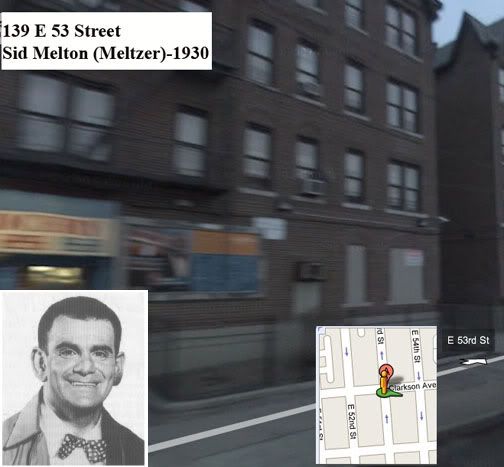
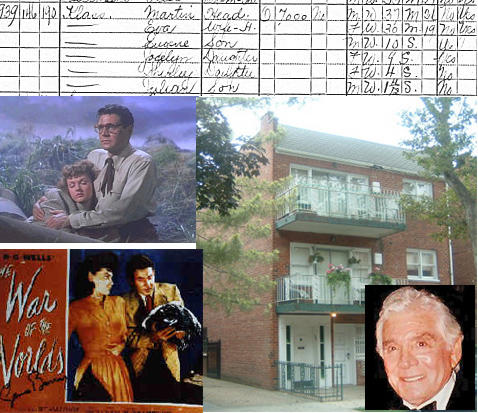
Gene lived at 1939 53rd Street in 1930, however:
Gene Barry, born Eugene Klass; June 14, 1919, is an American actor. He was the son of Eva (née Conn) and Martin Klass; all of his grandparents were Jewish immigrants from Russia. Barry adopted his professional name in honor of John Barrymore. He was trained in violin and voice and spent two years at the Chatham Square School of Music on a singing scholarship. He performed on Broadway in Catherine Was Great in 1944, and returned many years later to star in the 1983 musical La Cage aux Folles (based on the French film of the same name about a gay couple with a straight son) with George Hearn as his life partner/spouse. For his contribution to live theater, Gene Barry has a star on the Hollywood Walk of Fame at 6555 Hollywood Blvd.
A prominent early film role came in the 1953 production of the sci-fi classic The War of the Worlds. He made an eyeblink-length cameo appearance in Steven Spielberg's 2005 War of the Worlds, along with his 1953 co-star Ann Robinson.
Known for his suave manner, Barry was featured on television in a recurring role in Our Miss Brooks and as the star of three of his own popular TV series -- Bat Masterson, The Name of the Game, and Burke's Law. He won the 1965 Golden Globe for Burke's Law. The series, featuring homicide investigations by a millionaire police captain, returned in 1993-94 with Barry once again in the title role.
He also starred in the 1973 ITV television series The Adventurer, with Barry Morse and Catherine Schell. He recreated the role of the debonair Wild West lawman Bat Masterson for two episodes of Guns of Paradise in 1990 alongside Hugh O'Brian as Wyatt Earp and again the following year in The Gambler Returns: Luck of the Draw, also with O'Brian as Earp.
Barry portrayed the murderer in the original two-hour pilot for the television mystery series Columbo, a psychiatrist who kills his wife in Prescription: Murder.
His wife of 58 years, Betty Clair Kalb, died in 2003. They met in 1944 while appearing on Broadway together in the musical Catherine Was Great with Mae West. He has two sons, Michael and Frederick, and an adopted daughter, Elizabeth.

I had never heard of the Chatham Square School of Music. I found out it was was located at 211 Clinton Street, between Henry and Madison Streets. It was torn down around 1960 to make may for the construction of the new Gouverneur Hospital. Gene probably traveled to the school as a kid from his Brooklyn home by taking the F train to East Broadway.

Who's Almost Who In Knickerbocker Village History: Gene Barry


Gene Barry was born in Brooklyn, however he does qualify for the "who's almost who label." The next post will explain why
Burke's Law is a detective series which ran on ABC from 1963 to 1965 and was revived on CBS in the 1990s. The show starred Gene Barry as Amos Burke, millionaire Los Angeles Chief of Detectives, who was chauffeured around to solve crimes in his Rolls-Royce. There were stylistic similarities to Barry's previous series, Bat Masterson, in which he had played the debonair dandy Bat Masterson in the Old West. During the opening credits, as the title flashed onscreen, a woman's voice was heard seductively pronouncing the words "It's Burke's Law!" The title also reflected the character Burke's habit of dispensing wisdom to his underlings in a professorial manner, e.g. "Never ask a question unless you already know the answer. Burke's Law." The title of each episode started with the words "Who Killed..." with the name or description of the victim (who died in the show's opening minutes) completing it.
In the original series, other characters were Detective Tim Tilson (Gary Conway), Detective Les Hart (Regis Toomey), Sergeant Ames (Eileen O'Neill), and Henry, Burke's Asian chauffeur Leon Lontoc. The character of Tilson was that of a go-getting young man whose ability to find clues and trace references didn't result in his solving the murders, being always outflanked by Burke's cool intuition.
In several episodes Anne Francis appeared as female detective Honey West, which led to a short-lived spin-off series.
The musical score for Burke's Law was largely the work of Herschel Burke Gilbert, whose middle name was coincidentally the same as the character of the series.

Thursday, December 4, 2008

Jack Kirby On Video


from youtube:
Jack and Roz Kirby appeared, along with other comics luminaries, on this episode of the Bob Newhart sitcom "Bob", where Newhart played a comic book creator. Also, In 1991, Glenn Fleming visited Jack Kirby in his home. Mr. Kirby told this story while Mr. Fleming videotaped. David Schwartz edited the video for the Kirby Museum in 2005.

If you're new to the blog Jack, aka King Kirby, was a LES boy who live on Suffolk Street, 76 Suffolk Street to be exact. His exploits there, as well as his WW2 service mentioned above, were inspirations for many of his comics

Jack Kirby's Newsboy Legion Fights The Enemy On The Home Front, Part 2

newsboy-legion-pt2
Get your own at Scribd or explore others:

Jack Kirby's Newsboy Legion Fights The Enemy On The Home Front

newsboy-legion-pt1
Get your own at Scribd or explore others:

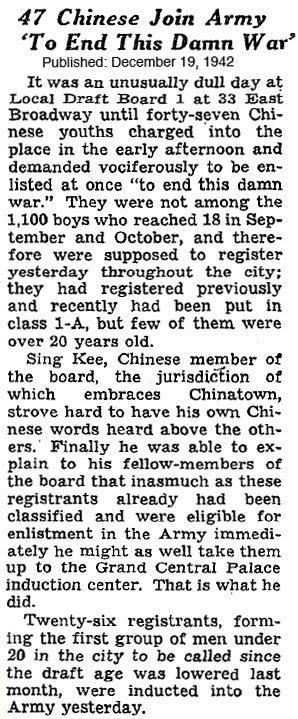
Chinese Rush To Enlist And End "This Dam War"

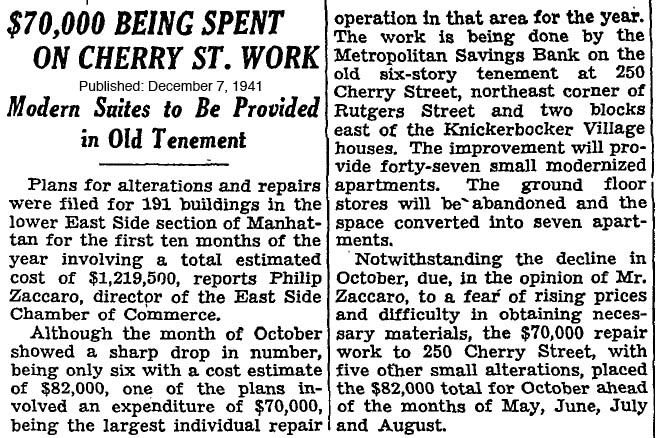
Cherry Street: December 7, 1941


Philip Zaccaro was Geraldine's father-in-law. The Zaccaros at one time owned 49 Market Street, a property that was used for nefarious purposes.

In The News December 7, 1941


The news of the attack wouldn't be in the papers until the next day. Some of those old buildings can be viewed in the post previous to this

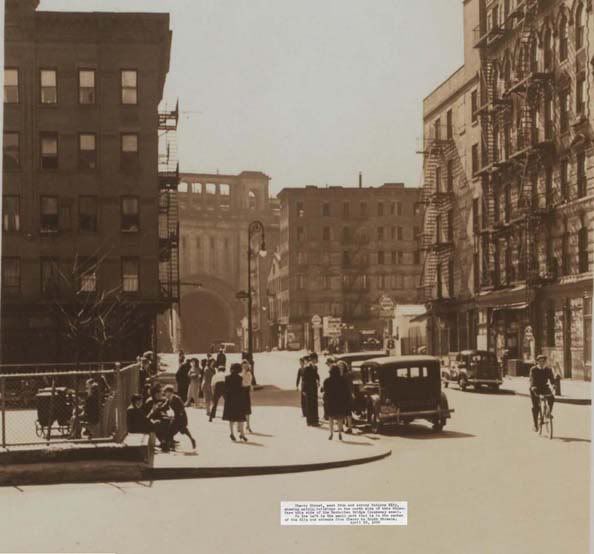
The Calm Before Pearl Harbor


On Cherry Street looking west from Rutgers Street on April 23, 1939, photographer Percy Loomis Sperr. There was a small park in this area of Rutgers Street which was called Rutgers Slip. It's possible some of these folks were KVers. Makes you wonder how some of these young people's lives would change in two years.

Hillary Brooke: In Black Nylons


From the 1953 Invaders From Mars. Not quite the Hillary that comes to mind for most of the world.
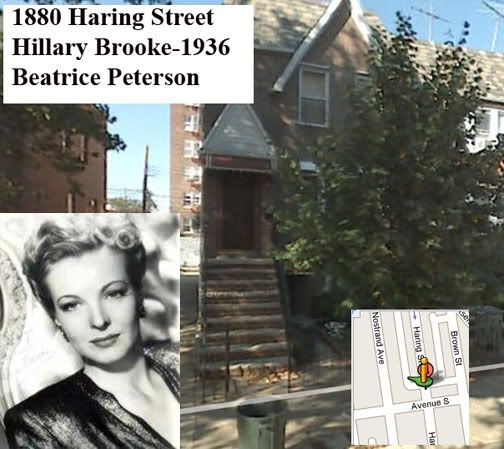
Hillary Brooke (September 8, 1914 – May 25, 1999), was an American film actress best known for her work in Abbott and Costello and Sherlock Holmes films. She also played Lou Costello's love interest in the first season of the Abbott and Costello Show. A former model, the tall (5'6") blonde was born Beatrice Peterson in Astoria, New York but spoke with a cultured accent. Brooke developed this early in her career to separate herself from other sexy blonde actresses. She appeared in Africa Screams (1949) and Abbott and Costello Meet Captain Kidd (1952) with the comedy team, and was a regular on The Abbott and Costello Show. She also co-starred in three Sherlock Holmes movies with Basil Rathbone and Nigel Bruce, including The Woman in Green (1945). Her other film credits include Jane Eyre (1944), The Enchanted Cottage (1945), the Alfred Hitchcock thriller, The Man Who Knew Too Much (1956), the 3-D film The Maze (1953), and the sci-fi B-movie classic Invaders from Mars (1953).
In The Abbott and Costello Show, which was broadcast in the early 1950s but syndicated for decades afterwards, Brooke played the role of a straitlaced, classy fellow tenant of the rooming house where the two main characters lived. She was treated with deference by the duo and was not a target of pranks and slapstick. Like the other main characters, her character's name in the show was her real name.
On September 28, 1957, she played Doris Cole in the second episode of the Perry Mason TV show, titled "The Case of the Sleepwalker's Niece". She was married to Raymond A. Klune an executive at MGM (1960 - 24 September 1988) (his death), had two children, son Donald Klune in Ketchum, Idaho and stepdaughter Carol Klune of Arcata, CA. After her marriage to Klune in 1960, Brooke retired from acting and devoted her time to religious and charitable causes.Hillary is survived by her children, brother Arthur Peterson of Seattle; 17 grandchildren, and 11 great-grandchildren. On May 25, 1999, Brooke died in a hospital in Fallbrook, California. For her contribution to the television industry, Hillary Brooke has a star on the Hollywood Walk of Fame.

Native New Yorkers, But Not Who's Almost Who...: Sid Melton and Hillary Brooke


For baby boomers Sid and Hillary were all over the tv dial. Sid grew up in East Flatbush. Hillary was born in Astoria and later she moved to Sheepshead Bay.
About Sid, an excerpt from an interview with Tom Weaver
Brooklyn's own Sid Melton (real name: Sid Meltzer) inherited his comedic talent from his father, a well-known comic who appeared on stage with many of the greats of his era. (Melton: "When my father was playing in London, Charles Chaplin came backstage and wanted to meet him. To tell him how much he enjoyed his performance.") Sid made his stage debut in the road company of the Broadway play See My Lawyer in 1939 and then, with an assist from his screenwriter-brother, broke into motion pictures two years later. TV fans are apt to associate him with some of the popular series (Make Room for Daddy, Green Acres, etc.) he worked on as a regular, while B movie fans will remember him as the "house nebbish" for Lippert Pictures, the low-budget outfit that churned out scores of late 1940s-early '50s pictures -- and, it seemed, tried to "make room for Melton" in nearly all of them! Here, he talks about one of his favorite movie roles: the comic relief Air Force crew chief in director Sam Newfield's 1951 dinosaur "epic" Lost Continent.
SID MELTON: My brother, who's gone, was Lewis Meltzer, a wonderful screenplay writer who wrote I-don't-know-how-many movies. His first movie was Golden Boy [1939] -- he adapted the Clifford Odets play for the screen. He also wrote Rita Hayworth's first starring role, The Lady in Question [1940] with Brian Aherne. It was a great movie. And he put in it a part for a guy called Glenn Ford, and that started him on the road. My brother wrote for Cary Grant, Charles Laughton ... wonderful pictures.
My brother had friends in the industry, and one of them was an agent who got me an interview at MGM. And I got the part: In 1941, I did a little one-scene thing with William Powell and Myrna Loy, who were giant stars. Shadow of the Thin Man. It was just a couple of days, but I loved working in front of the camera with people like Powell. William Powell was a wonderful actor. I was 20 or 21.
I remember exactly how Robert Lippert and I met. I met him because of a friend who's gone, Harry Berman. Harry was an actor -- he was talented, and a wonderful guy. Six-five! And you're talkin' to a fella five-four, five-three-and-a-half or four. Harry was with us when we went over to entertain the troops, toward the end of World War II. After the war, he suggested that I call this Englishman we knew, an English writer, wonderful fella. Aubrey Wisberg [a Hollywood screenwriter]. Harry said to call Aubrey, 'cause we both had met him and knew him. When I called Aubrey, Aubrey said, "You'd be good for one of the little parts in Treasure of Monte Cristo" [a 1949 crime drama Wisberg co-wrote and co-produced]. We went to San Francisco and did it. It was a Lippert picture and Lippert, having seen me in that, I guess became slightly interested. Not excited.
Then I did a nightclub revue, wonderful revue, called Smart Set, at the most famous club in Hollywood ever, Ciro's on the Sunset Strip. I guess Lippert saw that too, and one of his associates, Murray Lerner, called me in to do a part in another Lippert picture. Lerner was a nice guy -- he knew pictures, the making of 'em, the marketing, the distribution, everything. This new picture they put me in was called Tough Assignment [1949] with Don Barry and Marjorie Steele. After Tough Assignment, I went back to New York on a bus -- the All American Bus, I'll never forget it. Forty dollars with meals, and the meals were always chili [laughs]. In New York, I did a couple of shows, including one I did on Broadway and I got wonderful notices, wonderful reviews. Called The Magic Touch. I was staying at the Capitol Hotel near Madison Square Garden, the original one, on Eighth Avenue and 50th or 51st Street, and one day I got a message that I was to call Murray Lerner in Hollywood. When I got him on the phone, he said, "You want to come back? Bob Lippert wants to sign you to a contract." I went back by train -- three days. The bus was five days.
When I got back to Hollywood, they talked to me about signing with Lippert. Which I did. Terrible, terrible pay, but that didn't matter, I was thrilled. I will always be thrilled, because I learned to use my talents before the camera. That was the thing I loved about it, the fact that I learned to work before the camera and got to know the "tricks." I always, always loved the movies, ever since I can remember.
My favorite director then, and will be one of my favorites forever, was Sam Newfield, who did Lost Continent and many other great pictures. His Lost Continent is an epic that was waaay ahead of its time. He could do anything, Sammy Newfield, he was one of the most wonderful directors. He used to let me re-write my own scenes in the various pictures, which I did.
TOM WEAVER: Do you remember re-writing any of your Lost Continent scenes?
SID: No, on Lost Continent I don't think I did. Maybe I put in a line or two ... I don't remember.
Sammy Newfield's brother was Sig Neufeld, a producer. (Sammy had changed his name to Newfield.) It was a strange thing: Sammy and his brother SIG Neufeld, they both had one short arm. I don't know what the reach is for most people, 31 inches maybe. Well, both Sammy and Sigmund, I would say there was almost a foot's difference between the two arms. About 10, 12 inches -- very noticeable. Each had an arm that was really crippled at birth, both sons. It was an amazing thing.
Newfield knew what he was doin'. I think that guy has gone down on record as being the fastest B picture director, and he was (I think) superb at what he did. Sammy Newfield was an ace behind the camera, knew what he wanted. He was one of the most wonderful directors and one of the most underrated. He was never given his "big break," the chance to do big A-budget pictures. We did Lost Continent in 11 days, Nowadays, for the same type of picture, if not the same picture, they would take five to six months. Eleven days, we did it in. Most of the features I did for Lippert were done in five days! Would you believe that? I thought so much of Newfield, he was that easygoing and that tremendously gifted. He was the sweetest guy in the world, and I was so sorry when he went [died]. He and Sidney Furie [Lady Sings the Blues, 1972] were my two favorite directors. Sammy was very inventive and very, very kind, he was the nicest director I ever worked with. I never worked with anyone as kind and as understanding and as inventive ... such a great director.
Q: What was your reaction to being offered a starring role in a sci-fi movie?
SID: It was a very good one, it was a happy one, a happy reaction. I hadn't read the script yet, but I liked the idea as soon as I was told, "You guys are assigned to go and look for a missing rocket." You know who is in your camp, who really thinks as [highly of Lost Continent as] you do? Frank Sinatra, Jr. Lost Continent is one of Frank Sinatra, Jr.'s, favorite movies of all time. He never stops talking about it. He got me for Christmas a case of about 10 or 15 VHSs he wanted me to watch, and one of them is Lost Continent.
We shot Lost Continent at Sam Goldwyn Studios. The thing that really stunned me was that set that they built for the climbing-the-mountain scenes, a wonderful, wonderful set. It was about 60 feet high, and they didn't have a net -- that really threw me! I'll never forget the fact that I was that frightened and worried. And a few others were, too. There were no nets under us, and you really had to dig into that material that the special effects men and set designers and carpenters built it out of. It was at least 60 feet high -- big! -- and there was nothing under us to catch us. But no one fell, thank God. No one except for the stunt double for Whit Bissell. The stuntman fell into a mattress or an air bag or something. It was a pretty good fall -- and he had to fall backwards. It was not less than 30 feet.
Everyone in the cast was wonderful. And I don't just say that. The cast was wonderful to work with -- Cesar Romero and Whit Bissell and Hugh Beaumont and Chick Chandler. Cesar Romero, I got along with fine. He was a good actor. Whit Bissell -- excellent, excellent actor. And John Hoyt -- oh my God, he was a wonderful actor. You know his real name? Hoysrack. German name. I remember my brother the writer taking me to see John Hoyt (when he was John Hoysrack) in a club. A little club, like cafe society. I was about 16 or 17. My brother said, "This man is very funny and very wonderful." I never drank then, I never drink now, I never will, but I sat and had my root beer, and Hoysrack did his wonderful stand-up act. Very, very intelligent, very intellectual, you know. He'd talk about this friend of his who was [imitating Hoyt] "veddy, veddy, veddy much into gardening. He'd have a lovely garden outside his window. A bed of roses ... a bed of marijuana ... a bed of roses ... " [Laughs] In Lost Continent, he was excellent, playing the guy everybody thinks is the heavy. Wonderful actor and nice man. He was really a gentleman.

1951: Lost Continent and Lost New Yorkers


While looking through M Squad sites and episode lists I found an old favorite, Sidney Melton, as a guest actor. Sid, aka "Uncle Charlie Halper" from the Danny Thomas Show,
was also in this cult favorite. Amazing that of the stars (6 out of 8 if you count Hoyt, who came from Eastchester) in this "movie" were New Yorkers (bold):
The Lost Continent (1951) is a science fiction film, starring Cesar Romero and Chick Chandler. It was directed by Sam Newfield. This independent film was only shot in eleven days, on a low budget. The footage on the plateau where the dinosaurs lived was printed with green tinting.
Major Joe Nolan (Romero) is the head of a rescue mission to the South Pacific to retrieve an atomic rocket that vanished. Their plane crashes on a remote tropical island. They find a lone native girl (Acquanetta) who indicates something fell from the sky onto a forbidding plateau which dominates part of the island. The expeditioners reach the top despite numerous obstacles, and discover a lush jungle inhabited by dinosaurs. Some die during the climb, others are killed by the presumed-extinct animal life, but two return to the flatland with a critical component of the rocket, and escape, along with the island girl, as a dormant volcano erupts and destroys the island utterly, plateau, dinosaurs and all.
* The film contains rocket-takeoff footage from Rocketship X-M (1950).
* The film was mocked on a 1990 episode of the American TV program "Mystery Science Theater 3000".
* Cesar Romero (Major Joe Nolan)
* Hillary Brooke (Marla Stevens)
* Chick Chandler (Lieutenant Danny Wilson)
* John Hoyt (Michael Rostov)
* Sid Melton (Sergeant William Tatlow)
* Whit Bissell (Stanley Briggs)
* Hugh Beaumont (Robert Phillips)
* Murray Alper (Air Police Sergeant)