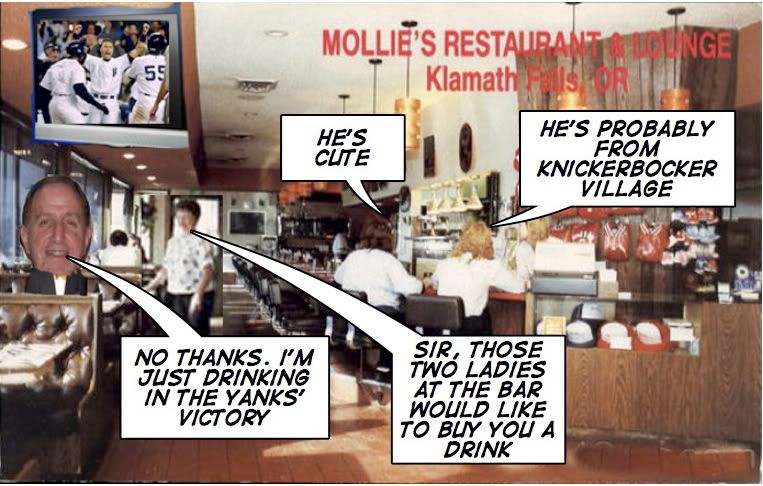
Another sojourn. The KV journeyman's reaction to the Yankee win last night in Klamath Falls, Oregon.

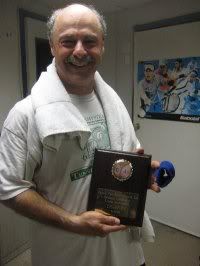
Francis Eugene Walter (May 26, 1894 – May 31, 1963) was a Democratic member of the U.S. House of Representatives from Pennsylvania.
Francis Walter was born in Easton, Pennsylvania. He attended Lehigh University in Bethlehem, Pennsylvania, and George Washington University and Georgetown University in Washington, D.C.
During both World War I and World War II he served in the air service of the United States Navy. He was the director of the Broad Street Trust Company in Philadelphia, Pennsylvania, and of the Easton National Bank in Easton, Pennsylvania. From 1928 to 1933 he was the Solicitor of Northampton County, Pennsylvania. He was a delegate to the 1928 Democratic National Convention. He was elected as a Democrat to the 73rd United States Congress and served until his death in Washington, D.C.
Walter is best known for the McCarran-Walter Act, passed over President Truman's veto in 1952, which continued the quota system based on the national origin of immigrants introduced in 1924 and allowed the United States government to deport and bar from entry those identified as subversives, particularly members and former members of the Communist Party.
A noted immigration historian has characterized Walter's views as "reactionary and racist." A strong anti-Communist, Walter went on to serve as chairman of the United States House Un-American Activities Committee during the 84th through 88th Congresses. Walter also served as a director of the Pioneer Fund, a foundation best known for its advocacy of IQ variation among races.
Walter appeared in a central role in the 1960s-era U.S. government anti-Communist propaganda film Operation Abolition. Historical footage of Walter also appears in the 1990 documentary film Berkeley in the Sixties..
He is buried in Arlington National Cemetery.
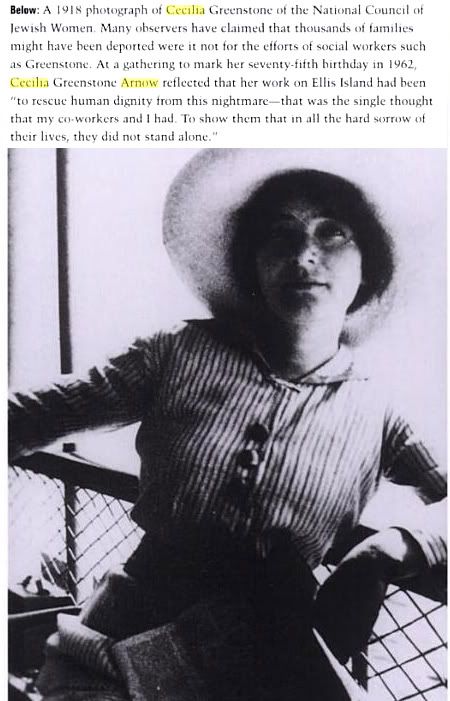
Cecilia Greenstone: Born in Bialystok, in Russian Poland in 1887, Cecilia led an unconventional life from an early age. Her father owned a cigarette factory in their hometown, and Cecilia would frequently be left in charge in her father’s absence. By the age of 12 she had gotten caught up in the Socialist spirit of the times and had succeeded in organizing the cigarette factory’s workers. Though the factory did not last, Cecilia’s career in social work and issues had already begun. Cecilia, fearful of the pogroms, joined the Socialist Zionists and would frequently protest on the streets. Soon the Russian government accused the group of being anti-government and the police began to raid their meetings in battles that became increasingly violent. In 1905 the family fl ed for America. After arriving in New York, and turning down job offers until she could speak English, Cecilia went to the Astor Place Library (which would later become the headquarters for HIAS) determined to learn English. Spending hours on end at the library, she taught herself not just English, but also Hebrew, German and Yiddish, and eventually learned to speak seven languages. This feat brought her to the attention of the head of the Hebrew Division, where she became an assistant to the librarian. She later worked as a translator for the famed Jewish banker and philanthropist Jacob Schiff. It was while in this position that she came to the attention of the New York Section of the National Council of Jewish Women (NCJW,) an organization that worked hand in hand with HIAS. Founded out of concern for the hundreds of thousands of single and unaccompanied young Jewish women who came through the port of Ellis Island, the NCJW feared that these young women might be “mislead into immoral lives, and other girls will be subjected to great dangers because of the lack of some directing and protecting agency at Ellis Island.” At the time, it was not uncommon for young, newly arrived female immigrants to be taken advantage of, and many fell into lives of crime and prostitution. It was the job of the NCJW “to make sure that the ‘uncle’ who was waiting to meet the immigrant girl was truly her uncle and not a procurer.” “To rescue human dignity from this nightmare – that was the single thought my co-workers and I had,” recalled Greenstone in 1962. “To show them that in all the hard sorrow of their lives, they did not stand alone, and they did not have to succumb. To show them that if one person misuses or betrayed them, another would not; that their violated dignity could not be healed on the street, in theft, in drink, in drugs or suicide. To show them dignity could only be restored by that which a human does for oneself.” Beginning work in 1907, Greenstone would eventually work six days a week at Ellis Island, assisting single women, mothers and children through the immigration process. She personally intervened in countless cases where young women, who had been rejected by the health inspectors, were scheduled for deportation. She helped those, who because they could not speak enough English to answer inspector’s questions, were labeled “retarded” and set to be deported. She arranged for kosher food to be delivered to patients at the island’s hospital, and she established Shabbat and holiday services on the Island for Jewish immigrants. In 1910 alone the NCJW dealt with over 60,000 women and children, most of whom were helped by Cecilia. In her spare time she taught English classes and arraigned socials, theater outings and events that would bring newly settled immigrants in touch with American life. She helped to arrange marriages for young women whose suitors were moral and upstanding citizens, and she helped young women find work. Her motto: “ jobs, not charity.” By 1912 she was promoted to head agent for the NCJW on Ellis Island. A 1913 letter to an official at HIAS reads in part that “Miss Greenstone spends every cent of her salary to help the immigrants on the island… [She] renders her service without any regard to time or effort to any girl or woman who needs her service.” In 1914 Cecilia was asked by HIAS to travel to Riga, in Russian Latvia to inspect a new facility that had been built by the Russian government to house Jewish immigrants that were awaiting passage to America. Given the special commission as a “delegate” to Russia, Cecilia traveled to Europe aboard the Kursk. It was an uneventful trip, but a day before they reached Liverpool, England declared war on Germany, and the path of the Kursk was diverted. Cecilia became a witness to the first naval battle of World War I. By the time she returned to America, the number of immigrants arriving at Ellis Island was dwindling. With the war in Europe the number of immigrant arrivals dropped, from 875,000 in 1914 to 28,000 by 1918. After the end of the war, restrictive new laws limited the number of Jewish immigrants, and Greenstone was no longer needed at Ellis Island. Greenstone later married and had two children, but always continued her career in social work, first at Hamilton House, then Henry Street, and later through the depression years and the second World War at the Grand Street Settlement. She later worked as a social worker at the Sons and Daughters of Israel Home. She died in 1971 at age 84. “She was a liberated woman in Russia,” recalled her great grandson Jesse Peterson, “running a cigarette factory, marching into a hail of bullets with the young Socialist Zionists and emerging as the matriarch of the entire Greenstone family. This was not a woman who would accept second-class status in any culture or country, and throughout her career, she fought it, both for herself and her fellow women. In America, she took up the same struggle against injustice that she had fought on the streets of her native Russia, but here, rather than protest; she would fight injustice as a social worker, caring for one victim at a time.”

Attorney revisits traitor case of Rosenbergs/Sobell at Skidmore
In 1953, Americans Ethel and Julius Rosenberg and Morton Sobell were convicted of conspiring to steal classified information about the atomic bomb on behalf of the Soviet Union. The Rosenbergs were sentenced to death, and Sobell was sentenced to 30 years in prison. Sunday, September 22, 2002, By MAE G. BANNER
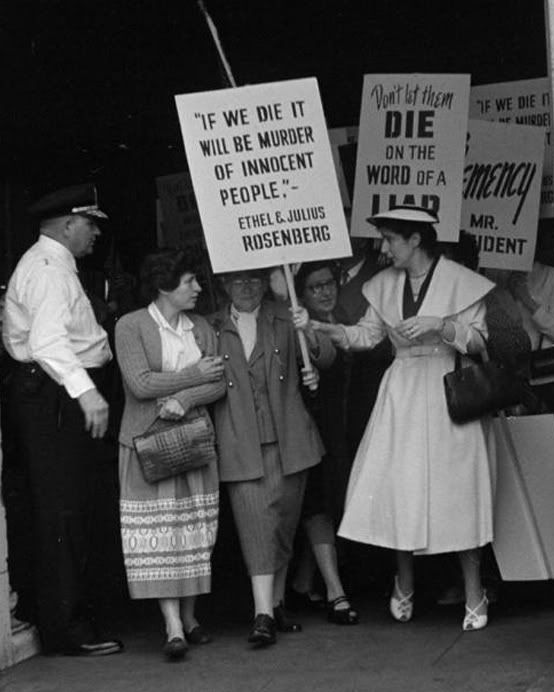
From the outset of the case, many believed that a gross miscarriage of justice was being done. One of those who questioned the trial and sentence was Dr. Emily Arnow Alman, a professor emerita and former chairwoman of the Sociology Department at Douglass College, Rutgers University. Dr. Alman also is an attorney who has received many honors for her service to clients and to the field of matrimonial law. Now a resident of Ballston Spa, Dr. Alman will give a talk, ''The Case against Julius and Ethel Rosenberg and Morton Sobell: Was Justice Done?'' at 7:30 p.m. Monday, Sept. 23, in Wilson Chapel on the Skidmore College campus. The talk is free and open to the public. Dr. Alman will describe the social and political context of the time, 1950-53, in which the Rosenberg-Sobell case arose. Also, she will present evidence to support her conclusion, arrived at through decades of study, that the defendants were wrongly convicted. In 1951, Dr. Alman became interested and involved in the Rosenberg-Sobell case. After reading the trial transcript, she was convinced that a gross miscarriage of justice had occurred. She helped to form the National Committee to Secure Justice in the case. The committee's goals were to obtain a new trial for the defendants and/or clemency for the Rosenbergs. New evidence surfaced, including a written confession by David Greenglass, the prosecution's chief witness, that he had agreed to testify to matters he knew nothing about first-hand, but that had been described to him by the FBI. The committee published 10,000 copies of the verbatim trial transcript and sent copies to editors, government officials, scientists, members of Congress and prominent persons. Similar committees arose in major cities around the country, and their efforts culminated in a vigil at the White House. There was also an outpouring of support from around the world. The New York Times estimated that at least 3 million Americans eventually petitioned the White House for clemency for the Rosenbergs. In 1956, three years after the execution of the couple, Dr. Alman and her husband David were called to testify before the House Un-American Activities Committee, where they defended the right of Americans to criticize prosecutorial and judicial actions that led to miscarriages of justice. While on sabbatical leave from Rutgers in 1978, Dr. Alman used the Freedom of Information Act and other sources to obtain many definitive documents bearing on the case, including a pre-trial assurance by Federal Judge Irving Kaufman to the Department of Justice that he intended to sentence Julius Rosenberg to death. Other documents came from the Atomic Energy Commission, the State Department and the Department of Justice. Dr. Alman and her husband are now completing a book on the case that will carry the first full account of the activities of the Committee to Secure Justice and of the campaign for a new trial and clemency that they spearheaded. The book will examine the case in light of David Greenglass's televised confession in December, 2001, that he had committed perjury at the Rosenberg-Sobell trial at the instruction of the prosecution. The Skidmore lecture is co-sponsored by the Saratoga Springs chapter of Hadassah, which is the largest Jewish women's Zionist organization in the U.S.
Emily Arnow Alman BALLSTON SPA -- Emily Arnow Alman of Ballston Spa died on March 18, 2004, at the age of 82. Dr. Alman was a sociologist and attorney.At her retirement from law, she was honored with a plaque by the Middlesex County Bar Association of New Jersey that read in part, 'The fact that you often faced overwhelming odds could not quench your indomitable spirit.' Dr. Alman was committed to advancing the causes of battered women, the poor and the rights of children in broken homes to have access to both their parents and grandparents. Dr. Alman received her B.A. at Hunter College in 1945 and her M.A. and Ph.D. at the New School For Social Research in 1963.She received her law degree at Rutgers University Law School in 1977.She taught sociology at Rutgers University's Douglas College from 1960 to 1986 and served as chairperson of the Department of Sociology for eight years.Her chief interests in sociology and law were family law, bias law and public policy law and interactions between social agencies and institutions and various population groups.
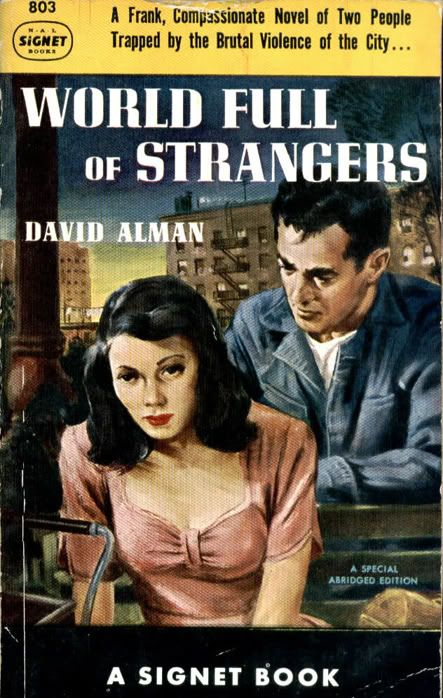
Dr. Alman's creative works include 'Ride the Long Night,' a novel (McMillan, 1963), and 'The Ninety-First Day,' a semi-documentary film on mental illness and shortcomings in institutional treatment (1963). 'We Were There,' a book in progress at the time of her death and co-authored with her husband, is based on government documents.
Dr. Alman was persuaded by the trial record to become one of the founders of a committee in 1951, the National Committee to Secure Justice in the Rosenberg-Sobell Case, to secure a new trial or clemency for the Rosenbergs and reduction of Morton Sobell's 30-year sentence. Dr. Alman was also a chairperson of the Concerned Citizens of East Brunswick, N.J., from 1970-78, which was instrumental in causing the New Jersey Turnpike to erect noise abatement berms along portions of the turnpike.She was also a member of the American and New Jersey bar associations and a number of professional associations and organizations for the protection of battered women.
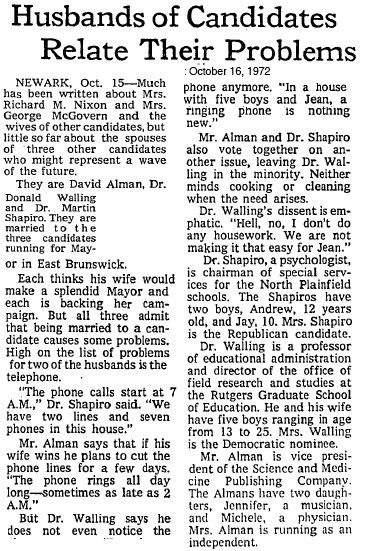
Dr. Alman won first prize at the American Film Festival in 1964 for 'The Ninety-First Day' and the Appleton Award for dedicated service to the legal community.A short biography of her appears in Who's Who in American Women. Prior to becoming a sociologist and lawyer, Dr. Alman was a New York City probation officer.From 1957 to 1970, she and her husband and children were farmers in Englishtown, N.J. In 1972, Dr. Alman was an Independent candidate for mayor of East Brunswick, N.J. She is survived by her husband, David, whom she met at the age of 13 and married in 1940 at the age of 18 and with whom she celebrated every day of her life.
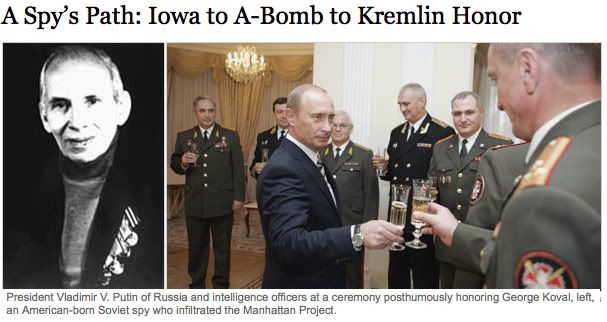
A Spy’s Path: Iowa to A-Bomb to Kremlin Honor
By WILLIAM J. BROAD
He had all-American cover: born in Iowa, college in Manhattan, Army buddies with whom he played baseball.
George Koval also had a secret. During World War II, he was a top Soviet spy, code named Delmar and trained by Stalin’s ruthless bureau of military intelligence.
Atomic spies are old stuff. But historians say Dr. Koval, who died in his 90s last year in Moscow and whose name is just coming to light publicly, was probably one of the most important spies of the 20th century.
On Nov. 2, the Kremlin startled Western scholars by announcing that President Vladimir V. Putin had posthumously given the highest Russian award to a Soviet agent who penetrated the Manhattan Project to build the atom bomb.
The announcement hailed Dr. Koval as “the only Soviet intelligence officer” to infiltrate the project’s secret plants, saying his work “helped speed up considerably the time it took for the Soviet Union to develop an atomic bomb of its own.”
Since then, historians, scientists, federal officials and old friends have raced to tell Dr. Koval’s story — the athlete, the guy everyone liked, the genius at technical studies. American intelligence agencies have known of his betrayal at least since the early 1950s, when investigators interviewed his fellow scientists and swore them to secrecy.
The spy’s success hinged on an unusual family history of migration from Russia to Iowa and back. That gave him a strong commitment to Communism, a relaxed familiarity with American mores and no foreign accent.
“He was very friendly, compassionate and very smart,” said Arnold Kramish, a retired physicist who studied with Dr. Koval at City College and later worked with him on the bomb project. “He never did homework.”
Stewart D. Bloom, a senior physicist at the Lawrence Livermore National Laboratory in California, who also studied with Dr. Koval, called him a regular guy.
“He played baseball and played it well,” usually as shortstop, Dr. Bloom recalled. “He didn’t have a Russian accent. He spoke fluent English, American English. His credentials were perfect.”
Once, Dr. Bloom added, “I saw him staring off in the distance and thinking about something else. Now I think I know what it was.”
Over the years, scholars and federal agents have identified a half-dozen individuals who spied on the bomb project for the Soviets, especially at Los Alamos in New Mexico. All were “walk ins,” spies by impulse and sympathetic leaning rather than rigorous training.
By contrast, Dr. Koval was a mole groomed in the Soviet Union by the feared G.R.U., the military intelligence agency. Moreover, he gained wide access to America’s atomic plants, a feat unknown for any other Soviet spy. Nuclear experts say the secrets of bomb manufacturing can be more important than those of design.
Los Alamos devised the bomb, while its parts and fuel were made at secret plants in such places as Oak Ridge, Tenn., and Dayton, Ohio — sites Dr. Koval not only penetrated, but also assessed as an Army sergeant with wide responsibilities and authority.
“He had access to everything,” said Dr. Kramish, who worked with Dr. Koval at Oak Ridge and now lives in Reston, Va. “He had his own Jeep. Very few of us had our own Jeeps. He was clever. He was a trained G.R.U. spy.” That status, he added, made Dr. Koval unique in the history of atomic espionage, a judgment historians echo.
Washington has known about Dr. Koval’s spying since he fled the United States shortly after the war but kept it secret.
“It would have been highly embarrassing for the U.S. government to have had this divulged,” said Robert S. Norris, author of “Racing for the Bomb,” a biography of the project’s military leader.
Historians say Mr. Putin may have cited Dr. Koval’s accomplishments as a way to rekindle Russian pride. As shown by a New York Public Library database search, the announcement has prompted detailed reports in the Russian press about Dr. Koval and his clandestine feats.
“It’s very exciting to get this kind of break,” said John Earl Haynes, a Library of Congress historian and an authority on atomic spying. “We know very little about G.R.U. operations in the United States.”
David,
I lived in KV from about 1941 to 1957 with my wife, Emily, and two daughters, Michelle, now a physician living in India, and Jennifer, now a lawyer, formerly practicing in NJ, NY and about to take bar exam in Florida. My wife became a sociology professor at Douglas College at Rutgers University, and then became a lawyer in NJ. Emily and I met at Seward Park High School, on Essex Street, in 1936.
I was a NY State Parole Officer for about a year when we lived at KV . Became a writer and Emily and I got interested in the Rosenberg-Sobell case in 1951 and were involved in the clemency campaign on behalf of the Rosenbergs. In 1995 we began writing a book on the case, but Emily died in 2004 before we had finished it. I completed the book and, since I'm now 90, decided to forego the 2-3 years of making the rounds of publishers, and arranged with a small press, Green Elms, to publish it. It's called Exoneration, and we printed a draft of the book about 3 months ago to circulate among historians and lawyers for their reactions. Official publication will be at the beginning of 2010.
Checked out the KV website. Terrific, but wonder where you find the time to keep it up.
Feel free to be in touch if you have any questions.


 Posts
All Comments
Posts
All Comments