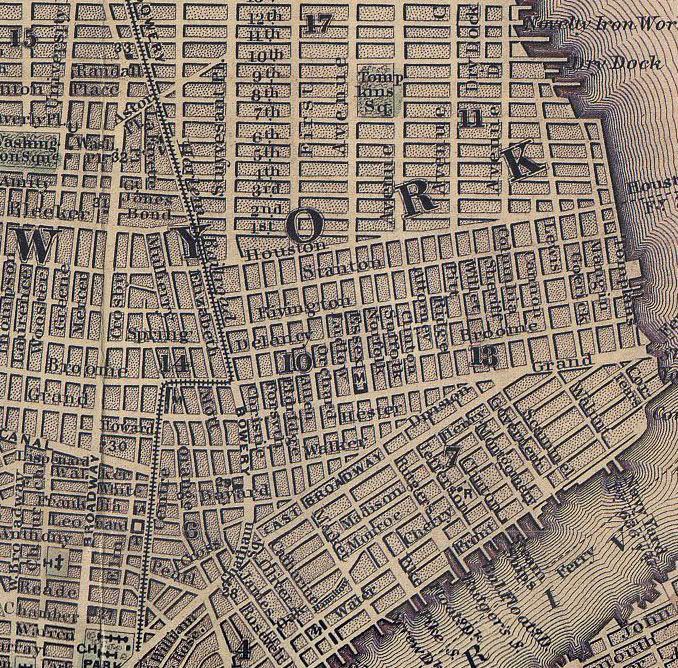
Maybe Al Smith would know if Raoul Walsh's parents lived in the 4t Ward
Al Smith Remembers
Sunday, October 25, 2009


Raoul Walsh: Who's Almost Who?
Raoul Walsh was a great director and ahead of his times in his views on race, as mentioned above, in a fascinating analysis. My father always enjoyed his films and so did I and now I understand a little better why. He was born in New York City in 1888 but I don't think it's the Fourth Ward, but the upper west side. Who knows, maybe his parents had their origins there.
Sequence analysis of They Died with Their Boots On (1941, dir. Raoul Walsh), #911 (51) in the Shooting Down Pictures project. Commentary by Matt Zoller Seitz, film critic for the New York Times and host of The House Next Door
Saturday, October 24, 2009
Fourth Ward Civil War Draftees
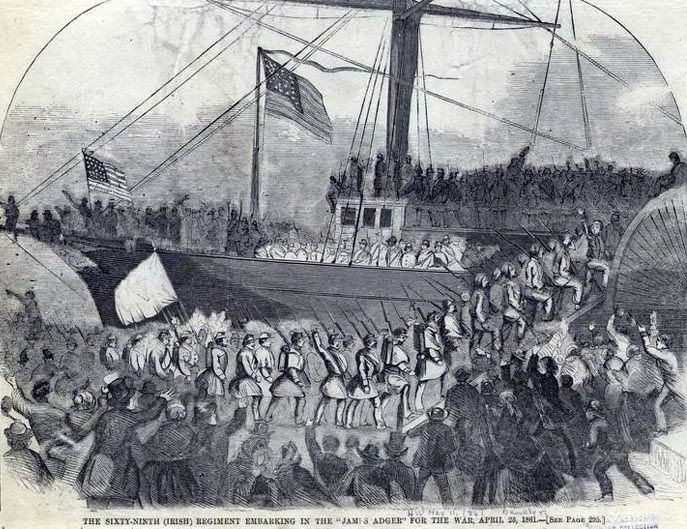
Many of them probably fought in the Irish Brigade, the Fighting 69th Regiment.
From Peter Baldwin's great Fourth Ward site
Civil War Draftees
From Peter Baldwin's great Fourth Ward site
Civil War Draftees
Garry Owen And The Irish Brigade And The Fourth Ward
The Irish Brigade was an infantry brigade, consisting predominantly of Irish immigrants, that served in the Union Army in the American Civil War. Many of them came from New York's Fourth Ward. The designation of the first regiment in the brigade, the 69th New York Infantry, or the "Fighting 69th", continued in later wars. The "Fighting 69th" adopted Garry Owen as their song.
They Died with Their Boots On is a 1941 western film directed by Raoul Walsh and starring Errol Flynn and Olivia de Havilland. Despite being rife with historical inaccuracies, the film was one of the top-grossing films of the year, being the last of eight Flynn-de Havilland collaborations.
The film follows the life of George Armstrong Custer (Errol Flynn) from attending West Point, wooing of Elizabeth Bacon (Olivia de Havilland) who becomes his loving wife, the American Civil War, and the Battle of Little Big Horn. In the film, the battle is blamed on unscrupulous corporations and politicians craving the land of Crazy Horse (Anthony Quinn) and his people.
Custer is portrayed as a fun-loving, dashing figure who chooses honor and glory over money and corruption. Though his "Last Stand" is probably treated as more significant and dramatic than it may have actually been, Custer (Flynn) follows through on his promise to teach his men "to endure and die with their boots on." In the movie's version of Custer's story, a few corrupt white politicians goad the Western tribes into war, threatening the survival of all white settlers in the West. Custer and his men give their lives at Little Bighorn to delay the Indians and prevent this slaughter. A letter left behind by Custer absolves the Indians of all responsibility.
...The character of "Queen's Own" Butler, while English, is essentially a composite of two real-life officers who were from other parts of the British Empire: Canadian William W. "Queen's Own" Cooke, and Irishman Myles Keogh, who is linked to an apocryphal account of introducing the song "Garryowen" to the 7th Cavalry.
the origins of Garryowen are unclear, but it emerged in the late eighteenth century, when it was a drinking song of rich young roisters in Limerick. It obtained immediate popularity in the British Army through the 5th (Royal Irish) Lancers, who were garrisoned in Limerick and was played throughout the Napoleonic War, becoming the regimental march of the 18th Foot (The Royal Irish Regiment).
Garryowen became the marching tune for the 69th Infantry Regiment, New York Militia, (the famed "Fighting 69th" ) in the mid-1800s. The "Fighting 69th" adopted Garry Owen before the Civil War and recently brought it back to combat in Operation Iraqi Freedom
It later became the marching tune for the US 7th Cavalry Regiment during the late 1800s. The tune was a favorite of General George Armstrong Custer and became the official air of the Regiment in 1867. According to legend it was the last tune played before the Battle of the Little Bighorn.
The name of the tune has become a part of the regiment, the words Garry Owen are part of the regimental crest, and there is a Camp Garry Owen, north of Seoul, Korea, which houses part of the 4th Squadron of the regiment.The Seventh Cavalry regiment became a part of the US 1st Cavalry Division in 1921, and "Garryowen" became the official tune of the division in 1981.
The word garryowen is derived from Irish, the proper name Eóghan ("born of the yew tree") and the word for garden garrai - thus "Eóghan's Garden". The term refers to an area of the town of Limerick, Ireland.
Instead of spa, we'll drink brown ale
And pay the reckoning on the nail;
No man for debt shall go to jail
From Garryowen in glory.
2. We are the boys who take delight
In smashing Limerick lamps at night,
And through the street like sportsters fight,
Tearing all before us
Chorus
3. We'll break the windows, we'll break down doors,
The watch knock down by threes and fours,
And let the doctors work their cures,
And tinker up our bruised
Chorus
4. We'll beat the bailiffs out of fun,
We'll make the mayor and sheriffs run
We are the boys no man dares dun
If he regards a whole skin.
Chorus
5. Our hearts so stout have got us fame
For soon 'tis known from whence we came
Where'er we go they fear the name
Of Garryowen in glory.
Chorus
They Got Caught With Their Watch On
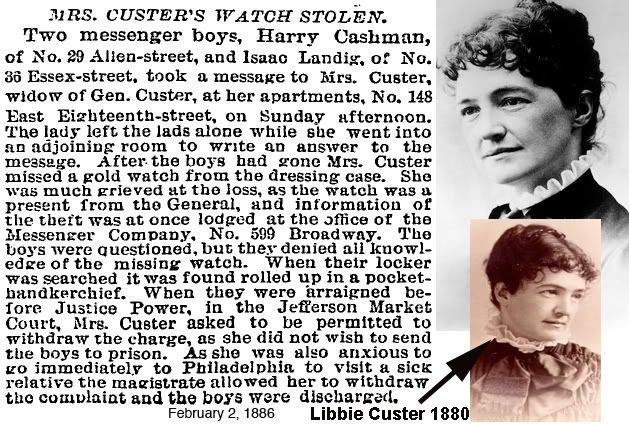
from Civil War Women
...After Custer's death, Libbie moved to New York, where she sought work to supplement her small widow's pension. She wrote three books about their life at frontier posts in order to ensure that Custer's memory would always be honored. In Boots and Saddles: Life in Dakota with General Custer, published in 1885, she describes her life from 1873 to 1876, and compellingly presents the shared anxiety of wives left at Fort Lincoln while their husbands fought and died at Little Big Horn.
In Tenting on the Plains: General Custer in Kansas and Texas (1887), she describes her experiences following General Custer in Kansas and Texas from 1865 to 1867. Insects, illness, and scorpions dominate her recollections of the march to Texas, and her Kansas memories include prairie fire, flood, and cholera.
In 1890, Libbie published her last book, Following the Guidon, in which she picks up the story when her husband returned to duty in Kansas in 1868 to join the campaign culminating in the Battle of Washita. She vividly recalls her fearful visits with captured Native Americans and tribal peace council delegates, while glorifying her husband's honest treatment of those he helped defeat.
Throughout her 57 years of widowhood, Mrs. Custer worked untiringly to defend her husband's reputation and transform him into a hero. She influenced a number of writers, and in all her works, her husband emerged as an exemplary son, brother, husband, and conscientious commanding officer. Since the army and the public saw Libbie as a model wife and a devoted widow, many Custer critics withheld their comments during her lifetime.
Known throughout her life for her undying devotion to her husband, Libbie was the only officer's wife to live in a tent on the edges of a Civil War battlefield, ride in the ranks with the soldiers, and accompany the 7th Cavalry on many of its expeditions. During those adventures, she wore her own uniformed dresses to show her dedication to her husband and the US Army.
Libbie Bacon Custer remained utterly devoted to her husband and never remarried. She died at her home in New York City on April 4, 1933, a few days before her 91st birthday. She was buried at West Point Military Academy next to her husband. They had no children.
The Folks Who Live On The Hill
Many men with lofty aims,
Strive for lofty goals,
Others play at smaller games,
Being simpler souls.
I am of the latter brand;
All I want to do,
Is to find a spot of land,
And live there with you.
Someday we'll build a home on a hilltop high,
You and I,
Shiny and new a cottage that two can fill.
And we'll be pleased to be called,
"The folks who live on the hill".
Someday we may be adding a thing or two,
A wing or two.
We will make changes as any fam'ly will,
But we will always be called,
"The folks who live on the hill".
Our veranda will command a view of meadows green,
The sort of veiw that seems to want to be seen.
And when the kids grow up and leave us,
We'll sit and look at the same old view,
Just we two.
Darby and Joan who used to be Jack and Jill,
The folks like to be called,
What they have always been called,
"The folks who live on the hill".
Sidney Hillman
on excerpt from wikipedia. The last 4 paragraphs (bold-faced) mention the ILGWU/mob connection which Hillman tried to put a stop to after it had got out of hand.
Sidney Hillman (March 23, 1887 - July 10, 1946) was an American labor leader. Head of the Amalgamated Clothing Workers of America, he was a key figure in the founding of the Congress of Industrial Organizations and in marshaling labor's support for Franklin Delano Roosevelt and the Democratic Party.
Born in Zagare in Lithuania, Hillman left home to attend rabbinical school at age 14, but soon left school and became a member of the General Jewish Labor Union, a Jewish and socialist labor union within the Pale which the Czarist authorities tried to repress. After being arrested twice for political activity and spending several months in prison, Hillman fled the country in the wake of the suppression of the Russian Revolution of 1905, moving first to Manchester, England, and then in 1907 to Chicago.
Hillman found work there as an employee of Hart Schaffner & Marx, a prominent manufacturer of men's clothing. When a spontaneous strike by a handful of women workers there led to a citywide strike of 45,000 garment workers in 1910, Hillman was a rank-and-file leader in the strike.
That strike was a bitter one and pitted the strikers against not only their employers and the local authorities, but also their own union, the United Garment Workers, a conservative AFL affiliate. When the UGW accepted an inadequate settlement, the membership rejected the offer and continued the strike, winning some gains at Hart, Schaffner. Hillman became a business agent for the new local.
The leadership of the international union mistrusted the more militant local leadership in Chicago and in other large urban locals, which had strong Socialist loyalties. When it tried to disenfranchise those locals' members at the UGW's 1914 convention, those locals, representing two thirds of the union's membership, bolted to form the Amalgamated Clothing Workers of America.
Hillman had taken the position of Chief Clerk within the International Ladies' Garment Workers' Union in New York in early 1914. He found that job, in which he tried to maintain the stability imposed on a ferociously competitive industry by the Protocols of Peace, and in which the internal rivalries within the union threatened to flare up into all-out conflict, frustrating. When the insurgents who had walked out of the UGW convention to form the Amalgamated sent him a telegram imploring him to accept the Presidency—followed by another telegram from Bessie Abramowitz, one of the original leaders of the 1910 strike, an important figure in union politics and his fiance—he accepted and left the ILG after less than a year.
Hillman knew the risks he was taking. The AFL refused to recognize the new union and the UGW regularly raided it, furnishing strikebreakers and signing contracts with struck employers, in the years to come. He helped the Amalgamated solidify its gains and extend its power in Chicago through a series of strikes in the last half of the 1910s and to extend the union's membership into important garment centers in Baltimore and Rochester, New York, where the union had to overcome divisions within garment workers on ethnic lines and the opposition of the Industrial Workers of the World.
The ACWA also benefited from the relatively pro-union stance of the federal government during World War I, during which the federal Board of Control and Labor Standards for Army Clothing enforced a policy of labor peace in return for union recognition. Hillman was particularly receptive to the opportunities that government intervention in labor relations presented the union; he not only did not have the ingrained distrust of governmental regulation that now marked Samuel Gompers and other leaders of the AFL, but had a firm belief in the sort of industrial democracy in which government helped mediate between labor and management. The government's interest in maintaining production and avoiding disruptive strikes helped the Amalgamated organize non-union outposts such as Rochester and control the cutthroat competition that had prevailed in the industry for decades.
That policy ended in 1919, when employers in nearly every industry with a history of unionism went on the offensive. The ACWA not only survived a four month lockout in New York City in 1919, but came away in an even stronger position. By 1920, the union had contracts with 85 percent of men's garment manufacturers in the city and had reduced the workweek to 44 hours.
The ACWA pioneered a version of "social unionism" in the 1920s that offered low-cost cooperative housing and unemployment insurance to union members and founded a bank that would serve labor's interests. Hillman had strong ties to many progressive reformers, such as Jane Addams and Clarence Darrow, who had assisted the Amalgamated in its early strikes in Chicago in 1910 and New York in 1913. While other unions, notably the railroad brotherhoods and building trades unions within the AFL also founded banks of their own, the Amalgamated also used its banks to supervise the business operations of those garment businesses that came to it for loans.
Under Hillman's leadership, the union tried to moderate the fierce competition between employers in the industry by imposing industry wide working standards, thereby taking wages and hours out of the competitive calculus. The ACWA tried to regulate the industry in other ways, arranging loans and conducting efficiency studies for financially troubled employers. Hillman also favored "constructive cooperation" with employers, relying on arbitration rather than strikes to resolve disputes during the life of a contract. As Hillman explained his philosophy in 1938:
Certainly, I believe in collaborating with the employers! That is what unions are for. I even believe in helping an employer function more productively. For then, we will have a claim to higher wages, shorter hours, and greater participation in the benefits of running a smooth industrial machine....
Hillman's belief in stability as the basis for progress was coupled with a willingness to embrace industrial engineering approaches, such as Taylorism, that sought to rationalize the work processes as well. This put Hillman and the ACW leadership at odds with the strong anarcho-syndicalist tendencies within the union's membership, many of whom believed in direct action as a principle as well as tactic. On the other hand, it made Hillman receptive in the early 1920s to the Soviet Union's reconstruction efforts, particularly during its New Economic Policy phase. Hillman led the union into a joint business project with the Soviet Union that brought western technology and principles of industrial management to ten clothing factories in the Soviet Union.
Hillman's support for the Soviet experiment won him the enthusiastic support of the Communist Party USA in the early 1920s; it also further alienated him from those in the Socialist Party and associated with the Daily Forward under the leadership of Abraham Cahan, with whom Hillman and the Amalgamated already had strained relations. While Hillman's relationship with the Communist Party ultimately broke up in the conflict over whether to support Robert La Follette, Sr.'s candidacy for President on the Progressive Party ticket in 1924, Hillman never faced the sort of volcanic upsurge that nearly tore apart the International Ladies' Garment Workers' Union during this period and never undertook the wholesale purges that David Dubinsky and other leaders of the ILGWU used to stay in power. By the end of the decade, after fighting and losing battles in Montreal, Toronto and Rochester, the CP was no longer a significant force in the union. While battling the CP, Hillman turned a blind eye to the infiltration of gangsters within the union. The garment industry had been riddled for decades with small-time gangsters, who ran protection and loansharking rackets while offering muscle in labor disputes. First hired to strongarm strikers, some went to work for unions, who used them first for self-defense, then to intimidate strikebreakers and recalcitrant employers. ILG locals used "Dopey" Benny Fein and his sluggers, who were more often hired by unions than employers although they were thugs for hire.
Internecine warfare between labor sluggers eliminated many of the earliest racketeers. "Little Augie" Jacob Orgen took over the racket, providing muscle for the ILGWU in the 1926 strike. Louis "Lepke" Buchalter had Orgen assassinated in 1927 in order to take over his operations. Buchalter took an interest in the industry, acquiring ownership of a number of trucking firms and control of local unions of truckdrivers in the garment district, while acquiring an ownership interest in some garment firms and local unions.
Buchalter, who had provided services for some locals of the Amalgamated during the 1920s. also acquired influence within the ACWA. One of his allies within the ACWA was Abraham Beckerman, a prominent member of the Socialist Party with close ties to The Forward, whom Hillman used to inflict strongarm tactics on his communist opponents within the union. Beckerman and Philip Orlofsky, another local officer in Cutters Local 4, made sweetheart deals with manufacturers that allowed them to subcontract to cut rate subcontractors out of town, using Buchalter's trucking companies to bring the goods back and forth.
In 1931 Hillman resolved to act against Buchalter, Beckerman and Orlofsky. He began by orchestrating public demands on Jimmy Walker, the corrupt Tammany Hall Mayor of New York, to crack down on racketeering in the garment district, Hillman then proceeded to seize control of Local 4, expelling Beckerman and Orlofsky from the union, then taking action against corrupt union officials in Newark, New Jersey. The union then struck a number of manufacturers to bar the subcontracting of work to non-union or cut rate contractors in Pennsylvania and New Jersey. In the course of that strike the union picketed a number of trucks run by Buchalter's companies to prevent them from bringing finished goods back to New York.
While the campaign cleaned up the ACWA, it did not drive Buchalter out of the industry. The union may, in fact, have made a deal of some sort with Buchalter, although no evidence has ever surfaced, despite intensive efforts of political opponents of the union, such as Thomas Dewey and Westbrook Pegler, to find it. Buchalter claimed, before his execution in 1944, that he had never had any deal with either Hillman or Dubinsky, head of the ILGWU. He did claim to have murdered a factory owner and labour opponents of Hillman at Hillman's behest, a claim which was never corroborated.
Friday, October 23, 2009
Schmatta And The Union Label
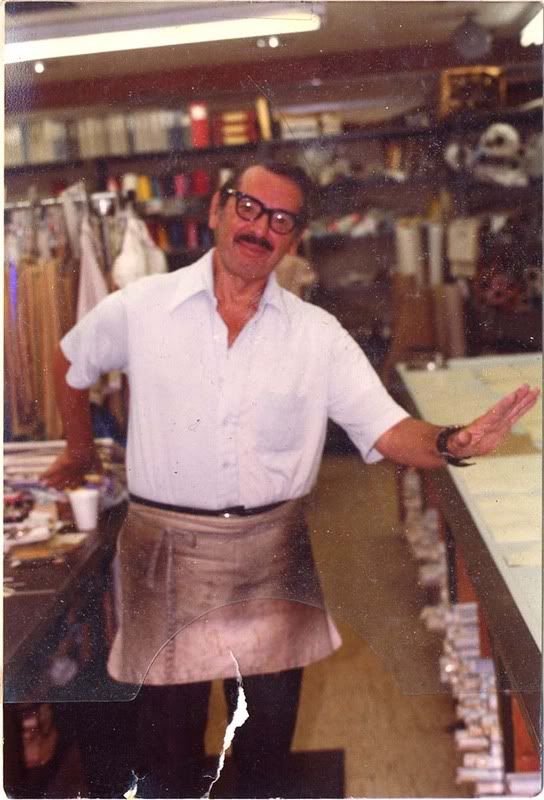 Two older posts that are noteworthy in regard to the recent Schmatta movie on HBO. One was on 12/27/07 And the other followed it the next day on 12/28/07
Come Fly With Me 2 and 3

I forgot that I once used Come Fly With Me in a third grade social studies project on ancestors about five years ago. It took me a while but I remembered that I had tucked it away here
I also remembered that I had posted Frank's video version here.
Come Fly With Me
Come pie with me and soupy naturally led me to this. I couldn't find a decent enough Sinatra version and I don't like Buble. I never heard of Westwing, but evidently they're big. I imagine it's not hip to like them, but who cares. The LES justification? Sammy Cahn from the 7th Ward and Seward Park High School wrote the lyrics
Come fly with me, let's fly, let's fly away
If you can use some exotic booze
There's a bar in far Bombay
Come on fly with me, we'll float down in the blue
Fly with me, float down to Peru
In llama land there's a one-man band
And he'll toot his flute for you
Fly with me, we'll take off in the blue
Once I get you up there where the air is rarefied
We'll just glide, starry-eyed
Once I get you up there I'll be holding you so very near
You might even hear a gang of angels cheer just because we're together
Weather-wise it's such a cool, cool day
You just say those words we'll whip those birds down to Acapulco Bay
It is perfect for a flying honeymoon, they do say
Come on and fly with me, let's fly, let's fly away
Once I get you up there where the air is so rarefied
We're gonna glide absolutely starry-eyed
Once I get you up there I'll be holding you so very near
You might even hear a gang of angels cheer just because we're together
Weather-wise it's such a groovy day
You just say those words we'll whip those birds down to Acapulco Bay
It's perfect for a flying honeymoon, they do say
Come on fly with me, let's fly, let's fly
Pack up your bags and let's get out of here
Come on let's fly away
Soupy Sales: Come Pie With Me
the youtube description
Barry Mitchell created this biographical tribute to Soupy Sales. A live version was performed for the legendary comedian during his birthday dinner at the New York Friars Club. (Watch Barry take a pie in the kisser from Soupy at 01:41). From Barryfunny.com.
Subscribe to:
Posts (Atom)


 Posts
Posts