Thursday, April 19, 2012
Milton Pappas: Future KVer in 1920 and 1930


Who's Who In KV History: Edmund Epstein
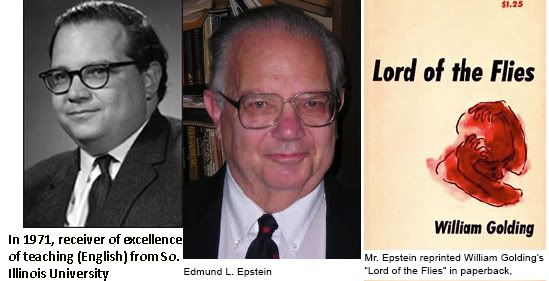
Edmund L. Epstein, Scholar Who Saved ‘Lord of the Flies,’ Dies at 80 By BRUCE WEBER Edmund L. Epstein, a literary scholar who, as a book editor in the late 1950s, was so taken by a well-reviewed but not especially popular first novel by a largely unknown British writer that he decided to reprint it in paperback, thus enabling the extravagant American success of “Lord of the Flies” and its author, the future Nobel Prize winner William Golding, died on April 1 in Melville, on Long Island. He was 80. The cause was complications of multiple myeloma, his daughter Dr. Lucy Hutner said. Mr. Epstein, who taught at Queens College of the City University of New York for many years , was a Joyce scholar and the author of influential book-length studies of Joyce’s “Portrait of the Artist as a Young Man” and “Finnegans Wake.” He was also a founder, in 1957, of the James Joyce Review, a short-lived journal that was an important antecedent of the James Joyce Quarterly, which was founded in 1963 and to which he contributed. “Professor Epstein helped shape the field for nearly two generations across a range of essays covering all of the Joyce canon,” the Quarterly wrote in an obituary on its blog. In 1957, Mr. Epstein became the editor of Capricorn Books, an imprint of G. P. Putnam’s Sons (now owned by the Penguin Group) aimed at the college market. “Lord of the Flies,” the allegorical tale of well-brought-up British boys who, left to their own devices on a remote island, devolve into savagery, had been published in England in 1954. The next year, after being rejected by a number of prominent American houses, it was published in the United States by Coward-McCann (also owned by Putnam’s and later known as Coward, McCann & Geoghegan) in a hardcover edition. It sold poorly. But Mr. Epstein was one of its select readers.a story from 2006 about a lecture he gave in Port Washington
Joan Kent, former president of the Library Board of Trustees and also of the Library Foundation, talked with Professor Epstein at the conclusion of the program. Photo by Will Wright Queens College Professor of English and Port resident Edmund Epstein recently lectured at the library on the subject "What, exactly, is a Classic?" This well-attended event, sponsored by the Friends of the Port Washington Library, commemorated the fifth anniversary of the creation of the Ruth D. Bogen memorial collection and the purchase of the 1,000th volume under its aegis. Prof. Epstein, a neighbor and friend of Ruth Bogen, began his thought-provoking remarks by commenting, "Ruth was one of the classiest people I knew. She was a classics major in college and member of our reading group for a long time. She never let us get away with anything. Sam [Bogen], too." Epstein said, "This question of what is a classic turns out to be a very complicated business." He traced the meaning back to the ancient Romans, where it meant those at the top and later best in category, through the Middle Ages where it meant in the classical tradition of Greek and Rome, to modern times. He pointed out that the word has now and has had many different meanings. He said, "I began to work in a different idea of what a classic is. If you look at the functions of language, the main thing is that they assert things about the outside world." He added that language is our way of trying to make sense of the things in the world that we see. "I am making sense of the world through my brain," he said "It's a way of solving problems." Literature, he commented, is a society's way of solving puzzles that have not been solved by individual members. "It is classic because it is preserved and it is preserved until the puzzle is solved." Epstein said that his definition of a classic is not limited to literature-it applies to the visual arts, science, history, music, and other fields as well.
Monday, April 16, 2012
Filmed In The Fourth Ward In 1947: A Double Life
I never new about this movie being filmed in the Fourth Ward until I read Victor Colaio's book.
Note the elevated train that is shown. It was probably the 3rd Avenue El near the junction at Chatham Square. Victor said some of the street scenes shown in the clip above were on Roosevelt Street. About the movie:
A Double Life (1947) Anthony John is an actor whose life is strongly influenced by the characters he plays. When he's playing comedy, he's the most enjoyable person in the world, but when he's playing drama, it's terrible to be around him. That's the reason why his wife Brita divorced him; although she still loves him and works with him, she couldn't stand living with him anymore. So when Anthony accepts to play Othello, he devotes himself entirely to the part, but it soon overwhelms him and with each day his mind gets filled more and more with Othello's murderous jealousy.Ronald Coleman won an Oscar for the part of Anthony John. So if anyone asks you to name two Oscar winning movies shot in the Fourth Ward (the other being French Connection) you will know.
The successful middle-aged Broadway actor Anthony "Tony" John is a dedicated lonely professional that still loves his former wife Brita. They are playing Othello for almost two years and Tony has a breakdown, beginning to lose his mind and sense of reality, confusing his identity with his characters. One night, he meets the waitress Pat Kroll in a distant bar and he spends the night with the easy woman. Then he proposes Brita, who is his best friend, but she refuses to marry him again triggering a jealousy process against their friend Bill. Tony decides to visit Pat late night and in an insanity process, he lives the situation of Othello killing Desdemona. The police arrest a suspect but Bill wants to prove that Tony is responsible for the murder.
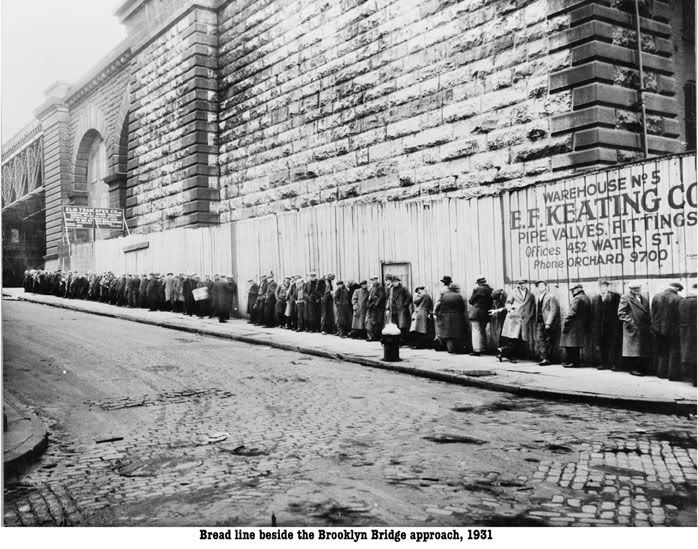
Bread Line On Dover Street: 1931
Victor Colaio's Fourth Ward

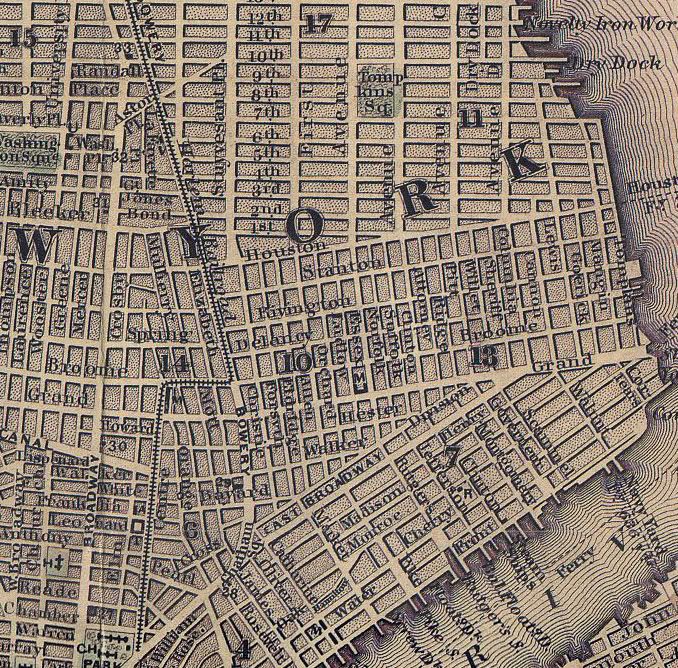
From a 1891 map. Victor lived on Madison Street marked #1. The triangular view at #2 was a good spot to see and be seen by his pals.
Victor Colaio's Between Two Bridges
Colaio Scribd
I found out about this wonderful book from Victor's old pal Jack Randolph. Victor and Jack grew up in the 40's and 50's
in the area of the Fourth Ward that would be mostly absorbed by the Alfred E. Smith Projects. He was kind enough to let me
upload a chapter. I tried to add pics that coincided with the text.
About the book:
About the book:
Born in the middle of the Great Depression, Victor Colaio grew-up on the lower east side of NYC. He attended Cardinal Hayes High School in the Bronx. He later attended St. John's University where he obtained a BBA. Mr. Colaio's first job was employment as an accountant for a freight forwarder. After serving in the US Army, he held positions with several NYC agencies including the NYPD and FDNY. Subsequently, he accepted a position with the IRS as a tax law pension specialist. He later transferred to the US Merchant Marine Academy as Deputy Head of Budgets. He left government service and joined a Wall St. bond broker, RMJ Securities, where he performed various assignments and retired. He now spends most of his time writing. He lives with his wife Mary Christina. He has a daughter Jean and five grandchildren. His sons Mark and Stephen perished on Sept 11, 2001 at the WTC. Victor Colaio now resides on the eastern end of Long Island.
Buster Keaton In The Fourth Ward: 1964
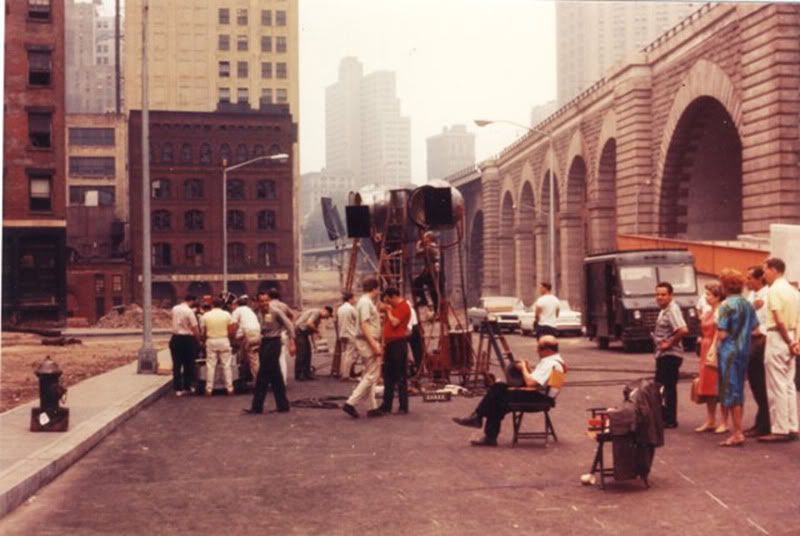
During the summer of 1964, Buster Keaton and Samuel Beckett collaborated making a black and white, avant garde, nearly silent short movie entitled Film. Keaton, who is seen only from the rear, plays a man attempting to evade perception, eluding everyone except himself. It was Beckett’s only screenplay, and one of Keaton’s final films.
Production began on July 20, 1964, by filming exteriors within the shadow of the Brooklyn Bridge. Film critic Leonard Maltin, then a young teenager, had read about the planned shooting in the newspaper, and traveled from his home in New Jersey to witness Keaton at work. Leonard brought along a handful of stills for Buster to autograph, and spent a few moments chatting with Buster between takes.

PS 177: Built In 1899

Somewhere in this blog I have it as 1903. Other KVers recall seeing a marker on the building to that effect. Maybe it was begun in 1899. from the mcny collection
Thursday, February 2, 2012
90 Gold Street: Site Of Philip White's Pharmacy
below from NYPL Digital Gallery, The New York Public Library
 Carla Peterson talks about her ancestor Philip White in her book, Black Gotham: A Family History of African Americans in Nineteenth-Century New York City
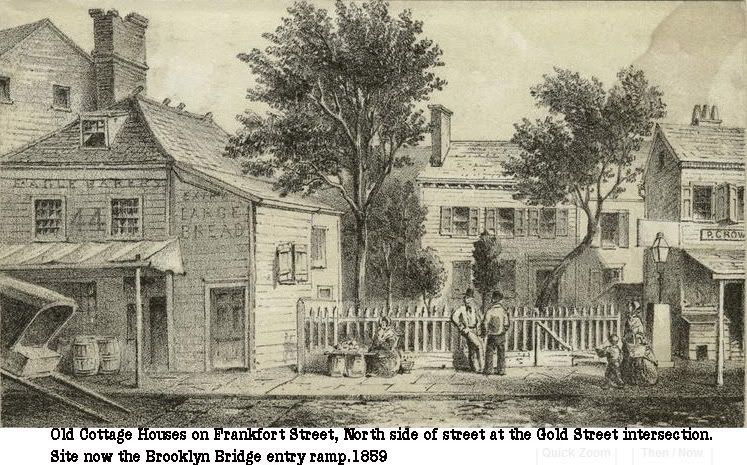
While researching Philip White’s life in postbellum New York City, Peterson used city directories to uncover that while White had moved his residence from Lower Manhattan to Brooklyn in 1870, his pharmacy remained in its same location in Manhattan until his death in 1891. Peterson wondered why, since he moved his home, White hadn’t also moved his business, either in 1863 in the aftermath of the Draft Riots (which traumatized the black community), or in 1867, when he married Elizabeth Guignon? So she decided to walk the streets where White’s home had once been located—and found the entrance ramp for the Brooklyn Bridge. To build the unsuspended approaches and anchorages leading up to the bridge’s span on the Manhattan side, “this required clearing six blocks between Chatham and Water and Frankfort and Duane Streets…Philip’s drugstore on the corner of Frankfort and Gold was saved, but his home on Vandewater Street was demolished” (311). City directories led to city maps which led to city streets which revealed urban renewal – and a crucial piece of Peterson’s story.View a booktalk by Professor Peterson on cspan She will we speaking at the Brooklyn Museum on Saturday February 4, 2012
Friday, January 27, 2012
Revisiting Pickup On South Street
My daughter Emma is taking a really interesting film class at Clark University with a Professor Michael Siegel
SCRN 120 - History of U.S. Film Since 1950 The history of post-WWII American cinema is the story of an ongoing series of adjustments to (or developments within the context of) instability in postwar film business: film noir, 3-D, biblical epics, blockbusters, art film influences, “new blood” from TV and film schools, Black filmmaking, revisionist genre films, high-concept filmmaking, etc. Further complicating this process of adjustments, cinema was overlaid onto, and consequently influenced by, the political turmoil within American society in general: the “Red Scare,” the Vietnam War, the emergence of a mass counterculture, the antiwar movement, Watergate, Reaganomics, the end of the Cold War and increasingly vocal demands by women and minorities for social equality (and media representation).One of the films she viewed was Pickup On South Street. I've talked about the film and Sam Fuller several times here and I always assumed some scenes were filmed on location. Evidently according to this blogger they weren't. However, in part 2 of the film embedded above, it looks like at about the 5:36 mark a shot is filmed near the Brooklyn side of the Manhattan Bridge. I can make out other NYC shots in other scenes, but evidently the outdoor views from Widmark's dockside shack, towards the end of the clip above, are fake.
Saturday, January 7, 2012
When I'm 64
When I get older losing my hair,
Many years from now,
Will you still be sending me a valentine
Birthday greetings bottle of wine?
If I'd been out till quarter to three
Would you lock the door,
Will you still need me,
will you still feed me,
When I'm sixty-four?
oo oo oo oo oo oo oo oooo
You'll be older too,
(ah ah ah ah ah)
And if you say the word,
I could stay with you.
I could be handy mending a fuse
When your lights have gone.
You can knit a sweater by the fireside
Sunday mornings go for a ride.
Doing the garden, digging the weeds,
Who could ask for more?
Will you still need me,
will you still feed me,
When I'm sixty-four?
Every summer we can rent a cottage
In the Isle of Wight, if it's not too drear
We shall scrimp and save Grandchildren on your knee
Vera, Chuck, and Dave
Send me a postcard,
drop me a line,
Stating point of view.
Indicate precisely what you mean to say
Yours sincerely, Wasting Away.
Give me your answer,
fill in a form
Mine for evermore
Will you still need me,
will you still feed me,
When I'm sixty-four?
Subscribe to:
Posts (Atom)


 Posts