Friday, December 26, 2008

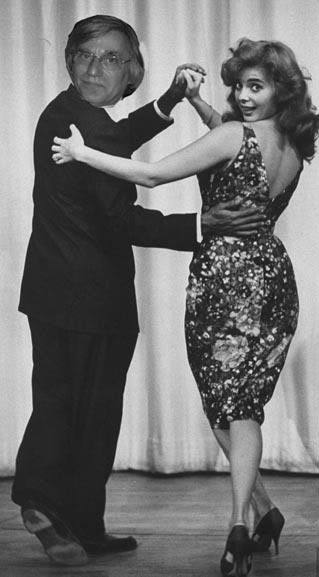
Abbe Lane


a video from the 1960's.
Abbe Lane (born December 14, 1932) is an American singer and actress.
Born Abigail Francine Lassman to a Jewish family in Brooklyn, New York, Lane began her career as a child actor on radio, and from there she progressed to singing and dancing on Broadway. Quickly establishing herself as a "femme fatale", Lane found popularity in Italian films but was often criticized for her flagrantly sexual persona.[citation needed]
Married to Xavier Cugat from 1952 until their divorce in 1964, Lane achieved her greatest success as a nightclub singer, and was described in a 1963 magazine article as "the swingingest sexpot in show business". Cugat's influence was seen in her music which favored Latin and rumba styles. In 1958 she starred opposite Tony Randall in the Broadway musical Oh, Captain!. Unfortunately, her recording contract prevented her from appearing on the original cast album of the show. On the recording, her songs were performed by Eileen Rodgers. Lane later recorded her songs on a solo album. The most successful of her records was a 1958 album collaboration with Tito Puente titled Be Mine Tonight. Fans either didn't know or care that Abbe's roots were as far away from a Latin bombshell as a Jewish girl from Brooklyn could have. Apart from working solo, Lane would frequently make the talk show rounds with Cugat. After their break-up, Cugat would introduce his new wife/discovery, Charo.
She attracted attention for her suggestive comments such as "Jayne Mansfield may turn boys into men, but I take them from there", and also commented that she was considered "too sexy in Italy". Her costume for an appearance on the Jackie Gleason Show was considered too revealing and she was instructed to wear something else; however she appeared on the shows of Red Skelton, Dean Martin and Jack Benny without attracting controversy.
In addition to her Italian films, Lane was a frequent performer on the television show Toast of the Town during the 1950s. She also played guest roles in such series as The Flying Nun, The Brady Bunch (as cosmetics maven "Bebe Gallini"), Hart to Hart and Vega$. Lane fans got to see her once more in the 1983 film version of The Twilight Zone, in the role of an airline stewardess.
She has a star on the Hollywood Walk of Fame for her contribution to television, at 6381 Hollywood Boulevard.

Marv's Marvelous 2009 Predictons

All the way from Portland, Oregon, the fastest fellow of the Jewish and other persuasions in KV history, and putting some fast moves on Abbe as well, checks in with these predictions:
I know you Yankee fans are kvelling with your recent "acquisitions" but I believe there's trouble brewing for 2009. I predict the following developments:
1) Mark Teixeira announces that he does indeed go both ways and reveals he and Barry Manilow will be wed at the Eldridge St. synagogue the day before opening day.
2) A-Rod and Madonna also announce their marriage plans also to be held at Eldridge St. synagogue the day before opening day as Madonna has now totally converted to Reconstructionist Judaism which allows you to adopt any part of Judaism that suits you.
3)Xavier Nady announces that in honor of his idol Xavier Cugart he is marrying both Charo and Abbe Lane. As Abbe Lane is Jewish and Eldridge St. synagogue will not allow Charo to do the "cuchi-cuchi" at the ceremony, their wedding will occur at the Pike street synagogue also the day before opening day.
4) Rabbi Dick is hired by all 3 "couples" to perform the staggered ceremonies that day-he requests the presence of Prof Bob to both test the orange juice to make sure it has not been spiked with vodka and provide a lecture based on his book.
5) Opening day there is tension in the clubhouse-Ron S's anticipating this sends massive amounts of Koopala urging all the Yankees to calm down and concentrate on baseball. Hideki Matsui is particularly pissed as none of the weddings served sushi at the receptions only gefilte fish, smoked whitefish and fried plantains.
6) Second day of the season Nick Swisher announces that he is indeed gay(he changed his name many years ago to reflect that), not that there's anything wrong with that and is wedding Fritz Peterson who after 2 failed marriages came "out of the closet".
7) Third day of the season CC Sabathia and AJ Burnett buyout the Steinbrenner's and move the team to Brooklyn with all games to be played at Gil Hodges field.
8) The Brooklyn Yankees go on to a 160-2 season sweeping all playoff games and the World Series.
9) Jim Bouton announces that his new book "Ball Five", based on the 2009 Brooklyn Yankee season, will be made into a movie with Pee Wee Herman (who is Jewish and was married at the Eldridge St. synagogue the day before opening day), will play the role of Joe Girardi. Directed by Peter Jackson this trilogy (extended versions will be 15 hrs. long) will feature a soundtrack by, yes you guessed it, the previously unreleased recordings of Xavier Cugart featuring Charo and Abby Lane!
So these are my predictions for the coming year. A Happy and Healthy New Year to all of you!

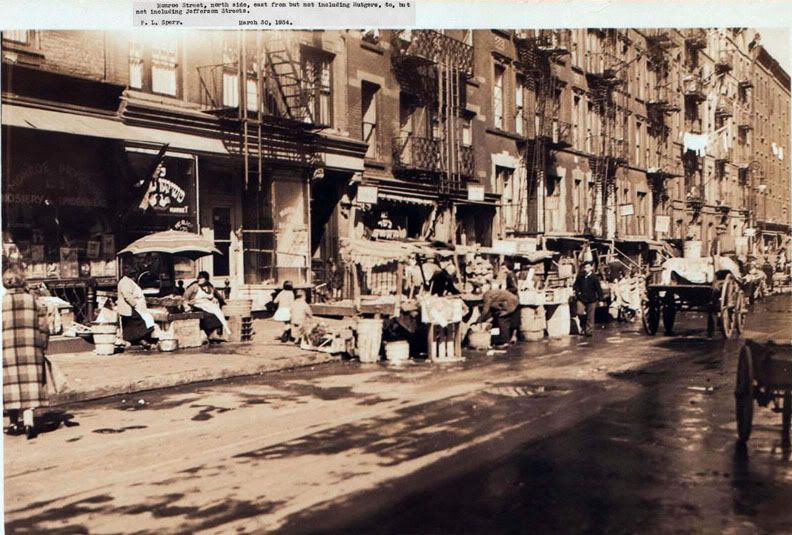
Max Weintraub: 129 Monroe Street


Taken in 1934. This was the exact block Max grew up on. It's between Jefferson and Rutgers. I wonder whether Max's mother is visible. She had her own pushcart. You can see, upon clicking, that the 123 Monroe St. storefront is called Monroe Dry Goods, Hosiery and Underwear

Wednesday, December 17, 2008

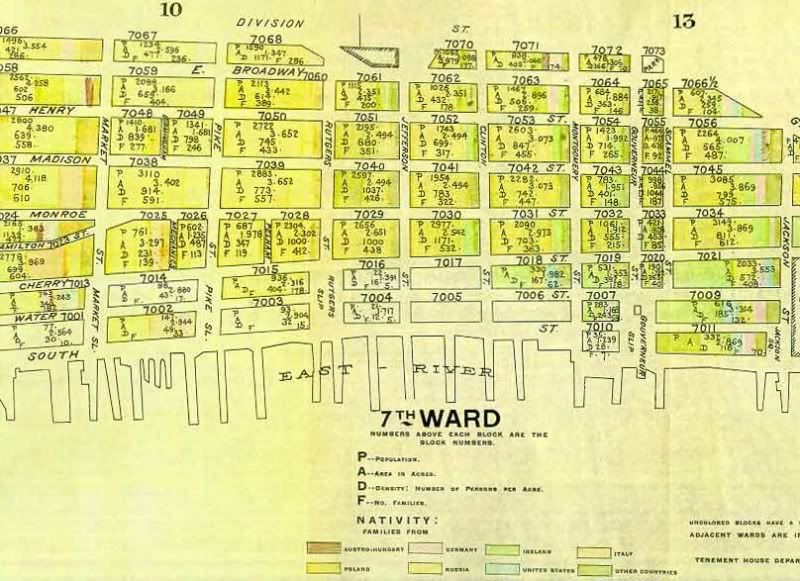
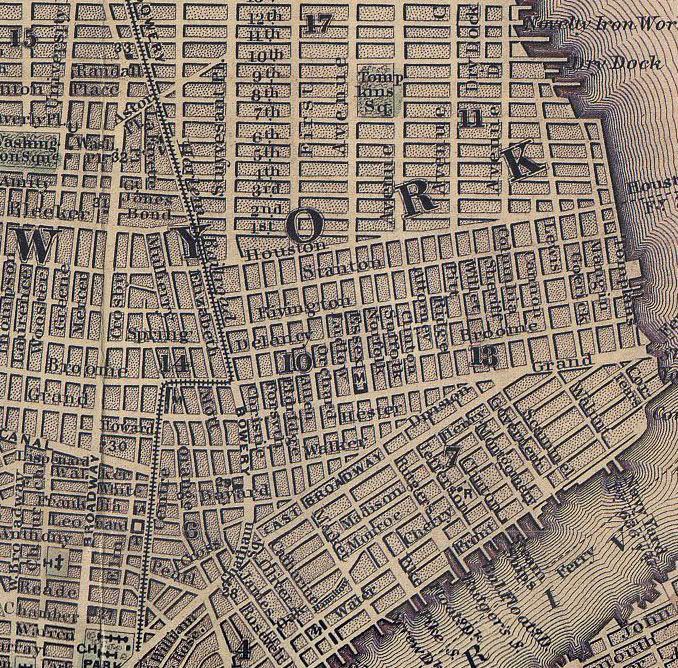
1900 Ethnic Data Map Of The 7th Ward


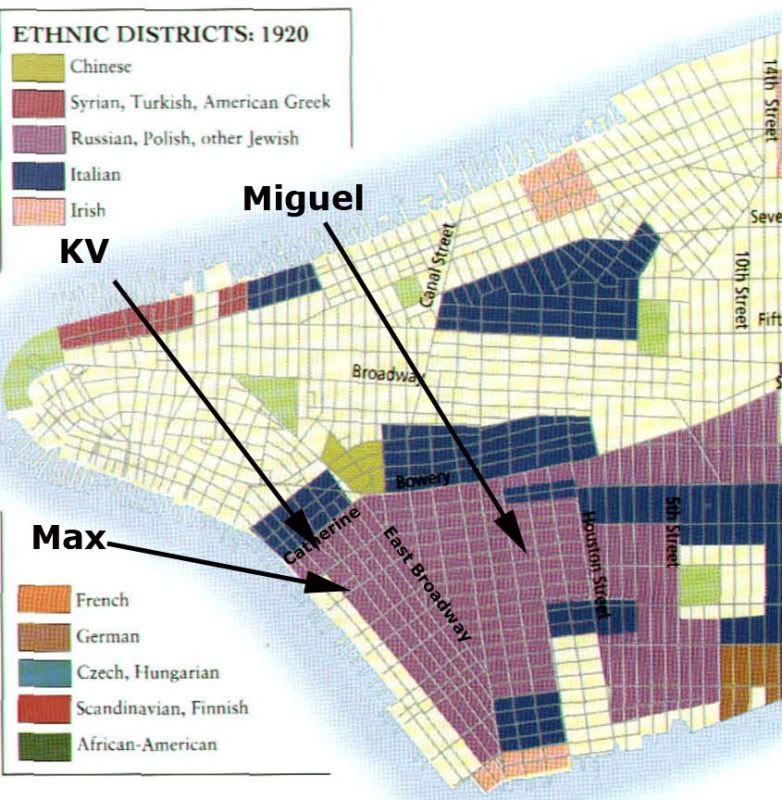
This is where Max grew up. It's hard to distinguish the differences in the shades of yellow, but this area was more Russian and Polish, whereas in the 10 Ward, north of here, it would be more Hungarian, German, Romanian and Austrian. Going northeast, ward 13, the same as Ward 10, but less German. Going west, 4th Ward, it would be more Italian, Irish and Greek. Going northwest 6th Ward, it would be Chinese and Italian. Going further east it would be more Irish.

1920 LES Ethnic Map


From Eric Homberger's Historical Atlas Of New York City

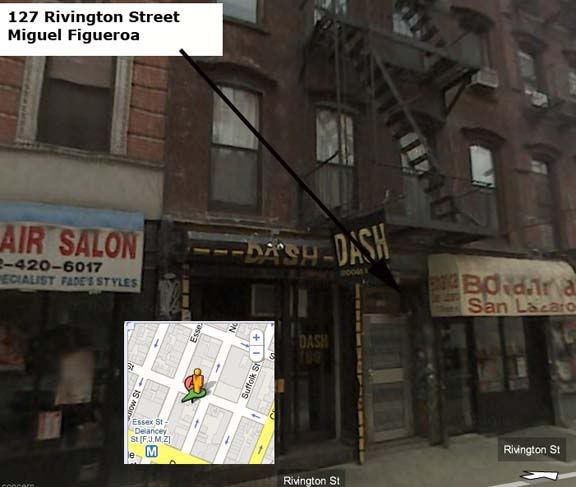
Miguel Figueroa: 127 Rivington Street

Tuesday, December 16, 2008

The Return Of Max And Miguel (and Miguel's Mom)


We haven't seen the dynamic duo of Max and Miguel for over a year. I'm trying to sponsor Max, from 129 Monroe Street, and Miguel from 127 Rivington Street, as oral history subjects.

Monday, December 15, 2008

Cool Yule


From Coney Island to The Sunset Strip
Somebody's gonna make a happy trip
Tonight, while the moon is bright
He's gonna have a bag of crazy toys
To give the groanies of the boys and girls
So dig, Santa comes on big
He'll come a callin' when the snows the most
When all you cats are sleepin' warm as toast
And you gonna flip when Old Saint Nick
Takes a lick on the peppermint stick
He'll come a flyin' from a higher place
And fill the stocking by the fire place
So you'll, have a yule that's cool
-Instrumental Jazz Break-
Yeah, from Coney Island to The Sunset Strip
Somebody's gonna make a happy trip
Tonight, while the moon is bright
He's gonna have a bag of crazy toys
To give the groanies of the boys and girls
So dig, Santa comes on big
He'll come a callin' when the snows the most
When all you cats are sleepin' warm as toast
And you gonna flip when the Old Saint Nick
Takes a lick on the peppernint stick
He'll come a flyin' from a higher place
And fill the stocking by the fire place
So you'll, have a yule that's cool
Have a yule that's cool
Yeah, cool yule

Lost In Paradise: Samuel J. Chotzinoff's Autobiography, Chapter 4

Chap 4 Lost Paradise

NYC: Back On The Block


an excerpt from the nytimes of 10/17/08
The Jump Rope Girls, 20 Years On, By SUSAN HARTMAN
TWENTY years ago, six girls lit up a troubled Brooklyn block. Gunfire could be heard in the distance. There was a stream of visitors to the apartments of drug dealers. But these girls had claimed a patch of sidewalk in front of their building, and from April to October, on a strip of Parkside Avenue just east of Prospect Park, these 8- and 11-year-olds were unstoppable.
GeeGee Goodwin, top, with her son, Aaron Jr.; Peachie Navarro, middle, with her son, Cleveland, in background, and a nephew, and Jackie Rendon, bottom, with her son, Josiah.
No matter what was going on in their lives — financial problems, divorces, family illness — they showed up. Some days, they played double Dutch, but many other days they performed what they called “cheers” — a clapping, foot-stamping game that drew from rap music, from traditional childhood games, from cheers they had learned in school and from their own lives. They worked these bits into short, dramatic routines.
The girls had personality galore: Jackie and Steffie Rendon, the twins, were strong-willed, green-eyed 11-year-olds, their ponytails flying as they jumped. Always nearby were two other 11-year-olds — Elbe Vasquez, their ebullient, curly-haired cousin, and Peachie Navarro, who was quieter and had almond-shaped eyes.
The two 8-year-olds, joined at the hip, were Starr Bryant, who was tall, athletic and had high cheekbones, and GeeGee Goodwin, who had slightly bowed legs and a megawatt smile.
In the fall of 1988, the girls’ cheers and their lives were described in an article in The New York Times. Ten thousand turns of the jump rope later, Parkside Avenue looks much the same — a tree-lined mix of brick apartment buildings, and two- and three-story row houses and town houses.
Two of the girls who were part of this world have moved on — Elbe moved to nearby Sunset Park in 1998, and Steffie to Florida in 2004.
But the other four are still powerfully connected to the block, and are negotiating the world for their children, a task likely to be even more daunting, given the waves of economic distress hitting the city and the nation.
Three of the women live in the apartments in which they grew up: Peachie, a pharmacy technician who has two children and helps support a four-generation household; Starr, who is raising two daughters; and GeeGee, mother of an 8-year-old son.
And although Jackie, the one who made it into the middle class, moved away, she returns to the block every day at 5 p.m. to pick up her son at her mother’s apartment.
“There’s a homey feel,” Jackie said of Parkside as she sat in her Nissan Altima waiting for her child. “My mother’s here. My sister’s here. Even if they weren’t, I’d come back.”
Parkside, part of the Prospect-Lefferts Gardens neighborhood, sits within the 71st Precinct, which, along with the rest of the city, has seen a sharp decline in crime in recent years. The murder rate has dropped 69 percent since 1990; rape is down 80 percent, according to police data. But despite signs of gentrification on Parkside — a house that cost $76,000 in 1984 recently sold for $760,000 — safety can still feel elusive.
Drug dealers sit on boxes and folding chairs at the end of the block. As Peachie summed it up: “If I can see it, smell it, what does my daughter see?”
Many current residents have vivid memories of the 1980s and early 1990s, when Parkside was hit hard by the citywide crack epidemic. Thirty-six murders were reported in the precinct in 1990, and the block felt the tremors from nearby events, among them a riot the following year involving blacks and Hasidic Jews in nearby Crown Heights.
Throughout this turmoil, the girls stayed focused on their cheers.

Sunday, December 14, 2008

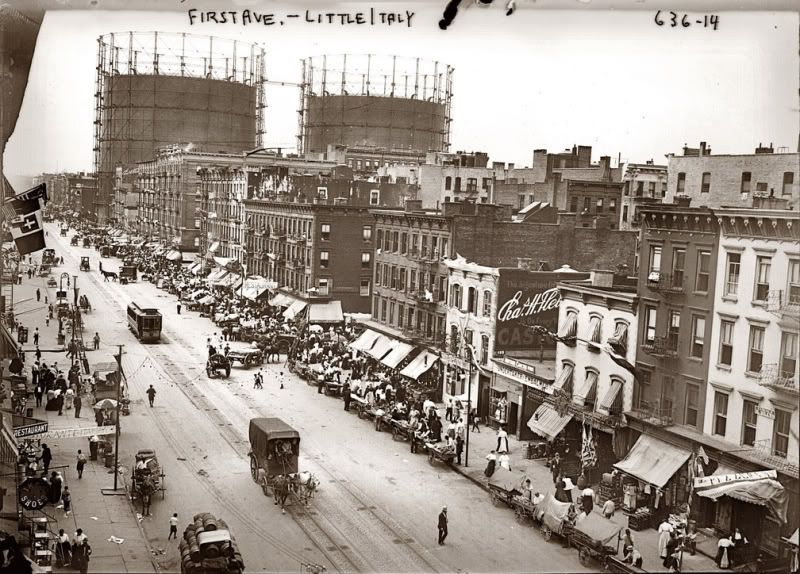
Another Little Italy


From Shorpy
New York's First Avenue at East 29th Street during the annual Little Italy festa circa 1908. 5x7 glass negative, George Grantham Bain Collection.
comments that accompanied the photo
The the danger of fire was not the greatest of the problems caused by living in close proximity to the gas tanks. Before the Second World War, New York (and many other cities) were not supplied with natural gas. They used manufactured gas, which was made by heating cheap grades of bituminous coal or bunker oil in a retort. This process produced several byproducts, including noxious, sulfurous fumes which permeated the air in the surrounding district. These tanks were located in very close proximity to several large gas manufacturing plants.
What a fire and explosive hazard - gas tanks in a residential and commercial neighborhood. I guess there were no restrictions at that time.
That would absolutely put it in the East Village, though in 1908 I think it would have been the Lower East Side.
First Avenue ends at Houston Street. Little Italy is south of that, around Mulberry and Grand Streets. This was probably another Italian neighborhood. The area around lower First Avenue is now called the East Village (as opposed to the West Village, which is really Greenwich Village). The East Village area is being gentrified with new restaurants and upscale condos. The photograph really belongs in a Godfather II scene, it is amazing.
If we use the address number 489 as a clue, the first cross street in the photo would be Those are two of the many huge natural-gas storage tanks along the East River waterfront that gave the Gashouse District its name.

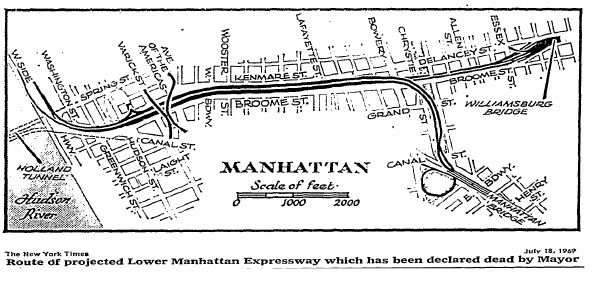
Louis DeSalvio: The Map Of The Planned Highway