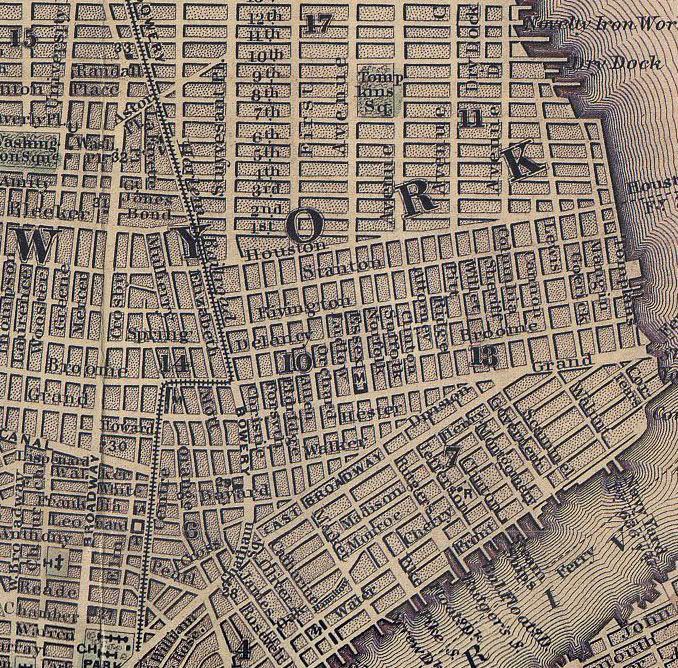
After giving the tour to Zeva and her friends I went back to do some more research on the Rosenbergs and also re-watched Heir To An Execution to refresh my knowledge about the case. The clip above caught my attention because of this recent article in the villager, an excerpt
Rosenberg backers say, ‘Case is still full of holes’, By Mary Reinholz
For nearly six decades now, friends and sympathizers of Julius and Ethel Rosenberg have marched, picketed and petitioned the U.S. government, claiming that the Lower East Side couple were framed by prosecutors as atomic spies for Russia before they were unjustly executed in Sing Sing’s electric chair on June 19, 1953.
The sensational case seared the American psyche during the Cold War and still elicits passionate debate even as many Rosenberg supporters came to believe that Julius and possibly Ethel had been at least minor players in an espionage ring starting when the U.S. was an ally of the Soviet Union during the Nazi onslaught of World War II.
Then came a stunning acknowledgement last September: For the first time, Morton Sobell, a co-defendant of the Rosenbergs who had maintained his innocence before and after more than 18 years in federal prisons, including Alcatraz, admitted to Sam Roberts of The New York Times that he had been a spy with Julius Rosenberg, passing on military and industrial secrets to the Soviets.
Sobell, now 92, also told Roberts that he didn’t believe Ethel Rosenberg was guilty of anything beyond being Julius’s wife, a claim disputed by historians like Ronald Radosh, author of “The Rosenberg File,” who nonetheless believe that secret grand jury testimony released last September by the National Archives cast doubt on a key government charge that led to her conviction for a capital crime.
And while Radosh claimed that Sobell’s disclosures shattered a fundamental assumption of the American left, there were no mea culpas coming from organizers of a recent annual memorial marking the 56th anniversary of the Rosenbergs’ execution at New York University’s Tamiment Library and Robert F. Wagner Labor Archives on Washington Square South.
The free event, held on the Rosenbergs’ 70th wedding anniversary, drew about 75 people — some in their 80s and 90s. They heard speeches, musical tributes, messages of support from the Rosenbergs’ orphaned adult children, Michael and Robert Meeropol, and from a granddaughter, Rachel Meeropol, now an attorney with the Center for Constitutional Rights.
There was also a reading of a petition to be sent to U.S. Attorney General Eric H. Holder, Jr., asking once again that the government re-examine the Rosenberg-Sobell case.
“The case is still full of holes,” said Richard Corey, 62, a Chelsea painter and songwriter who is co-director of the National Committee To Reopen the Rosenberg Case, which sponsored the memorial. Corey attended the event with his 95-year-old father, “Professor” Irwin Corey, the celebrated stand-up comic and activist who was blacklisted during the McCarthy era.
“Everybody now recognizes that Ethel Rosenberg was arrested and lies were told so the government could use her as a lever to get a confession from Julius, who was not involved in atomic spying. He helped an ally during World War II,” contended the younger Corey. He noted in a telephone conversation that he grew up on Long Island “with an F.B.I. car parked in front of our house. All I can say is that I was extremely disappointed that my family didn’t storm Sing Sing prison and get Ethel out,” he said.
Long Island conductor/composer Leonard Lehrman, who co-directs the N.C.R.R.C. with Corey, noted that the secret grand jury testimony in the case suggests that key trial statements from co-defendant David Greenglass, Ethel’s brother, and his wife, Ruth Greenglass, both of whom became government witnesses and pariahs on the American left, were fabricated by them and “coached by the F.B.I.”
Their claim at trial that Ethel typed up notes from David Greenglass when he was an Army machinist at a top-secret, atom bomb-making facility in Los Alamos, N.M., called the Manhattan Project and moonlighting as a Soviet mole, is believed by many to have helped seal Ethel Rosenberg’s doom. A jury convicted the couple in a Foley Square federal courthouse on March 29, 1951, for conspiracy to commit espionage. Their lawyer, Emanuel Bloch, protested the Rosenbergs’ innocence up until the night before their deaths after worldwide pleas for clemency were ignored. French philosopher Jean-Paul Sartre called their execution a “legal lynching.”
None of the people interviewed for this article knew the Rosenbergs personally. But one of the speakers at the memorial, Miriam Moskowitz, 93, who was convicted in 1950 for conspiracy to obstruct justice in another Cold War case that prosecutors at the time billed as a “dress rehearsal” for the Rosenberg trial, told this reporter that she met Ethel Rosenberg in jail — the notorious Women’s House of Detention on Greenwich Ave.
“On July 29, 1950, I was arrested and two weeks later Ethel Rosenberg was arrested,” Moskowitz wrote in an e-mail. “She was lodged on the 9th floor and I on the 5th so we still did not meet. After her conviction she was brought down to my floor (5th) because there was a special cell there where the guard could keep her in sight all the time — they were afraid, I think, that she would do something drastic to herself. (What a joke: Ethel said they never understood that would be the last thing in the world she could ever do.) So on the 5th floor we finally met and shared ‘leisure’ time until she was shipped to Sing Sing prison.”
Moskowitz, who is including the episode in a chapter of a book she’s completing about her case and that of co-defendant Abraham Brofman, said she decided to come to the memorial because “for 56 years I have been haunted by the Rosenberg case — it was a terrible time, sheer madness and more frightening than my worst childhood bad dreams.”
She also seemed concerned about New York Timesman Sam Roberts’s article on Morton Sobell’s admissions, claiming Roberts misquoted him and “slanted” his account of Sobell’s spy activities.
Not surprisingly, N.C.R.R.C.’s Lehrman, 59, shares that view.
“Sam twisted [Sobell’s] words to make it seem as though he was admitting to more than he was,” Lehrman said. “And Morty’s letter that appeared in The New York Times [clarified] that he, in fact, knew absolutely nothing about any atomic espionage.”
Lehrman, who was 3 years old when the Rosenbergs were executed, believes that Julius Rosenberg, regarded by many on the left as an ardent Communist, was motivated by idealistic notions about the Soviet Union — viewed by some party members as a socialist utopia free of anti-Semitism.
“Some of those who tried to help the Soviet Union as a wartime ally may have broken some laws in order to do that,” Lehrman said in an e-mail. “The Cold War put their actions into a different context, just the way 9/11 put Lynne Stewart’s sometimes rule-breaking defense of her client into a different light,” he added, alluding to the Downtown lawyer convicted of materially aiding terrorism in her defense of an imprisoned Egyptian Muslim cleric. “She did not deserve a harsh sentence, and neither did Julius Rosenberg,” Lehrman said.
The National Committee to Reopen the Rosenberg Case was directed for 42 years by Aaron Katz, who died in Florida last year at 92. Katz was also active in a predecessor group that began in 1951 called The Committee To Secure Justice in the Rosenberg Case, said one of the founders of that group, David Alman, 90. Alman also spoke at the Rosenberg memorial and read from a draft of a book he wrote with his late wife, lawyer and sociologist Emily Arnow Alman, called “Case for Exoneration: The Rosenberg-Sobell Trial in the 21st Century.”
The Almans did not know the Rosebergs socially when both couples were living at the Knickerbocker Village housing complex on the Lower East Side. But Alman said his wife had a brief conversation with Ethel Rosenberg at a small park nearby and never forgot it.
“My wife was walking with a neighbor who introduced her to Ethel Rosenberg in a little park and the women both had little babies with them,” he recalled. “They only spoke three or four minutes, but Emily said she couldn’t get it out of her mind that this woman she had spoken to in the park had been sentenced to death. It was a human connection and it led to the formation of a committee to obtain clemency in the fall of 1951. We were both deeply involved in the campaign for clemency and for a new trial.”
Alman has come to believe that Julius Rosenberg, Morton Sobell and David Greenglass, the government’s chief witness who testified against his sister, Ethel Rosenberg, were guilty of crimes “no matter how you parse it,” but were convicted on the wrong charges.
“I don’t feel what they did is any small thing,” Alman said. “I can’t speak for everyone, but I would have no problem if they had been tried for the crime they committed — and not treason. Greenglass and his wife weren’t able to stand up to the threats [of prosecutors] and they capitulated,” he added. “But they didn’t tell the whole truth.”





 Posts
Posts