Friday, October 23, 2009
RIP Soupy Sales
Not only was Soupy very funny but he was an appreciator of good music. Above is clip from one of his shows with a rare live view of the great jazz trumpeter Clifford Brown.


Benny Fein's Home In Brooklyn

Benny Fein's WW2 draft registration card revealed he lived here in Crown Heights. It's from one of my "famous People Who Lived In Brooklyn Google Maps." I wonder whether the current owner according to property shark, Hill Hyacinth, knows. It's not too far away from where I taught at PS 397 for many years.
Garment Gangsters 2
 portions of a 1914 nytimes article mentioning Benny Fein's use as a starker or strong arm for labor. Images are by Pat Hamou. Pat has a great mobster site six for five and he sells his art work, very reasonably, on etsy
a biography of Benny Fein
Benjamin "Dopey Benny" Fein (c. 1889-1962) was an early Jewish American gangster who dominated New York labor racketeering in the 1910s. With a criminal record dating back to 1900, Fein's arrest record included thirty charges from petty theft and assault to grand larceny and murder (of which he was acquitted twice due to lack of evidence). Fein was nicknamed "Dopey Benny" because of his eyes always being halfway-closed due to a medical condition.
Born in New York City, New York in 1889, Fein grew up in a poor neighborhood on Lower East Side becoming a petty thief and pickpocket as a child. A talented organizer Fein had formed his own gang of robbers in 1905 and during the next 5 years Fein would be sent to Elmira Reformatory several times particularly serving 3 1/2 years for armed robbery. Soon after his release in 1910 Fein joined "Big" Jack Zelig's organization soon becoming involved in labor union and extortion of the garment district. Fein also used his gang as labor sluggers, renting his gang out to either unions or companies, dominating much of New York's East Side eventually earning $20,000 a year. In 1913 several minor labor slugger gangs formed to break the monopoly held by Fein and rival Joseph Rosenzweig in which a large shootout took place on Grand Street and Forsyth Street lasting several hours, although few were killed, beginning the New York Labor slugger war which would last almost 4 years. Arrested for assault in 1914, Fein agreed to testify against several members involved in labor slugging when his political connections refused to help Fein resulting in the indictments of 11 gangsters and 21 union officials however none would be brought to trial. That same year Fein was again arrested for the murder of court clerk Frederick Strauss, who was killed in the crossfire during a shootout near St. Mark's Place, however he was later released when witnesses could not identify Fein at the scene. After his release in 1917 for labor slugging Fein's power had declined and by the end of the gang war, with Rosenzweig in prison for manslaughter, Fein decided to retire becoming a successful garment businessman.
In July 1931, appearing in court for the first time in 13 years, Fein was arraigned at Essex Market Court on felonious assault charges along with Samuel Hirsch and Samuel Rubin after throwing acid on local Brooklyn businessman Mortimer Kahn.
In 1941, Fein was arrested by detectives in a police raid ordered by District Attorney Thomas E. Dewey during which mobsters Abraham Cohen, John Ferraro and two Dallas businessmen, Herman Fogel and Samuel Klein, were also taken into custody after purchasing a recently stolen garment shipment valued at $10,000.
He and Cohen were named as the ringleaders of a criminal gang which, from armed robbery and burglary, took in an estimated $250,000 over a three-year period raiding the city's garment industry. Held in The Tombs until their trial, Fein was spared a mandatory life sentence for fourth time offenders and instead received a reduced sentence of ten to 20 years disappearing from public records sometime after.
Garment Gangsters
The Schmatta documentary doesn't touch on the gangster influence in the industry. Originally "good" mobsters were employed to counter the boss' use of mobsters to intimidate workers and break strikes. However, their influence soon transferred into control and ownership of several garment concerns, especially trucking. Little Augie and Benny Fein (mentioned in the article below) were part of that group. Benny Fein was mentioned before in April
SCHMATTA: RAGS TO RICHES TO RAGS
Currently on HBO.
from the hbo site of the movie
Youtube has a few more clips of this excellent movie. Clip two is here. A third clip is here. The Boston Globe has a review, strangely nothing in the nypress. I'm sure my father knew many of the oldtimers in the movie. I believe he worked for a while as a cutter and a marker/grader at Russ Togs. Amongst my KV friends, the Schumer and the Hyman dads were employed in the Schmatta trade on 7th Avenue. I'm sure there were many more KV Schmatta families, past and present, but today it's a dying breed. That's part of the problem with the U.S. economy.
from the hbo site of the movie
SCHMATTA: RAGS TO RICHES TO RAGS
A cautionary story of labor and greed, Schmatta: Rags to Riches to Rags follows the decline of the once-robust apparel manufacturing industry in the U.S., while chronicling the industry's relationship with unions and government. From the "Garmento" to the seamstress, from the designer to the marketing maven, from the small businessman to the financier, Schmatta offers a firsthand account of how the industry helped generations of Americans march out of poverty and right into the golden age of the American middle class. But while Schmatta reminds us of the early days of the garment industry and its heyday, it also probes its troubling decline, which has occurred largely within the last 30 years. In 1965, 95% of American clothing was made in the U.S.A.; by 2009, only 5% is manufactured here.
Director Marc Levin focuses his lens on Manhattan's Garment District, an eight-block area on Manhattan's West Side which gave birth to the domestic industrial labor movement, and played a key role in major American political activities. From its immigrant origins in the 19th Century, the labor movement rose quickly against deplorable sweatshop conditions. In recent years, however, the realities of automation, deregulation, globalization and outsourcing - all part of the race to the bottom line - eventually eroded the industry's unprecedented momentum.
This film tells some of the stories of the workers, labor organizers, designers, fashion execs and manufacturers who built their careers in the Fashion District, including: Joe Raico, a fabric cutter who took great pride in his workmanship, and laments that America doesn't produce anything anymore; Charles Kernaghan of the National Labor Committee, whose open letter to Kathy Lee Gifford caused a media circus in 1996; Irving Ruosso, owner of Russ Togs, one of the U.S.'s largest sportswear companies; Stan Herman, a designer who has worked in the District for five decades, and others.
Youtube has a few more clips of this excellent movie. Clip two is here. A third clip is here. The Boston Globe has a review, strangely nothing in the nypress. I'm sure my father knew many of the oldtimers in the movie. I believe he worked for a while as a cutter and a marker/grader at Russ Togs. Amongst my KV friends, the Schumer and the Hyman dads were employed in the Schmatta trade on 7th Avenue. I'm sure there were many more KV Schmatta families, past and present, but today it's a dying breed. That's part of the problem with the U.S. economy.
Thursday, October 22, 2009
Garden Of Dreams' Tour Bus Departs From Cherry Street
I just happened to come by when the bus was departing. Seeing the kids with the Yankee hats gave me a clue to what was going on. It's part of the Garden Of Dreams' Events going on this week.
A Sweeter Sweet Lorraine
A 1963 version of the Nat King Cole hit.
Just found joy
I'm as happy as a baby boy
When he's playing with his choo-choo toy
When I'm with my sweet Lorraine
She's got a pair of eyes
That are bluer than the summer sky
When you see her you're gonna realize
Why I love my sweet Lorraine
When it's raining I don't miss the sun
'Cause it's in my sweetie's smile
Just think that I'm the lucky one
Who will lead her down the aisle
Each night how I pray
That nobody steals her heart away
I can't wait until that lucky day
When I marry my Lorraine
When it's raining I never miss the sun
'Cause it's in my sweetie smile
Just the think that I'm the lucky one
Who's gonna lead her down the aisle
Each night how I pray
That nobody steals her heart away
I can't wait until that lucky day
That'll be the day when I marry my Lorraine
93 Years Ago At 167 Orchard Street
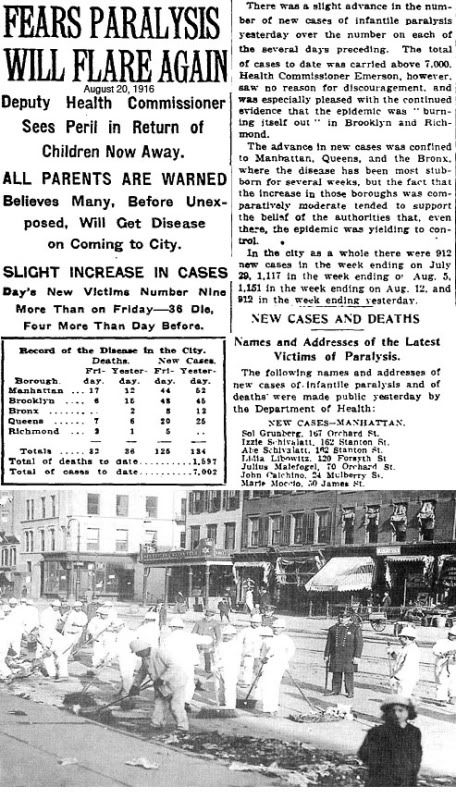 It wasn't so sweet. The city was in the middle of a polio epidemic and Solomon Grunberg of 167 Orchard Street was a victim.
about that epidemic from the University of Mary Washington
Polio Epidemic of 1916
Although polio has sporadically plagued the earth for thousands of years, isolated cases did not show up in the United States until the late nineteenth century. Even then, it was considered a "medical rarity" as doctors spanned entire careers without seeing a single case of polio. However, this changed in 1916 when the first polio epidemic hit the United States, killing and crippling thousands of Americans.
The polio epidemic of the summer of 1916 appears to have begun in Brooklyn, New York when a limited number of children awoke one morning unable to move their arms or their legs. Desperate, their parents rushed the stricken children to neighborhood health stations, but the doctors and nurses were puzzled by the various symptoms. As the days passed, the cases continued to steadily increase. By the end of June, the professionals finally recognized that they were facing an epidemic of infantile paralysis or polio. But, the doctors could not explain it, accurately diagnosis it, treat it, or prevent it--circumstances that enhanced the public's fear and uncertainty, especially since most Americans in the early twentieth century believed that they were living in a new age of science and medicine. As the disease spread, and doctors could not provide effective help or knowledgeable answers, many Americans concurred with one Philadelphian who wrote that "the ignorance of the medical profession in this instance is appalling, and is quite sufficient to cause lack of confidence and distrust toward the whole profession."
Out of confusion and lack of control and understanding of polio, scientists turned to the usual scapegoats of disease and epidemics in America: immigrants and their slums. However, this explanation was not tied solely to rampant nativist sentiments of the early twentieth century; it was based also in the Progressive Era's emphasis on sanitation and hygiene. Scientists and medical professionals claimed that the simple explanation for the spread of polio was the apparent filth and overcrowding of the immigrant neighborhoods. The disease then reached the middle- and upper-classes through direct contact, flies, or animals like cats and dogs.
Ironically, as scientists eventually would come to understand, polio was, according to polio historian Jane Smith, an "inadvertent by-product of modern sanitary conditions." As a result of public sanitation efforts and closed sewer systems, Americans had a dramatically decreased possibility of being exposed to the polio virus as infants, resulting in non-immunity for children and adults. Thus, polio defied traditional demographics of disease. It struck blacks, immigrants, and native Americans whether urban, suburban, or rural, clean or dirty, rich or poor, and young or old (although the largest percentage of cases were elementary school-age children). By December of 1916, the polio epidemic had spread from New York City to twenty-seven states along the eastern seaboard and into the mid-west. Over the course of seven months, out of twenty-seven thousand reported cases of polio, six thousand people had died, and thousands more would be paralyzed or deformed for the rest of their lives. After 1916, the United States did not escape a single summer without an epidemic, although some years were far worse than others.
Sweet Lorraine
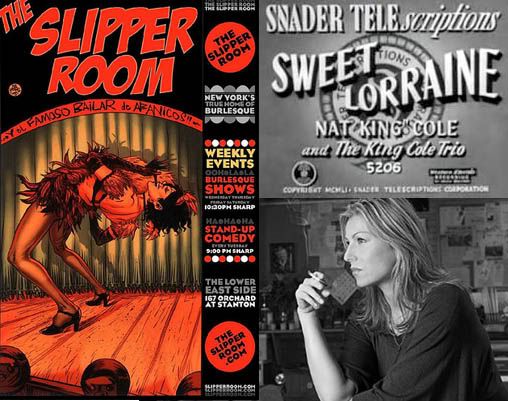 The bowery boogie has a scoop on a story that Tatum O'Neal is filming on the lower east side
a new film called Sweet Lorraine is currently filming inside the Slipper Room on Orchard Street. The movie stars Tatum O’Neal as a former city “scene queen” who about-faces and moves to New Jersey. There she gets caught up in local politics when her ex becomes mayor.
Pike Street Loop Project
From Bowery Boogie from October 12
An industrial sized robotic arm has recently taken up residency in the pedestrian island on Pike Street between Division and East Broadway. Code named “R-O-B,” the high-tech human-operated machine is part of the Pike Loop installation sponsored by the Storefront for Art and Architecture. We stopped by yesterday to scope the progress, and there’s already a wavy brick wall in the works. It was hard to avoid the spectacle and watch as the arm played a complex game of Jenga. Passersby were all equally amazed, with F-bombs of confusion dropped somewhat regularly.
I dropped an F-bomb myself. More great "city art" ala the Bloomberg Waterfalls from this past summer.
Seward Park Aerial View 2
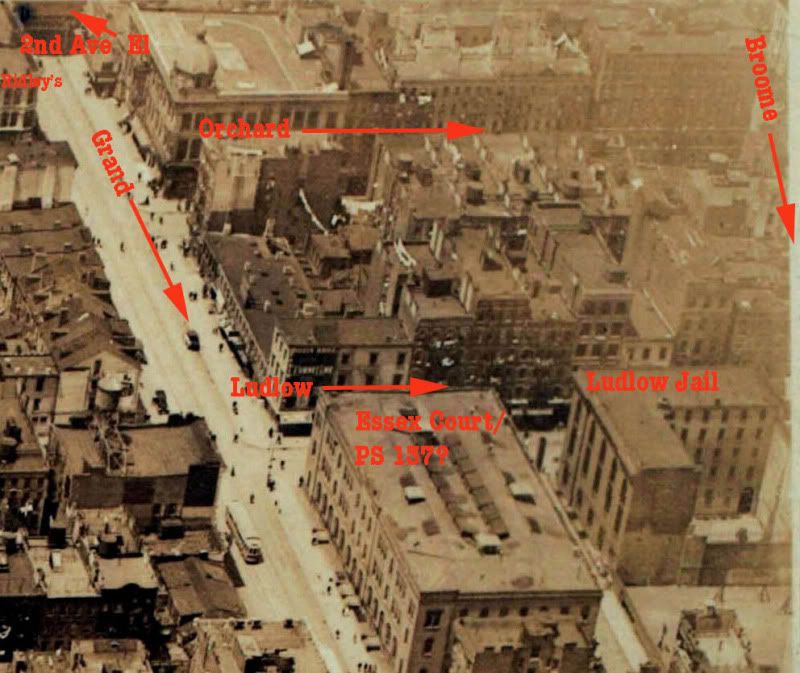
Another in the series that originates from an aerial photo of the Seward Park area circa 1930. Here the square block area incorporates Orchard, Grand, Essex and Broome Streets. Seward Park High is yet to be built, so PS 137 and the Essex Street Courthouse and the Ludlow Street Jail still exists. Notice the dome on the structure on NW corner of Orchard and Grand. I remember that is where Fishkin's used to be. I remember my mother being a big fan of the elder Mr. Fishkin. It was either that or it was part of her negotiating tactics.
Seward Park Aerial View 1
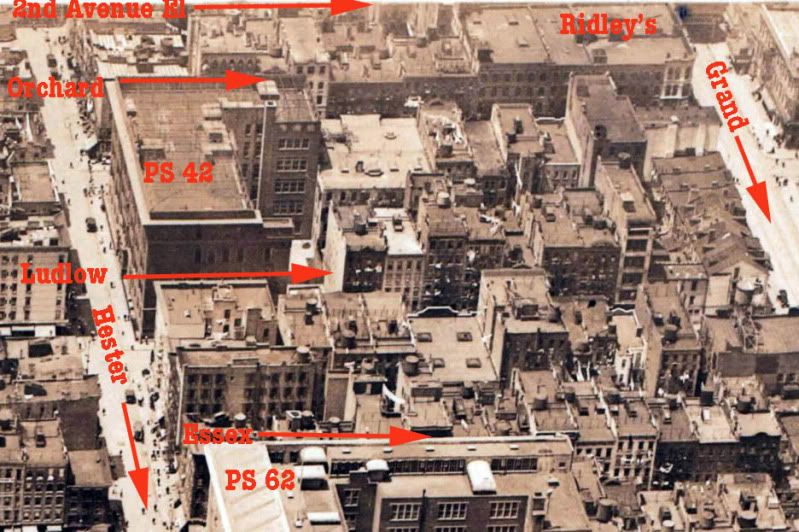
I finally finished the painstaking work of piecing together an enlarged view of an amazing aerial shot of the Seward Park area. It measures about 47 by 38 inches. I would guess it was taken in the early 1930's, but it's mislabeled 1947. I'll post it in sections with some labeling. The above shows the approximate square block area incorporating Orchard, Hester, Essex and Grand Streets. The 2nd Avenue El is visible at the top. It was demolished in 1942. Prior to that, in 1930, a portion of the eastern side of Allen Street was demolished as well in order to widen the block. Allen Street becomes First Avenue above Houston Street. PS 62 is visible in the photo at the bottom. It would soon be torn down because of the construction of the 6th Avenue Independent line. The last section of that line, which was completed in 1936, required the excavation of portions of Essex Street. You can view PS 62 in 1930 in this prior post
Subscribe to:
Posts (Atom)


 Posts
Posts