Thursday, August 23, 2012
End Of A 14 Monroe Era


Saturday, August 11, 2012
Alan Fisher, Part 2
Alan Fisher
From the library of Congress. Fisher was a photographer for the World Telegram and the Sun in the 1930's.
Another part of an interview done with him for a library of Congress oral history project:It concerns Fisher's time as a photojournalist in Vietnam. For part one on a previous postQ: This was after Dien Bien Phu?
FISHER: Oh, yes.
Q: You were doing it for South Vietnam because the North had already separated. Objective of Mopix in Vietnam FISHER:
Yes. We were doing it for South Vietnam, and we had three objectives, basically: to support President Ngo Dinh Diem, to tell what USOM, the operation mission, was doing in Vietnam, and to support other American policy objectives through news clips which we brought in. So theoretically, I was to check every newsreel with the Minister of Information, but after checking with him a few times, he said, "You know what you're doing. Don't bother me with it." So we put it out under their name. It was released in 37 theaters first run in Vietnam, all over South Vietnam, and very effective. I had two cameramen everywhere President Ngo Dinh Diem went. We had two cameramen with him. We always had a story of him, and that's the way they knew him. Remember this was before television, so they knew him through the newsreels. I think it was a very effective way of doing it.
Q: It didn't keep him from being overthrown, however.
FISHER: No, it didn't. He was a nice guy, you know. Mrs. FISHER: He was not overthrown; he was murdered. FISHER: Yes. Incidentally, an aside. Wes Fischel was the head of the United States Operation Mission at that time. He used to breakfast with Ngo Dinh Diem every morning and they'd work out a program for the day. We saw Wes in Washington when he got back. He'd left the service. He was a contractor. He came to the house for dinner one night, and we were talking about perils of living in the Far East. He said, "You know, I spent something like 18 years in the Far East, and I had stomach troubles all the time I was there. Because of these troubles, my diet consisted of just white rice and tea." He said, "You know, I just went through a series of allergy tests and they discovered I'm highly allergic to white rice." (Laughs) To get back to Saigon, it was a good operation. We had a contract with USOM to produce 48 reels of documentaries for them a year. I was there on TDY at this time. Then at the end of this period, I went back to Washington. I had written a long report to Turner while I was there. When I got back to Washington, Turner came over and came out to the house for breakfast one morning. As we were having breakfast, he said, "How would you like to transfer to Vietnam?" And I got a terrible kick in the shins from Florence under the table. I said, "I would like it. I would like it." Because it was exciting, it was fun. Professionally, it was great.
Q: How long were you there on TDY?
FISHER: Three months. I made those changes when I was there.
Q: Florence was still in Paris.
FISHER: She was still in Paris.
Mrs. FISHER: With our daughter, of course.
FISHER: So I agreed, and we went back, direct transfer to Saigon. I really enjoyed it because it was a job that took every moment of my time. In addition to that, I had supervisory responsibilities for production in Cambodia and Vientiane, plus a laboratory contract operation in the Philippines, where all our laboratory work was done. When Turner proposed that I be transferred to Saigon, I said, "I will take it on one condition, that you get me Bill Ridgeway out of Korea, transfer him to the Philippines, to Manila, to supervise that laboratory operation." Because Bill was a crackerjack. I knew if I had him there, I'd never have any lab problems. He agreed to it, so Bill was transferred to the Philippines. I would go over every month or so and talk with Bill. He'd come over occasionally to Saigon. It was a good operation.
FISHER: Oh, yes.
Q: You were doing it for South Vietnam because the North had already separated. Objective of Mopix in Vietnam FISHER:
Yes. We were doing it for South Vietnam, and we had three objectives, basically: to support President Ngo Dinh Diem, to tell what USOM, the operation mission, was doing in Vietnam, and to support other American policy objectives through news clips which we brought in. So theoretically, I was to check every newsreel with the Minister of Information, but after checking with him a few times, he said, "You know what you're doing. Don't bother me with it." So we put it out under their name. It was released in 37 theaters first run in Vietnam, all over South Vietnam, and very effective. I had two cameramen everywhere President Ngo Dinh Diem went. We had two cameramen with him. We always had a story of him, and that's the way they knew him. Remember this was before television, so they knew him through the newsreels. I think it was a very effective way of doing it.
Q: It didn't keep him from being overthrown, however.
FISHER: No, it didn't. He was a nice guy, you know. Mrs. FISHER: He was not overthrown; he was murdered. FISHER: Yes. Incidentally, an aside. Wes Fischel was the head of the United States Operation Mission at that time. He used to breakfast with Ngo Dinh Diem every morning and they'd work out a program for the day. We saw Wes in Washington when he got back. He'd left the service. He was a contractor. He came to the house for dinner one night, and we were talking about perils of living in the Far East. He said, "You know, I spent something like 18 years in the Far East, and I had stomach troubles all the time I was there. Because of these troubles, my diet consisted of just white rice and tea." He said, "You know, I just went through a series of allergy tests and they discovered I'm highly allergic to white rice." (Laughs) To get back to Saigon, it was a good operation. We had a contract with USOM to produce 48 reels of documentaries for them a year. I was there on TDY at this time. Then at the end of this period, I went back to Washington. I had written a long report to Turner while I was there. When I got back to Washington, Turner came over and came out to the house for breakfast one morning. As we were having breakfast, he said, "How would you like to transfer to Vietnam?" And I got a terrible kick in the shins from Florence under the table. I said, "I would like it. I would like it." Because it was exciting, it was fun. Professionally, it was great.
Q: How long were you there on TDY?
FISHER: Three months. I made those changes when I was there.
Q: Florence was still in Paris.
FISHER: She was still in Paris.
Mrs. FISHER: With our daughter, of course.
FISHER: So I agreed, and we went back, direct transfer to Saigon. I really enjoyed it because it was a job that took every moment of my time. In addition to that, I had supervisory responsibilities for production in Cambodia and Vientiane, plus a laboratory contract operation in the Philippines, where all our laboratory work was done. When Turner proposed that I be transferred to Saigon, I said, "I will take it on one condition, that you get me Bill Ridgeway out of Korea, transfer him to the Philippines, to Manila, to supervise that laboratory operation." Because Bill was a crackerjack. I knew if I had him there, I'd never have any lab problems. He agreed to it, so Bill was transferred to the Philippines. I would go over every month or so and talk with Bill. He'd come over occasionally to Saigon. It was a good operation.
Friday, August 10, 2012
Whose Who In Knickerbocker Village History: Harold and Josephine Hatcher

In 1969 Josephine and Harold Hatcher decided to retire to Spartanburg, South Carolina, from Indianapolis, Indiana, where they had lived for over thirty years. They came south partly because of the warmer weather and the seasonal changes that make gardening a delightful endeavor and also because their daughter Alice and her family lived here. The Hatchers purchased a home with a small lot on Briarwood Road on the west side of town. From their small back yard they could see that the wooded area behind their house was covered with tall pines, mature hardwoods, and even a stream. The land itself had once been home to cotton fields, was badly eroded, and had become a dumping ground for local trash, but even so, the Hatchers could see that it had great potential. Soon after moving, Harold expanded his property by purchasing three acres behind his lot for $2000 and he began to convert the old, worn-out cotton fields into usable land for his gardening projects. The Hatchers then started spending all of their spare time filling in the eroded gullies, amending the soil, building paths and ponds, and planting over 10,000 trees, shrubs, and flowers. As the garden continued to grow through the 1970s, members of the Spartanburg Men’s Garden Club, the Spartanburg Garden Club Council, Spartanburg Community College, and the Unitarian Universalist Church became intrigued with the Hatchers’ vision for their garden and began to volunteer their time and resources to support the garden’s development. ......... The Hatchers’ work continued into the 1980s, and in 1987, when he was nearly 80 years old, Harold decided to give the garden more permanent protection by donating the property to the Spartanburg County Foundation. Ownership was transferred, a board established, and 501(c)(3) non-profit status acquired, thus assuring the garden’s continuity. The garden was officially given the name Hatcher Garden and Woodland Preserve with the Hatchers’ blessings. Although Josephine’s health became fragile, Harold continued to work in the garden every day and to direct its progress as more additions were made: a gardening shed, pavilion area, and a parking lot. Josephine Hatcher succumbed to health problems in 1999 and Harold restored the wildflower area in her honor. Harold died in 2003 at the age of 96. The ashes of both Hatchers were scattered in the garden to which they had dedicated so much of their lives and themselves. The Hatchers’ vision that culminated in a public garden in their back yard was not unique. Indeed, there are many public gardens and arboreta around the world that began as private family estates. However, what sets the Hatcher Garden apart from other private estates turned public gardens is the fact that the Hatchers were not wealthy landowners. They were humble people dedicated to a rich spiritual and intellectual life and they were unconcerned with material gain....
Whose Who In Knickerbocker Village History: Alan Fisher
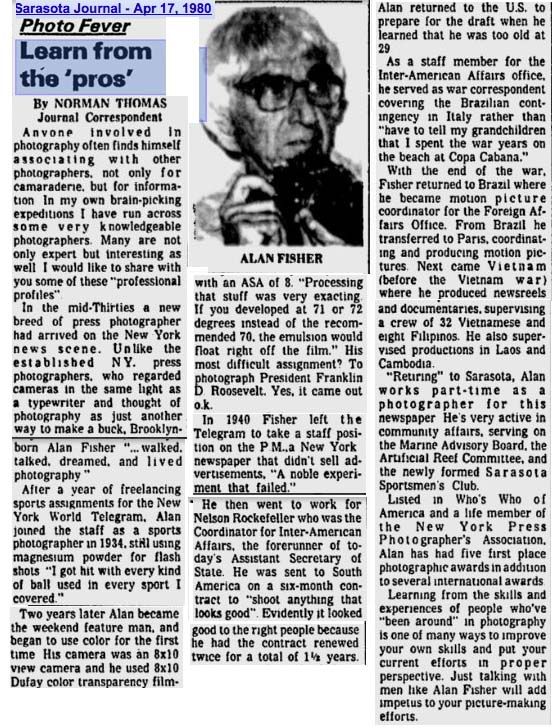
Interviewed by: G. Lewis Schmidt Initial interview date: July 27, 1989Q: I want to start out with having Alan give a brief description of his background before he became affiliated with the Agency or its predecessor agencies and institutions, and then we'll take it from there. In the meantime, as I feel that I want to prompt him on particular subjects, I will intervene with a question. Otherwise, I will let him say pretty much what he wants to talk about. So Alan, please begin with a brief bio sketch of your background, and then take it from there.
Biosketch: Alan Fisher
FISHER: I was born in Brooklyn in 1913. I graduated from high school, Brooklyn Technical High School, was going to be a chemical engineer, and changed my mind. I started to work for the New York World Telegram as a freelance photographer, and then after a year of that, was given a job as sports photographer. In 1934 I started with them. Then I became special features and color photographer and general all-around photographer on their staff until 1942. Then I left them because I had a very good job offer to join the staff of the newspaper PM. I was on the staff for two years and did an awful lot of coverage of Army camps. I spent almost one year covering Army camps. Then I got a call from Washington from Alexander Murphy, who had been with the AP and had been our photo assignment editor on PM. Al asked me whether I'd go to South America for a six-month contract to work for Nelson Rockefeller's office. At that time, Nelson was the Coordinator of Inter-American Affairs. It was equivalent to modern-day Assistant Secretary for Latin America, but there was no such title at that time. So I said I didn't know whether I could get a leave of absence, and he said, "Sure, we can arrange it with Ralph Ingersoll," the publisher. They arranged it, and I arranged then to go to South America. The interesting thing was that I was given just general ideas on what was wanted, and then I went to Washington on my way to Miami to pick up the plane to Brazil, which was my starting point. I said, "Any final instructions? Specifically what do you want?" Fisher Goes to South America as Photographer for Rockefeller's IIA Program It was an assignment of a lifetime. Al Murphy said, "Just take anything that looks good to you." And those were my instructions for Latin America. I spent two years instead of two months in Latin America on a contract for Nelson Rockefeller, and I photographed Brazil, basically the war effort, industry, prominent people, politicians, and so forth. I went over to Chile after a year and a half, was sent over to Chile to cover the break in relations with the Axis, and after three months there, I was fortunate in getting there in time to cover the break. Florence came with me as my interpreter. She spoke Spanish, I didn't. Then she went back to Brazil, and Vice President Wallace came down to visit Latin America. I was assigned by Washington to cover him for the combined American press. I spent a month with him, then went back to Chile for a month, and then back to Brazil. By that time, I had been reclassified to be 1A, and I got a call from Washington. I said, "I'll be right back."
Q: 1A meaning in the draft.
FISHER: Yes. I had been 2B, essential war worker. The day I got back to the States, they decided that men over 29 were not wanted anymore, particularly married men, and I was automatically reclassified to 2B again. I was given a choice then of going back to Brazil or going over as a war correspondent with the Brazilian Expeditionary Force.
Q: At this point, let me ask a couple of questions to clarify exactly what you were doing with the Nelson Rockefeller program, the IIA program. Were you doing entirely photographic work in connection with things Brazilian, or were you trying to get out any information about the United States and its relationship with Brazil? Fisher's Role in US War Effort Pictures for Publication in US to Acquaint US With Latin America And Have US Stories Played Back to Latin America
FISHER: My job was strictly a one-way job. I was photographing and writing stories to send back to the United States to acquaint the Americans with Latin America. Because at that time, the war wasn't going too well, and our fallback position was Latin America. We were doing a lot of things in Latin America to help the Latin Americans, such as helping them build a steel plant out of Rio, bringing in equipment for them to manufacture airplane motors, heavy equipment, tractors, and so forth, raising the level of food production, and trying to raise the health standards. We were doing this all throughout Latin America, and one of the things I was to do was to photograph this effort, write stories and send them back. The Agency would then distribute them through the wire services, so they were getting a great play. But this really was a fallback position for us. In the event that we did get driven out of the States, we would fall back to Latin America. [Editor's underscoring. It is not thought that the American public ever knew of this possible fallback consideration.] So there was some strategic importance to what I was doing, but it was all the other way. In other words, I wasn't disseminating any information about the United States in Latin America. I was also covering stories for the two slick magazines that the coordinating office put out in Latin America, EM/GUARDA, which is in Brazil and Portuguese, and EM/GUARDA, which was in Spanish for the rest of Latin America. That was really much like the forerunner of Life magazine, the same format, big slick color, a very, very good-looking publication, and a very popular magazine in Latin America. So that carried stories of the American war efforts and battles and American military activity.
Q: Did you write any of those stories?
FISHER: No. No, my pictures were used for that. They were in-house stories out of Washington, but there many of my pictures used for that. Then when I went back, I went back to Washington, and there was a hiatus. I thought I would like to get into the military, because I had been offered a commission as a captain before I left for Latin America. Those positions were no longer available.

Whose Who In Knickerbocker Village History: Rabbi Max Felshin

Judith Coplon Socolov (May 17, 1921 – February 26, 2011) was one of the first major figures tried in the United States for spying for the former Soviet Union; problems in her trials in 1949–50 had a profound influence on espionage prosecutions during the McCarthy era. Coplon obtained a job in the Department of Justice shortly after she graduated from Barnard College, cum laude in 1943. She transferred to the Foreign Agents Registration section in 1944, where she had access to counter-intelligence information, and was allegedly recruited as a spy by the NKGB at the end of 1944. She first came to the attention of the FBI as a result of a Venona message in late 1948. Coplon was known in both Soviet intelligence and the Venona files as "SIMA". She was the first person tried as a result of the Venona project—although, for reasons of security, the Venona information was not revealed at her trial. FBI Special Agent Robert Lamphere testified at her trial that suspicion had fallen on Coplon because of information from a reliable "confidential informant". An extensive counter-intelligence operation planted a secret document for her to pass to the Soviets. FBI agents detained Coplon in March, 1949 as she met with Valentin Gubitchev, a KGB official employed by the United Nations, while carrying what she believed were secret U.S. government documents in her purse. Coplon was convicted in two separate trials, one for espionage in 1949, and another for conspiracy along with Gubitchev in 1950; both convictions were later overturned in 1950 and 1951, respectively in appeal. The appellant judge in New York concluded that, while the evidence showed that she was guilty, FBI agents had lied under oath about the bugging. Moreover, he wrote, the failure to get a warrant was not justified. He overturned the verdict, but the indictment was not dismissed. In the appeal of the Washington trial, the verdict was upheld, but, because of the possible bugging, a new trial became possible. For political and evidentiary reasons it never took place. Due to these legal irregularities, she was never retried and the government ultimately dropped the case in 1967.
Wednesday, July 18, 2012
Joe Darion's "Ilya Darling"
A Broadway adaptation of the movie ''Never On Sunday,'' it ran for 320 performances.
Who is this girl who sits so sad A tear a-shining in her eyes Can this be laughing Illya Laughing Illya who wants to cry Illya Darling, Darling Illya Like a song we sing your name You are music, you are laughter You make life a lovely day Laugh with us and sing with us And dance with us, we need you so Illya Darling, Darling Illya Be the joy we used to know Now, Illya's name it means "The Sun" To cry was never Illya's style The sun we know was made to shine And Illya was made to smile Oh, Illya Darling, Darling Illya Like a song we sing your name You are music, you are laughter You make life a lovely day Laugh with us and sing with us And dance with us, we need you so Illya Darling, Darling Illya Be the joy we used to know Laugh with us and sing with us And dance with us, we need you so Illya Darling, Darling Illya You are all the joy we know Illya!In 1968 Darion was nominated for a Tony Award for best lyricist for "Ilya, Darling:" Manos Hatzidakis as the Composer.
Joe Darion's "Shinbone Alley"
Before there was Cats, there was Shinbone Alley. Never saw Shinbone in any version and I never understood the popularity of Cats.
Shinbone Alley (sometimes performed as archy & mehitabel) is a musical with a book by Joe Darion and Mel Brooks, lyrics by Darion, and music by George Kleinsinger. Based on archy and mehitabel, a series of New York Tribune columns by Don Marquis, it focuses on poetic cockroach Archy, alley cat Mehitabel, and her relationships with theatrical cat Tyrone T. Tattersal and tomcat Big Bill, under the watchful eye of The Newspaperman, the voice-over narrator and only human being in the show. The project began in 1954 as a Columbia Records concept album with Marquis' original title, featuring Eddie Bracken, Carol Channing, and David Wayne. That same year a concert version was presented by the Little Orchestra Society at The Town Hall in New York City. With an expanded book, the addition of several lengthy ballet sequences, and a cast of animal characters, the rechristened Shinbone Alley preceded Cats by a couple of decades and was a precursor of the far more successful Andrew Lloyd Webber hit. It was one of the first Broadway shows to feature a fully integrated cast. With neither an out-of-town tryout nor a preview period, the Broadway production opened on April 13, 1957 at The Broadway Theatre, and closed on May 25, 1957 after 49 performances. Following "creative differences" with the writers and producers, original director Norman Lloyd requested that his name be removed from the credits. The production was supervised by Sawyer Falk and choreographed by Joe and Rod Alexander, with production design by Eldon Elder, costumes by Motley, and lighting by Tharon Musser. The cast featured Bracken, reprising his role as archy, Eartha Kitt as mehitabel, Erik Rhodes as Tyrone, and George S. Irving as Big Bill. Supporting players included Cathryn Damon, Jacques d'Amboise, Ross Martin, Lillian Hayman, and Allegra Kent. Relative newcomer Chita Rivera was Kitt's standby. The show's sole Tony Award nomination was for Best Costume Design. In lieu of a cast album recorded in a studio, a tape of a live performance was transferred to acetate and released on the Legend label. In 2005 the musical had its Australian premiere in Melbourne, under the name archy & mehitabel. Produced by Magnormos, it was directed by Aaron Joyner and starred Jane Badler in the role of Mehitabel, and Michael Lindner as Archy.[1][2] The "Musicals Tonight!" series presented a staged concert version in November 2006 in New York City.
Joe Darions "Strange Things Are Happening"
"Strange things are happening" became a national catchphrase evolving from the run of The Red Buttons Show. It remained his signature theme. For half a century, he would hop on one foot, clap hands, and palm his ear whenever the music played, a childlike, trademark bit recalled by fans of his TV program. The lyrics were written by Joe Darion.
Ho Hofor more on the Joe Darion KV connection
Ho Ho
Hee Hee
Hee Hee
Hah Hah
Hah Hah
Strange Things Are Happening
Strange Things Are Happening
I once had a teacher who flunked me in history
She asked, "Who shot Lincoln?"
I answered, "Don't blame me."
Ho Ho
Ho Ho
Hee Hee
Hee Hee
Hah Hah
Hah Hah
Strange Things Are Happening
Strange Things Are Happening
I gave golden earrings to someone who turned sweet sixteen
Now, I'm so embarrassed her ears are turning green
Ho Ho
Ho Ho
Hee Hee
Hee Hee
Hah Hah
Hah Hah
Strange Things Are Happening
Strange Things
I went to the movies and witnessed the strangest scene.
One kid brought a tv and tried to dial the screen
Ho Ho
Ho Ho
Hey Hey
Hey Hey
Hee Hee
Hee Hee
Strange Things
Strange Things
"Since girls wear those blue jeans, my troubles just never cease
What looks like my nephew, turns out to be my niece."
Ho Ho
Ho Ho
Hee Hee
Hee Hee
Hah Hah
Hah Hah
Strange Things Are Happening
Strange Things
Joe Darion's "Ricochet Romance"
for more on the Joe Darion KV connection
for the more popular Teresa Brewer version
They warned me when you kissed me your love would ricochet Your lips would find another and your heart would go astray I thought that I could hold you with all my many charms But then one day you ricocheted to someone else's arms [Chorus:] And baby I don't want a ricochet romance, I don't want a ricochet love If you're careless with your kisses, find another turtle dove I can't live on ricochet romance, no, no not me If you're gonna ricochet, baby, I'm gonna set you free I knew the day I met you, you had a roving eye I thought that I could hold you, what a fool I was to try You promised you'd be faithful and you would never stray Then like a rifle bullet, you began to ricochetAmazing that someone who went to CCNY in the thirties during a time of political upheaval and who was suspected of being a fellow traveler could write such lame stuff. Amazing too that is was so popular. Yet, that was the landscape of much of the 1950's
Joe Darion's "Change Partners"
for more on the Joe Darion KV connection Music by Larry Coleman We were waltzin' together to a dreamy melody
When they called out "change partners"
And you waltzed away from me
Now my arms feel so empty as I gaze around the floor
And I'll keep on changing partners
Till I hold you once more
Though we danced for one moment and too soon we had to part
In that wonderful moment something happened to my heart
So I'll keep changing partners till you're in my arms and then
Oh, my darlin' I will never change partners again
Though we danced for one moment and too soon we had to part
In that wonderful moment something happened to my heart
So I'll keep changing partners till you're in my arms and then
Oh, my darlin' I will never change partners again
Monday, July 16, 2012
Joe Darion's Impossible Dream
To dream ... the impossible dream ...
To fight ... the unbeatable foe ...
To bear ... with unbearable sorrow ...
To run ... where the brave dare not go ...
To right ... the unrightable wrong ...
To love ... pure and chaste from afar ...
To try ... when your arms are too weary ...
To reach ... the unreachable star ...
This is my quest, to follow that star ...
No matter how hopeless, no matter how far ...
To fight for the right, without question or pause ...
To be willing to march into Hell, for a Heavenly cause ...
And I know if I'll only be true, to this glorious quest,
That my heart will lie will lie peaceful and calm,
when I'm laid to my rest ...
And the world will be better for this:
That one man, scorned and covered with scars,
Still strove, with his last ounce of courage,
To reach ... the unreachable star . On 9/11/2011 Congressman Dennis Kucinich honored Joe Darion
Mr. Speaker, I rise today to honor the memory of a man who inspired the American people with beautiful song, Mr. Joe Darion, lyricist of ``Man of La Mancha.'' Born in New York City in 1911, Mr. Darion worked throughout his life in every genre of music from popular songs to opera. Mr. Darion attended City College before serving his nation in World War II. In the early 1950's he had three Top-10 hits; the Patti Page ballad ``Changing Partners'', the Teresa Brewer novelty ``Ricochet'', and Red Buttons' comedy hit ``The Ho Ho Song''. Mr. Joe Darion is most known for his beautiful lyrics of ``The Impossible Dream,'' which quickly became one of the most beloved pop anthems of our time. ``Man of La Mancha'' opened in New York in 1956 and ran for an incredible 2,328 performances. In recognition of his heart-warming lyrics, Mr. Darion was rewarded a Tony Award for best score. ``The Impossible Dream'' has affected thousands of people, young and old. His lyrics have inspired and touched countless Americans. His words dive deep into the human soul and character. His words, Mr. Speaker, please join me in honoring the memory of a man who touched millions of Americans with his inspiring lyrics and, enabled countless people everywhere to ``Dream the Impossible Dream'', Mr. Joe Darion.
Subscribe to:
Posts (Atom)


 Posts
Posts