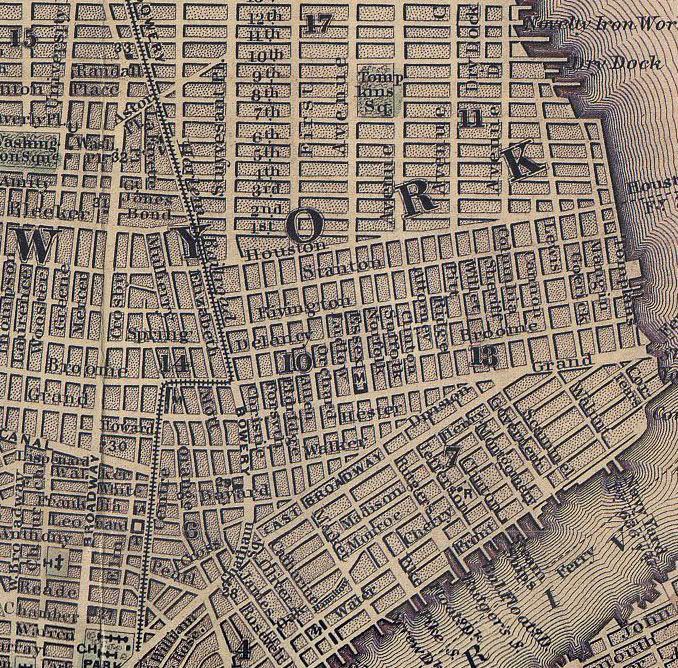
Had David Kotzin, Stubby Kaye's father, made the usual progressive move from the Lower East Side to Harlem he could have gone to PS 5
Wednesday, October 8, 2008


Phil Silvers, Aka Sergeant Bilko
Here's another story that got separated from it's origin all the way back to 11/05/07.
It's a Collier's Magazine article written about Silvers/Bilko in 1956 that I found on the Bilko tribute site. Use the zoom tools for better focus of the text in the pdf version of this story. The tool all the way to the right allows you to open the document in a new window
It's a Collier's Magazine article written about Silvers/Bilko in 1956 that I found on the Bilko tribute site. Use the zoom tools for better focus of the text in the pdf version of this story. The tool all the way to the right allows you to open the document in a new window
The Raskins Of Knickerbocker Village 2
This belonged with a post about the Raskin's from 9/27/08. It's the text that accompanied the pictures from the Times' article about Judith Raskin that was in the nytimes in 1966
Tuesday, October 7, 2008
1960's: Cat Ballou
Any minute now I suspect Sarah Palin to accuse Obama of associating with that "terrorist" Jane Fonda.
Artists: Nat King Cole and Stubby Kaye, Words by Mack David and Music by Jerry Livingston, title song from the 1965 film starring Jane Fonda, Lee Marvin (who won an Oscar for his dual role as a drunken lawman and his counterpart, outlaw Kid Sheleen)Cole and Kaye, as strolling minstrels, functioned as a Greek chorus, commenting on the action
Well now friends just lend an ear
For you're now about to hear
The ballad of Cat Ballou
It's a song that's newly made
And Professor Sam The Shade
And the Sunrise Kid are singin' it for you
Cat Ballou, Cat Ballou
It's a hangin' day in Wolf City, Wyomin'
Wolf City, Wyomin', eighteen ninety four
They're gonna drop Cat Ballou
Through the gallows floor
She killed a man in Wolf City, Wyomin'
Wolf City, Wyomin', killed a man it's true
And that is why they're a-hangin'
Hangin' Cat Ballou
She has the smile of an angel
(Fights like the Devil)
The eyes of an angel
(Bites like the Devil)
The face of an angel
(I say she's the Devil)
(She's mean and evil through and through)
Cat Ballou, Cat Ball-ou-ou-ou
She's mean and evil through and through
With her outlaw band they're now tellin' a story
Now tellin' a story how she rode the plain
The wildest gal in the We-est
Since Calamity Jane
And today's the day that she's goin' to glory
She's goin' to glory for the way she sinned
They'll be a-speedin' her soul
On a wayward wind
She has the smile of an angel
(Fights like the Devil)
The eyes of an angel
(Bites like the Devil)
The face of an angel
(I say she's the Devil)
(She's mean and evil through and through)
Cat Ballou (Cat Ballou)
Cat Ball-ou-ou-ou (Cat Ballou)
She's mean and evil through and through
Cat Ballou, Cat Ball-ou-ou-ou
She's mean and evil through and through
When I Was Last On Cherry Street 2: Harry Roskolenko
The book flap as well as the final few pages of an excellent Lower East Side memoir that is unfortunately out of print. Harry reminisces on the history of the area and on the changes that took place. He wrote this in 1965
When I Was Last On Cherry Street 1: Harry Roskolenko
The first chapter of a remarkable memoir of a man who grew up at the turn of the 20th Century on Cherry Street, near Corlear's Hook. Reading it you realize how lucky we are to be descendants of those you lived in that environment, because many boys and girls of that era never made it to adulthood. We previously mentioned Harry in two posts on 8/24/08
Regeneration
A clip from an early movie classic made by Raoul Walsh that captures part of the world that David Kotzin lived in. A description:
It stars John McCann, James A. Marcus, Maggie Weston, H. McCoy, Rockliffe Fellowes, William Sheer, Carl Harbaugh, and Anna Q. Nilsson. It was adapted by Carl Harbaugh and Raoul Walsh from a memoir My Mamie Rose by Owen Frawley Kildare and the adapted play by Kildare and Walter C. Hackett. It was directed by Walsh. In 2000, Regeneration was selected for preservation in the United States National Film Registry by the Library of Congress as being "culturally, historically, or aesthetically significant". This is the story of a young buy whose mother has died at an early aged and he is forced to live in poverty and the life of a gangster until he is reformed Famous quote from the film: “And then the years pass and Owen still lives in a World where might is right – and where the prizes of existence got to the man who is the most daring in defying the law, and the quickest fist in defending his own rights. Owen, at seventeen” – H. McCoy Stylistically a very advanced film with it's use of crosscutting and advanced plot development.
Who's Almost Who In Knickerbocker Village History: Stubby Kaye
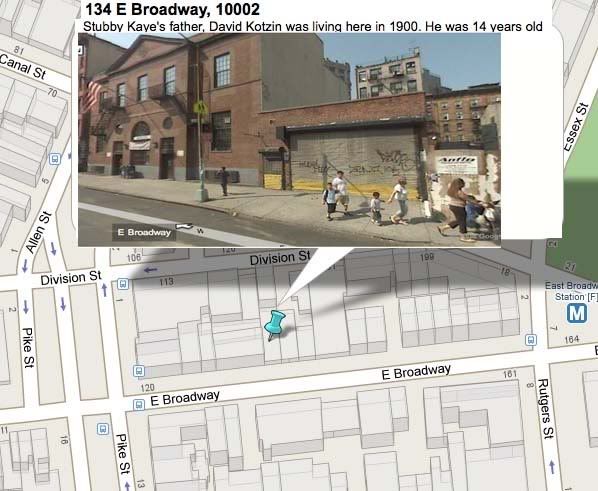
Here's the "proof" that was promised. While viewing Stubby Kaye in the Guys and Dolls clip it dawned on me that I never searched for Stubby's origins. I've come to believe that vast majority of the early actors and actresses and musical comedy stars of the stage and cinema came from New York City. If they did, they probably lived at some time on the lower east side. I then go on to use some dramatic license to substitute KV for the LES. In many cases there's a direct line to trace their immigration and migration. It leads from the boat to Ellis Island to the Lower East Side and then usually to East Harlem and then either to the Bronx or Brooklyn. In each step in their path there's an attempt to better the living conditions. What's unique about Knickerbocker Village is that it's construction in 1934 changed some of those paths. The value and location provided by Knickerbocker lead some of those "migratory" families to actually reverse course. But back to Stubby. His wikipedia biography stated:
Stubby Kaye (November 11, 1918 – December 14, 1997) was an American comic actor. He was born Bernard Kotzin in New York City on West 114th Street in the Morningside Heights section of Manhattan to first generation Jewish-Americans originally from Russia and Austria. He was raised in the Far Rockaway section of Queens and in the Bronx.
I learned while checking the census that Stubby's father was David. In 1910, before Stubby (Bernard) was born David was living in East Harlem. However, the 1900 census found a 14 year old David living at 134 East Broadway, the location of the future Knickerbocker branch Post Office. David probably played in the newly constructed Seward Park as well as attended the Educational Alliance. David's father, Solomon, was a cap maker.
Who's Almost Who In Knickerbocker Village History: Stubby Kaye
Don't believe me you say? All will be revealed on the next post. In the meantime a clip from this show which aired on Saturdays on ABC: accompanyng comments from the youtube source
Yes, "SHENANIGANS", which was a slight variation of Heatter-Quigley's previous "giant board game", "VIDEO VILLAGE" [CBS, 1960-'62], repackaged for sponsor Milton Bradley, was on Saturday mornings at 10am(et) from September 1964 through December 1965 on ABC. Very few examples of the series exsist...If I remember correctly, this program aired on Saturday mornings just before the Beatles Cartoon show in 1965. At least here in Los Angeles it did. In light of this, the tie-in with the harmonica is not surprising.
I Got The Horse Right Here
We had a references to Guys and Dolls before this as well as a 1955 Broome Street crap game
but we take a renewed interest since we've learned that former Chinatown Mayor, Johnny Keyes, aka Andrew Canonico, was an inspiration for a Damon Runyon named Spaghetti Joe. He also, under another pseudonym, was an inspiration for one of the characters in Guys and Dolls. Was it Benny, Nicely, Rusty, Brandy Bottle Bates,Scranton Slim...? Johnny was a big bettor and according to Joe Bruno's cousin Joe Gerage,
Jack Dempsey bought him a Studebaker because Johnny Keyes lost a lot of money on one of his fights.
Johnny is mentioned in a memoir by San Diego reporter Neil Morgan
After the war, I found San Diego just a tad on the quiet side. Seeking a semblance of sin and scandal…and of course column items…. I sought out F Street and met Bob Johnston, who ran the burlesque house, the Hollywood Theater. He let me play his rinky dink piano. I am a preacher’s kid and I know a lot of hymns. The strippers came in on their breaks and sang along. They knew the words, and that gave me a lot to think about. Sometimes I recognized friends from north of Broadway. Please, they would say, don’t mention that I was here. I made good friends on F Street, like Johnny Keyes, known as Spaghetti Joe. His walls were pasted with columns about him by New York’s great Damon Runyon. Damon celebrated Spaghetti Joe as the first Italian mayor of New York’s Chinatown.
NICELY: I got the horse right here, his name is Paul Revere and
here's a guy who says if the weather's clear, can do, can do.
This guy says the horse can do.
If he says the horse can do, can do, can do.
NICELY: can do, can do this
BENNY: I'm picking Valentine 'cause on the morning line, the guy has
NICELY: guy says the horse can do If he says the horse can
BENNY: got him figured at five to nine. Has chance has
RUSTY: But look at Epitaph, he wins it
NICELY: do, can do, can do, For Paul Revere
BENNY: chance, this guy says the horse has chance. If he says
RUSTY: by a half, according to this hare in the Telegraph, Big threat,
NICELY: I'll bite, I hear his foot's all right. Of course it all depends if it
BENNY: the horse has chance, has chance, has
RUSTY: big threat, This guy calls the horse Big
NICELY: rained last night. Likes mud, likes mud. This "X" means the horse
BENNY: chance. I know it's Valentine, the morning works looks fine, besides
RUSTY: Threat. If he calls the horse big threat, big threat
NICELY: likes mud. if that means the horse likes mud, likes
BENNY: the jockey's brother's a friend of mine. Needs race, needs race this
RUSTY: Big threat. And just a minute boys, I got the feedbox noise. It
NICELY: mud, likes mud, I tell you Paul Revere now this is
BENNY: guy says the horse needs race. If he says the horse needs
RUSTY: says the great-grandfather was Equipoise, shows class, shows
NICELY: no bum steer. It's from a handicapper that's real sincere. Can
BENNY: race. Needs race, needs race. I go for
RUSTY: class. This guy says the horse shows class. If
NICELY: do, can do. This guy says the horse can do. If
BENNY: Valentine, 'cause on the morning line, the guy's got him figured at 5 to 9
RUSTY: he says the horse shows class, shows class. So make it
NICELY: he says the horse can do, can do, can
BENNY: has chance, has chance. This guy says the horse has
RUSTY: Epitaph. He wins it by a half, according to this hare in the
NICELY: do. Paul Revere! I got the horse right here!
BENNY: chance. Valentine! I got the horse right here!
RUSTY: Telegraph, Epitaph! I got the horse right here!
Monday, October 6, 2008
More Reaction To Release Of Rosenberg Documents
above, from cbs news
also more reactions from the Meeropol's at the Rosenberg Foundation For Children
a h/t to Irvine, Californian Kver Norma for the following article in the LA Times of 10/5/08,
an excerpt:
We are the sons of Ethel and Julius Rosenberg. We were young children -- 10 and 6 years old, respectively -- when our parents were put to death in the electric chair at Sing Sing for passing the secret of the atomic bomb to the Soviet Union.
For many years after that, we believed our parents to be wholly innocent of the charges against them. But over the years, and especially as further evidence became available at the end of the Cold War, we began to question that belief.
Now, 55 years after their execution, two recent revelations in our parents' case have again rekindled fierce debate about their culpability. But in our opinion, these disclosures -- the release of our aunt's sworn statements to a grand jury and a surprise new admission by our parents' codefendant -- have obscured both the essence and the essential lessons of the Rosenberg case.
Many Americans now living were not born when our parents stood trial in 1951 for conspiracy to commit espionage, so they may not understand why this case remains one of our nation's most sensational courtroom dramas. The reason is that, at the height of the Cold War, two people were executed for allegedly giving the secret of the atomic bomb to the Soviet Union.
Viewed through the lens of 1950s America, it appeared to many that the Rosenbergs had given our archenemy the means to destroy our nation. The trial judge justified the death sentences by pronouncing that our parents made it possible for the Soviets to build their bomb earlier than expected, causing the Korean War and the deaths of thousands of American soldiers. "I consider your crime worse than murder," said the judge as he sentenced our parents to death. "Plain deliberate contemplated murder is dwarfed in magnitude by comparison with the crime you have committed."
But was that true? Had they in fact passed the so-called secret of the atomic bomb to the Russians? We have acknowledged for a long time the possibility that our father may have engaged in non-atomic espionage. The recent statement by our parents' codefendant, Morton Sobell, confirms exactly that, and several weeks ago we stated publicly for the first time that we now believe that our father did, in fact, participate in passing along military information.
But Sobell's recent admission sheds no light on whether our father in fact stole the secret of the atomic bomb, the crime for which he was executed. To this day, there is no credible evidence that he participated in obtaining or passing on any such secret.
In contrast, the newly released grand jury transcript does provide interesting new information about the case.
Who's Almost Who In Knickerbocker Village History: Albert Einstein
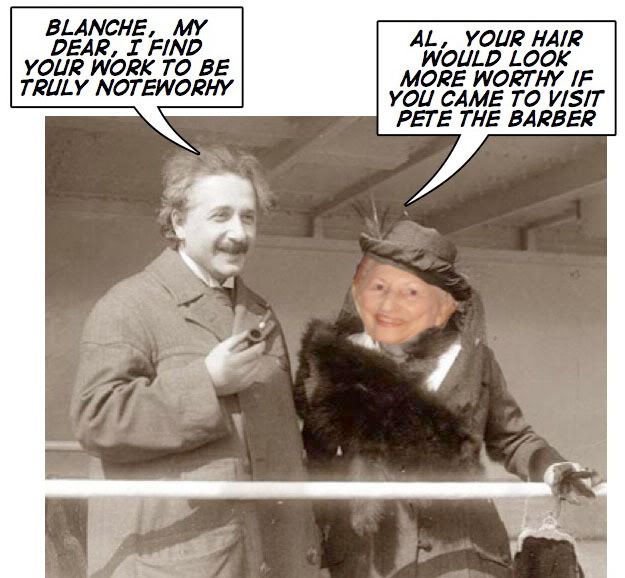 The recent post about the 1939 World's Fair shook loose this story about Blanche Reisel from the KV "Memory Tree"
My mother met Albert Einstein at that World's Fair. She went to hear him speak in order to take down his speech in shorthand, good practice for developing her stenographic skills. Later she would become a court reporter writing around 200 words per minute and typing 100. Anyway, at the Fair, officials saw her with a steno notebook and figured she was the official stenographer. Apparently, the person hired for this purpose didn't show up so they escorted my mother to the front and introduced her to a number of people including Einstein. They then got a chair for her to stand on to hear his speech and write it while a policeman steadied it. Following up, she was given the contact info for all the people and dutifully typed up the speech and mailed it to the appropriate people.
PS, Blanche will be celebrating her 90th birthday in 2009.
Subscribe to:
Posts (Atom)


 Posts
Posts