Wednesday, April 25, 2012

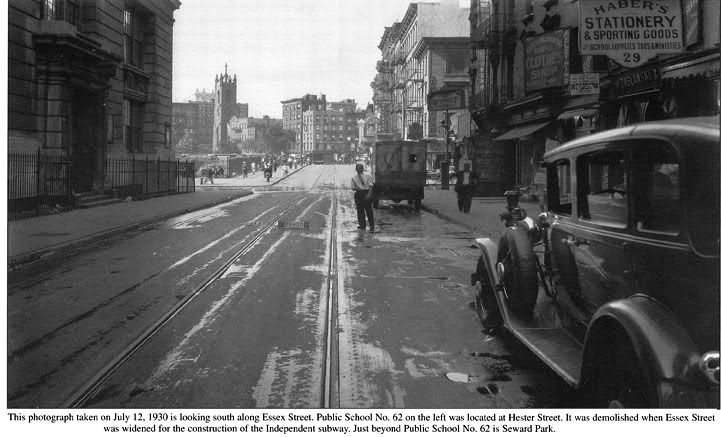
29 Essex Street: Haber's Stationery and Sporting Goods


Viewable on the right side. It was a favorite destination of KVers. Supposedly, Joe Kuperstein once considered becoming an owner. about two years ago from Marsha Algranati Levine:
I lived on Essex St, over Haber's. My mom actually worked in Habers, a pretty short commute. My parents moved into the Seward coop my last year in high school, my mom's still living there. If anyone hasn't been in the old neighborhood for a while, you're in for a big shock, it's changed a lot
.

341 Grand Street: Site Of Grand Street Dairy Restaurant


The photo was taken sometime in the late 1940's. The view is Grand Street looking east towards Ludlow Street. The Dairy Restaurant (although I don't know that was it's incarnation at the time) can be seen at the extreme right. My mother is in the top row on the left. My aunt is seated in the middle. For more about that restaurant, an excerpt from a 1988 nytimes article
2 Waiters and Their Producer Dine at a Source of Inspiration By RICHARD F. SHEPARD Published: November 10, 1988 ''Enter, two Jewish waiters.'' Now what kind of stage direction is that in a script for the New York Shakespeare Festival? It may have been that Joseph Papp, the founder and head of the festival, was evading an answer. But more likely, he never heard the question above the gustatory din at the Grand Dairy Restaurant, Grand Street at the corner of Ludlow Street, on the Lower East Side. Mr. Papp was accompanied by Bob Dishy and Fyvush Finkel, who nowadays are bringing an inspirational interpretation of tray chic to their central roles as Jewish waiters in Hy Kraft's ''Cafe Crown,'' a play based on the old Cafe Royal, which for decades was the center of the Yiddish theater's off-duty life on Second Avenue. The play is being produced by Mr. Papp and his festival at the Public Theater. Frank Rich, reviewing ''Cafe Crown'' in The New York Times, called it a ''feast of Jewish waiter jokes and Jewish theater jokes, heavily laced with schmaltz.'' He particularly praised the waiters - Mr. Dishy, ''his expression so dill-sour that even his tufts of hair seem exasperated,'' and Mr. Finkel, ''sure to say 'You'll love it!' to any irritating customer who alights upon one of the less palatable daily specials.'' In Other Words, an Interview The lunch on Grand Street was intended to install the professional theater people in suitable ambiance amid real Jewish waiters for the purpose of discussing how the actors achieved a credibility so overpowering in their roles as waiters that the audience might have picked up a check were it presented. Mr. Dishy and Mr. Finkel, projecting a thinly veiled contempt for their customers, evoke a world now hovering on the brink of oblivion. Wearing black jackets, black bow ties and full-length white aprons, they display tympanic virtuosity when it comes to slamming plates on the table. They intimidate diners, kibitz at card games, dish out philosophy and invariably spill half the tea from the glass. The Shakespeare Festival is meticulous about training its performers in swordplay, with an expert on hand to teach the finer points of the epee. Did Mr. Papp hire a Jewish waiter to instruct Mr. Dishy and Mr. Finkel in their roles? Did he show them how not to meet the eye of a complaining customer, how to put the thumb in the soup to indicate that it is not too hot to slurp, how to bring the potato pirogi to a table that wanted chopped liver? Did a licensed instructor teach them the shuffle that assures room temperature by the time a hot dish reaches the table? Necessary but Insufficient The answer again proved elusive. After all, every waiter who happens to be Jewish is not necessarily qualified as a Jewish waiter....
some KVers' comments:
I walked by there yesterday with my wife and told her about the restaurant. Most embarrassing was cutting class and seeing your teacher there.

I remember the dairy restaurant very well from my Seward days. Used to take out a cheese danish and coffee every so often when I stayed late to edit the sports column of the Seward World. Those were the days....

Tuesday, April 24, 2012

Guss' Pickles

an excerpt from a nytimes' article on Guss'
The author is related to Marilyn Altman and Goldie Daniels, the Guss girls, who are heard above.
I know it’s unseemly to brag about one’s illustrious family lines, but sometimes a historic turn of events invites the opportunity to name-drop. Some of my closest friends don’t even know it, but I’m related to Jewish royalty (by marriage, I should clarify, but still). My brother married into pickles — Guss’ Pickles, to be specific, the famous Lower East Side institution that announced this week that it would soon leave that neighborhood for the lower rents and enthusiastic pickle purchasers of Borough Park, Brooklyn. The New York blogs have been outdoing themselves in fits of nostalgia about this loss of lingering history on Orchard Street. But for my brother’s mother-in-law, Marilyn Altman, and her sister, Goldie Daniels — the Guss girls, as they were known back in the day, along with their late sister, Elaine — the news about the business, which they sold in 1979, came as a shock. It was also an excuse for them to come in from New Jersey, where they both live, share some old stories about their father, Isadore Guss, and, in Goldie’s case, wolf down some of the half-sours she loves so well. After greeting the current owner of the shop, Goldie, blond and petite at 71, in a gold watch and gold hoops, instinctively situated herself in back of the barrels, the vantage point from which she had sold so many pickles to long lines down Hester Street, the store’s original location. “I ate more pickles than I sold,” she said, dipping a pan — a schissel, she called it, Yiddish for pail — into a barrel. “I loooove pickles.” She took a bite and rolled her eyes. “It’s like my heritage.” Of the three daughters, only Marilyn, the baby, now 65, was deprived the privilege of working at the store. That’s what you get for dropping a yo-yo in a pickle barrel and thinking maybe no one would notice. Goldie, however, worked there until she had children. If her mother had thought a woman could run a business, Goldie would have taken it over after her father’s death in 1975. Those days holding court behind the barrels as the whole neighborhood stopped by were some of the happiest of her life. “You just talked to everyone,” she said, and it was easy to see how that worked. As she chewed her pickle, a man with his daughter contemplated the barrels, and suddenly they were all four in animated conversation about the Great Wall of China, from where the father and daughter had just returned. What did they think? Wasn’t it fabulous? When Marilyn went, she’d worn the wrong shoes, wouldn’t you know it, kept sliding backward the whole time.

84 Orchard Street: 1934

Just across the street at 85 Orchard was Lasky's Shoe Store.

A View Of Gluckstern's In 1947

A blow up from a still shot taken during the filming of Naked City. Gluckstern's is visible (blurry) in the top right corner.

Gluckstern's: 135 Delancey Street

The jingle is from the Yiddish Radio Hour, sung by the Barry Sisters  from someone selling a quill pen from Gluckstern's on ebay
Gluckstern's Restaurant was a Jewish or Yiddish restaurant that started in NYC in the early 1900s. This restaurant with its home cooked style meals (Romanian, Hungarian, Slavic and Corned Beef and Cabbage "Kosher" Style) was popular with a lot of the stars of the era as well as having a loyal following with the general public. I have a nice 1959 write up on the restaurant and I found mention of the restaurant in some 1960s era publications but I don't find any info after that point, so it looks like this restaurant was around over 60 years and then must have closed. I checked the 135 Delancey St Address in a current search and it seems to be a parking garage or lot.
The Fabulous Kuperstein twins had their bar mitzvah at Gluckstern's

Monday, April 23, 2012

101 Orchard Street: 1934

This could be near where former KVer Norma A. Petillo's (Boodman) father had a store. She wrote:
Sadly, my father died in 1951 at age 44. He owned a small store on Orchard Street, mens' belts, ties socks etc. It was really a stand so he was mostly exposed to the elements, not good for a person with a heart condition. His name was Frank Boodman. He was born in the US but his family went back to Poland. I did locate him and his brothers Dawid (David) and Phillip on the Ellis Island web site when they were young teens who came back to the states. I found my mother, Clara, there as well. She was born here, family from Austria, but they went back to Poland. She and her brother, Morris Holzer (spelled here with a t) came back separately to the states at ages 14 & 15. Sadly, my 4 aunts and grandmother and some cousins were killed in Poland in 1943. All the more tragic because there were already here, but had left a child back there , and were poor and could not make a go of it in the U.S.

Sunday, April 22, 2012

There Used To Be A Bakery Here: Gertels


A video I put together back in 2007, just prior to Gertels' closing. It was on 53 Hester Street. Kadouri Import was at 51 Hester and a tile factory was at 55. Many of the images came from this nytimes article :
An excerpt:
No More Babka? There Goes the Neighborhood By JOSEPH BERGER
 Gertel’s, the legendary bakery on Hester Street on the Lower East Side known for its Jewish treats like rugelach, babka and marble cake, has closed its doors. The closing is one more change in a string of changes on the historic Lower East Side, where hundreds of thousands of immigrants from Russia, Poland, Romania and Italy established their foothold in America and set up hundreds of dry goods and food shops that until recent years gave the area a characteristic pungency. But those shops are being replaced by hip boutiques and voguish restaurants, and only a few survivors, like the Russ & Daughters appetizing store and Katz’s Delicatessen, are left. Opened in 1914, Gertel’s, at 53 Hester Street near Essex Street, closed on June 22. A few days earlier, a sign had been posted, warning customers and passers-by of what some consider a culinary disaster. This writer’s father, who during his retirement worked part-time on the Lower East Side as a salesman in a dry goods store, J. S. Hosiery, would bring home challahs and cakes from Gertel’s, and they were always eagerly welcomed by his wife, grown children and their families. Gertel’s hung on even as its neighbors, like a store that sold dried fruit out of burlap bags, shut their doors. ....... On the tenement blocks nearby live Web designers, fashion photographers, makeup artists, and even some lawyers and stockbrokers who find this gritty, though gussied-up neighborhood to their liking. Some of them are grandchildren and great-grandchildren of striving sewing machine operators and hatmakers who fled the railroad flats with their airshafts and bathtubs in the kitchen for the fancy precincts of, yes, the Bronx and Brooklyn......
 Another story about the closing from lost new york city
ny curbed has links to several stories about what replaced Gertels.
Gertels still lives as a wholesale bakery and has merged with the Delancey Brand (so-so)
Quite by chance, I found them in Harlem, while wandering the air-conditioned aisles at Fairway. They wore the Delancey brand, and I almost didn't notice the Gertel's name, printed in much smaller type. (Via email, a representative for the food market stated that Gertel's "joined forces" with Delancey Bakery, a longtime Fairway supplier, less than a year ago.)
Fairway also carried Gertel's-baked, Delancey-branded sugar bowties, seven-layer cake, marble cake, cinnamon and chocolate swirls, cinnamon babka, Russian coffee cake, mini black-and-whites, and a hamentashen assortment, but with little hesitation I gravitated toward the chocolate rugelach.
I must confess as much as I miss the great food of the lower east side I was never a big fan of Gertels.
I much preferred Savoia's on Catherine Street.

Saturday, April 21, 2012

Former KVer Joel Sosinsky Interviewed About The Triangle Fire

Joel and his wife Andi co-authored a book about the fire

Joel begins speaking at around the 34 second mark.

Friday, April 20, 2012

The Empty Lot On Henry And Market: 1932

In the original plans this lot was supposed to be included as part of Knickerbocker Village

The Original Plans For Knickerbocker Village: 1931

kv-plans-1931 I always wondered why there was an empty lot on the corner of Henry and Market in 1930 photos. It remained empty for a long time. According to Bob Wilson there is a photo of Al Smith breaking ground for Knickerbocker at this site. Bob posed the question, "How did those lots go back from French's hands to others?"

Thursday, April 19, 2012

Still Photos Of The Filming Of Naked City: Summer 1947

Naked City Stills-mcny
I look at some of these photos, especially the ones near Delancey and Suffolk and Clinton, searching to possibly see my parents. They were living at 76 Suffolk at the time. They come from the mcny collection
and they were taken by Stanley Kubrick, who was working then as a still photographer
About the movie:
The Naked City (1948) Directed by Jules Dassin. Barry Fitzgerald, Howard Duff, Don Taylor (96 min.)
There are 8 million stories in The Naked City! As a hot summer night works its way towards dawn, a murder is discovered; a girl whose crime was "wanting too much--that's why she went wrong. Bright lights, theaters, furs and nightclubs. That's why she's dead now. Dear God, why wasn't she born ugly!" A narrow apartment kitchen, rush-hour subways, the Williamsburg Bridge and Lower East Side streets swarming with passers-by are among the 107 riveting locations around NYC. No other film had ever conveyed the immensity of police work in the teeming metropolis.
Feature films had not been shot on location in NYC since the silent era, when Mark Hellinger, a former columnist, screenwriter and veteran of the Army Air Force's Motion Picture Unit proposed that a fiction film made with the urgency of a documentary would be a fresh approach to the crime film. There were plenty of films set in New York, of course, in the fantasy New York of the Hollywood backlots and soundstages, created by writers and directors nostalgic for the cultural rush and urban beauty of the East Coast. Second unit crews shot background shots in the city, and newsreels were still made there. But, feature film making in NYC was only a memory. A few films had attempted something more ambitious, notably a sequence shot with hidden cameras on Third Avenue in Billy Wilder's The Lost Weekend.
The script was originally called Homicide, but was renamed The Naked City, a title purchased from the still photographer WeeGee, notorious for his unadorned, sometimes ghastly flashes of New York after dark. In the summer of 1947 a full crew commanded by director (and former New Yorker) Jules Dassin descended on the city. The onlookers created countless problems for the police assigned to protect the filmmakers. Perhaps as many as 200,000 spectators watched the filming around town at different times, and others kept up with the production schedule in the daily newspapers.